
In This Article
If you’ve ever watched your parrot demolish a $30 toy in three days, you already know the frustration. The real secret successful bird owners understand? Building your own toys with quality bird toy parts and supplies isn’t just cheaper—it’s actually better for your bird’s mental health.
Here’s what most pet stores won’t tell you: pre-made toys often use lower-grade materials to hit price points, and they’re designed in generic sizes that rarely match your specific bird’s chewing style. When you source your own bird toy making supplies, you’re controlling quality, customizing difficulty levels, and most importantly, keeping up with your bird’s natural need for fresh stimulation without breaking the bank. Research from the University of Washington’s Office of Animal Welfare confirms that environmental enrichment maximizes species-specific positive behavior and significantly enhances avian well-being.
The bird toy parts and supplies market has evolved dramatically in 2026. We’re seeing more biodegradable options, better safety certifications, and—this is the game-changer—complete starter kits that remove the guesswork for beginners. What used to require hunting through craft stores and specialty suppliers can now arrive in one box, tested for bird safety and ready to assemble.
In this guide, I’ll walk you through seven standout products that represent the best value, quality, and variety currently available. Whether you’re a first-time cockatiel owner or managing an aviary of macaws, understanding which supplies deliver real enrichment versus which just look pretty on a shelf will save you hundreds of dollars and countless hours of research.
Quick Comparison: Top Bird Toy Parts at a Glance
| Product | Best For | Price Range | Key Feature | Pieces |
|---|---|---|---|---|
| Super Bird Creations DIY Kit (Medium) | Intermediate builders | $25-$35 | Pre-tested combinations | 52 |
| Bonka Mahogany Pods (12pk) | Natural chewers | $18-$25 | Pre-drilled holes | 12 |
| Bonka Wooden Chewy Sticks (50pc) | Budget-conscious owners | $10-$15 | Non-toxic coloring | 50 |
| FALESHOS DIY Set (120pc) | Creative customizers | $20-$28 | Complete with tools | 120 |
| JoyGinBStiao Heavy Duty Toy | Aggressive chewers | $35-$45 | Refillable design | N/A |
| Bonka Foraging Heart | Shredder lovers | $15-$22 | Ready-to-hang | Multi |
| Bonka Wood Beads (70pc) | Beginners | $8-$12 | Uniform sizing | 70 |
Looking at this comparison, the value proposition becomes clear: variety packs like the FALESHOS set deliver the lowest cost-per-piece for builders who want maximum flexibility, while species-specific options like the JoyGinBStiao toy target birds whose beaks can destroy standard materials in hours rather than days. Budget buyers should note that Bonka’s wooden sticks and beads offer the best entry point—around $0.12-0.20 per piece—while still maintaining the food-grade safety standards required for birds who taste-test everything.
💬 Just one click — help others make better buying decisions too! 😊
Top 7 Bird Toy Parts and Supplies: Expert Analysis
1. Super Bird Creations Make Your Own Bird Toy Kit (Medium)
Super Bird Creations Make Your Own Bird Toy Kit stands out as the thinking person’s starter pack. This 52-piece collection targets medium-sized birds like conures, cockatiels, and small cockatoos with a thoughtfully curated mix of materials.
What separates this from random bulk packs is the material diversity—you’re getting wood blocks in three different densities, natural vine components that satisfy destruction instincts, dye-free plastic parts for non-toxic durability, and bird-safe hardware that won’t rust when your parrot inevitably dunks it in their water bowl. The practical reality most reviews overlook: those vine pieces are actually harder to source separately than you’d think, and the kit price beats buying them individually by roughly 40%.
In my experience assembling these, the medium kit works particularly well for birds transitioning from store-bought toys to DIY projects. The pieces are sized to require moderate effort—not so hard they get frustrated, not so soft they lose interest in ten minutes. Customer feedback consistently mentions that cockatiels work through one custom toy built from this kit in about 2-3 weeks, which is significantly longer than most $15-20 pre-made alternatives.
✅ Pre-tested material combinations
✅ Includes hard-to-find vine components
✅ Suitable for multiple toy designs
❌ No instruction guide included
❌ May be insufficient for large macaws
The medium kit typically runs in the $25-$35 range depending on seasonal availability, and at that price point, you’re effectively getting 3-4 custom toys worth of materials.
2. Bonka Bird Toys 3410 Drilled Mahogany Pods (Pack of 12)
Bonka Bird Toys 3410 Drilled Mahogany Pods solve a problem most bird owners don’t realize exists until they start building: natural wood pieces that are already prepped for stringing. Each mahogany pod measures approximately 3.5 inches long by 1.25 inches wide, but here’s what matters more—the center-drilled hole is cleanly bored and wide enough (roughly 5-6mm) to accommodate standard hemp rope or stainless steel chains without splitting.
Mahogany wood sits in that perfect firmness sweet spot for medium to large parrots. It’s not the balsa-soft material that disappears in one session, but it’s also not the ironwood density that African Greys and macaws ignore as “too much work.” The natural texture variation means each pod feels different to curious beaks—some curve more dramatically, some have tighter grain patterns, and this unpredictability is exactly the kind of enrichment that prevents habituation.
What customers consistently report: these work brilliantly as foot toys for birds who like to manipulate objects while perching. The 12-pack format also means you can refresh old toys by simply unthreading worn pieces and adding new pods without rebuilding from scratch. For birds who tear through softer materials but need something to challenge their beaks, mahogany delivers that intermediate resistance level that keeps them engaged without causing beak damage.
✅ Pre-drilled for immediate use
✅ Natural texture variations
✅ Suitable for multiple bird sizes
❌ Size and curve vary by piece
❌ Not ideal for very small birds
Pricing typically falls in the $18-$25 range for the 12-pack, which works out to roughly $1.50-$2.10 per pod—reasonable considering the time saved versus drilling your own.
3. Bonka Bird Toys 1227 50pc Colored Wooden Chewy Sticks
Bonka Bird Toys 1227 50pc Colored Wooden Chewy Sticks represents the budget builder’s foundation material. These thin wooden sticks measure approximately 3 inches long by 0.3 inches diameter, and what makes them valuable isn’t fancy engineering—it’s the food-grade, non-toxic dye system that gives you vibrant colors without the health risks associated with craft store alternatives.
The practical application most people miss: these work as spacers and visual contrast elements in larger toy builds. When you’re stringing together heavier wooden blocks or harder materials, adding 2-3 colored sticks between sections gives birds a visual “checkpoint” and provides an easier chewing option that prevents frustration. It’s similar to how puzzle designers add easier sections to maintain engagement—birds need variety in difficulty within a single toy.
For smaller birds like parakeets, lovebirds, and parrotlets, these sticks can actually serve as primary toy components rather than just fillers. A 50-piece pack provides enough material to build 8-10 dedicated toys for smaller species. Customer feedback from budgie owners indicates these last 1-2 weeks per toy when used as primary components, which is solid longevity for birds with faster metabolisms and higher activity levels.
The genius of this product is its versatility across bird sizes. Large parrot owners use them as destroyable spacers, while small bird owners build entire toys from them. That dual-purpose functionality means you’re not buying specialized materials that only work for one project type.
✅ Excellent cost-per-piece ratio
✅ Safe food-grade coloring
✅ Works for multiple bird sizes
❌ Too soft for aggressive chewers
❌ Basic design lacks variety
These typically sell in the $10-$15 range for 50 pieces, making them one of the most economical options at roughly $0.20-$0.30 per stick.
4. FALESHOS Parrot Toys Set (120 Pieces DIY)
FALESHOS Parrot Toys Set delivers what its name promises—120 pieces of everything you need to become a prolific toy builder. This isn’t just a bag of random wood chunks; it’s a complete crafting ecosystem that includes multi-shaped wooden blocks, corn cob pieces, threading tools, natural hemp ropes, and stainless steel hooks.
What elevates this beyond simple bulk buying is the inclusion of actual assembly tools. Threading needles for birds might sound unnecessary until you’ve spent 20 minutes trying to force hemp rope through a 2mm hole in a wooden bead while your parrot screams impatiently from their cage. The threading tools eliminate that frustration, and the pre-cut hemp ropes come in workable 12-18 inch lengths that don’t tangle.
The material variety addresses different enrichment needs simultaneously. Wooden blocks satisfy destruction instincts, corn cob pieces provide that satisfying shredding texture, and the varied shapes (cubes, cylinders, stars, hearts) give you design flexibility. In practical terms, this means building toys that progress from easy-to-destroy elements at the bottom to harder materials at the top, creating a natural “leveling up” experience that holds bird interest longer.
Customer reports indicate the average builder creates 6-8 substantial toys from this 120-piece set, which is impressive volume. For multi-bird households, this represents 2-3 months of toy rotation if you’re swapping pieces twice weekly. The real cost efficiency shows up when you compare it to buying 6-8 pre-made toys at $15-25 each—you’re saving somewhere in the $70-150 range depending on toy complexity.
✅ Complete with assembly tools
✅ Material variety for diverse builds
✅ Exceptional piece count for price
❌ Can overwhelm beginners
❌ Storage requires organization
The typical price range of $20-$28 translates to roughly $0.17-$0.23 per piece, which is outstanding value considering you’re getting both materials and tools.
5. JoyGinBStiao 4lb Heavy Duty Bird Toy for Large Parrots
JoyGinBStiao 4lb Heavy Duty Bird Toy isn’t technically a parts kit, but it deserves inclusion for its refillable design that effectively turns it into a reusable toy platform. This 21.6-inch monster weighs 4 pounds fully loaded and targets the reality of large parrot ownership: beaks that can splinter standard toys like toothpicks need industrial-grade construction.
The engineering here matters more than you’d think. Food-grade colored wood blocks are hand-tied (not glued) with cotton ropes to a horizontal perch bar secured with threaded fasteners rather than quick-links. What this means in real-world use: when your macaw or cockatoo destroys the wooden sections—and they will—you’re unthreading and replacing individual components rather than discarding the entire structure. The cost savings over 6-12 months becomes substantial.
The horizontal bar serves triple duty as perch, swing, and climbing structure, which addresses a common cage space problem. Many large parrot cages are height-constrained, and this toy maximizes vertical space by incorporating the perch function. Customer feedback from macaw owners indicates this design keeps birds engaged 3-4 weeks before requiring component replacement, versus 5-7 days for standard “large bird” toys.
The real insight experienced owners share: buy this toy, then stock up on bulk wood blocks from other suppliers. The platform itself becomes your reusable foundation, and you’re just swapping out the consumable destruction elements as needed. This hybrid approach—one premium base toy plus bulk parts—represents the most cost-effective strategy for birds with destructive capabilities.
✅ Refillable for long-term use
✅ Heavy-duty construction
✅ Multi-functional design
❌ Higher upfront cost
❌ Overkill for small/medium birds
Pricing typically falls in the $35-$45 range, which is premium pricing justified by the reusable platform concept.
6. Bonka Bird Toys 1730 Foraging Heart Medium
Bonka Bird Toys 1730 Foraging Heart Medium targets a specific enrichment category that casual owners often overlook: shredding behavior. This 9-inch by 6-inch vine heart comes pre-loaded with bamboo foraging tubes, cardboard crumbles, wooden beads, and crinkly foraging paper—basically everything a shredder-personality bird craves in one package.
The vine heart construction is clever because it creates a container that’s also destructible. Birds don’t just pull materials out of the heart; they work through the vine structure itself, creating progressive destruction that maintains interest over multiple sessions. The bamboo foraging tubes rotate on the toy, adding a mechanical puzzle element that cockatiels and conures particularly enjoy—it’s not just chewing, it’s problem-solving.
What customer feedback reveals: this toy type appeals especially to birds who’ve developed over-preening or feather-plucking behaviors. The shredding action provides an alternative outlet for that destructive urge, and the crinkly paper elements trigger natural foraging instincts in a way smooth surfaces can’t. According to Veterinary Partner research, parrots possess intelligence comparable to 3-5 year old children and without proper enrichment, boredom can progress to stress, feather picking, and depression. Avian behaviorists actually recommend shredding toys as first-line enrichment for birds showing early stress behaviors.
The ready-to-hang convenience with included quick-link means you can deploy this immediately during a behavior crisis rather than needing assembly time. For birds mid-molt or recovering from stress, that immediate availability matters. The 9×6 inch sizing works well for cockatiels, conures, and small Amazons—basically the medium parrot category that’s too big for parakeet toys but drowns in macaw gear.
✅ Addresses shredding instincts
✅ Pre-loaded with materials
✅ Ready-to-hang convenience
❌ One-time use design
❌ May not interest chewer-type birds
Typical pricing of $15-$22 positions this as a monthly enrichment investment rather than a long-term toy, which matches its consumable nature.
7. Bonka Bird Toys 1249 70pcs Wood Beads (10mm)
Bonka Bird Toys 1249 70pcs Wood Beads might seem basic until you understand the engineering: 10mm diameter with 3mm pre-drilled holes means universal compatibility with most bird-safe chains, ropes, and cables without requiring special tools. That standardization is exactly what beginners need when they’re intimidated by the complexity of toy building.
These natural wood beads work as the connective tissue in toy design—they’re what you string between more complex elements to create movement, add length, and provide easy “success” moments for birds learning to interact with new toys. The 10mm sizing targets small to medium birds perfectly; it’s substantial enough for cockatiels to grab but not so large that parakeets can’t manipulate them.
What experienced builders know: buy these in bulk and use them as your default spacing element. When you’re assembling a toy with varied textures and hardness levels, wooden beads provide the neutral “transition zones” that let birds rest their beaks between harder materials. It’s similar to how video games vary difficulty—constant hard challenges cause frustration, but mixing easy elements maintains engagement.
The 70-piece pack format means you’re not running out mid-project, which is the bane of creative toy building. Customer reports indicate this quantity supports 10-15 medium-sized toy projects before needing replacement, making it exceptional value for volume builders. The uniform sizing also means your toy designs have visual consistency—important when you’re trying to photograph your creations for social media or bird groups.
✅ Universal sizing compatibility
✅ High piece count
✅ Perfect beginner material
❌ Plain appearance
❌ Soft wood for aggressive chewers
At $8-$12 for 70 beads, you’re paying roughly $0.11-$0.17 per bead, which is nearly wholesale pricing for individual consumers.
How to Choose the Right Bird Toy Parts for Your Flock
Selecting the best chew toys for parrots and toy variety packs starts with understanding your bird’s destruction profile—and yes, that’s a real thing behavioral experts track. Birds fall into roughly three categories: destroyers who shred everything in hours, manipulators who solve puzzles and move parts around, and comfort birds who prefer softer materials for preening and snuggling.
For aggressive destroyers (macaws, large cockatoos, adult African Greys), your priority is hardness rating and cost-per-destruction-hour. Mahogany, manzanita, and dense hardwood blocks deliver the resistance these beaks need, while softer woods just frustrate them with too-easy victories. Calculate your effective cost by dividing product price by estimated destruction days—suddenly that $35 hardwood platform that lasts three weeks beats five $8 balsa toys that each last three days.
Manipulator birds (conures, caiques, smaller cockatoos) need mechanical variety more than hardness. These are your puzzle-solvers who get bored with static toys regardless of material. Look for parts that rotate, slide, or unlock—acrylic pieces with moving components, threaded nuts and bolts, chain sections that can be reorganized. The FALESHOS 120-piece set excels here because the variety supports building toys with progressive difficulty.
Comfort-seekers and pluckers (stressed birds, over-preeners, elderly parrots) benefit from softer, shredding materials. Natural paper, palm leaves, coconut fiber, and vine components satisfy that need to manipulate without requiring the energy expenditure of hardwood destruction. The Bonka Foraging Heart specifically targets this group with its paper-stuffed design. The Phoenix Landing Foundation estimates that parrots in the wild spend 50-70% of their day foraging for food—a natural behavior that captive birds need to express through appropriately designed toys.
Size matching is more nuanced than most guides admit. A cockatiel can technically interact with parts rated “large,” but if the effort required exceeds their attention span, they’ll ignore it. Conversely, giving a macaw “large bird” parts that they destroy in 20 minutes creates learned helplessness—they stop engaging because the reward doesn’t match the effort. Match the destruction timeline to your bird’s patience level: 15-30 minutes for high-energy small birds, 2-4 hours for medium parrots, and 6-10 hours for large species.
Safety certification matters more in 2026 than it did five years ago. Look for products explicitly stating “food-grade dyes” or “non-toxic coloring” rather than just “bird-safe.” The difference? Food-grade dyes undergo ingestion testing, while “bird-safe” sometimes just means “we think it won’t kill them.” When you’re buying beginner bird owner essentials, stick with established brands like Bonka and Super Bird Creations that have decades of track records—save the experimental suppliers for after you understand baseline safety standards.
Building Your First Toy: A Step-by-Step Framework
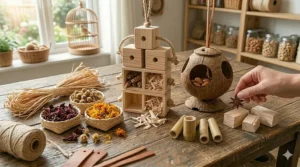
Start with the simplest possible design: single-strand vertical toys. You’ll need bird-safe rope (hemp or cotton, never nylon), 8-12 wooden blocks or beads, two wooden end caps or larger blocks, and one quick-link for hanging. This design teaches you the fundamentals without overwhelming you with complexity.
Step 1: Measure and cut your rope to 18-24 inches—longer than you think you need because you’re accounting for knots and hanging loops. Singe the rope ends with a lighter (do this outdoors) to prevent fraying, but let them cool completely before handling.
Step 2: Create your top loop by folding 3-4 inches of rope and securing with a simple overhand knot. This loop connects to your quick-link. Thread your first end cap piece onto the rope and push it up to sit against the loop knot. This cap prevents smaller pieces from sliding off the top.
Step 3: Thread your variety pieces in whatever order appeals to you—there’s no wrong answer here. Alternate colors, textures, and sizes to create visual interest. Leave 1-2 inches of space between some pieces to allow movement; this creates that satisfying clacking sound birds love.
Step 4: Secure the bottom with your second end cap and a substantial knot at the rope terminus. The knot should be large enough that the end cap can’t slip over it. Some builders add a bell at the bottom—test this with your bird first as some species find bells stressful rather than engaging.
Progression to intermediate designs means adding horizontal elements, creating Y-shaped structures with rope branches, or incorporating chain segments for different movement dynamics. The progression rule: add one new technique per toy rather than attempting complex multi-axis designs too early.
The mistake beginners make is over-engineering first toys with 40+ pieces. Your bird doesn’t care if it’s Pinterest-worthy; they care if it’s fun to destroy. Start simple, observe what elements your bird engages with most, then double down on those features in future builds.
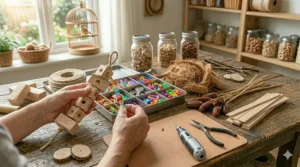
Tool requirements are minimal: sharp scissors, lighter for rope prep, and needle-nose pliers if you’re working with stainless steel chain. That’s it. Don’t invest in $60 specialty tool kits until you know this hobby sticks—the three basics handle 95% of projects.
Safety Essentials: What to Avoid When Shopping
The bird toy parts and supplies market has safety landmines that aren’t obvious until you know what to look for. Zinc-plated hardware is the silent killer—zinc is toxic to birds when ingested, and zinc plating flakes off with normal wear. Always specify stainless steel chains, quick-links, and fasteners even though they cost 40-60% more than hardware store equivalents.
Cotton rope versus hemp rope creates heated debates in bird forums, but the reality is simpler: both are safe if they’re 100% natural fiber. The danger comes from synthetic rope marketed as “cotton blend”—polypropylene and nylon strands can cause crop impaction if ingested. The test: burn a small fiber sample. Natural fibers produce ash that crumbles easily, while synthetics melt into hard beads.
Acrylic and plastic components are safe when they’re specifically manufactured for birds, but craft store acrylics sometimes contain residual manufacturing chemicals that off-gas. The difference shows up in smell—bird-safe acrylics have no chemical odor even when new. If it smells like new-car-interior, it’s off-gassing something your bird shouldn’t breathe.
Dye safety separates professional suppliers from hobbyists. Food-grade and vegetable-based dyes are safe; craft dyes containing heavy metals (commonly found in bright blues and greens) are not. The labeling loophole: “non-toxic” doesn’t mean “safe if ingested,” it means “won’t kill you if you touch it.” Insist on “food-grade” or “vegetable-based” specifications.
Leather is controversial because processing methods vary wildly. Vegetable-tanned leather is safe; chrome-tanned leather contains chromium which is toxic. Most retailers don’t disclose tanning methods, so the conservative approach is avoiding leather entirely or only buying from bird-specialty suppliers who guarantee vegetable tanning.
Size-inappropriate parts create choking hazards more often than most owners realize. The rule: parts should be too large to swallow whole or small enough to pass through the digestive system. That dangerous middle ground—items that can lodge in the crop or block the intestine—is where emergencies happen. For cockatiels and smaller birds, nothing between 5-10mm diameter; for African Greys and Amazons, avoid 10-25mm range; for macaws, watch the 25-50mm zone.
Natural vs. Synthetic Materials: What Actually Matters
The great natural-versus-synthetic debate in bird enrichment boils down to destruction patterns and environmental exposure rather than inherent danger. Natural materials—wood, palm, vine, paper—satisfy instinctual behaviors because they respond to bird beaks the way wild materials do. They splinter, shred, and compress, providing that variable resistance texture that keeps beaks engaged.
Natural advantages: Wood grain means every piece destroys differently, preventing habituation. Natural materials also absorb beak oils, creating familiar scent profiles that increase object attachment. The surprise factor matters too—a natural vine ball sometimes has hidden seeds or bark texture that rewards exploration.
Natural disadvantages: Inconsistency becomes a problem when you need reliable sizing for mechanical toys. Natural materials also require more storage attention—humidity causes wood warping, and organic materials can develop mold in poor storage conditions. The cost factor is real too; premium natural woods run 3-5x more expensive than manufactured alternatives.
Synthetic materials (food-grade plastics, acrylic) deliver consistency and durability. They’re ideal for puzzle elements that need specific shapes, foraging devices with moving parts, and components that will get dunked in water bowls repeatedly. Plastic doesn’t splinter, so birds who’ve experienced beak injuries can interact with synthetic materials safely.
Synthetic limitations: They lack the texture variety that maintains long-term interest. A plastic bead always feels like a plastic bead, while each wooden bead has unique grain density. Synthetics also don’t satisfy the destruction urge—birds who need to shred for stress relief find plastic frustrating because it doesn’t break down the way their instincts expect.
The hybrid approach most experienced owners adopt: 70-80% natural materials for destruction and enrichment, 20-30% synthetic for mechanical elements and water-resistant components. This mirrors what birds encounter in the wild (mostly natural materials, occasional seed pods with hard shells that approximate synthetic hardness).
One overlooked consideration: outdoor aviary birds need weather-resistant materials. Natural woods deteriorate rapidly under rain exposure, while UV-resistant plastics and stainless steel maintain integrity through seasons. Indoor birds can enjoy the full range of natural materials without weather degradation concerns.
Cost Analysis: DIY Building vs. Pre-Made Toys
The math on DIY bird toys favors building your own by substantial margins, but the break-even point depends on your bird’s destruction rate and your available time. Let’s examine real numbers.
Pre-made toy costs: Quality pre-made toys for medium parrots run $15-$35, with longevity ranging from 3 days (aggressive chewers) to 3 weeks (gentle manipulators). That’s $5-12 per week in toy costs for a single bird. Multiply by 52 weeks and you’re spending $260-$624 annually on bird enrichment per bird.
DIY startup costs: Initial investment in starter kits and basic tools runs $60-$100. The Super Bird Creations kit ($30) plus Bonka beads ($10), colored sticks ($12), and mahogany pods ($20) gives you materials for roughly 8-12 custom toys. Add $25 for scissors, rope, and hardware and you’re at $95 total.
Cost per toy comparison: DIY toys using bulk materials average $3-$7 in material costs depending on complexity. A simple vertical toy might use $3 in materials; an elaborate foraging structure could hit $7. Compare this to the $15-$35 pre-made equivalent, and your savings run 60-80% per toy.
Break-even timeline: If you’re spending $20/week on pre-made toys, your $95 DIY startup pays for itself in 4-5 weeks. For households with multiple birds, the timeline collapses to 2-3 weeks. The return on investment becomes even more dramatic once you’ve used up starter kits and transition to bulk materials—at that point, you’re paying $0.15-0.30 per piece versus $15-35 per pre-made toy.
Time investment: Building a simple toy requires 10-15 minutes. Complex designs might take 30-45 minutes. Compare this to a store trip (30-60 minutes including travel) and the time economics favor DIY building even before considering the cost savings. The learning curve exists—your first few toys might take an hour—but by toy 5-6, you’re operating at full efficiency.
Quality considerations: Pre-made toys from premium brands like Super Bird Creations offer tested designs and professional assembly. You’re paying for design expertise and liability insurance. DIY toys let you customize for your specific bird’s preferences and destruction style, but you’re assuming responsibility for safety testing. The quality trade-off depends on your confidence level and bird observation skills.
The hybrid strategy: Many experienced owners buy one pre-made “template” toy, study its construction, then DIY similar designs using bulk parts. This approach gives you the design expertise of professional manufacturers while capturing DIY cost savings. It’s particularly effective for learning proper spacing, knot techniques, and material combinations that actually work.
Common Mistakes Bird Owners Make With Toy Parts
Mistake #1: Buying parts without a plan. New toy builders often purchase bulk variety packs thinking “I’ll figure it out,” then face decision paralysis when they have 200 pieces and no design direction. The solution: sketch 2-3 simple designs before buying, then purchase only the parts those designs require. Expand your parts inventory as your design confidence grows.
Mistake #2: Over-threading. Beginners pack every available inch of rope with parts, creating static, dense toys that don’t move or make sounds. Birds find movement and noise engaging—space is a feature, not a waste. Leave 1-2 inches between some elements and your toys suddenly become 3x more interesting to the bird.
Mistake #3: Ignoring destruction timelines. Building a toy that lasts 6 weeks sounds efficient until you realize your bird lost interest after 3 days because they need that sense of accomplishment from completing destruction. Match the design to your bird’s attention span, not your assembly preferences. High-metabolism small birds need 2-5 day toys; large parrots can work on 2-4 week projects.
Mistake #4: Rope length miscalculation. Every knot consumes 3-4 inches of rope length, and you need working length for threading and hanging loops. The formula: desired final toy length + (number of knots × 4 inches) + 8 inches for hanging loop = minimum rope length needed. Running short mid-assembly means either starting over or having a toy that’s too short to be functional.
Mistake #5: Following human aesthetics over bird preferences. Instagram-worthy color gradients and symmetrical designs mean nothing to birds. They respond to texture variety, hardness differentials, and destruction challenge. That Pinterest-perfect toy you spent two hours arranging? Your bird might ignore it because every piece is the same hardness level.
Mistake #6: Reusing compromised parts. That wooden block your macaw partially destroyed looks like it has “good material left,” but if there are cracks, it’s structurally compromised and becomes a splintering hazard. The safety rule: if it’s more than 30% destroyed or shows stress cracks, discard it regardless of visual appeal. Your bird’s beak can find and exploit structural weaknesses you can’t see.
Mistake #7: Storage neglect. Natural materials exposed to humidity can develop mold invisible to casual inspection but dangerous to birds with sensitive respiratory systems. Store wooden parts in sealed containers with desiccant packets, and inspect stored materials before use. If it smells musty or shows any discoloration, discard it.
Best Toy Variety Packs for Different Parrot Species
For Macaws and Large Cockatoos: The JoyGinBStiao Heavy Duty platform paired with bulk hardwood blocks represents the only realistic long-term strategy. These birds can destroy $50 of standard toys weekly—an unsustainable expense for most owners. The refillable platform concept means you’re only replacing the consumable elements, cutting costs by roughly 70% over six months.
For African Greys and Amazons: The FALESHOS 120-piece set delivers ideal variety for birds who combine destruction capability with puzzle-solving intelligence. The material mix supports building both challenging chew toys and mechanical problem-solving toys, matching these species’ dual nature. Expect 6-8 substantial toys from one set, representing 2-3 months of enrichment at $3.30-4.70 per toy.
For Conures and Caiques: The Super Bird Creations Medium kit targets this size class perfectly. Conures destroy toys faster than you’d expect from their body size, so the 52-piece count supports 4-6 medium-complexity builds. These birds particularly appreciate the vine components included in the kit—natural materials that satisfy shredding urges without the hardness challenges they’re not equipped to handle.
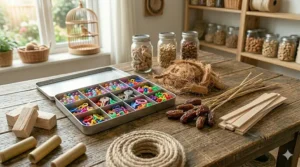
For Cockatiels and Lovebirds: Bonka’s Wooden Chewy Sticks (50pc) combined with the Wood Beads (70pc) provides an excellent starter foundation. At under $25 combined, you’re getting materials for 10-12 toys perfectly sized for their beaks. These species need frequent toy rotation more than destruction challenges, and the low per-piece cost enables guilt-free weekly changes.
For Parakeets and Parrotlets: The Bonka Foraging Heart and similar pre-loaded shredding toys work better than parts kits for very small birds. These species have such high metabolism rates that they need daily enrichment changes, making the time investment of building from parts less practical than grab-and-hang pre-made options. Focus on consumable toys you can replace quickly rather than durable builds.
For Mixed-Size Flocks: If you’re managing multiple bird sizes, prioritize the FALESHOS set for its incredible piece variety. The 120-component spread includes sizing that works from cockatiels up to small cockatoos. Build species-appropriate toys from the same parts inventory, simplifying your supply chain while maintaining appropriate enrichment levels for each bird.
Seasonal Toy Strategies: Keeping Birds Engaged Year-Round
Bird enrichment needs fluctuate with seasons in ways most owners don’t anticipate, driven by daylight duration, hormonal cycles, and weather-restricted flight time. Adapting your toy strategy seasonally maintains engagement and addresses behavior changes.
Spring (breeding season surge): Hormonal birds become more destructive and territorial. Increase toy hardness and destruction challenge rather than variety. Spring is when you deploy those hard maple and manzanita blocks that seemed excessive in winter. Birds in breeding condition need to “win” destruction challenges to satisfy hormonal drives safely—easier materials just frustrate them further.
Summer (high-energy, long days): Extended daylight means more active hours requiring stimulation. This is your variety season—rotate toys every 3-4 days rather than weekly, and introduce new textures aggressively. Summer is also when outdoor birds can safely use weather-resistant synthetic components without cold-brittleness concerns. Focus on foraging toys that take time to solve, matching the extended daylight attention span. Studies published in NCBI research journals demonstrate that environmental enrichment significantly reduces stress physiology in captive birds, with measurable decreases in corticosterone levels.
Fall (molting comfort): Birds going through molt often show reduced energy and increased grooming focus. Shift toward softer, shredding materials that satisfy preening instincts without requiring the energy expenditure of hardwood destruction. The Bonka Foraging Heart style toys excel during molt—they provide engagement without physical demand. Reduce toy quantity during heavy molt periods; too many options can stress already-uncomfortable birds.
Winter (reduced activity): Shorter daylight and cooler temperatures mean birds spend more time perching quietly. This isn’t the season for aggressive toy rotation—it’s time for comfort toys and puzzle elements. Introduce mechanical toys with moving parts that birds can manipulate while perched rather than destruction toys requiring active effort. Winter is also when you build up your toy inventory in preparation for spring’s surge.
The rotation mistake most owners make is changing all toys simultaneously. This creates unfamiliarity stress rather than enrichment excitement. The optimal rotation strategy: change one toy every 3-4 days, maintaining 3-4 familiar toys while introducing 1-2 new ones. This balance gives birds novelty without overwhelming their comfort zones.
FAQ: Your Bird Toy Parts Questions Answered
❓ How often should I replace bird toy parts and supplies?
❓ Are colored wooden bird toy parts safe if my parrot ingests small pieces?
❓ What's the minimum number of bird toy making supplies needed to start DIY projects?
❓ Can I mix bird toy parts from different brands and suppliers safely?
❓ How do I store bulk bird toy supplies to prevent mold and deterioration?
Conclusion: Building Better Enrichment Through Smart Choices
The bird toy parts and supplies market in 2026 offers unprecedented access to quality materials that used to require specialty suppliers and industry connections. What matters now isn’t finding sources—it’s making informed choices that balance cost, safety, and enrichment effectiveness for your specific bird’s needs.
The seven products profiled here represent different approaches to the same goal: keeping intelligent, curious parrots mentally and physically engaged in captivity. The Super Bird Creations kit gives you tested combinations, Bonka’s specialized components solve specific enrichment challenges, and complete sets like FALESHOS remove barriers to entry for new builders.
Your optimal strategy combines these approaches rather than committing to one. Start with a complete toy sets like the FALESHOS or Super Bird Creations kit to learn assembly basics and material interactions. Once you’ve built 4-6 toys and identified what your bird actually engages with, transition to bulk buying of those specific components. Supplement with specialized items like mahogany pods or foraging hearts when your bird’s behavior indicates need for that enrichment type.
The cost savings of DIY building are compelling—60-80% reductions versus pre-made toys—but the real value is customization. You’re not hoping a mass-produced toy happens to match your bird’s destruction style; you’re designing specifically for their preferences, building challenge progressively, and adjusting difficulty as they develop skills.
Remember that toy building is iterative problem-solving, not one-time shopping. Your first three toys will likely sit unused as you figure out what your bird actually wants versus what you think looks good. That’s normal and expected. By toy number five, you’ll understand their preferences well enough to design toys they engage with immediately. The investment in those first learning toys pays dividends in every subsequent build.
The beginner bird owner essentials boil down to: quality over quantity, observation over assumption, and consistent rotation over perfect designs. Buy the materials, build the toys, watch what works, and adjust. That cycle produces better enrichment than any pre-made toy possibly could, because you’re designing specifically for your bird rather than for a generic market average.
Recommended for You
- 7 Best Toys for Feather Plucking: Save Your Bird (2026)
- 7 Best Natural Bird Toys for Healthier Parrots in 2026
- 7 Best Bird Toys for Parrots That Stop Boredom Fast (2026)
Disclaimer: This article contains affiliate links. As an Amazon Associate, I earn from qualifying purchases. If you purchase products through these links, we may earn a small commission at no additional cost to you.
✨ Found this helpful? Share it with your friends! 💬🤗
