
In This Article
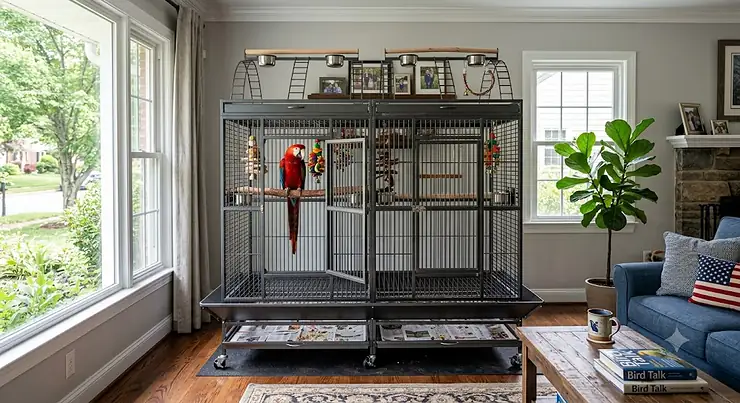
Here’s a fact that surprises a lot of new macaw owners: the cage matters more than almost anything else you’ll buy for your bird. Not the toys. Not the fancy pellet blend. The cage. A macaw is essentially a flying crowbar with feathers, and if the enclosure you pick can’t handle that beak, that wingspan, and that need for room to move, you’re going to be replacing it within a year — or worse, dealing with a bored, stressed bird who starts screaming or plucking out of sheer frustration.
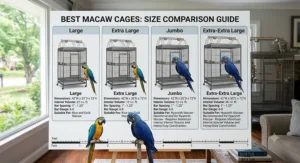
So what is a macaw cage, exactly? It’s a specialized, heavy-duty enclosure built with wide bar spacing, thick-gauge wire, and enough interior volume to accommodate a bird whose tail alone can stretch two feet long. This guide breaks down the best macaw cages on the market in 2026, based on real product specifications, verified owner feedback, and honest comparative analysis — not marketing copy dressed up as a review. Organizations like the Association of Avian Veterinarians exist to help owners find qualified care for their bird, and that same level of diligence should go into picking where that bird actually lives every day. We looked at budget picks, extra large options, and premium stainless builds so you can match a cage to your specific macaw, your space, and your wallet.
Top Rated Macaw Cages at a Glance
Before diving into the full breakdown, here’s a quick-reference table of the seven cages covered in this guide. Think of this as your cheat sheet — skim it, then jump to whichever product matches your situation.
| Category | Cage | Best For |
|---|---|---|
| Best Overall | A&E Cage Co. 40″x40″ Macaw Flight Cage | Single large macaw, everyday use |
| Most Spacious | A&E Cage Co. 8040FL Double Macaw Cage | Two macaws or a serious breeder setup |
| Most Flexible | A&E Cage Co. Double Macaw Cage with Removable Divider | Growing households, future second bird |
| Best Budget | Prevue Pet Products Wrought Iron Select Bird Cage | Mini macaws, first-time owners |
| Best Value | Yaheetech 63″ Extra Large Open Play Top Cage | Hahn’s or severe macaw on a budget |
| Best Stainless Steel | King’s Cages SLT 3628 Superior Line | Heavy chewers, humid climates |
| Best Heavy-Duty | SD Factory Direct XL 304 Stainless Macaw Cage | Indoor-outdoor use, large macaw species |
Notice a pattern here? The cheaper options cluster around mini and severe macaws, while the premium picks scale up for blue and gold, scarlet, and green-winged birds that need serious floor space. That’s not a coincidence — it’s physics. A bigger bird needs a bigger, tougher box, and that box costs more to build. Buyers on a budget should prioritize interior square footage over paint color or playtop bells and whistles, since a cramped bird will develop behavioral problems regardless of how attractive the cage looks in your living room.
💬 Found a pick you’re leaning toward already? Scroll down to see it ranked side-by-side with the rest — you might change your mind.
💬 Just one click — help others make better buying decisions too!😊
Top 7 Macaw Cages: Expert Analysis and Reviews
We dug into real product listings, manufacturer specs, and aggregated macaw cage reviews from owners on Amazon, Walmart, and dedicated bird-owner forums to build this list. Every entry below includes honest commentary — not just a spec dump — because a bar-spacing number means nothing until you understand what it means for your bird.
1. A&E Cage Co. 40″x40″ Macaw Flight Cage — best all-around single-macaw upgrade
The standout here is the sheer footprint: 40 inches by 40 inches of floor space in a cage that stands 76 inches tall, giving a full-grown macaw room to actually stretch and flap rather than just shuffle. At roughly 198 pounds assembled, this is not a cage you casually reposition on a whim — it’s built like furniture, which is exactly the point. The 1-inch bar spacing sits right in the sweet spot for large macaws, wide enough to let your bird see out clearly but tight enough that a curved beak can’t easily pry the bars apart.
Based on the spec comparison, this cage earns its keep through details that matter daily: four swing-out feeder doors mean you’re never sticking your hand into a territorial bird’s main compartment just to refill water, and the two breeder doors add flexibility if you ever expand your flock. What most buyers overlook about this model is the slide-out grill and tray combo, which turns a chore that could eat twenty minutes into a five-minute wipe-down. Reviewers consistently note that A&E’s welded construction and powder-coated finish hold up far better under macaw beak pressure than the thinner wire used in budget cages, and forum discussions among long-term macaw keepers repeatedly list A&E alongside King’s Cages as one of the two most trusted heavy-duty brands in the hobby.
Pros:
- ✅ Full 40×40 footprint gives real wing-flap room
- ✅ Four swing-out feeders reduce daily handling risk
- ✅ Two breeder doors add long-term flexibility
Cons:
- ❌ Nearly 200 lbs — a two-person assembly job
- ❌ Premium build means a premium price tag
Expect to pay in the $800-$1,000 range, and given the interior volume and A&E’s reputation for longevity, that price buys you a cage that should outlast several bird toys’ worth of chewing before it needs replacing.
2. A&E Cage Co. 8040FL Double Macaw Cage — most spacious for two macaws
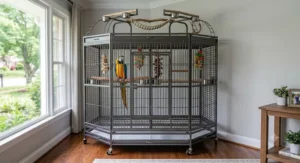
This is the cage version of buying a house instead of an apartment. At 80 inches by 40 inches by 74 inches tall, with an interior height of 61 inches, the 8040FL is designed from the ground up to either house two macaws side by side or give one very large bird an almost aviary-like amount of room. The included removable center divider is the real innovation — you can run it as two separate habitats when introducing a new bird, then pull the divider and let two bonded macaws share one giant space.
Here’s what the spec sheet won’t tell you, but reviewers note: that divider is what makes this cage genuinely useful rather than just big. Quarantine periods, personality clashes, and simple redecorating all become manageable without buying a second cage outright. The four stainless steel feeder cups on swing-out doors and the bird-proof front door locks are standard A&E fare, but at this scale they matter more, since a cage this size houses more food stations and more opportunities for an escape attempt. Buyers considering an extra large macaw cage for multiple birds should weigh this option seriously before assuming they need two separate enclosures.
Pros:
- ✅ Removable divider doubles as two habitats or one
- ✅ Massive 80-inch width suits pairs or big singles
- ✅ Four feeder stations simplify multi-bird feeding
Cons:
- ❌ Requires serious floor space — measure your room first
- ❌ Heaviest and priciest cage on this list
Pricing typically lands in the $2,200-$2,900 range depending on finish and current promotions, which sounds steep until you compare it to buying two separate premium cages instead.
3. A&E Cage Co. Double Macaw Cage with Removable Divider — best flexible mid-size option
Slightly smaller than the 8040FL at 64 inches by 32 inches by 76 inches, this variant is the practical middle ground for owners who want divider flexibility without committing to an 80-inch-wide footprint. The interior height still accommodates long macaw tails without the constant risk of feather damage that comes from a too-short cage, and the 1-inch bar spacing is standard for large-macaw species like blue and gold and green-winged birds.
What most buyers overlook about this model is how well it fits into a standard bedroom or den corner compared to its bigger sibling — you get the same divider versatility in a footprint that doesn’t require a dedicated bird room. Reviewers on Amazon note the same swing-out feeder design and bird-proof latch system found across A&E’s line, and the rolling casters make the difference between a two-person moving ordeal and a one-person adjustment when you need to vacuum behind it. Based on the spec comparison against the smaller flight cage, this is the pick for owners who anticipate adding a second bird eventually but aren’t ready for double-macaw scale today.
Pros:
- ✅ Divider flexibility in a more manageable footprint
- ✅ Rolling casters ease single-person repositioning
- ✅ Bar spacing suits large macaw species safely
Cons:
- ❌ Still too large for small apartments
- ❌ Assembly instructions get mixed feedback across A&E’s lineup
Expect a price in the $1,700-$2,300 range, positioning it as a genuine middle tier between the single flight cage and the full double macaw setup.
4. Prevue Pet Products Wrought Iron Select Bird Cage — best budget pick for mini macaws
Prevue has been building bird housing since 1869, and this Select series cage is where budget-conscious owners of mini macaws — Hahn’s, yellow-collared, severe — should start looking. Measuring 36 inches long, 24 inches wide, and 66 inches high with 3/4-inch wire spacing, it’s sized appropriately for the smaller macaw species rather than a full-size blue and gold or scarlet.
Aggregated review sentiment on this cage is refreshingly specific: one Walmart reviewer described it as “the right size for our severe macaw” and confirmed the cage held up well in daily use, while others flagged real quality-control issues — bent trays, paint scrapes on arrival, and instructions that reviewers called close to useless. Prevue apparently ships small vials of touch-up paint with these units, which tells you the scuffing issue is known and, frankly, common enough that the company has a standard fix for it. What this means in practice: budget hardware saves you real money up front, but plan on tightening a few bolts and maybe touching up a scratch or two rather than expecting a flawless unboxing.
Pros:
- ✅ Real-world reviewer confirmation it suits severe macaws
- ✅ Nearly 160 years of manufacturing reputation behind it
- ✅ Castered stand and playtop included at this price
Cons:
- ❌ Reported shipping damage and cosmetic paint scrapes
- ❌ Too small for full-size blue and gold or scarlet macaws
This cage typically sits in the $200-$300 range, making it one of the most affordable entries here — provided you’re housing a mini macaw species and not a giant.
5. Yaheetech 63″ Extra Large Open Play Top Cage — best value for first-time owners
Yaheetech built its reputation on delivering large-format bird cages at prices that undercut the legacy brands, and this 63-inch open play top model is a strong example why. With a 24-inch by 22-inch by 44.5-inch interior and 1-inch bar spacing, it’s marketed specifically toward African Grey, Amazon, and Hahn’s macaw-sized birds — in other words, the smaller end of the macaw spectrum rather than a blue and gold or scarlet.
The spec sheet won’t tell you this, but user reports suggest the open Victorian archtop is a genuine highlight: it gives birds an elevated, out-of-cage perching space that owners describe as a favorite hangout spot, with one reviewer calling it “the best cage — in this price range — I have owned.” That said, honest reporting requires flagging the flip side: another owner of a similarly-spaced Yaheetech cage noted the bars ran slightly too wide for a smaller bird and had to wrap the exterior in hardware cloth as a fix, a detail worth remembering if you’re housing a bird on the smaller end of what this cage claims to fit. Assembly reviews are largely positive, with several buyers completing setup solo in under an hour.
Pros:
- ✅ Open playtop adds genuine out-of-cage enrichment space
- ✅ Strong reviewer praise for value at this price point
- ✅ Four heavy-duty rolling casters ease repositioning
Cons:
- ❌ Bar spacing may run wide for smaller-bodied birds
- ❌ Sized for mini macaws only, not full-size species
Pricing generally falls under $300, cementing this as one of the better entry points for owners easing into macaw ownership without a four-figure commitment.

6. King’s Cages SLT 3628 Superior Line — best stainless steel for chewers
King’s Cages has decades of history in the exotic bird housing space, and the Superior Line stainless builds are the go-to recommendation whenever a macaw owner asks about a cage that can survive genuinely destructive chewing. This model uses medical-grade stainless steel construction rather than powder-coated wrought iron, which eliminates the chip-and-peel cycle that eventually exposes bare metal on painted cages.
Here’s what’s worth weighing honestly: verifiable, independently-sourced customer reviews for this specific stainless model are harder to find publicly than for mass-market brands like Yaheetech, so treat glowing testimonials on manufacturer sites with some skepticism. What is well documented, though, comes from long-running avian owner forum discussions, where multiple experienced macaw keepers independently describe King’s Cages as having “a very long history of providing well constructed cages,” alongside candid notes that some manufacturing has shifted overseas in recent years without a drop in build quality reported by those same owners. The core trade-off is straightforward: stainless costs more up front but never needs repainting, never chips into a chewing bird’s mouth, and wipes clean in humid climates where powder coat tends to degrade faster.
Pros:
- ✅ Stainless build eliminates chip-and-peel paint failure
- ✅ Strong long-term reputation among experienced macaw owners
- ✅ Bird-proof latches and swing-out feeders included
Cons:
- ❌ Independently verified owner reviews are relatively scarce online
- ❌ Highest ongoing investment of any cage on this list
Pricing runs roughly $1,800-$2,500 depending on configuration, positioning this as a long-horizon investment rather than an impulse buy.
7. SD Factory Direct XL 304 Stainless Macaw Cage — best heavy-duty indoor-outdoor option
This 48-inch wide, 36-inch deep, 60.5-inch tall cage is built from 304 medical-grade stainless steel with notably thick bars — roughly 5mm, compared to the 2-3mm bars found on many budget stainless competitors that reviewers elsewhere describe bending under sustained beak pressure. The 1-inch bar spacing and reinforced secondary door lock make this a serious option for owners who want a cage that can live outdoors part-time without rusting through in a single season.
What most buyers overlook about this model is the bar thickness claim specifically — it’s an easy detail to skip past, but it’s the difference between a cage that shrugs off a determined macaw beak and one that slowly deforms over years of use. The seller’s own marketing repeats the common industry claim that stainless steel “lasts a lifetime” compared to a 3-to-5-year lifespan for powder-coated alternatives; that claim shows up nearly verbatim across multiple stainless cage sellers, so treat it as an industry talking point rather than an independently tested statistic, even though the underlying material logic — stainless resists rust and doesn’t flake lead-free paint — does hold up to scrutiny.
Pros:
- ✅ Thicker 5mm bars resist bending under heavy beak pressure
- ✅ Rated safe for indoor or part-time outdoor placement
- ✅ Secondary door lock adds real escape-prevention
Cons:
- ❌ Assembly required, with flat-packed shipping for transport
- ❌ Independent long-term owner reviews are limited
Prices fluctuate with promotions but commonly land between $2,200 and $3,500, so check current listings before assuming any advertised discount is standard.
Comparing All 7 Cages Side by Side
| Cage | Interior Size | Bar Spacing | Best For | Price Range |
|---|---|---|---|---|
| A&E 40″x40″ Macaw Flight Cage | 40″ x 40″ x 76″ | 1″ | Single large macaw | $800-$1,000 |
| A&E 8040FL Double Macaw Cage | 80″ x 40″ x 74″ | 1″ | Two macaws / breeders | $2,200-$2,900 |
| A&E Double Macaw w/ Divider | 64″ x 32″ x 76″ | 1″ | Flexible mid-size households | $1,700-$2,300 |
| Prevue Wrought Iron Select | 36″ x 24″ x 66″ | 3/4″ | Mini/severe macaws, budget | $200-$300 |
| Yaheetech 63″ Open Play Top | 24″ x 22″ x 44.5″ | 1″ | First-time mini macaw owners | Under $300 |
| King’s Cages SLT 3628 | 26″ x 24″ x 66″ | 3/4″-1″ | Heavy chewers, humid climates | $1,800-$2,500 |
| SD Factory Direct XL Stainless | 35″ x 46.5″ x 52.5″ | 1″ | Indoor-outdoor, large species | $2,200-$3,500 |
Looking at the numbers side by side, the split between mini macaw cages and full-size macaw cages becomes obvious — the two budget picks max out around 44 inches of interior height, while every full-size option clears 66 inches. If you’re shopping for a blue and gold macaw cage or a scarlet macaw enclosure specifically, the four A&E, King’s Cages, and SD Factory Direct options are your realistic candidates, not the Prevue or Yaheetech units. Buyers should also note that bar spacing scales with bird size for a reason: too-wide spacing on a small macaw risks head entrapment, while too-narrow spacing on a large macaw simply wastes material cost.
✨ Ready to Compare Real Listings?
🔍 Take your macaw’s living situation to the next level with these carefully selected picks. Click on any highlighted product to check current pricing and availability before you commit. The right enclosure today saves you a costly re-purchase in six months!
Extra Large Macaw Cage vs Standard Enclosures: Which Do You Need?
Sizing a cage correctly starts with a simple gut check: does your bird’s tail ever touch two sides of the cage at once? If so, you need to size up. According to veterinary housing guidelines summarized by VCA Animal Hospitals, mini macaws need a minimum footprint of roughly 3 feet wide by 3 feet tall by 4 feet long, while large macaws need closer to 4 feet wide by 5 feet tall by 5 feet long — and that’s a floor, not a target. An extra large macaw cage, like the A&E 8040FL or the SD Factory Direct stainless model, exists precisely because “minimum” and “adequate for a happy bird” are two very different numbers.
Here’s the honest trade-off: a standard-sized cage costs less, moves more easily, and fits into more homes, but it forces your macaw into a more restricted daily routine, often supplemented by long out-of-cage time to compensate. An extra large cage costs more and eats more floor space, but it lets your bird actually behave like a macaw — flapping, climbing, and using its whole body — inside its primary enclosure rather than only when supervised outside it. If your living situation genuinely can’t accommodate an 80-inch-wide cage, prioritize daily out-of-cage time and a play stand to offset a smaller enclosure; it’s not a perfect substitute, but it meaningfully narrows the gap.
Blue and Gold Macaw Cage Requirements
The blue and gold macaw is one of the most commonly kept large macaw species, and its housing needs are fairly representative of the “big macaw” category as a whole. Published husbandry guidance on the species recommends bar spacing of roughly 3/4 to 1.5 inches, which lines up with every full-size cage reviewed above. Blue and gold macaws are also notably strong chewers and climbers, so a blue and gold macaw cage benefits from thicker-gauge bars and reinforced door latches more than almost any other design feature.
What most buyers overlook about this species specifically is how much horizontal space matters relative to height. Blue and golds climb constantly and use horizontal bars as a ladder system, so a cage with horizontal siding — like several A&E models — offers genuine enrichment value beyond just floor footprint. Reviewers consistently note that this species also throws food and tips water bowls with some enthusiasm, which is exactly why swing-out feeder doors with secure locks, rather than simple cup-in-a-holder designs, hold up better over time.
Scarlet Macaw Enclosure Essentials
Scarlet macaws bring a specific housing wrinkle: their tails are proportionally longer than a blue and gold’s, often accounting for more than half the bird’s total body length. A scarlet macaw enclosure needs enough vertical clearance that the tail never drags on the cage floor or bends against the bars, since chronic tail damage is both a cosmetic and a welfare issue for this species. Based on the spec comparison across this list, cages in the 74-76 inch height range — like the A&E flight cage and double macaw options — give scarlets meaningfully more room than a 60-66 inch cage would.
Scarlet macaws are also known for being especially food-motivated and food-possessive in captivity, so a scarlet macaw enclosure with multiple, well-separated feeder stations reduces resource-guarding stress between cage mates or during routine refills. Owners frequently underestimate how much a scarlet’s plumage — brilliant reds fading to blue and yellow — actually shows dust and debris buildup on lighter-colored cage interiors, which is a minor point but one that makes darker powder coat or brushed stainless interiors a genuinely easier long-term cleaning choice for this species.
Setting Up Your New Macaw Cage: A Practical Usage Guide
Getting a new cage home is only step one. Setup mistakes in the first 30 days are where most avoidable problems happen, so here’s what actually matters once the box is open.
Place the cage against at least one solid wall, never in a direct traffic path or next to a kitchen, since cooking fumes — including nonstick cookware off-gassing — are genuinely dangerous to a bird’s respiratory system. Position perches at slightly varying heights and diameters rather than uniform dowels, since foot health depends on your macaw gripping different surfaces throughout the day. During the first week, expect some noise and cautious behavior as your bird investigates every latch, bar, and feeder door; macaws are problem-solvers, and this is completely normal rather than a sign something’s wrong with the cage.
On maintenance: wipe feeder cups daily, do a full tray-and-grate clean weekly, and inspect welds and latch mechanisms monthly for wear, especially on cages with heavy chewers. A common first-month mistake is under-toying a new cage — an empty-feeling enclosure, even a large one, reads as understimulating to an intelligent bird, so budget for foraging toys and rotate them every few days from day one rather than waiting to see if your macaw “needs” them.
Which Cage Fits Your Situation? Real-World Scenarios
If you’re a first-time bird owner adopting a rescued Hahn’s or severe macaw and living in a one-bedroom apartment, the Yaheetech 63″ or Prevue Wrought Iron Select gives you appropriate sizing without requiring you to reroute furniture around an 80-inch footprint.
If you’re an established owner with a bonded pair of blue and gold macaws and a dedicated bird room, the A&E 8040FL Double Macaw Cage is built for exactly this situation, letting you separate the pair during introductions or health monitoring and reunite them once cleared.
If you’re a macaw owner in a humid coastal climate, or one whose bird has chewed through more than one powder-coated cage already, the King’s Cages SLT 3628 or the SD Factory Direct stainless model solves a problem that a cheaper replacement cage will only recreate in another year or two — the math on stainless starts favoring you the moment you’d otherwise be buying a third budget cage.
Your Macaw Cage Decision Framework
If your macaw is a mini species and your budget is under $300, choose the Prevue or Yaheetech option, because both are sized correctly for smaller macaws and the savings are real rather than a compromise on safety.
If your macaw is full-size and you have the floor space, choose an A&E flight or double cage, because the interior volume directly reduces feather damage risk and stress-related behaviors documented in undersized housing.
If your bird is an aggressive chewer or you live somewhere humid, choose stainless steel over powder coat, because the long-term cost curve favors stainless once you account for repainting, touch-ups, or full replacement of a degraded painted cage.
If you’re planning to add a second bird within the next year or two, choose a divider-equipped cage now rather than buying single, because retrofitting a divider later usually isn’t possible on cages that weren’t designed for it.
How to Choose the Best Macaw Cage
- Match cage size to your macaw’s actual species, not just “macaw” as a category — a Hahn’s and a hyacinth have wildly different space needs.
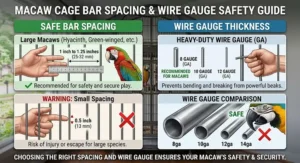
- Check bar spacing against your bird’s head size, since spacing that’s safe for one species can be an entrapment risk for another.
- Prioritize interior height for long-tailed species like scarlets, where a cramped tail causes real physical damage over time.
- Count the feeder doors and their lock type, since swing-out designs with secure latches reduce daily escape risk significantly.
- Decide on powder coat versus stainless early, because retrofitting isn’t possible and the two paths have very different long-term cost curves.
- Confirm your floor can handle the weight, particularly for cages in the 150-340 pound assembled range.
- Read aggregated owner feedback for the specific model, not just the brand, since quality control can vary meaningfully within a single manufacturer’s lineup.
Common Mistakes When Buying a Macaw Cage
The single most common mistake is buying for the macaw you have today rather than the one you’ll have in a year — young macaws grow into their full tail length and wingspan, and an undersized “starter” cage often needs replacing within twelve months. A close second is ignoring bar spacing in favor of overall cage size; a technically huge cage with the wrong spacing for your species is still a safety hazard.
Owners also frequently underestimate assembly complexity, particularly on premium cages exceeding 150 pounds, and end up attempting solo assembly on a unit genuinely designed for two people. Finally, many buyers skip reading model-specific macaw cage reviews and instead trust brand reputation alone — as this guide’s product breakdowns show, quality control complaints like paint scrapes or bent trays can show up even within otherwise well-regarded brands.
Macaw Habitat Requirements Beyond the Cage
A cage is necessary but not sufficient. Most avian vets, including the general care overview published by PetMD, point out that macaw habitat requirements extend well past bar spacing into daily routine: full-spectrum lighting to substitute for natural sunlight, supervised out-of-cage time of at least an hour daily, and consistent placement away from temperature swings, drafts, and direct kitchen fumes.
Diet ties directly into habitat, too. A macaw’s care should be built around a formulated pellet diet alongside fresh vegetables and limited fruit, and feeding stations inside the cage should be positioned away from perches to avoid contamination from droppings. Social structure matters as well: macaws are flock animals by nature, and a cage sited in an isolated room, away from household activity, tends to produce a more anxious, more vocal bird than one placed in a shared living space where the macaw can observe and participate in daily family life from a secure vantage point.
Long-Term Cost and Maintenance
The sticker price of a macaw cage is only the opening bid. Powder-coated cages typically need touch-up paint within the first year or two of heavy chewing, and full repainting or replacement somewhere in the three-to-five-year range under sustained use, based on patterns reported across multiple cage brands’ own product literature and owner forums. Stainless steel cages cost roughly two to three times more upfront but functionally eliminate that recurring repaint-or-replace cycle, which is why owners who’ve already burned through one or two budget cages tend to migrate toward stainless on their next purchase.
Factor in replacement parts too — feeder cups, perches, and casters wear out independently of the main cage frame and are worth budgeting for annually regardless of which cage you choose. It’s also worth remembering that macaws, as detailed on Wikipedia, can live 50 years or more in captivity, which means a cheap cage isn’t a one-time saving — it’s a decision you may end up repeating five or six times over your bird’s lifespan. Looked at over a five-year ownership window, a $250 budget cage that needs full replacement at year three actually costs more than a $2,000 stainless cage that’s still functioning at year ten, which is the kind of total-cost-of-ownership math that’s easy to miss when you’re focused on the checkout price alone.
Features That Actually Matter (And Those That Don’t)
Bar spacing, feeder door design, and interior volume matter enormously — these directly affect safety and daily welfare. Bar gauge thickness matters just as much for genuine chewers, even though it’s rarely the headline feature in product listings. Casters and rolling stands matter more than they sound like they should, purely because you will move this cage for cleaning far more often than you expect.
On the other hand, decorative color options, non-functional “designer” playtop accessories, and marketing claims about “aviary-style” aesthetics rarely affect your bird’s actual quality of life. A hammertone black cage and a chalk white cage of identical dimensions and bar spacing offer your macaw the exact same experience — the color choice is entirely about matching your home decor, not about avian welfare, so don’t let cosmetic upsells inflate your budget away from the structural features that genuinely matter.

Frequently Asked Questions
❓ What is the best cage size for a blue and gold macaw?
❓ Is stainless steel worth it for macaw cages?
❓ How often should I clean a macaw cage?
❓ Can two macaws share one cage?
❓ What bar spacing is safe for a macaw cage?
Conclusion
Choosing among the best macaw cages really comes down to three honest questions: what species and size is your bird, how much floor space can you genuinely dedicate, and how much are you willing to spend now versus later. The A&E Cage Co. lineup covers most full-size macaw owners well, the Prevue and Yaheetech options serve mini macaw households on tighter budgets, and the King’s Cages and SD Factory Direct stainless builds make sense once you’ve already learned — sometimes the expensive way — that a determined macaw beak eventually finds every weakness in a powder-coated finish.
Whatever you choose, treat the cage as the foundation your bird’s entire daily wellbeing sits on, not just a line item in a shopping cart. A slightly bigger, slightly pricier cage today is almost always cheaper than a cramped bird’s vet bills, a replacement cage next year, or both.
Recommended for You
- 7 Best large parrot cage under $300 Picks (2026 Buyer’s Guide)
- Heavy Duty Large Bird Cage: 7 Nearly Indestructible Picks (2026)
- Large Bird Cage With Play Top: 7 Best Picks Ranked for 2026
Disclaimer: This article contains affiliate links. As an Amazon Associate, I earn from qualifying purchases. If you purchase products through these links, we may earn a small commission at no additional cost to you.
✨ Found this helpful? Share it with your friends! 💬🤗
