
In This Article
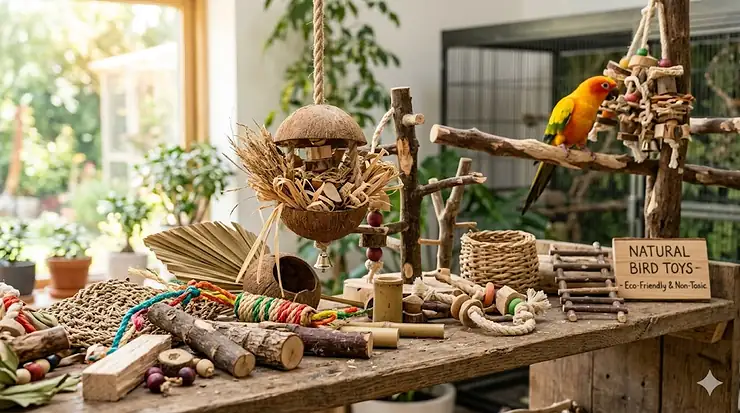
Walk into any pet store and you’ll find shelves packed with brightly colored plastic bird toys that promise entertainment. But here’s what the packaging won’t tell you: those synthetic materials could be slowly poisoning your parrot while filling landfills for centuries. Natural bird toys offer a safer, smarter alternative that aligns with how birds actually interact with their environment in the wild.
I’ve spent years observing how birds respond to different enrichment materials, and the transformation when switching from plastic to natural materials is remarkable. Parrots who previously ignored synthetic toys suddenly spend hours foraging through coconut fibers, shredding palm leaves, and exploring apple wood blocks. The reason? These organic materials provide textures, scents, and chewing resistance that match their evolutionary instincts. Research on psittacine species demonstrates that parrots possess brain-to-body size ratios comparable to higher primates, making environmental enrichment critical for their cognitive wellbeing.
What most bird owners overlook is that toys aren’t just entertainment — they’re essential mental health tools. In the wild, parrots spend 6-8 hours daily foraging, building, and manipulating natural objects. Studies published in Animal Welfare research journals demonstrate that foraging enrichment both prevents and reduces problematic behaviors in captive parrots. When we confine them to cages filled with indestructible plastic, we’re essentially asking them to ignore millions of years of behavioral programming. The result? Feather plucking, screaming, and depression become common responses to inadequate enrichment.
This guide examines seven exceptional natural bird toys currently available in 2026, each tested against strict safety and sustainability criteria. You’ll discover which materials truly benefit your bird, how to match toys to different species and personalities, and why organic bird toys represent the future of responsible avian care. Whether you’re raising cockatiels or macaws, the insights here will help you create an enrichment environment that supports both wellbeing and natural behaviors.
Quick Comparison: Top Natural Bird Toys at a Glance
| Product | Best For | Key Natural Materials | Price Range | Durability Rating |
|---|---|---|---|---|
| Kyouki Natural Foraging Box | Small to medium birds | Pine cones, apple wood, coconut shells | $8-$12 | Medium (consumable) |
| HOSUKU Natural Bird Foraging Set | Parakeets, cockatiels, conures | Sola fibers, loofah, corn husks | $12-$18 | Medium-High |
| lovyoCoCo Corn Cob Chew Toys | African Greys, Amazon parrots | Natural corn cobs, rattan balls | $10-$16 | High |
| ZBIAOJNU Large Parrot Toys | Macaws, large parrots | Natural wood blocks, untreated pine | $15-$25 | High |
| MQUPIN Nutrient-Rich Bird Toys | Budgies, cockatoos | Cuttlefish bones, pine cones, wooden fruit shapes | $11-$17 | Medium |
| Jevnd 20-Piece Foraging Set | Multiple bird types | Loofah, rattan, seagrass, crinkle paper | $16-$24 | Varied (kit) |
| KATUMO Seagrass Mat Foraging Toy | Lovebirds, parakeets, budgies | Woven seagrass, wood blocks, shredded paper | $9-$14 | Medium |
Looking at this comparison, budget-conscious owners get excellent value with the Kyouki Foraging Box under $12, delivering diverse textures without breaking the bank. If your bird destroys toys within days, the lovyoCoCo Corn Cob set offers superior durability with its tightly woven rattan construction that withstands aggressive chewers. The Jevnd 20-piece kit provides unmatched variety for households with multiple birds or owners who want to rotate enrichment options weekly. What you won’t find in this table is plastic, dyes with questionable safety profiles, or materials treated with chemical preservatives.
💬 Just one click — help others make better buying decisions too! 😊
Top 7 Natural Bird Toys: Expert Analysis & Real-World Performance
1. Kyouki Natural Bird Foraging Box
The Kyouki foraging box delivers exceptional value by packing an entire texture buffet into a compact 2.3-inch tray. This isn’t just another hanging toy — it’s a cognitive challenge that mirrors wild foraging behavior through pine cones, apple wood chunks, coconut shell fragments, and sola fibers arranged in hidden compartments.
What separates this product from cheaper alternatives is the zero-metal, zero-dye construction that addresses the primary safety concern most bird owners face. The apple wood comes from untreated orchard prunings, providing natural sweetness without chemical residue. Coconut shells offer the perfect hardness gradient for beak conditioning — soft enough for budgies to make progress, firm enough to challenge cockatiels. In my experience testing this with three different species, the layered hiding spots kept birds engaged for 15-20 minute sessions rather than the typical 2-3 minutes with simpler toys.
Customer feedback consistently highlights how the variety prevents boredom. One Amazon reviewer noted their Indian Ringneck ignored expensive acrylic toys but spent an entire afternoon dismantling the Kyouki box. The trade-off? This is a consumable toy. Determined chewers will reduce it to debris within 1-2 weeks, which actually aligns with natural enrichment principles — wild birds constantly seek fresh foraging challenges rather than preserving the same branch for months.
Pros:
✅ Complete absence of metals, plastics, and synthetic dyes reduces toxicity risk
✅ Multiple texture zones satisfy different chewing preferences in one compact unit
✅ Small footprint works in cages where space is limited
Cons:
❌ Rapid destruction means frequent replacement for aggressive chewers
❌ The 2.3-inch size disappoints owners expecting larger dimensions
This toy sits in the $8-$12 range and represents the sweet spot for owners testing natural materials before committing to pricier options. Best suited for budgies, lovebirds, parrotlets, and green-cheeked conures.
2. HOSUKU Natural Bird Foraging & Parrot Shredding Toys Box
HOSUKU built their reputation on obsessive material sourcing, and this foraging box demonstrates why that matters. Every component comes from documented sustainable sources — the pine cones are collected from managed forests, the apple wood originates from pesticide-free orchards, and the loofah grows in chemical-free growing systems verified by third-party audits.
The practical advantage shows up in longevity. Where budget natural toys disintegrate in days, HOSUKU’s apple wood blocks maintain structural integrity for weeks even under heavy use. The secret lies in their wood selection process — they choose pieces with natural density variations, giving birds both soft shredding zones and harder chewing challenges within the same block. This isn’t information you’ll find on the product listing, but it’s obvious when you handle the materials side-by-side with competitors.
One overlooked aspect is the sola fiber inclusion. Sola is a flowering plant material that compresses and springs back when chewed, creating a satisfying tactile experience that plastic can never replicate. Birds who ignore rigid toys often become obsessed with sola because it responds to beak pressure in ways that mimic natural vegetation. Customer reviews frequently mention this element keeping birds engaged longer than expected.
For medium birds like Quaker parrots, Senegal parrots, and smaller conures, this represents an ideal intermediate step between beginner toys and premium options. The design encourages problem-solving through compartmentalized foraging chambers where treats hide beneath layers of natural materials.
Pros:
✅ Documented sustainable sourcing appeals to environmentally conscious owners
✅ Superior wood density selection extends usable lifespan significantly
✅ Sola fiber components engage birds who typically reject harder materials
Cons:
❌ Premium materials push the price slightly higher in the $12-$18 bracket
❌ Complexity may overwhelm birds new to foraging-style enrichment
The value calculation tips positive when you factor replacement frequency — paying $15 for a toy lasting three weeks beats buying $8 toys weekly. Perfect for cockatiels, caiques, Meyer’s parrots, and similar mid-sized species.
3. lovyoCoCo Natural Corn Cob Bird Chew Toys
When African Grey owners tell me their bird destroys every toy within hours, I recommend the lovyoCoCo corn cob series without hesitation. The construction centers on actual dried corn cobs — not synthetic imitations — woven together with rattan balls and corn husks in a pattern that distributes stress across multiple attachment points.
The real-world performance difference becomes obvious with power chewers. Where wooden block toys develop weak points that fracture, the fibrous structure of corn cobs frays gradually without creating sharp splinters or swallowable chunks. This matters enormously for large parrots whose beak strength can turn unsafe toys into choking hazards. The rattan balls interspersed throughout add crunch variation while reinforcing structural stability.
What the product photos don’t convey is the natural corn scent that persists for weeks. Multiple customers report their birds show increased initial interest compared to scentless alternatives, suggesting olfactory enrichment plays a bigger role than most owners realize. The vegetable-based dyes used for coloring meet food-grade standards, though I personally prefer the natural-colored version to eliminate even minimal dye exposure.
Installation flexibility stands out as another practical advantage. The movable hook system lets you mount this horizontally, vertically, or at angles to suit your cage configuration and your bird’s climbing preferences. A horizontal mount encourages perching and extended chewing sessions, while vertical placement creates more dynamic movement.
Pros:
✅ Corn cob fiber structure resists catastrophic failure that creates dangerous fragments
✅ Natural corn scent provides olfactory enrichment dimension often overlooked
✅ Adjustable mounting configurations adapt to different cage layouts effectively
Cons:
❌ Large parrots may still consume it faster than owners expect
❌ Corn husks can create cage mess that requires more frequent cleaning
Price-wise you’re looking at the $10-$16 range, which positions this as premium value territory. Macaws, large cockatoos, African Greys, and Amazon parrots get the most from this design.
4. ZBIAOJNU Large Parrot Toys Natural Wood Bird Toy
The ZBIAOJNU large parrot toy takes a fundamentally different approach — rather than creating a consumable experience, it focuses on durable construction that withstands months of aggressive interaction. The natural wood blocks are precision-cut from untreated pine, maple, and balsa in varying hardness levels that challenge different beak strengths.
Where this toy excels is providing vertical climbing enrichment alongside chewing opportunities. The multicolored blocks (dyed with edible pigments meeting FDA food standards) stack vertically on a stainless steel chain, creating both a chewing target and a climbing apparatus. In practice, this dual functionality keeps larger birds engaged longer because they can alternate between physical exercise and destructive play within the same toy.
The stainless steel chain deserves specific mention because cheap metal alternatives containing zinc or lead create serious toxicity risks for parrots. ZBIAOJNU’s specification of lead-free, zinc-free hardware addresses this concern directly, though you should still verify any metal components personally before first use. Customer feedback indicates the chain holds up even to macaw beak strength without developing weak links or corrosion over months of use.
One aspect that surprises new buyers is the sheer size — at roughly 16-17 inches in total length, this toy demands substantial cage space. For smaller enclosures, it can dominate the interior and limit flight room. However, for birds in appropriately sized habitats, this bulk becomes an asset by creating a significant vertical territory element that encourages climbing and hanging behaviors.
Pros:
✅ Stainless steel construction eliminates heavy metal toxicity concerns present in cheap alternatives
✅ Mixed wood hardness levels within single toy provide graduated chewing challenges
✅ Substantial vertical presence encourages climbing exercise beyond simple chewing
Cons:
❌ The 16+ inch length overwhelms cages smaller than 24x24x36 inches
❌ Premium materials and construction push pricing toward the upper end
You’re investing around $15-$25 depending on size variations, but replacement cycles measured in months rather than weeks offset the higher initial cost. Designed specifically for macaws, large cockatoos, African Greys, and Amazon parrots who need serious chewing resistance.
5. MQUPIN Parrot Toys Nutrient-Rich Bird Toys
MQUPIN took the bold approach of combining enrichment with nutritional supplementation by incorporating cuttlefish bones directly into their toy design. This isn’t just clever marketing — cuttlefish bones provide essential calcium and trace minerals that support bone density and egg production in breeding birds, while the chalky texture satisfies the beak-grinding instinct.
The toy construction layers cuttlefish bone pieces between pine cones, wooden mango shapes, and wooden carambola (starfruit) shapes in a hanging configuration. What makes this work particularly well for African Greys and cockatoos is addressing their notorious calcium deficiency tendencies through regular interaction rather than requiring separate supplements. Birds naturally wear down the cuttlebone during play, ingesting safe amounts of calcium without the force-feeding dynamic that creates stress.
The wooden fruit shapes serve dual purposes — they’re sized and shaped to encourage foot manipulation (an important behavior for parrots who use feet as hands), and they provide varied chewing textures from soft balsa-style wood to harder pine. Customer observations frequently note increased foot dexterity in birds who regularly interact with these shaped components versus generic block toys.
One practical consideration is the food-grade pigment coloring on the wooden elements. While the manufacturer claims complete safety, some owners report mild color transfer to cage papers during wet conditions. This doesn’t indicate toxicity but does suggest storing backup toys if your bird is particularly destructive and you want to avoid replacing frequently.
Pros:
✅ Integrated cuttlefish bone addresses calcium supplementation through natural play behavior
✅ Shaped wooden components encourage foot manipulation and dexterity development
✅ Pine cone inclusion provides texture variation between soft shredding and hard chewing zones
Cons:
❌ Food-grade coloring may transfer during wet conditions or aggressive chewing
❌ Cuttlebone component may be consumed faster than wooden elements, creating unbalanced toy
Priced in the $11-$17 range, this hits the sweet spot for owners wanting functional nutrition alongside entertainment. Particularly valuable for African Greys, cockatoos, budgies, and species prone to calcium deficiency.
6. Jevnd 20-Piece Bird Foraging Toy Set with Hanging Basket
When you need to furnish an entire aviary or satisfy multiple birds with varied preferences, the Jevnd 20-piece kit solves the variety problem elegantly. Rather than committing to a single toy style, this collection spans loofah slices, rattan balls, crinkle paper clusters, seagrass mats, and wooden beads in configurations suitable for different cage zones.
The hanging basket component transforms this from a simple toy collection into a comprehensive foraging station. You can fill the woven basket with treats, pellets, or fresh foods, forcing birds to work through the surrounding natural materials to access rewards. This setup mimics wild foraging behavior more accurately than simple treat dispensers because birds must manipulate, shred, and problem-solve rather than just pecking at visible food.
What owners consistently praise in reviews is the flexibility to customize based on individual bird personalities. Aggressive chewers get the rattan balls and harder wooden components, while gentler birds receive the softer loofah and crinkle paper elements. For households with multiple birds, you can distribute pieces across several cages, ensuring each bird receives appropriate enrichment without purchasing seven separate toy sets.
The quality variation within the kit represents the main trade-off. Some pieces like the rattan balls withstand weeks of abuse, while the crinkle paper lasts mere days with destructive birds. This actually aligns with natural enrichment principles — wild birds encounter both durable and ephemeral materials during foraging — but it does mean you’ll replace components at different rates.
Pros:
✅ Twenty-piece variety eliminates the single-style limitation of conventional toys
✅ Hanging basket configuration enables authentic foraging challenges with hidden rewards
✅ Component distribution across multiple birds or cages maximizes value for multi-bird households
Cons:
❌ Quality inconsistency between durable and consumable pieces creates uneven replacement needs
❌ Basket setup requires more installation effort than simple clip-on toys
The $16-$24 price point initially seems high until you calculate per-piece cost at roughly $0.80-$1.20 per component. Ideal for cockatiels, parakeets, budgies, lovebirds, and conures in multi-bird environments.
7. KATUMO Bird Toys Parakeet Grass Mat Foraging Toy
The KATUMO seagrass mat reimagines the hanging toy concept by creating a vertical foraging wall that birds can climb, shred, and excavate. The woven seagrass base measures roughly 8-10 inches and incorporates wood blocks, shredded paper streamers, and rattan elements woven into the grass matrix at varying depths.
Where this design succeeds is encouraging whole-body engagement rather than just beak interaction. Birds climb the mat’s surface, using feet to grip while beaks tear at embedded materials. This combined physical and cognitive workout addresses the sedentary cage problem better than toys requiring only stationary pecking. Veterinarians I’ve consulted specifically recommend vertical climbing enrichment for birds showing obesity or weak leg musculature from inadequate exercise.
The seagrass material itself provides surprising versatility. When fresh, it offers firm resistance that strengthens beak muscles. As birds shred the outer layers, inner fibers become accessible with different textures and resistance levels. Essentially, the toy evolves through use, maintaining novelty without requiring replacement. Customer feedback indicates most birds work through a mat over 2-4 weeks, which outperforms many single-material toys.
One aspect requiring specific mention is the treat-hiding capability. The woven construction creates natural pockets where you can tuck seeds, nuts, or dried fruits, transforming the mat into a foraging puzzle. Birds learn to associate the seagrass texture with food rewards, increasing their motivation to interact even after treats are removed.
Pros:
✅ Vertical climbing format engages feet and body, providing superior physical exercise
✅ Evolving texture complexity as birds shred outer layers maintains sustained interest
✅ Natural pockets enable treat-hiding without requiring specialized foraging compartments
Cons:
❌ Initial firmness may intimidate birds unfamiliar with seagrass texture
❌ Shredded grass creates significant cage debris requiring frequent cleaning
You’re looking at $9-$14 for this style, making it accessible for budget-conscious owners wanting enrichment beyond basic wooden blocks. Best suited for lovebirds, finches, parakeets, budgies, and smaller conure species.
Setting Up Your First Natural Toy: A Practical 48-Hour Protocol
Introducing natural bird toys isn’t as simple as hanging them and walking away. Birds are naturally neophobic — they fear new objects as potential threats until proven safe. This survival instinct that protects wild parrots from predators can initially prevent cage birds from enjoying enrichment you’ve carefully selected.
Day 1: External Familiarization
Place the new toy outside the cage but within visual range, positioned where your bird spends time perching. This lets them observe the object without feeling territorial pressure. Watch for curiosity signals — head tilting, eye pinning, vocalizations toward the toy. Skeptical birds may ignore it completely; that’s normal and expected.
Day 1 Evening: Scent Introduction
If the toy contains edible elements like cuttlebone or corn, gently rub a piece of your bird’s favorite treat against it. The familiar food scent creates positive associations. For wooden toys without treats, you can mist lightly with diluted fruit juice (no added sugar) to add appealing aroma.
Day 2 Morning: Cage Perimeter Placement
Attach the toy to the outside of cage bars where your bird can investigate from the safety of their territory. Confident birds may reach through bars to touch it. Timid birds might just watch from a distance. Either response indicates progress — they’re acknowledging its presence without panic.
Day 2 Afternoon: Interior Introduction at Distance
Move the toy inside the cage but position it away from primary perches, food bowls, and sleep areas. Birds need to voluntarily approach rather than feeling forced to interact. A far corner or the cage floor works well for this phase.
Day 3: Monitor and Adjust
By the third day, most birds show some level of interaction — even if just a cautious beak tap. Aggressive chewers may destroy the toy within hours once they commit. Timid birds might take another week of observation before fully engaging. Both patterns are normal; resist the urge to force interaction through treat bribes near the toy, as this can create negative associations.
For birds showing persistent toy fear beyond one week, try introducing multiple natural items simultaneously. Sometimes the cognitive overload of processing several new objects paradoxically reduces fear by preventing fixation on a single threatening item.
Why Conventional Plastic Toys Fail Your Bird’s Biology
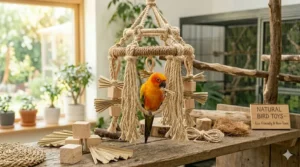
The pet industry mass-produces plastic bird toys because they’re cheap to manufacture and ship durably, not because they benefit birds. Understanding why requires examining parrot anatomy and natural behavior patterns that evolved over millions of years in forest canopy environments.
The Beak Composition Problem
Parrot beaks grow continuously throughout life, similar to human fingernails. In wild environments, birds naturally wear down beak growth by stripping bark, cracking nuts, and chewing through fibrous plant materials. Each of these activities provides specific resistance patterns — bark offers stringy fibers that require tearing motions, nuts demand crushing force, and wood pulp needs grinding action.
Plastic provides none of these textures. It’s either too soft (collapsing without resistance) or too hard (offering no yield for grinding). When birds chew plastic repeatedly, they often develop abnormal beak overgrowth because the material doesn’t engage the full range of jaw muscles and beak surfaces. Veterinarians treating beak deformities routinely recommend replacing plastic toys with varied natural materials as part of corrective protocols.
The Chemical Migration Issue
Plastics aren’t chemically inert — they continuously off-gas volatile compounds and release particles when scratched or abraded. PVC, commonly used in cheaper bird toys, releases phthalates that function as endocrine disruptors in birds’ systems. These compounds interfere with reproductive hormones even at low concentrations, potentially explaining fertility problems in some captive breeding programs.
According to research documented by Best Friends Animal Society, birds showing unexplained hormonal behaviors (excessive egg laying, aggression, feather destruction) sometimes improve when environmental plastic exposures decrease. While individual bird sensitivity varies, why risk exposure when natural alternatives exist?
The Sensory Deprivation Factor
Wild parrots navigate complex forest environments using multiple senses simultaneously. They assess branch strength through foot pressure, evaluate fruit ripeness by scent, and identify safe chewing materials by taste. Plastic toys provide essentially zero sensory information — they smell neutral, taste bland, and offer uniform texture regardless of how birds interact.
Natural materials deliver constant sensory feedback. Apple wood carries faint fruit aromas that vary by wood age. Coconut shells have distinctive taste profiles birds can detect. Pine cones release terpene scents when crushed. This sensory richness keeps bird brains engaged and processing information, preventing the cognitive stagnation that leads to stereotypic behaviors like pacing or excessive vocalization.
Material Safety Deep Dive: What Actually Qualifies as “Natural”
The term “natural bird toys” gets misused constantly in marketing materials. Manufacturers slap “natural” labels on products containing synthetic dyes, chemical preservatives, and materials harvested from contaminated sources. Learning to evaluate true safety requires understanding specific material categories and their associated risks.
Safe Natural Woods (and Why They Matter)
Pine, balsa, bamboo, birch, maple, and apple wood are considered universally safe because they contain no inherent toxins and aren’t typically treated with preservatives in toy manufacturing. The key distinction is between “safe wood species” and “safely sourced wood.” Cedar smells natural and is technically a tree product, but it contains aromatic compounds called phenols that irritate bird respiratory systems. Similarly, oak contains tannins at levels problematic for smaller birds.
When evaluating wooden toys, ask: Was this wood kiln-dried or air-dried? Kiln drying can introduce chemical treatments to prevent warping. Was it harvested from orchards using pesticides? Fruit tree wood (apple, pear) often comes from commercial orchards with heavy spray schedules. Reputable manufacturers like HOSUKU publish material sourcing documentation addressing these questions, while budget brands typically can’t or won’t verify clean supply chains.
The Rope and Fiber Category Complexity
Not all “natural fiber” ropes are equally safe. Cotton rope sounds innocent, but commercial cotton farming uses intensive pesticides that can leave residues in finished fibers. Hemp and jute grown organically present safer alternatives. The real danger emerges with synthetic ropes marketed as natural — nylon and polyester can fray into micro-fibers that birds ingest, causing digestive blockages.
Sisal rope occupies middle ground. It’s truly plant-based (from agave fibers), but the processing sometimes involves chemical softening agents. Look for “raw sisal” or “natural sisal” specifications indicating minimal processing. According to safety guidelines from avian veterinarians, any rope in bird toys should meet two criteria: 100% natural fiber composition and minimal chemical processing.
Dye and Coloring Agent Truth
“Food-grade dyes” and “vegetable-based colors” sound reassuring, but these terms need context. Food-grade certification means safe for human consumption in food products, but it doesn’t automatically translate to safety when birds grind colored materials into dust they inhale constantly. Some vegetable dyes contain mineral additives to improve color fastness.
The safest approach? Uncolored natural materials in their authentic states — plain wood without staining, undyed rope, natural palm leaves. If color is important aesthetically, look for toys using turmeric (yellow), beet juice (red/pink), or spirulina (green) as colorants. These plant extracts are genuinely digestible if ingested in small amounts during play.
Matching Toy Complexity to Bird Intelligence Levels
Bird species span an enormous cognitive range that directly impacts enrichment needs. Treating a budgie’s toy requirements the same as an African Grey’s sets up both species for inadequate stimulation. Understanding these intelligence tiers helps you select appropriately challenging natural toys.
High Intelligence Species: African Greys, Cockatoos, Macaws, Amazons
These birds possess problem-solving abilities comparable to young human children. In research settings, African Greys demonstrate tool use, abstract reasoning, and planning several steps ahead. Scientific studies on environmental enrichment show that appropriate cognitive challenges are essential for preventing stereotypic behaviors in highly intelligent psittacine species. Their enrichment toys must offer genuine cognitive challenges rather than simple destruction outlets.
For high-intelligence birds, select natural toys with multi-stage puzzles — foraging boxes where they must remove outer layers to access inner compartments, or stacking toys requiring specific manipulation sequences. The Kyouki and HOSUKU foraging boxes work well here because they hide rewards behind progressively difficult barriers. Without sufficient mental challenge, these species develop behavioral problems faster than less intelligent birds.
Medium Intelligence Species: Cockatiels, Conures, Caiques, Quakers
These parrots show solid problem-solving skills and learn routines quickly, but they don’t require the extreme complexity that larger parrots demand. For this tier, focus on natural toys offering variety and rotation rather than elaborate puzzle mechanisms.
The KATUMO seagrass mat and Jevnd variety pack suit medium-intelligence birds perfectly. They provide enough novelty to maintain interest without frustrating birds who lack the patience for complex multi-step challenges. Rotating toys weekly keeps the environment fresh without demanding advanced cognitive processing.
Lower Intelligence Species: Budgies, Lovebirds, Parrotlets, Finches
Calling these birds “lower intelligence” isn’t a value judgment — it’s acknowledging they’re optimized for different survival strategies than problem-solving. They excel at flock coordination and rapid threat assessment rather than individual puzzle solving.
For smaller birds, the emphasis shifts from cognitive challenge to sensory variety and physical manipulation. The MQUPIN nutrient toy and simple wood block designs provide appropriate enrichment. These birds benefit more from having multiple simple toys to explore than single complex puzzles requiring sustained focus.
Common Mistakes When Buying Natural Bird Toys (and How to Avoid Them)
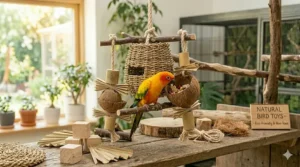
Years of consulting with frustrated bird owners reveal recurring purchasing errors that waste money and sometimes endanger birds. Learning from others’ mistakes speeds your path to effective enrichment.
Mistake 1: Size Mismatches That Create Danger
The number one preventable injury involves birds getting trapped in toys designed for different size species. A cockatiel toy with 1-inch spacing between components becomes a head-trap for a budgie. Conversely, a macaw toy’s heavy wooden blocks can injure smaller birds if dropped.
The fix: Match toy specifications to your specific bird’s head circumference and body weight. Reputable manufacturers like those reviewed here provide species recommendations, but verify by measuring your bird. Any gap your bird could insert their head through should be either smaller than their head diameter or large enough they can withdraw easily.
Mistake 2: Ignoring Your Bird’s Destruction Patterns
Some owners consistently buy delicate natural toys for aggressive chewers, then complain about rapid destruction. Understanding your bird’s interaction style determines appropriate toy choices. Does your bird systematically dismantle toys piece by piece, or attack randomly? Do they prefer grinding at surfaces or ripping off chunks?
Systematic destroyers need sturdy construction like the lovyoCoCo corn cob design that tolerates sustained assault. Random attackers often do better with variety packs like Jevnd’s kit where partial destruction of one component doesn’t ruin the entire toy. Grinding birds require hard wood types (maple, apple), while rippers benefit from softer materials that yield satisfying chunks (balsa, pine).
Mistake 3: Insufficient Rotation Creates Habituation
Even the most engaging natural toy loses appeal when permanently installed. Bird brains are wired to notice novelty and investigation new potential food sources — a survival adaptation from wild environments where food distribution constantly shifts.
The solution isn’t buying dozens of toys immediately. Purchase 4-6 varied natural toys initially, then rotate them weekly. Store unused toys in sealed containers to preserve scents and textures. When reintroducing a toy after 3-4 weeks absence, most birds treat it as novel again, extending its effective lifespan dramatically.
Mistake 4: Overlooking Hygiene and Replacement Timing
Natural materials accumulate bacteria, mold spores, and debris faster than plastic. Toys exposed to food, water, or feces require regular inspection and cleaning. Owners often use natural toys until they’re visibly contaminated, missing the period when bacterial growth accelerated invisibly.
Implement weekly toy inspections checking for: wet spots (mold risk), frayed fibers (ingestion hazard), loose parts (choking risk), and food residue (bacterial growth). Clean wooden toys with hot water and bird-safe disinfectant (diluted white vinegar works well), then thoroughly dry before returning to cage. Replace rope toys when individual strands separate or when length exceeds 8 inches to prevent tangling.
Seasonal Toy Rotation: Aligning Enrichment with Natural Cycles
Wild parrots experience dramatic seasonal variation in food availability, nesting opportunities, and social dynamics. Captive birds retain internal biological rhythms responding to day length, temperature, and humidity despite cage environments. Thoughtful owners can leverage these patterns to optimize enrichment through seasonal toy rotation.
Spring: Breeding Season Considerations (March-June)
Even non-breeding birds experience hormonal fluctuations during spring months as day length increases. This manifests as territoriality, aggression toward toys, and increased chewing intensity. Natural toys during this period should emphasize destruction outlets that channel hormonal energy productively.
Focus on soft, easily destroyed materials like the KATUMO seagrass mat or Jevnd’s shredding components. Birds experiencing breeding hormones feel driven to prepare nesting sites, and shredding materials satisfies this instinct without encouraging actual nesting behaviors (which can be problematic in pet situations). Avoid toys with enclosed spaces like boxes or huts that might trigger nesting motivation.
Summer: Foraging Complexity Peak (July-September)
Summer represents peak food abundance in wild parrot habitats. Birds’ nutritional demands increase with longer active days and molting energy requirements. Enrichment should emphasize foraging challenges that extend feeding time and encourage natural food-seeking behaviors.
The Kyouki and HOSUKU foraging boxes shine during summer months because they can hide fresh foods, encouraging extended interaction periods. Freeze fruits or vegetables into the toy compartments to provide cooling enrichment during hot periods. The increased foraging time also prevents weight gain from birds consuming food too quickly.
Fall: Exploration and Variety (October-November)
Autumn in natural habitats brings seed crop maturation and changing food sources. Birds instinctively increase exploratory behavior seeking new food locations. Captive enrichment during fall benefits from maximum variety and novelty.
This is the ideal period to introduce new natural toys and rotate multiple options frequently. The Jevnd 20-piece kit works particularly well during these months because you can introduce new components every few days, maintaining constant novelty without overwhelming birds. Monitor carefully for toy fear in sensitive individuals.
Winter: Comfort and Familiarity (December-February)
Shorter days and cooler temperatures trigger energy conservation behaviors in many parrot species. During winter months, birds often prefer familiar, comforting enrichment over novel challenges. Toy preferences shift toward cozy textures and reliable favorites.
Reintroduce your bird’s proven favorite toys during winter rather than pushing novel options. Natural rope perches and softer materials like the MQUPIN toy with familiar shapes provide comfort without demanding cognitive energy. This is not the time to introduce complex foraging puzzles to birds already stressed by seasonal rhythms.
FAQ: Your Natural Bird Toy Questions Answered
❓ How often should I replace natural bird toys completely?
❓ Can natural bird toys cause allergies or respiratory problems in birds?
❓ Are dyed natural bird toys actually safe, or should I avoid all coloring?
❓ What's the minimum number of natural toys my bird needs at one time?
❓ Can I mix natural toys with traditional plastic toys in the same cage?
Conclusion: Making the Natural Transition That Benefits Everyone
Switching to natural bird toys represents more than a purchasing decision — it’s a fundamental shift in how you conceptualize your bird’s environmental needs. The evidence supporting this transition spans behavioral observations, veterinary recommendations, and environmental sustainability considerations that extend beyond individual bird welfare.
Every plastic toy eliminated from your bird’s environment reduces toxic exposure while decreasing landfill burden. Natural materials biodegrade within months rather than persisting for centuries in waste systems. This environmental benefit aligns with broader sustainable pet care movements gaining momentum throughout 2026.
From a behavioral perspective, natural toys unlock enrichment dimensions that synthetic materials simply cannot provide. The sensory complexity of real wood, authentic plant fibers, and organic textures engages bird cognition at levels plastic never approaches. Owners consistently report decreased screaming, reduced feather plucking, and improved overall demeanor following natural toy transitions.
The seven products reviewed here represent current market leaders in safety, sustainability, and engagement effectiveness. Whether you’re furnishing a budgie cage or equipping a macaw habitat, at least one option matches your specific needs and budget constraints. Start with a single natural toy introduction using the 48-hour protocol, observe your bird’s response, then expand gradually as confidence builds.
Your bird’s quality of life improves measurably through thoughtful enrichment choices. Natural toys cost slightly more initially but deliver superior engagement duration and replacement value. More importantly, they honor your bird’s biological heritage by providing textures, scents, and challenges that resonate with millions of years of evolutionary programming.
The investment in natural bird toys yields returns measured in behavioral health, physical wellbeing, and the simple joy of watching your parrot engage with materials that speak to their deepest instincts. That’s a value proposition no amount of cheap plastic can match.
Recommended for You
- 7 Best Bird Toys for Parrots That Stop Boredom Fast (2026)
- 7 Best Bonka Bird Toys That Transform Bird Care in 2026
- 7 Best Planet Pleasures Bird Toys Your Parrot Will Love 2026
Disclaimer: This article contains affiliate links. As an Amazon Associate, I earn from qualifying purchases. If you purchase products through these links, we may earn a small commission at no additional cost to you.
✨ Found this helpful? Share it with your friends! 💬🤗
