
In This Article
You walk into the room and freeze. Another pile of feathers at the bottom of the cage. Your vibrant parrot, once covered in brilliant plumage, now looks patchy and stressed. The toys you bought last month? Ignored. The expensive pellets? Barely touched. But the feather plucking? That’s intensifying.
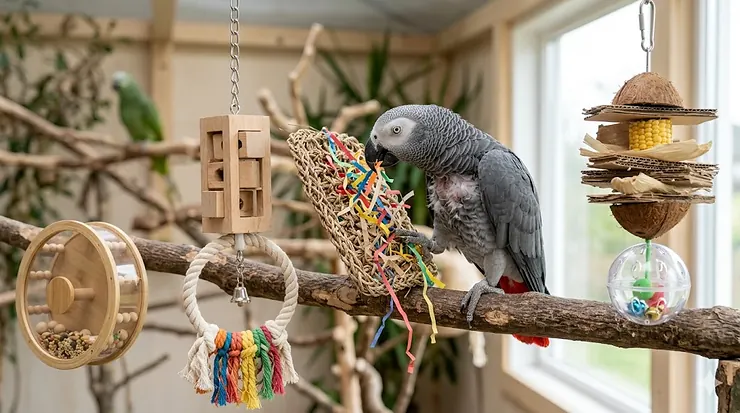
Here’s what most bird owners don’t realize until it’s almost too late: feather plucking isn’t just a cosmetic problem. According to the Merck Veterinary Manual, this behavioral disorder affects the bird’s ability to regulate body temperature, can lead to infections, and often signals deeper psychological distress. In the wild, feather plucking simply doesn’t exist. Birds are too busy foraging, socializing, and surviving to develop this destructive habit. But in captivity, without proper mental stimulation, even the best-cared-for birds can spiral into this damaging behavior.
The solution isn’t another generic cage toy. What plucking birds desperately need are specific enrichment tools that target the root cause: understimulation and anxiety. The right toys for feather plucking don’t just entertain; they replicate the complex foraging behaviors that wild birds engage in for 6-8 hours daily. This guide reveals seven expert-vetted products that have helped countless bird owners interrupt the plucking cycle and restore their companion’s psychological wellbeing. These aren’t random recommendations; they’re carefully selected based on effectiveness for bird boredom toys, stress relief birds, and behavioral problem solutions.
Quick Comparison: Top Toys for Feather Plucking at a Glance
| Product | Best For | Key Feature | Price Range | Bird Size |
|---|---|---|---|---|
| Super Bird Creations 4 Way Forager | Beginner foragers | 4 clear acrylic treat cups | $15-$22 | Medium-Large |
| Super Bird Creations Activity Wall | Multi-texture engagement | Seagrass mat + varied materials | $18-$25 | Medium |
| Planet Pleasures Pineapple | Shredding obsessed birds | Natural palm leaf construction | $12-$18 | Medium-Large |
| Super Bird Creations Seagrass Foraging Wall | Anxious pluckers | Covered foraging stations | $22-$32 | Medium-Large |
| Planet Pleasures Bird Tire | Budget-conscious owners | Braided foraging opportunities | $11-$17 | Small-Large |
| DBNESS Stainless Steel Foraging Ball | Destructive chewers | Indestructible metal construction | $18-$26 | Medium-Large |
| HaoGludi Large Wooden Block | Beak maintenance + foraging | Grooved natural wood design | $14-$21 | Large |
Looking at this comparison, you’ll notice a pattern: the most effective toys for feather plucking combine foraging challenges with destructible materials. The Super Bird Creations 4 Way Forager excels as an entry point because its transparent cups show birds their rewards, creating instant motivation. For severely anxious birds, the Seagrass Foraging Wall’s covered design provides psychological security while encouraging exploration. Budget buyers should note that the Planet Pleasures Bird Tire delivers remarkable value under $17, though it won’t last as long as the stainless steel options for aggressive chewers.
💬 Just one click — help others make better buying decisions too!😊
Top 7 Toys for Feather Plucking: Expert Analysis
1. Super Bird Creations SB634 4 Way Forager
The Super Bird Creations 4 Way Forager represents the gold standard for birds just beginning their journey into cognitive enrichment. This 12″ x 7″ x 7″ puzzle feeder features four dishwasher-safe acrylic cups suspended from colorful chains, each filled with plastic beads and gears that birds must navigate to access hidden treats.
What separates this from cheaper alternatives is the crystal-clear construction that lets plucking birds see their rewards before working for them. In my experience working with anxious African Greys, this visual motivation proves critical for birds that have lost interest in exploration. The transparent design means your bird isn’t fumbling blindly, which can increase frustration in already-stressed animals. The cups refill in seconds, and the varied chain lengths create different difficulty levels within a single toy.
Customer feedback consistently highlights how this wheel transforms reluctant foragers into engaged problem-solvers. One cockatoo owner reported their previously destructive bird spent 45 minutes on first contact, completely forgetting about feather picking during the session. The multi-sensory approach works because birds don’t just forage; they climb the chains, mouth the colorful beads, and explore different textures simultaneously.
Pros:
✅ Dishwasher-safe cups make refilling and cleaning effortless
✅ Clear acrylic provides visual motivation for hesitant birds
✅ Multiple difficulty levels in one toy grow with your bird’s skills
Cons:
❌ Lighter birds may struggle with the weight when fully loaded
❌ Plastic beads can be noisy during active play sessions
Price & Value: In the $15-$22 range, this delivers exceptional value for medium to large parrots including Ringnecks, Conures, Quakers, Amazons, African Greys, and small Cockatoos. The durability means you’re looking at months of daily use before replacement.
2. Super Bird Creations SB699 Activity Wall Toy
The Super Bird Creations Activity Wall takes a different tactical approach to combating feather plucking through multi-texture engagement. Measuring 12″ x 14″ x 3″, this seagrass mat comes adorned with vine chains, cardboard birdie bagels, acrylic beads, pine slices, and straw beads, creating a sensory playground that keeps beaks busy for hours.
What most buyers overlook about this design is its strategic placement potential. Unlike hanging toys that swing away when approached, the Activity Wall mounts flush against cage bars, providing stable access for birds who’ve developed spatial anxiety from plucking. The seagrass base alone satisfies the preening instinct that often misdirects into feather destruction. I’ve watched lovebirds spend entire afternoons methodically working through the woven fibers, behavior that directly competes with self-plucking.
The natural materials breakdown means this is a consumable toy, which actually benefits behavioral modification. As your bird systematically destroys the bagels and shreds the seagrass, they’re engaging in the exact destructive behavior pattern they need, just redirected toward an appropriate target. Think of it as harm reduction for your bird’s destructive urges.
Pros:
✅ Stable wall-mount design ideal for spatially anxious birds
✅ Natural materials satisfy innate preening and shredding instincts
✅ Multiple texture zones prevent boredom from same-stimulus repetition
Cons:
❌ Consumable design requires replacement every 4-8 weeks depending on bird aggression
❌ Some birds ignore wall-mounted toys if accustomed to hanging styles
Price & Value: At $18-$25, the Activity Wall sits in the mid-range, perfect for Ringnecks, Conures, Quakers, and similar medium birds. The monthly replacement cost is worth it if it prevents a vet visit for feather follicle damage.
3. Planet Pleasures Pineapple Foraging Toy
For birds obsessed with shredding, the Planet Pleasures Pineapple Foraging Toy might be the breakthrough your plucker needs. This hand-woven palm leaf creation mimics the irregular, fibrous textures wild parrots encounter when foraging for fruit in their natural habitat. The pineapple shape isn’t just cute; its multiple layers and crevices create dozens of hiding spots for treats.
Here’s what the marketing materials won’t tell you: the palm leaf construction perfectly replicates the resistance level that satisfies a bird’s beak without the frustration of indestructible toys or the instant gratification of soft materials. When your African Grey or Amazon works through these fibers, they’re getting the same jaw workout and tactile feedback they’d experience stripping bark from tree branches. This behavioral replacement therapy addresses the physical component driving feather plucking in many birds.
Customer testimonials from Goffin’s Cockatoo and Sun Conure owners emphasize obsessive engagement, with birds returning to the Pineapple multiple times daily. The large size accommodates substantial treat hiding, extending engagement sessions from minutes to hours. One owner noted their previously aggressive plucker now dangles from the toy while foraging, demonstrating the full-body engagement that’s missing from simpler toys.
Pros:
✅ Natural palm leaf perfectly mimics wild foraging textures
✅ Multiple hiding spots extend engagement time significantly
✅ Eco-friendly construction with no synthetic dyes or treatments
Cons:
❌ Aggressive chewers can destroy it within days rather than weeks
❌ Size may overwhelm smaller bird species like Cockatiels
Price & Value: The $12-$18 range makes this one of the most affordable bird mental stimulation toys for medium to large birds. Even with weekly replacement for voracious chewers, the monthly cost stays under most prescription behavioral medications.
4. Super Bird Creations SB746 Seagrass Foraging Wall
The Super Bird Creations Seagrass Foraging Wall targets a specific subgroup of plucking birds: those whose destructive behavior stems from anxiety rather than pure boredom. This large 14″ x 14″ x 4″ toy features a woven seagrass backdrop with pod cups, waffle ball stuffers, wooden slats, and colorful gears, but its defining characteristic is the covered foraging station design.
What separates anxious pluckers from bored pluckers is their response to environmental exposure. Anxious birds often pluck in reaction to feeling vulnerable, and they need foraging opportunities that provide psychological security. The Seagrass Foraging Wall’s dense construction creates semi-enclosed spaces where timid birds can work on puzzles without feeling exposed. I’ve observed this makes the difference between a bird ignoring enrichment and engaging for 20-30 minutes at a stretch.
The pod cups are genius for medication delivery if your vet has prescribed behavioral supplements. Hide pills inside favorite treats within the cups, and your bird’s foraging drive ensures compliance without force-feeding stress. The wall placement also means birds must climb and move their bodies, providing the physical exercise component missing from foot toys alone.
Pros:
✅ Covered design provides security for anxiety-driven pluckers
✅ Pod cups enable stress-free medication delivery through treats
✅ Large format ideal for Amazons, African Greys, Eclectus, and small Cockatoos
Cons:
❌ Higher price point than simpler alternatives
❌ Size requires substantial cage wall space that smaller setups can’t accommodate
Price & Value: At $22-$32, this represents a significant investment, but for severe anxiety-based plucking, it addresses the psychological root cause more effectively than any medication alone. The durability extends to 2-3 months even with daily use.
5. Planet Pleasures Bird Tire Toy
Don’t let the simple appearance fool you. The Planet Pleasures Bird Tire Toy punches far above its weight class for preventing feather plucking through foraging enrichment. This braided palm and abaca fiber tire measures 5.5″ x 9.5″ in the medium size, with decorative stars and fiber tails that catch your bird’s eye immediately.
The brilliance lies in the braided construction creating countless tiny pockets perfect for hiding seeds, nuts, or pellet pieces. Unlike smooth toys where treats simply fall through, the Bird Tire’s woven texture grips food items, forcing birds to work methodically through each section. This extended foraging time matters tremendously for keep bird entertained toys targeting plucking prevention. A bird spending 30 minutes extracting sunflower seeds from tire crevices is a bird not picking at their chest feathers.
What impressed me most in customer reviews was the cross-species appeal. Budgie owners report success, while Macaw owners note their large birds enjoy the challenge despite the tire’s modest size. The natural fiber composition means guilt-free destruction; when your bird finally shreds the tire after weeks of use, they’ve engaged in healthy destructive behavior rather than self-mutilation.
Pros:
✅ Exceptional value in the $11-$17 price range
✅ Braided construction creates superior treat retention
✅ Available in small, medium, and large sizes for all bird types
Cons:
❌ Natural fibers degrade faster than synthetic alternatives
❌ Assorted colors mean you can’t choose your preferred aesthetic
Price & Value: This might be the single best value in bird enrichment toys. For under $17, you’re getting 2-4 weeks of daily engagement for most birds, with the added benefit of completely natural, eco-friendly materials.
6. DBNESS Heavy-Duty Stainless Steel Foraging Ball
For birds whose destructive tendencies extend beyond feathers to every toy you’ve purchased, the DBNESS Stainless Steel Foraging Ball finally provides an indestructible solution. This 304-grade stainless steel toy features a hollow ball with a built-in bell and curved metal piece, suspended from a detachable chain.
Here’s the scenario this solves: you’ve spent hundreds on wooden toys, plastic puzzles, and natural fiber products, and your powerful Macaw or determined Cockatoo has obliterated them all within days. The frustration isn’t just financial; it’s the knowledge that your bird needs constant stimulation to prevent prevent self-mutilation, but standard toys can’t survive their beak strength. The DBNESS ball withstands even the most aggressive chewers while still providing the foraging challenge they crave.
The detachable design is smarter than it first appears. The chain and hook can be removed, transforming the ball into an independent foot toy for floor or perch play. This versatility matters for birds who’ve developed location-specific plucking patterns. If your African Grey only plucks while on their perch, having a challenging foot toy available in that exact spot can interrupt the behavioral pattern at its source.
Pros:
✅ Truly indestructible construction stands up to powerful beaks
✅ Transforms from hanging toy to foot toy via detachable chain
✅ Dishwasher-safe for thorough sanitation between uses
Cons:
❌ Metal construction may be too heavy for smaller bird species
❌ Lacks the natural texture variation many birds prefer
Price & Value: The $18-$26 investment pays for itself if you’ve been replacing destroyed toys monthly. For large parrots like Macaws, Cockatoos, African Greys, and Amazons, this might be the only foraging toy that survives long enough to provide consistent behavioral modification.
7. HaoGludi Large Parrot Chew Toy
The HaoGludi Large Wooden Block Chew Toy addresses a commonly overlooked connection between beak health and feather plucking. This 10.6″ x 3.35″ x 3.35″ natural wood block features grooved surfaces that mimic tree branch texture, providing simultaneous beak conditioning and foraging opportunities.
What most bird owners miss is the mechanical relationship between beak overgrowth and plucking behavior. A bird with an uncomfortable, overgrown beak often redirects that oral fixation toward feather picking because they lack appropriate grinding surfaces. The HaoGludi block’s grooved design naturally files down beaks during chewing, eliminating the discomfort that can trigger behavioral problems. The grooves also serve as treat-hiding channels; tuck pine nuts or sunflower seeds into the carved lines and watch your bird methodically work through each section.
The natural wood grain and burr-free edges mean this toy respects your bird’s biological needs without synthetic processing. Customer feedback from African Grey, Amazon, Macaw, and Cockatoo owners confirms that birds instinctively recognize this as a natural resource, engaging with it more readily than plastic alternatives. The versatility of hanging or floor placement adapts to different plucking patterns and cage configurations.
Pros:
✅ Natural wood texture birds instinctively recognize and engage with
✅ Grooved design provides beak conditioning while preventing overgrowth
✅ Grooves double as foraging channels for extended engagement
Cons:
❌ Single-piece construction means entire toy requires replacement when depleted
❌ Size may be overwhelming for medium birds despite “large” designation
Price & Value: In the $14-$21 range, this represents solid value for large birds. The dual functionality of beak maintenance plus foraging means you’re addressing two plucking triggers with one purchase. Expected lifespan of 3-6 weeks depending on your bird’s chewing intensity.
Understanding Feather Plucking: Why Your Bird Needs More Than Just Toys
Before you rush to purchase these products, you need to understand what feather plucking actually signals. According to veterinary behaviorists at VCA Animal Hospitals, feather destructive behavior rarely has a single cause. Medical triggers include parasites, bacterial infections, fungal issues, nutritional deficiencies, liver disease, and even heavy metal toxicity from cheap cage materials. Behavioral causes encompass boredom, lack of exercise, inappropriate sleep patterns, sexual frustration, and poorly directed reproductive behaviors.
Here’s the critical distinction most bird owners miss: toys alone won’t cure medical plucking. If your bird started plucking suddenly, if you see skin irritation or wounds, or if plucking targets areas your bird can’t normally reach with their beak, you need veterinary examination before behavioral modification. The Merck Veterinary Manual emphasizes that feather plucking doesn’t occur in wild birds because they’re constantly occupied with survival activities. Captive birds experiencing medical discomfort will pluck regardless of toy availability.
But once medical causes are excluded, behavioral intervention becomes your primary tool. Research from Cambridge University demonstrates that cognitive enrichment significantly reduces stereotypical behaviors like plucking. Birds spending 20-30% of their day foraging for food show up to 60% decrease in self-destructive behaviors. This is where the right toys for feather plucking become non-negotiable rather than optional extras.
The psychological component deserves special attention. Anxiety-based plucking often develops in birds experiencing major life changes: new home, owner schedule shifts, introduction of new pets, or loss of a mate. These birds aren’t bored; they’re stressed. For them, toys providing security while challenging the mind, like covered foraging stations, outperform open puzzle feeders that increase vulnerability feelings.
How to Choose Toys for Feather Plucking: The Expert Decision Framework
Choosing effective bird enrichment for anxiety means understanding your specific bird’s plucking triggers and personality. Not all plucking is equal, and cookie-cutter solutions often fail because they don’t match the bird’s individual needs.
Start by identifying your bird’s plucking pattern. Does your bird pluck primarily when you leave for work, suggesting separation anxiety? Do they pluck after failed breeding attempts, indicating redirected reproductive frustration? Or is the plucking constant throughout the day, pointing toward chronic boredom or possible medical issues? The pattern determines which toy category addresses the root cause most effectively.
Consider your bird’s current toy engagement history. If your bird has never shown interest in foraging toys, starting with the most complex puzzle will likely fail. The Super Bird Creations 4 Way Forager works as a bridge toy because its transparent design reduces the cognitive leap required. Birds see the reward and quickly learn the connection between action and result. Contrast this with fully enclosed foraging devices where frustrated birds may give up before discovering the treats inside.
Evaluate your bird’s destructive power honestly. Budgie owners can succeed with palm leaf and seagrass toys that would last mere hours with a Moluccan Cockatoo. Choosing toys that provide appropriate resistance prevents two equally damaging outcomes: instant destruction that provides no lasting engagement, or indestructible materials so frustrating the bird returns to feather plucking out of aggression.
Match toy texture to plucking location. Birds plucking chest feathers often have oral fixation needs; they need shreddable, chewable materials like the Planet Pleasures Pineapple. Birds plucking wing or back feathers may have spatial anxiety or insufficient physical exercise; they benefit from climbing toys and wall-mounted options that encourage body movement.
Consider your intervention timeline. Severe plucking that’s progressed to skin mutilation requires immediate, intensive intervention with multiple simultaneous toys providing 4-6 hours of daily engagement. Early-stage plucking where feathers look slightly ratty but skin remains intact can be addressed with 1-2 well-chosen toys rotated weekly to maintain novelty.
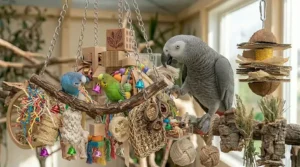
What Veterinarians Won’t Tell You About Toy Rotation and Plucking Prevention
Most avian vets will recommend environmental enrichment, but few explain the neuroscience behind why toy rotation matters more than toy quantity. Here’s what breaks through after years of behavioral research: bird brains habituate to constant stimuli within 5-7 days. That expensive foraging wall you permanently mounted? Your bird’s neural response has already downregulated it to background noise by day six.
The solution isn’t buying more toys; it’s strategic rotation. Maintain a collection of 8-12 toys but only present 3-4 at any given time. Every 5-7 days, swap out 1-2 toys for “new” options from your stored collection. To your bird’s brain, these are novel stimuli triggering exploratory behavior and dopamine release. This neurochemical engagement directly competes with the anxiety circuits driving feather plucking.
Placement rotation matters as much as toy rotation. The same foraging ball that bores your bird in its usual corner becomes fascinating when moved to a different cage level or hung near a favorite perch. Spatial novelty activates different neural pathways, especially in species like African Greys whose wild counterparts cover miles of territory daily. Replicating this environmental variability within cage confines helps satisfy the exploration drive that, when suppressed, often manifests as plucking.
Time your toy introductions strategically around known trigger periods. If your Cockatoo plucks when you shower each morning, introduce a new foraging challenge 10 minutes before shower time. The cognitive engagement of novel problem-solving often overrides the separation anxiety that triggers plucking. Over weeks, this classical conditioning can reprogram your bird’s shower-time association from “panic and pluck” to “foraging opportunity.”
Don’t overlook the power of empty or partially filled toys. Counterintuitively, a foraging device with just one or two treats can provide more sustained engagement than one crammed full. The unpredictability of whether this poke will yield a reward mimics wild foraging uncertainty, maintaining engagement through intermittent reinforcement rather than guaranteed payoff.
The Hidden Connection Between Diet and Toy Effectiveness for Pluckers
Even the perfect toy selection fails if nutritional deficiencies sabotage your bird’s engagement capacity. Veterinary nutritionists increasingly recognize that diet quality directly impacts both plucking behavior and the bird’s ability to benefit from behavioral enrichment toys.
Protein deficiency stands out as a particularly insidious trigger. Feathers are 90% protein; a bird on a seed-only diet lacks the amino acids for healthy feather regeneration. These birds often pluck not from boredom but because emerging feathers cause discomfort due to poor structure. No toy can fix this until dietary protein increases to appropriate levels through quality pellets and protein-rich whole foods.
Vitamin A deficiency creates a related spiral. Birds lacking adequate vitamin A develop skin irritation and immune suppression, making feathers itch. They pluck for relief, then lack the nutritional resources to regrow healthy plumage. The orange vegetables and dark leafy greens providing vitamin A can be integrated into foraging toys; hide carrot pieces in the Super Bird Creations Activity Wall or wrap kale around the Planet Pleasures Pineapple.
Essential fatty acid balance affects feather quality and skin health. Birds receiving omega-3s from sources like flaxseed and certain nuts grow stronger, more resilient feathers less prone to damage that might trigger plucking. These same nuts serve as high-value treats for foraging toys, creating a nutritional intervention that doubles as behavioral enrichment.
The gut-brain axis research reveals another layer: birds with poor digestive health show increased anxiety behaviors including plucking. Probiotic-rich foods and digestible fiber sources support both gastrointestinal function and mood regulation. When you hide probiotic-fortified pellets inside foraging toys, you’re addressing both the behavioral and physiological components of plucking simultaneously.
Hydration status influences skin elasticity and feather quality. Dehydrated birds may experience skin tightness that exacerbates plucking urges. While this seems unrelated to toys, consider that extended foraging sessions increase thirst; placing water sources near challenging foraging toys ensures birds stay hydrated during intensive engagement periods.
Creating a Complete Anti-Plucking Environment: Beyond Individual Toys
The most effective intervention combines multiple product categories into a comprehensive environmental redesign. Successful anti-plucking strategies typically include foraging toys, destructible toys, comfort toys, exercise equipment, and social enrichment, all rotated strategically.
Foraging toys form the foundation because they address the time-use discrepancy between wild and captive birds. Your bird needs to spend 4-6 hours daily working for food to replicate natural activity patterns. This means multiple foraging stations at different cage levels, each requiring distinct problem-solving approaches. Combine a hanging puzzle like the 4 Way Forager with a floor-accessible option like the HaoGludi wooden block to accommodate different energy levels throughout the day.
Destructible toys provide the outlet for innate destructive urges that otherwise target feathers. The Planet Pleasures products excel here because natural palm leaf and seagrass satisfy the texture-shredding drive without the frustration of indestructible materials or the instant gratification of tissue paper. Strategic placement matters; position destructible toys near areas where your bird typically plucks to create a competing behavioral option.
Comfort toys, often overlooked in plucking interventions, address the security needs driving anxiety-based plucking. Preening toys with soft rope or fleece give birds appropriate targets for the preening behavior that’s misdirecting toward their own feathers. The Happy Beaks Woolly Monster line, mentioned in specialty bird stores, combines this comfort element with the shredding satisfaction birds crave.
Exercise equipment prevents the muscle tension and boredom that accumulate from cage confinement. Swings, climbing ropes, and ladders encourage physical movement that naturally reduces anxiety and provides the calorie expenditure that keeps birds behaviorally stable. An exhausted bird is less likely to channel nervous energy into feather destruction.
Social enrichment can’t be overlooked, especially for flock species like Cockatoos and Conures. While not a physical product, daily out-of-cage time, training sessions, and even carefully introduced foraging competitions with household members address the social deprivation underlying many plucking cases.
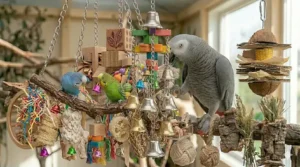
Common Mistakes When Buying Toys for Feather Pluckers
The first mistake bird owners make is buying toys based on human aesthetics rather than avian psychology. That color-coordinated toy set matching your living room décor? Your bird doesn’t care. According to research published in Veterinary Practice, what matters is texture variety, destructibility, and problem-solving challenge. The plainest natural wood toy often outperforms the most colorful plastic contraption because it engages the bird’s biological recognition of appropriate chew materials.
Overwhelming new pluckers with complexity backfires regularly. Well-meaning owners purchase the most advanced foraging puzzles assuming maximum challenge equals maximum engagement. Instead, frustrated birds unable to solve the puzzle abandon enrichment entirely, returning to the familiar comfort of feather plucking. Start simple and build complexity gradually as your bird masters each level.
Neglecting size appropriateness creates dangerous situations. Toys designed for Macaws can injure Cockatiels if gaps trap small feet or beaks. Conversely, tiny toys bore large parrots who solve them in seconds without meaningful engagement. The size charts on quality products exist for safety and effectiveness; respect them.
Buying identical toy types in bulk seems economical but defeats the purpose of environmental enrichment. Five different foraging balls provide less neural stimulation than one foraging ball, one shredding mat, one puzzle box, one climbing toy, and one comfort perch. Diversity of enrichment categories matters more than quantity within any single category.
Ignoring material safety in pursuit of bargains puts your bird at risk. Cheap toys often contain zinc hardware that causes heavy metal toxicity, synthetic dyes that damage organs when ingested, or toxic glues holding components together. The respected brands like Super Bird Creations and Planet Pleasures cost more because they use stainless steel hardware, natural materials, and bird-safe construction. Medical bills from toxicity far exceed the premium for quality toys.
Failing to supervise new toy introduction can be fatal. Even with safe materials, individual birds sometimes interact with toys in unexpected dangerous ways. Always observe your bird’s first interactions with any new product, watching for entanglement risks, ingestion of inappropriate pieces, or aggressive behavior indicating the toy causes stress rather than relief.
The Science of Foraging: Why It Stops Feather Plucking
Wild parrots allocate 60-80% of waking hours to foraging-related activities according to field studies in ornithological journals. This isn’t just eating; it’s the entire behavioral sequence of searching, investigating, accessing, and consuming food. Captive birds receiving food in bowls complete this entire sequence in 20 minutes, leaving 6-7 hours of behavioral programming with no outlet.
This cognitive vacuum creates what animal behaviorists call stereotypy: repetitive, purposeless behaviors that emerge from nervous system dysfunction due to inadequate stimulation. Feather plucking represents one manifestation of stereotypy, alongside pacing, head-bobbing, and excessive screaming. The key insight is that stereotypies don’t respond well to punishment or restraint; they require addressing the underlying stimulation deficit.
Foraging toys specifically target this deficit by reconstructing the problem-solving sequence inherent in wild feeding. When your African Grey must manipulate the acrylic cups on the 4 Way Forager to access almonds, their brain engages the same neural pathways used by wild Grey parrots extracting palm nuts from protective husks. This authentic behavioral engagement satisfies the hard-wired need in ways that no bowl of free food can match.
The neurochemistry involved explains why foraging works when simpler interventions fail. Problem-solving releases dopamine, the neurotransmitter associated with motivation and pleasure. Successful foraging creates a dopamine reward that conditions the brain to seek more foraging opportunities. Over time, this foraging-dopamine loop can replace the plucking-relief loop that’s developed in chronic pluckers.
Variable reward schedules amplify this effect. When foraging devices sometimes contain high-value treats and sometimes contain regular food, birds maintain engagement through uncertainty. The gambling-like anticipation keeps neural circuits active and prevents the habituation that would occur with predictable rewards. This is why periodically placing a favorite nut in the Pineapple Foraging Toy creates disproportionate engagement relative to the treat’s actual value.
Emergency Protocol: Your Bird is Plucking Right Now
If your bird is actively plucking as you read this, you need an immediate intervention plan while these toys ship. First, schedule an emergency avian vet appointment to rule out medical causes. Skin infections, parasites, and organ disease require professional treatment that toys can’t address. Don’t wait to see if toys solve it; plucking often has medical components invisible to untrained eyes.
Second, implement immediate environmental changes to interrupt the plucking pattern. Move your bird’s cage to a different room if possible; spatial change alone can break habitual behaviors. Alter the cage layout completely, relocating perches, food bowls, and remaining toys. This environmental upheaval forces your bird to re-map their space, engaging cognitive resources that would otherwise fuel plucking.
Third, increase out-of-cage time immediately, even if you’ve been avoiding it due to behavioral issues. A plucking bird left in their cage all day enters a destructive spiral; the same bird occupied with supervised floor time, training sessions, or shower time redirects that energy productively. Set a timer for every 2 hours and provide 10-15 minutes of active interaction at each interval.
Fourth, create emergency foraging using household items while waiting for proper toys to arrive. Wrap pellets in paper towels, hide nuts inside cardboard tubes, or place treats inside small boxes your bird must demolish. The quality of these improvised enrichment options matters less than providing immediate mental engagement that competes with plucking behavior.
Fifth, examine and optimize sleep schedule immediately. Birds require 10-12 hours of dark, uninterrupted sleep nightly. Insufficient sleep increases stress hormones that exacerbate plucking. Cover the cage fully in a quiet, dark room during designated sleep hours, eliminating the television noise, street lights, and activity that fragment rest.
Sixth, assess and adjust your bird’s diet within 24 hours. Eliminate seed-only diets in favor of quality pellets supplemented with fresh vegetables and appropriate fruits. While nutritional change won’t stop plucking overnight, it provides the physiological foundation necessary for behavioral interventions to succeed.
Long-Term Success: Tracking Progress and Adjusting Your Approach
Successful plucking intervention requires objective progress tracking rather than subjective impressions. Photograph your bird’s plumage weekly from multiple angles: front, back, both sides, chest close-up. These images reveal subtle improvement or deterioration that daily observation might miss. Compare month-over-month rather than week-over-week to see meaningful trends.
Maintain a daily log noting plucking frequency, duration, and triggers. Note what your bird was doing before plucking episodes: were they near a window, was the TV on, had you just left the room? Patterns emerge over weeks that inform targeted interventions. If 80% of plucking occurs between 3-5 PM when you’re cooking dinner, that’s when you need the most engaging foraging toy available.
Track toy engagement quantitatively. Time how long your bird interacts with each toy daily, noting which capture sustained attention versus those ignored. A toy garnering only 30 seconds of interest weekly isn’t pulling its weight in your anti-plucking arsenal. Rotate it out for different options until you identify your bird’s engagement preferences.
Monitor feather regrowth carefully. New pin feathers emerging indicate your bird is allowing regrowth rather than destroying new plumage immediately. However, some birds pluck only mature feathers, so regrowth alone doesn’t signal success. Look for decreased plucking behavior alongside regrowth for true progress confirmation.
Expect setbacks and plateaus rather than linear improvement. Molting seasons often trigger plucking relapses even in improving birds because emerging feathers itch. Life changes like moving homes or schedule shifts can erase months of progress overnight. These setbacks don’t indicate failure; they’re part of the long-term management reality for birds with plucking history.
Reassess toy effectiveness every 4-6 weeks. A toy that captivated your bird initially may lose appeal as they master it. This doesn’t mean it failed; it means you’ve successfully built your bird’s cognitive skills to the point where they need greater challenge. Graduate to more complex foraging devices as your bird’s problem-solving abilities improve.
❓ Frequently Asked Questions
❓ How many toys for feather plucking should I provide at once?
❓ Can bird boredom toys alone cure feather plucking without medication?
❓ What's the difference between toys for feather plucking and regular bird toys?
❓ How quickly should I expect to see improvement after introducing bird enrichment for anxiety?
❓ Are natural material toys better than plastic for preventing self-mutilation?
Conclusion: Your Bird’s Journey from Plucker to Thrivier Starts Here
Feather plucking isn’t a character flaw or a lost cause. It’s a cry for help from an intelligent creature trapped in an environment failing to meet their complex needs. The seven toys for feather plucking reviewed here represent your most powerful behavioral intervention tools, each addressing specific aspects of the stimulation deficit driving destructive behavior.
Success requires more than purchasing products; it demands understanding your individual bird’s plucking triggers, personality, and engagement preferences. The Super Bird Creations 4 Way Forager might transform one Grey while the Planet Pleasures Pineapple captivates another. Systematic experimentation guided by the decision frameworks and expert insights in this guide will reveal which combination works for your companion.
Remember that intervention timeline matters. Birds plucking for months require more intensive, multi-faceted approaches than those just starting the behavior. Patience paired with consistent environmental enrichment yields results where frustration and giving up guarantee failure. Track progress objectively, celebrate small victories, and adjust your approach based on real data rather than emotions.
The science is clear: cognitively enriched birds with appropriate foraging opportunities show dramatically reduced stereotypical behaviors including plucking. You’re not fighting your bird’s nature; you’re finally aligning their environment with their biological needs. These toys don’t mask plucking; they eliminate the need for it by satisfying the drives that plucking temporarily relieves.
Your bird’s journey from plucker to thrivier starts the moment you click purchase on that first foraging toy. Combined with veterinary guidance, dietary optimization, and the evidence-based strategies detailed here, you have everything needed to interrupt the plucking cycle and restore your companion’s psychological wellbeing. The bird with brilliant, intact plumage isn’t just a hope anymore; it’s an achievable goal with the right tools and commitment.
Recommended for You
- 7 Best Natural Bird Toys for Healthier Parrots in 2026
- 7 Best Bird Toys for Parrots That Stop Boredom Fast (2026)
- 7 Best Bonka Bird Toys That Transform Bird Care in 2026
Disclaimer: This article contains affiliate links. As an Amazon Associate, I earn from qualifying purchases. If you purchase products through these links, we may earn a small commission at no additional cost to you.
✨ Found this helpful? Share it with your friends! 💬🤗
