
In This Article
It’s 9 p.m. Your cockatiel is fluffed into a feather-ball at the bottom of the cage, eyes half shut, feet cold as pebbles. The avian vet’s office closed hours ago. What happens in the next sixty minutes matters more than almost anything else you’ll do this week.
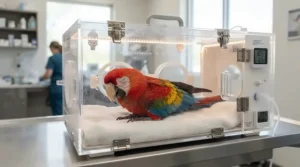
A small animal incubator for bird emergencies is a thermostatically controlled, enclosed chamber that holds a sick, injured, or orphaned bird at a steady, elevated temperature so it stops burning precious energy trying to stay warm. Veterinary-grade versions add fan-circulated air, alarms, and easy-to-disinfect walls. Cheaper stand-ins use ceramic heat emitters or heating pads, but they lack that precision.
Here’s the physiological logic. A bird’s normal body temperature runs high, in the neighborhood of 105°F, and a sick bird often can’t hold that line. Shelter guidance from the National Bird Day-affiliated avian welfare community puts it plainly: a sick or injured bird needs supplemental heat, fluids, nutrition, and quiet. Warmth is step one because every degree you supply is energy the bird doesn’t have to spend.
This guide compares seven real products, from lab-grade intensive care units to a budget ceramic heat emitter, and then walks through the stuff the product pages skip: temperature targets, brooder box setup, the mistakes that quietly hurt birds, and a decision framework for your exact situation. One honest caveat first. Nothing here replaces an avian vet. Heat stabilizes a bird; it doesn’t diagnose or cure one.
Quick Comparison: Small Animal Incubator for Bird Emergencies at a Glance
Before the deep dives, here’s the whole field on one screen. Price ranges reflect what I found at the time of research and will drift, so check current price before buying.
| Product | Type | Approx. Size | Price Tier | Best For |
|---|---|---|---|---|
| Brinsea TLC-30 Eco | ICU / brooder | ~9.5″ × 9.5″ floor | Mid-$300s | Small birds on a tighter budget |
| Brinsea TLC-30 Advance | ICU / brooder with alarms | ~9.5″ × 9.5″ floor | $400–$450 range | Rescuers who need alarm backup |
| Brinsea TLC-40 Advance Series II | Larger ICU | ~40 L volume | Premium (check current price) | Parrot chicks and mid-size patients |
| Brinsea TLC-50 Advance Series II | Largest ICU | ~100 L volume | Premium (check current price) | Larger birds, multi-patient rescue |
| Vetario S30 | Portable ICU | ~24 cm square floor | Check current price | Transport and field rescue (12V) |
| Zoo Med Ceramic Heat Emitter | Lightless heat source | Wattage-dependent | Budget (check current price) | Cage-side warmth with a thermostat |
| Brinsea EcoGlow Safety 600 | Contact-heat brooder plate | ~12″ × 8″ heating area | Around $90–$100 range | Hatchlings and nestlings only |
Look at the pattern in that table. The three-way tradeoff is control versus cost versus flexibility. The Brinsea TLC-30 Advance and its bigger siblings buy you tight, alarmed temperature control. The Zoo Med Ceramic Heat Emitter buys you raw heat for pocket change, but you supply the thermostat and the guard. And the Brinsea EcoGlow Safety 600 sits in its own lane entirely, because it was engineered for chicks rather than sick adults.
💬 Just one click — help others make better buying decisions too!😊
Top 7 Small Animal Incubators and Brooders for Bird Emergencies: Expert Analysis
A note on method. I’m drawing on manufacturer specifications, veterinary guidance, and the review sentiment that was publicly visible when I researched. I haven’t owned or bench-tested any of these, so nothing below claims hands-on experience. Where independent review data was thin, I say so rather than paper over it.
1. Brinsea TLC-30 Eco — cheapest way into proper intensive care
The standout here is simplicity: a dial, a glass thermometer, and a double-walled cabinet. That’s it. There’s no digital readout to confuse you at midnight.
The spec sheet lists an interior of roughly 9½” × 9½” × 6½”, 12-volt operation from the included adaptor, quiet low-speed fans, and a smooth interior meant for easy cleaning. In practice, 12V means lower shock risk around a damp, stressed animal, and the fan means warm air moves around instead of pooling at the ceiling. That’s the difference between a thermometer reading and a bird actually experiencing that temperature at perch level.
Who’s it for? Someone housing a budgie, finch, cockatiel, or a small songbird patient who wants real incubator behavior without paying for alarms. The tradeoff is blunt: no temperature alarm, no power-failure alarm. If the cabinet drifts, you find out by looking.
On reviews, I couldn’t find a deep, independent review pool for this specific unit. A third-party marketplace listing showed a 4.7 average across a few dozen ratings at the time of research, which is encouraging but thin, and sellers vary.
Pros:
- ✅ Dial control is fast to set under stress
- ✅ 12V adaptor and quiet fan design
- ✅ Easy-to-clean interior and removable door
Cons:
- ❌ No temperature or power-failure alarms
- ❌ Glass thermometer only, no digital readout
Price: mid-$300s range. Value verdict: the best entry point if you’ll supervise closely.
2. Brinsea TLC-30 Advance — alarms for when you can’t watch constantly
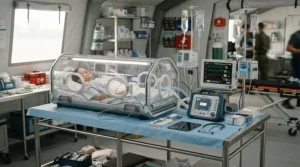
Same compact cabinet as the Eco, different brain. The Brinsea TLC-30 Advance adds the safety net that matters most in an emergency: alarms.
Here’s what that means beyond the marketing. If the temperature drifts past a threshold, or the power drops, the unit tells you. A sick bird in a 90°F box at 3 a.m. is only as safe as your ability to notice a problem, and an alarm is cheaper than guilt. The listing also describes the unit as built for hand-raising chicks and for sick, injured, or orphaned birds and small mammals, with a three-year manufacturer warranty.
Based on the spec comparison, this is the model I’d point most home rescuers toward. It shares the Eco’s footprint, so you’re paying for monitoring, not size. If you foster multiple small patients through a season, the alarms alone justify the gap.
The honest limitation: it’s still a small box. Anything larger than a budgie-to-cockatiel class bird will feel cramped, and cramped birds thrash.
Review picture: the manufacturer’s own page showed no posted ratings when I looked, so there’s no verified review sentiment to report. That’s a gap, not a verdict.
Pros:
- ✅ Digital control with alarm backup
- ✅ Three-year warranty with registration
- ✅ Antimicrobial cabinet protection (Biomaster)
Cons:
- ❌ Small interior limits larger parrots
- ❌ Costs noticeably more than the Eco
Price: roughly the $400–$450 range. Value verdict: worth it if emergencies happen on your watch at odd hours.
3. Brinsea TLC-40 Advance Series II — room for parrot chicks and mid-size patients
Step up in volume and the whole experience changes. At about 40 litres, the Brinsea TLC-40 Advance Series II is described by its maker as suitable for small mammals and birds, including parrot chicks.
What do the extras mean? Digital control and read-out of temperature and humidity, temperature and power-failure alarms, and compatibility with an optional humidity pump. Humidity matters more than most owners expect. A bird with respiratory trouble can benefit from moisture in the air, and a cabinet that reads humidity lets you manage it instead of guessing.
Who should care? Anyone with a larger-bodied patient: an African grey, a conure, an Amazon, or a clutch of hand-reared chicks. Space lets the bird shift position, which reduces pressure on the keel and calms the animal.
The tradeoff is cost and bulk. This is furniture, not a first-aid kit. I’d skip it if your birds are all budgie-sized.
Independent review data wasn’t easy to verify for this exact model, so I won’t invent any. Brinsea’s broader TLC line is used by rescue centers, rehabilitators, and breeders according to the manufacturer.
Pros:
- ✅ Humidity read-out with optional pump compatibility
- ✅ Alarms for temperature and power failure
- ✅ Spacious enough for parrot chicks
Cons:
- ❌ Premium price tier
- ❌ Too bulky for casual storage
Price: premium; check current price. Value verdict: justified for larger birds or serial rescuers.
4. Brinsea TLC-50 Advance Series II — the near-hospital option
At roughly 100 litres, the Brinsea TLC-50 Advance Series II is the biggest unit here, with digital temperature and humidity control and alarms. The maker says it can hold a small dog, or a cat with a litter of kittens.
For bird rescue, that volume is almost absurd, and that’s the point. It suits the person who runs a small wildlife or exotic rescue and might have several patients at once, or a large macaw-class recovery that needs room to turn.
The analysis comes down to honesty about scale. If you foster a few birds a year, this is overkill and the money is better spent on the Advance 30 plus a vet visit. If you run a clinic-adjacent operation, its multi-use flexibility (birds, mammals, neonates) lets one capital purchase cover many emergencies.
One practical consideration the spec sheet won’t highlight: bigger air volume takes longer to warm and recover after the door opens. Pre-warm it before you need it.
Verified reviews were thin, so I’ll leave sentiment out rather than guess.
Pros:
- ✅ Room for larger birds or several patients
- ✅ Digital temperature and humidity control
- ✅ Alarms plus antimicrobial cabinet protection
Cons:
- ❌ Highest price in this lineup
- ❌ Slower to re-warm after opening
Price: premium; check current price. Value verdict: only for high-volume or large-bird rescuers.
5. Vetario S30 — portable and car-powered for rescue runs
The Vetario S30 is Brinsea’s portable, stackable intensive care unit, and its party trick is power. It runs at 12 volts and can draw from the mains adaptor or a car cigarette-lighter adaptor sold separately.
Think about what that means in a real scenario. You find a grounded, chilled bird at a roadside or a parking lot. With the S30 on the passenger seat, warmth starts on the drive to the vet. The listing describes a carrying handle, an internal floor of around 24 cm square, and a small low-speed fan for temperature stability.
That’s a genuinely different job than a cabinet living in your spare room. It’s the pick for wildlife rescuers, transport volunteers, or anyone whose emergencies happen away from home.
The compromise is footprint, since the floor area is small, so think songbirds, budgies, and chicks rather than parrots. Check the control details of your specific variant too, because the S30 family sits beside alarmed siblings.
Review data on the S30 itself wasn’t verifiable in my research, so none is quoted.
Pros:
- ✅ Carrying handle and stackable design
- ✅ 12V operation with car-adaptor option
- ✅ Quiet, low-speed fan
Cons:
- ❌ Compact interior for larger birds
- ❌ Car adaptor sold separately
Price: check current price. Value verdict: strong for mobile rescue work.
6. Zoo Med Ceramic Heat Emitter — lightless cage-side warmth on a budget
Let’s talk about the cheap contender. The Zoo Med Ceramic Heat Emitter is a porcelain heater that screws into a ceramic socket and gives off infrared heat with no visible light. That matters for birds, because glowing lamps scramble sleep, and sick birds need rest. Some avian sources suggest up to 16 hours of it.
Zoo Med sells the line as ReptiCare emitters in several wattages, with the manufacturer noting it lasts up to five years and that a thermostat or rheostat can be used. The product is UL/cUL classified when paired with Zoo Med’s Wire Cage Clamp Lamp. Important honesty note: it’s marketed to reptile keepers, not bird owners.
So what’s the avian verdict? It can work as cage-side supplemental heat, but you are the engineer. Retail guidance for bird use stresses a dome fitting, a ceramic socket (plastic melts), a protective guard, and distance from the bird, since the surface gets extremely hot. Pair it with a thermostat or you’re gambling.
Review data: I couldn’t verify bird-specific reviews, so treat this as a reptile-heritage product adapted by owners.
Pros:
- ✅ No light to disturb the bird’s sleep
- ✅ Very low cost compared with an ICU unit
- ✅ Thermostat-compatible for tighter control
Cons:
- ❌ Surface gets dangerously hot, requires guard
- ❌ No built-in control or alarm
Price: budget tier; check current price. Value verdict: great value only if you add a thermostat and a safe fixture.
7. Brinsea EcoGlow Safety 600 — gentle contact heat, but for hatchlings
The Brinsea EcoGlow Safety 600 is a chick brooder: a 12-volt heated plate that chicks stand under, with roughly a 12″ × 8″ heating area and a quoted draw of around 12 watts.
Here’s why it’s on the list anyway. It represents a different philosophy from lamps. The brooder warms by contact and radiant heat, so a nestling can move in and out instead of being flooded with heat. Retailer reviewers praise the fire-safety angle and describe the chicks as comfortable using it.
But I want to be straight. It’s designed for poultry, game birds, and waterfowl hatchlings, and one retailer notes it isn’t ideal in temperatures below the low 60s. There’s also no way to read a precise temperature, since it’s radiant. Reviewers mention droppings on top and chicks struggling to find the plate in the dark.
For a sick adult parrot, it’s the wrong tool. For an orphaned, down-covered hatchling, it’s a sensible, low-risk supplement beside a proper incubator.
Pros:
- ✅ 12V and low wattage for safety
- ✅ Contact warmth mimics a brooding hen
- ✅ Height adjusts as chicks grow
Cons:
- ❌ No temperature readout or alarm
- ❌ Designed for chicks, not sick adults
Price: around the $90–$100 range. Value verdict: good for hatchlings, wrong for adult patients.
What Temperature Does a Bird Need? Incubator Temperature Range Explained
The incubator temperature range question has no single answer, which frustrates everyone. The sources disagree because birds, species, and conditions differ.
Here’s what the veterinary literature I found says. One shelter-care guide recommends at least 85°F, with a maintained range of 85–90°F. An emergency-medicine reference lists an ambient temperature of 85–92°F and warns the box is too warm if the bird pants, breathes with an open mouth, or holds its wings away from its body. An avian first-aid page recommends 80–85°F. And a veterinary proceedings paper says pediatric or veterinary incubators should be set at approximately 90–95°F.
Convert and compare: a WSAVA congress paper gives an ambient range of 28–33°C for most sick adult birds, which is roughly 82–91°F. Normal bird body temperature is quoted at 40–44°C.
What do I make of the spread? Start in the middle, around 85–90°F, and let the bird’s behavior steer you. Panting means too hot. Fluffed, shivering, and lethargic means probably too cool. Most important, call an avian vet for the exact target for your species and condition.
Critical-Care Warmth Needs: What Sick Birds Actually Require
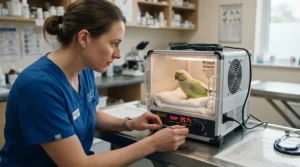
Warmth gets all the attention, but critical-care warmth needs come bundled with other basics. Think of it as a four-legged stool: heat, quiet, hydration, and nutrition. Remove any leg and the stool tips.
Why does heat dominate? Illness cuts metabolic output, so a sick bird produces less internal heat even in a comfortable room. The WSAVA proceedings note that birds fluff their feathers to conserve heat, and that sick birds often look fluffed because they can’t maintain body temperature. Wet birds and very small birds lose heat even faster because of their surface-area-to-volume ratio.
Quiet is the underrated one. An avian first-aid resource says sick birds may need up to 16 hours of restful sleep. That’s why lightless heat and a covered box beat a blazing lamp.
And fluids? Veterinary sources warn that any sick bird is likely at least somewhat dehydrated. Fluids should be warmed to body temperature, and that’s a job for your vet, not a syringe improvised from the kitchen drawer.
Bird Brooder Box for Critical Care: Commercial Unit vs DIY
A bird brooder box for critical care doesn’t have to be a four-figure device, but it has to do four things well: hold temperature, prevent drafts, stay clean, and keep the bird calm.
A commercial ICU does all four with fans, sensors, and washable walls. A DIY box usually fails on temperature stability, which is the whole point. A cardboard carton under a lamp can swing wildly, and cardboard doesn’t disinfect.
The middle path many owners use is a vented plastic carrier or hospital cage with a controlled heat source and a thermometer at perch height. An avian clinic care sheet describes a hospital cage approach: remove perches, place food and water on the floor, set a heating pad on its lowest setting under part of the cage, and drape a towel to retain heat. It also warns to watch for panting and wing-holding.
My honest read: a commercial unit is worth it if you’ll face emergencies repeatedly. For a one-time scare, a monitored carrier setup plus a fast vet call is reasonable.
Brooder Box Setup: A Step-by-Step Transformation Guide
A smart brooder box setup turns a stressful scramble into a calm routine. Amazon listings never tell you this part, which is exactly why it’s useful.
Before the Emergency (Do This Today)
Pick your location: quiet, away from other pets, with a stable power outlet. Pre-test your unit so you know how long it needs to warm. Put a spare thermometer in the box, because no controller should be trusted blindly.
During the First Hour
- Pre-warm the box to roughly 85–90°F before the bird goes in.
- Line the floor with a soft towel or paper towels and pad it so a weak bird doesn’t injure its keel.
- Place food and water low, since weak birds can’t climb or perch.
- Cover part of the box to dim light and cut stimulation.
- Watch the behavior: panting or wings held out means turn it down.
The First 30 Days of Ownership
Disinfect after every patient. A cabinet with antimicrobial protection helps, but it doesn’t replace cleaning. Check the cord, the adaptor, and the fan each season. And log your temperature readings if a bird stays multiple days, since a vet will want that history.
Ceramic Heat Emitter vs Brooder Heat Lamp vs Incubator for Injured Parrots
The brooder heat lamp for injured parrots question is really three questions bundled together.
Incubator. Best control, best isolation, highest price. The Brinsea TLC-30 Advance and Brinsea TLC-40 Advance Series II live here. The bird can’t wander into the heat, which matters because a critically ill bird can’t self-regulate by moving. One veterinary article says exactly that: a cage that lets a bird move toward or away from heat is no help to a patient who cannot move.
Ceramic heat emitter. Lightless and flexible. The Zoo Med Ceramic Heat Emitter is the representative option. But the surface can be extremely hot, so guards, ceramic fixtures, and distance are non-negotiable. A consumer bird-care article also notes that ceramic elements don’t disturb the day-night cycle.
Red or incandescent heat lamp. Cheap and common, but the light runs 24 hours and the fixtures can be a fire hazard. A farm-supply guide for brooders emphasizes ceramic sockets and thermostat control for exactly that reason.
Bottom line: incubators for the critically ill, emitters for stable supplemental warmth, and lamps only with real caution.
✨ Don’t Miss These Exclusive Deals!
🔍 Take your bird-emergency preparedness to the next level with these carefully selected products. Click on any highlighted item to check current pricing and availability. These tools will help you create a calm, safe recovery space your feathered family member will thank you for!
How to Choose a Small Animal Incubator for Bird Emergencies
When someone asks how to choose a small animal incubator for bird emergencies, I’d boil it down to seven steps.
- Match size to your largest bird. A bird that can’t turn around will panic. Compact units like the Brinsea TLC-30 Eco suit budgies; the Brinsea TLC-40 Advance Series II suits parrots.
- Demand real temperature control. A dial or digital controller beats any improvised setup.
- Prioritize alarms. Power-failure and temperature alarms are the cheapest insurance you can buy.
- Check humidity options. Respiratory cases benefit from moisture, so look for read-outs or pump compatibility.
- Weigh cleaning design. Removable doors, smooth interiors, and antimicrobial additives reduce infection risk.
- Think about portability. The Vetario S30 shines when emergencies happen away from home.
- Budget for the vet, too. The incubator buys time; the vet delivers treatment.
Features That Actually Matter (And Those That Don’t)
Marketing loves to shout. Here’s what’s worth your money.
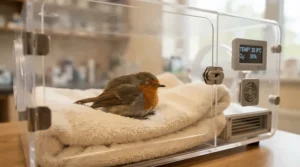
Matters: stable airflow, accurate thermostat, alarms, cleanability, and enough space. A fan keeps warm air from stratifying, which is why the Brinsea TLC-30 Eco and Vetario S30 both highlight fan-based stability.
Sometimes matters: humidity control. If your bird has respiratory distress, it’s valuable. Otherwise, it’s a nice extra on the Brinsea TLC-50 Advance Series II.
Mostly doesn’t matter: capacity numbers beyond what you’ll use, fancy lights, and cosmetic polish. A bigger cabinet isn’t a better cabinet for a finch.
One more filter: be skeptical when a heating product claims bird-safety without specifics. Ask what the surface temperature is, whether it has a guard, and whether it’s tested with the fixture you’re using.
Real-World Scenarios: Which Pick Fits Which Rescuer?
Abstract specs only go so far, so here are three realistic profiles.
The apartment budgie owner. One bird, limited space, tight budget, emergencies rare. The Brinsea TLC-30 Eco gives a stable, supervised warm box. Add a spare thermometer and a saved vet number. Total outlay stays modest relative to the bigger units.
The multi-bird household with parrots. Two conures, an Amazon, a cockatiel. Emergencies are a matter of when. The Brinsea TLC-40 Advance Series II gives room plus alarms, and the humidity read-out helps with respiratory scares.
The volunteer wildlife transporter. You’re driving injured songbirds to a rehabber. The Vetario S30 with a car adaptor keeps birds warm en route. Pair it with a small supply kit and you’ve got a mobile stabilization station.
And for a hatchling orphan? The Brinsea EcoGlow Safety 600 can supplement, but a proper incubator should still be the primary environment.
Common Mistakes When Buying Heat Gear for Sick Birds
I see the same errors over and over in how people shop for emergency warmth.
Mistake one: treating a chick brooder as an ICU. The Brinsea EcoGlow Safety 600 is excellent for hatchlings but isn’t a sick-adult solution.
Mistake two: skipping the thermostat. A bare Zoo Med Ceramic Heat Emitter without control is a gamble. Retail guidance for these emitters repeatedly recommends a thermostat or dimmerstat.
Mistake three: ignoring plastic. Plastic sockets melt under hot emitters. Ceramic fixtures only.
Mistake four: overheating. More heat isn’t better. The warning signs from veterinary sources are panting, open-mouth breathing, and wings held away from the body. Reduce heat immediately if you see them.
Mistake five: buying before calling the vet. A vet can tell you the right temperature and whether warmth alone is even enough. Even avian-welfare guidance for infrared lamps advises consulting an avian vet before starting.
Mistake six: forgetting the aftermath. Cleaning, disinfecting, and storage plans matter as much as purchase.
Long-Term Cost and Maintenance
Let’s talk total cost of ownership, since the sticker price is only the opening bid.
A premium unit like the Brinsea TLC-30 Advance costs several times what a ceramic emitter setup does. But consider what the emitter route really requires: the emitter, a ceramic dome fixture, a guard, and a thermostat. Add those up and the gap narrows more than people expect, while the control and safety gap stays wide.
The warranty helps too. Brinsea lists three-year warranties on its TLC units, and the Zoo Med Ceramic Heat Emitter line carries a two-year warranty with a stated lifespan of up to five years. Compare cost per year of useful life, not just checkout totals.
Maintenance costs are small but real: replacement thermometers, disinfectant, and the occasional spare part. Brinsea notes spares are available for its TLC line.
My rule of thumb: if you expect one emergency in a decade, go budget and lean on your vet. If you foster birds regularly, an alarmed ICU pays for itself in avoided losses and avoided panic.
Safety and Regulations: Keeping Heat Sources Bird-Safe
Heat equipment can hurt birds if mismanaged, so safety deserves its own section.
Electrical safety first. The 12-volt design on the Brinsea TLC-30 Eco, Vetario S30, and Brinsea EcoGlow Safety 600 reduces shock risk compared with mains-voltage heaters, which is meaningful around damp cages. The EcoGlow also advertises an IPX7 water-tight seal.
Fire safety next. Never run a bare emitter near bedding, curtains, or cardboard. Guard it, mount it securely so it can’t fall, and use ceramic sockets.
Bird-specific hazards matter too. A pet-supply article warns that you should buy heat lamps marketed for avian use and keep ceramic elements out of the bird’s reach. The same piece suggests smoke and carbon monoxide detectors for extra protection.
If you ever have a doubt about a household appliance, the U.S. Consumer Product Safety Commission is the agency to ask. And one cautionary footnote: if an oxygen setup is ever used under veterinary direction, remember that higher oxygen levels increase fire risk, which is why oxygen-compatible units are built differently.
Frequently Asked Questions
❓ How warm should a bird incubator be for an emergency?
❓ Can I use a ceramic heat emitter instead of a bird incubator?
❓ Is a chick brooder plate safe for a sick parrot?
❓ How do I know if my bird is too hot in the brooder?
❓ Do I still need a vet if my bird warms up and perks up?
Conclusion
Here’s where the whole thing lands. A small animal incubator for bird emergencies isn’t a luxury gadget; it’s a controlled pocket of safety for the moment your bird can’t protect itself.
If you want the simplest recommendation: the Brinsea TLC-30 Advance is the best all-round pick for most home rescuers, because alarms plus stable control beat raw size. The Brinsea TLC-30 Eco is the sensible budget entry. Go bigger with the Brinsea TLC-40 Advance Series II or Brinsea TLC-50 Advance Series II only if your birds or caseload demand it. Choose the Vetario S30 for mobile rescue. Treat the Zoo Med Ceramic Heat Emitter as a careful, thermostat-controlled supplement, and the Brinsea EcoGlow Safety 600 as a hatchling tool.
Remember the larger truth, too. Heat buys time, and time buys a vet appointment. Keep your avian vet’s after-hours number posted, pre-test your setup, and keep a spare thermometer in the box.
✨ Ready to be prepared before the next scare?
🐦 Review the options above, check current pricing and availability, and set up your emergency warmth station today. Your bird can’t ask for it, so be the one who’s ready!
Recommended for You
- Bird Mite Spray: 7 Best Safer Picks For Pet Birds In 2026
- Quarantine Cage For New Bird Parasite Isolation: 7 Best Picks 2026
- Foraging Toys Fo Prevent Feather Plucking: 7 Proven Picks 2026
Disclaimer: This article contains affiliate links. As an Amazon Associate, I earn from qualifying purchases. If you purchase products through these links, we may earn a small commission at no additional cost to you.
✨ Found this helpful? Share it with your friends! 💬🤗
