
In This Article
There’s a particular kind of dread that hits when you catch your parakeet scratching at 2 a.m. and then notice a faint gray-red speck crawling along the perch. Your first instinct is to grab the nearest can of anything with “mite” on the label. Please don’t. The wrong bird mite spray can do more harm than the parasites, because a bird’s respiratory system is exquisitely sensitive to fumes, oils, and aerosols.
The upside is that a well-chosen bird mite spray, used correctly, is one of the most practical tools in a bird owner’s kit. Mites and lice are external parasites. Lice are insects that chew on feathers and skin debris, while mites are spider relatives, and some of them feed on blood. Veterinary references note that infestations tend to hit stressed animals, and that crowding among caged and indoor birds can make lice problems worse. In other words, husbandry matters as much as the product.
This guide compares seven real products, from budget pump bottles to botanical blends and a post-infestation skin soother. We’ll also cover mite spray for pet birds in the situations owners actually face, like treating cockatiels, deciding between sprays and powders, and working out how often to spray. You’ll also see how to spot trouble early. Every product opinion here comes from spec analysis and aggregated review themes, not from claimed personal testing.
One honesty note before we start. Availability, formulations, and labeling for bird products vary by region and seller, so confirm the active ingredients and directions on the actual listing before you buy.
Quick Comparison Table: 7 Bird Mite Spray Options at a Glance
| Product | Core Trait | Best For |
|---|---|---|
| Vetafarm Avian Insect Liquidator | Veterinarian-formulated, long residual action | Serious infestations and aviaries |
| 8 in 1 UltraCare Mite and Lice Spray | Pump bottle, widely used on small caged birds | Everyday budget treatment |
| Johnson’s Anti-Mite Extra | Water-based, no mixing | Owners who dislike strong-smelling formulas |
| BioGance Anti-Mite Spray | Aloe, cade, and lavandin blend | Routine maintenance between treatments |
| EcoPest Mite Spray | Large botanical environmental spray | Cages, rooms, and aviary surfaces |
| Zymox Avian Care Topical Spray | Enzyme and aloe skin soother | Post-infestation skin recovery |
| KG Pet Spray by Fur and Feathers | Unscented citric-acid enzyme formula | Fragrance-sensitive households |
Read this table as a map of roles, not a leaderboard. The Vetafarm Avian Insect Liquidator is the heavy hitter for active infestations, while the 8 in 1 UltraCare Mite and Lice Spray is the sensible everyday workhorse. The Zymox Avian Care Topical Spray isn’t a mite killer at all; it belongs in the “repair” column, and buying it expecting a cure would be a mistake.
💬 Just one click — help others make better buying decisions too!😊
Top 7 Bird Mite Spray Picks: Expert Analysis
1. Vetafarm Avian Insect Liquidator — veterinarian-formulated with six-week residual protection
Vetafarm built this one with avian vets in mind, and it shows in the formulation. Label information lists permethrin, piperonyl butoxide, and methoprene as the actives. In plain English, that’s a knockdown agent, a synergist that boosts it, and an insect growth regulator that interrupts the life cycle. That third ingredient is the reason the label promises up to six weeks of residual protection.
The ready-to-use version is applied by holding the bottle about 30-40 cm from the bird and misting lightly. You then treat perches, nest boxes, and cage surfaces. Based on the spec comparison, the growth-regulator approach is what separates this from plain contact killers, because most mite eggs and nymphs sit in cage crevices, not on the bird.
This suits owners with confirmed mites or lice and multiple birds. The concentrate versions need accurate dilution, so beginners should lean toward ready-to-use.
On review sentiment, I couldn’t verify a large pool of product-specific customer reviews. One retailer advertises thousands of five-star store reviews, but that’s a store-wide claim, so don’t treat it as proof for this spray.
Pros:
- ✅ Growth regulator targets eggs and nymphs, not just adults
- ✅ Works on the bird and the environment
- ✅ Ready-to-use and concentrate sizes available
Cons:
- ❌ Permethrin-based, so keep cats away during use
- ❌ Concentrate dilution leaves room for user error
Retail listings put the ready-to-use 100 mL bottle in roughly the mid-teens to low-$20s range; check current price. For a genuine infestation, that’s strong value.
2. 8 in 1 UltraCare Mite and Lice Spray — the budget pump bottle with real-world track record
The 8 in 1 UltraCare Mite and Lice Spray comes in an 8-ounce pump bottle and is marketed for killing mites and lice on caged birds. That size is generous for small-bird households, where a single treatment uses very little product. I couldn’t verify the active-ingredient panel from the sources I found, so read the label before buying, especially if your bird has been sensitive to sprays before.
What stands out is the review pattern. Owners report using it around parakeets, and several describe a weekly spritz of cage surfaces during cleaning. One reviewer reports treating a rescued baby bird’s carrier and surroundings with no ill effects. The most repeated complaint is mechanical: the spray top can be finicky and uneven, so aiming near a small bird’s face takes care.
My analytical take: this is the “keep it in the cupboard” option for budget-minded owners who want a pump bottle with wide familiarity. It’s best for environmental treatment, and any direct-on-bird use should follow the label and your vet’s guidance.
Pros:
- ✅ Large 8-ounce bottle suits ongoing cage maintenance
- ✅ Reviewers report use around parakeets
- ✅ Budget-friendly compared with vet-brand options
Cons:
- ❌ Spray head reportedly sprays unevenly
- ❌ Active ingredients not verified from sources
Expect it in the budget tier; check current price. It’s a good value verdict if you want a simple routine spray.
3. Johnson’s Anti-Mite Extra — water-based and mix-free
Johnson’s Anti-Mite Extra is a ready-to-use, water-based pump spray aimed at red mite, northern mite, and lice in cage birds and pigeons. The listing instructs you to shake well, remove all food and water, dose by bird size, and spray cage surfaces, cracks, and crevices to prevent re-infestation.
That last instruction deserves emphasis. What the spec sheet won’t tell you, but veterinary references do, is that many mites spend most of their time off the bird, hiding in crevices. A product that explicitly tells you to treat the cracks understands the parasite’s biology.
A water base also means less heavy solvent smell, which matters in a small room where your bird sleeps. This is a UK-market brand, so US availability and the exact formulation can differ by seller. Confirm the label details before purchase. I couldn’t verify meaningful customer reviews, so I’m not summarizing any here.
Pros:
- ✅ Water-based, ready-to-use pump spray
- ✅ Directions cover crevices and cage surfaces
- ✅ Lists red mite, northern mite, and lice
Cons:
- ❌ Availability and bottle size vary by seller
- ❌ Active ingredients not verified from sources
Pricing appears to sit in the budget tier; check current price. It’s a fair value pick for owners who prioritize a gentler-smelling formula.
4. BioGance Anti-Mite Spray — the aloe-and-botanicals maintenance option
BioGance Anti-Mite Spray is marketed as a mostly natural formulation built around aloe vera, cade, and lavandin. The brand positions it as supporting feather and skin health while discouraging mites. The listing’s dosing guidance is notably specific: a single spray from about 20 cm for canaries up to small parakeets.
Here’s where honest analysis matters. “Natural” does not equal “risk-free” for birds. Lavandin is an aromatic plant oil, and birds’ airways react badly to strong fragrances. On paper, the plant-based blend is likely better suited to prevention and routine maintenance than to rescuing a bird with an active, heavy infestation. If you see pale skin, weight loss, or crusting, skip botanicals and call your avian vet.
Because the product is sold mainly in Europe and the UK, expect shipping variance. I couldn’t verify meaningful customer reviews, so I’m leaving them out.
Pros:
- ✅ Aloe base may soothe irritated skin
- ✅ Clear small-bird dosing guidance
- ✅ Gentle positioning for routine care
Cons:
- ❌ Aromatic oils may bother sensitive birds
- ❌ Weaker choice for heavy infestations
Retail listings suggest roughly the low-teens range after conversion; check current price. The value verdict is solid for maintenance but not for emergencies.
5. EcoPest Mite Spray — a big botanical bottle for the surroundings
EcoPest Mite Spray is a 22-ounce, non-staining spray built around clove oil, as described in one affiliate roundup that positions it for home and aviary treatment. That large volume is its real selling point, because cage furniture, window sills, perch bases, and wall corners add up quickly.
I’d treat this strictly as an environmental product. The same roundup flagged it as not specifically formulated for direct application on a stressed bird, and that caution is sensible. Clove oil is potent, and essential-oil products demand ventilation and complete drying before your bird returns. Because many mites live in the surroundings, a large-volume surface spray makes practical sense if the label allows use around birds.
The bottom line: confirm with an avian vet before using any plant-oil spray near a bird. Reviewer sentiment isn’t something I could verify in depth, so I’ll leave it out.
Pros:
- ✅ Large 22-ounce volume covers big areas
- ✅ Non-staining for cage surroundings
- ✅ Botanical approach for environmental treatment
Cons:
- ❌ Not suited to spraying directly on birds
- ❌ Strong plant oils require careful ventilation
Check current price; it’s likely mid-range per ounce. The value verdict favors multi-bird homes and aviaries.

6. Zymox Avian Care Topical Spray — the skin-recovery specialist
Zymox Avian Care Topical Spray is the odd one out, and it earns its slot. The listing describes a 2-ounce spray with LP3 enzyme and aloe, steroid-free, aimed at soothing skin after an infestation and during molting. It does not kill mites.
Why include it? Because mite damage doesn’t end when the parasites die. Irritated skin, feather-picking habits, and rough patches linger. Based on the spec comparison, this is a recovery tool you pair with a proper parasite treatment, not a substitute for one. Used that way, it addresses the part of the problem most owners forget.
The usual caveat applies: if a bird’s skin is crusted, bleeding, or deformed, topical soothers aren’t the fix. A vet visit is. Review sentiment couldn’t be verified, so I’m not summarizing any.
Pros:
- ✅ Targets post-infestation skin irritation
- ✅ Steroid-free enzyme and aloe formula
- ✅ Compact 2-ounce bottle for small birds
Cons:
- ❌ Does not kill mites or lice
- ❌ Small bottle empties quickly in multi-bird homes
Expect it in the budget-to-mid range; check current price. It’s good value only when paired with a real parasite treatment.
7. KG Pet Spray by Fur and Feathers — unscented and fragrance-free
KG Pet Spray by Fur and Feathers is a 16-ounce, unscented, citric-acid enzyme formula. One roundup positions it as suitable for direct application without removing the bird, but I’d verify that against the actual label before relying on it.
The strength here is the absence of perfume. For a bird whose airways bristle at scented products, an unscented formula is genuinely attractive. The trade-off is that I couldn’t verify strong independent evidence that citric-acid enzyme sprays eliminate heavy mite or lice loads. That makes it a better fit for light prevention and cleaning support than for confirmed infestations.
If your bird already shows mite infestation signs, pair any gentle spray with vet-guided treatment. Customer-review depth couldn’t be verified here, so none is summarized.
Pros:
- ✅ Unscented formula suits sensitive households
- ✅ Generous 16-ounce size
- ✅ Gentle positioning for routine use
Cons:
- ❌ Efficacy against heavy infestations unverified
- ❌ Label claims need checking before direct use
Check current price; it appears to sit in the budget-to-mid range. The value verdict is fair for prevention, weaker for treatment.
Top 7 Specs and Value Comparison
| Product | Key Ingredients / Basis | Size | Price Range | Best For |
|---|---|---|---|---|
| Vetafarm Avian Insect Liquidator | Permethrin, PBO, methoprene | 100 mL / 500 mL | Mid-teens to low-$20s (100 mL) | Active infestations |
| 8 in 1 UltraCare Mite and Lice Spray | Check label | 8 oz | Budget tier | Routine cage treatment |
| Johnson’s Anti-Mite Extra | Water-based; check label | ~100-150 mL | Budget tier | Mix-free convenience |
| BioGance Anti-Mite Spray | Aloe, cade, lavandin | 100 mL | Low teens | Maintenance |
| EcoPest Mite Spray | Clove oil botanical | 22 oz | Mid-range | Environmental use |
| Zymox Avian Care Topical Spray | LP3 enzyme, aloe | 2 oz | Budget to mid | Skin recovery |
| KG Pet Spray by Fur and Feathers | Citric-acid enzyme | 16 oz | Budget to mid | Prevention, sensitive homes |
Looking at the comparison above, the Vetafarm Avian Insect Liquidator is the only entry with a documented growth regulator and a stated six-week residual window, which justifies a modest premium. The 8 in 1 UltraCare Mite and Lice Spray and Johnson’s Anti-Mite Extra serve cost-conscious owners who need simple pump-bottle treatment. Pair the Zymox Avian Care Topical Spray with any killer, and reserve EcoPest Mite Spray for surroundings only.
What Is Bird Mite Spray?
Bird mite spray is a liquid pest-control product designed to kill or repel mites and lice on pet birds, their cages, perches, and nest boxes. Formulas range from synthetic insecticides to botanical and enzyme blends. Safe use depends on the ingredients, your bird’s size, and following the label exactly.
That definition hides an important split. Some products are made for direct application to a bird, some are made only for the environment, and some are marketed one way while the fine print says another. That’s why an honest answer to “is mite spray for pet birds safe?” is always “it depends on which spray, which bird, and which directions.”
A third category sits beside sprays: vet-prescribed antiparasitic drops. Veterinary sources describe medications like ivermectin as widely used for bird mites. A pigeon study found that 0.1% ivermectin applied topically cleared mites and lice within three days, though that was pigeons under research conditions, not a recipe for your cockatiel. Treat it as context for why vets favor medication for stubborn cases.
The practical rule: sprays shine at environmental control and light-to-moderate external parasites, while burrowing mites and heavy infestations belong in your avian vet’s hands.
Mite Infestation Signs Every Bird Owner Should Know
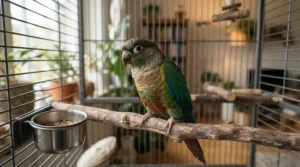
Mite infestation signs are sneaky, partly because birds hide illness by instinct. Here’s what to watch for:
- Restlessness and scratching: A bird that suddenly seems agitated, especially at night, may be hosting blood-feeding mites that attack under cover of darkness.
- Poor feather condition: Dull, ragged, or damaged plumage can point to feather mites or lice.
- Visible specks: Look closely along perches, cage corners, and nest boxes for tiny moving dots, especially at dusk.
- Pale skin or lethargy: Heavy blood-feeding can cause anemia. Poultry references note anemia in severe infestations.
- Crusty, honeycomb-like patches: On the beak, cere, eyes, or legs, this pattern suggests knemidokoptic mange, often called scaly face. VCA Animal Hospitals describes these lesions and notes that vets typically confirm the diagnosis with a skin scraping.
- Irritated owners: Some bird mites bite humans temporarily, causing itching, though they can’t live long without bird blood.
Here’s the catch many owners overlook: scaly face mites burrow into the skin, so a surface spray often can’t reach them. Birds-Online notes that mistaking food residue on a face for mite plaques is common, which is another reason a vet’s skin scraping beats guesswork.
When in doubt, photograph the bird’s face and legs and show your vet. Early action matters, because delayed treatment increases risk for small or already weakened birds.
How to Choose a Mite Spray for Pet Birds
Picking the right mite spray for pet birds comes down to seven criteria. Work through them in order.
- Confirm what you’re treating. Free-living mites and lice respond to sprays, while burrowing mites usually need vet-prescribed medication. Don’t guess.
- Read the label for bird-specific directions. Look for explicit instructions about distance, dosing by bird size, and whether the product is intended for direct application or only the environment.
- Check the active ingredients. Familiar bird-label actives include permethrin, pyrethrins with piperonyl butoxide, and methoprene. Plant-oil products need extra caution.
- Match the size to your flock. A 2-ounce bottle suits one budgie, while a multi-bird household benefits from larger volumes.
- Prefer pump sprays over aerosols. Pumps limit airborne particles and let you aim, though reviewers note some pump heads spray unevenly.
- Look for life-cycle coverage. Products with an insect growth regulator address eggs and nymphs that survive a single treatment.
- Consult an avian vet if you’re unsure. Sick, tiny, or young birds are the highest-risk cases.
The “what to weigh” part is simple: killing power matters, but safety margin matters more. A spray that’s slightly slower but gentle on your bird’s airways beats a powerhouse that stresses a sensitive species.
Safe Mite-Spray Ingredients: What to Look For and What to Avoid
Safe mite-spray ingredients aren’t a universal list, because “safe” depends on the bird, the dose, and the method. But some patterns are clear.
Ingredients that appear on bird-labeled products: Pyrethrins with piperonyl butoxide appear on one bird mite and lice spray’s label, and permethrin with piperonyl butoxide and methoprene appears on others. Methoprene is an insect growth regulator that disrupts development rather than acting as a classic poison. These ingredients appear on products labeled for caged birds, but label directions are what make them appropriate.
Skin-support ingredients: Aloe vera and enzyme-based formulas are used in recovery sprays. They soothe but don’t eliminate parasites.
Red flags:
- Human or dog flea products. One bird-care guide warns that using human flea spray on a bird can be fatal.
- Strongly scented essential oils. Avian respiratory sensitivity makes heavy fragrance risky.
- Mite-protector products hung in cages. VCA’s page on scaly face says such protectors have been implicated in some bird deaths.
- Aerosols in closed rooms. Even a “safe” ingredient becomes a problem when it lingers in stagnant air.
A household note: permethrin is known to be highly toxic to cats. If you share your home with felines, keep them out of the room until surfaces dry completely.
The honest bottom line is that contested ground exists. Some sources claim no spray is ever safe directly on a bird, while product labels from several brands explicitly allow it. Your avian vet breaks that tie for your specific bird.
Mite Spray vs Powder for Parakeets: Which Works Better?
The mite spray vs powder for parakeets debate really comes down to delivery, dust, and your bird’s airways.
| Factor | Spray | Powder |
|---|---|---|
| Coverage | Even misting reaches cage crevices | Better for dust boxes and litter |
| Airborne particles | Lower with pump sprays | Higher, with dust inhalation risk |
| Ease on small birds | Controllable by distance | Hard to dose on tiny birds |
| Residual effect | Some labels claim up to six weeks | Varies; reapplication common |
| Best For | Parakeets and cockatiels in cages | Floor-housed poultry |
The analysis: powders make sense in poultry settings where birds dust-bathe. A Merck Veterinary Manual entry on poultry lice notes that caged chickens and turkeys are best controlled with sprays, while floor-housed birds are easier to treat with insecticidal dust in litter. That logic transfers directly: caged parakeets generally favor sprays.
Powder’s biggest drawback for small cage birds is inhalation. A parakeet’s respiratory system is tiny, and a dust cloud in a small room is hard to control. A pump spray lets you aim at cage surfaces, perches, and nest boxes without filling the air.
For persistent infestations in budgies, the real alternative isn’t powder at all. It’s vet-prescribed drops, particularly for burrowing mites. Think of sprays as the cage-and-surroundings tool and drops as the on-bird medication.
Lice Treatment for Cockatiels: What Actually Works
Lice treatment for cockatiels starts with accurate identification. Veterinary references describe chewing lice as insects that mostly eat feathers and skin debris. They’re usually species-specific, so they transfer between birds in close contact, and they can reach new hosts by hitching rides on louse flies. Unlike some mites, lice are usually less dangerous to healthy adult birds, but they can be fatal to chicks.
To check a cockatiel, examine areas around the vent and under the wings, where eggs and moving lice tend to show up. Lice eggs attach near feather bases. Merck’s poultry page notes that lice complete a life cycle in about three weeks and survive only about a week off the host.
That timeline is the key to treatment. A single spray might kill adults, but eggs can hatch afterward. Hobbyist guidance suggests repeating spray or dip treatments after 10-14 days to catch newly hatched lice, which is consistent with the life-cycle numbers above. Products with growth regulators, like the Vetafarm Avian Insect Liquidator, are designed to reduce this re-infestation problem.
A practical sequence:
- Isolate the affected bird from other pets.
- Treat the bird per the product label or your vet’s instructions.
- Treat the cage, perches, and nest box thoroughly.
- Wash or replace cage liners and fabric toys.
- Repeat on schedule and recheck.
If your cockatiel has pale skin, weakness, or weight loss, skip home treatment and book a vet visit. Those are signs the problem is bigger than lice.

Spray Application Frequency: How Often Is Too Often?
Spray application frequency is where owners most often go wrong, usually by doing too much. More spraying is not better, because repeated chemical exposure adds up for a small body.
Here’s what the sources support. Hobbyist guidance recommends a repeat treatment in 10-14 days to catch hatching eggs. The Vetafarm Avian Insect Liquidator label states one application can give up to six weeks of protection, thanks to its growth regulator. One growth-regulator product says its effect lasts up to six weeks. Owner reviews of the 8 in 1 UltraCare Mite and Lice Spray mention weekly spritzing during cage cleaning, which is a common anecdote but not an official schedule.
My suggested approach, based on the label logic:
- Active infestation: Treat, then repeat once at roughly 10-14 days unless your vet or the label says otherwise.
- Long-residual products: Follow the label’s interval and don’t stack extra doses between treatments.
- Routine prevention: Focus on cage cleaning and inspection, using spray only when you have reason to.
- Always: Remove food and water first, air out the room afterward, and keep your bird away until surfaces are completely dry.
If you ever feel tempted to spray “just in case” every few days, stop. Talk to your avian vet about a prevention plan instead.
Affordable Bird Parasite Prevention Spray: Smart Savings Without Shortcuts
An affordable bird parasite prevention spray should save you money without costing you safety. Here’s how to think about cost.
Cost per use matters more than sticker price. A 100 mL ready-to-use spray treats a small-bird household many times, while an 8-ounce pump bottle like the 8 in 1 UltraCare Mite and Lice Spray stretches even further. The KG Pet Spray by Fur and Feathers and EcoPest Mite Spray offer large volumes for environmental use.
Where to spend and where to save:
- Spend on the Vetafarm Avian Insect Liquidator if you have an active infestation or multiple birds, because its longer residual window means fewer repeat treatments.
- Save with Johnson’s Anti-Mite Extra or a simple pump spray for routine surface care.
- Add the Zymox Avian Care Topical Spray only after an infestation, when skin recovery is the goal.
The cheapest prevention isn’t a spray at all. Regular cage cleaning, quarantining new birds, and routine inspection prevent far more problems per dollar than any bottle. As one veterinary source puts it in spirit, husbandry and individual health shape how bad parasites get.
Total cost of ownership also includes vet bills. A $15 spray used on the wrong problem can delay treatment and turn a minor case into an expensive one.
✨ Don’t Miss These Exclusive Deals!
🔍 Ready to protect your flock the smart way? Click on any highlighted product above to check current pricing and availability. These carefully chosen options help you build a mite-free routine your birds will thank you for! 🦜
Practical Usage Guide: Applying Bird Mite Spray Step by Step
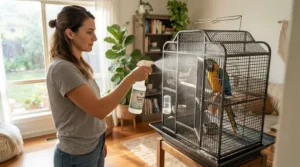
A bird mite spray works only as well as your technique. Here’s a simple routine you can follow, assuming the label allows the steps below.
Before you spray
- Read the entire label, including bird-size dosing.
- Move your bird to a safe, well-ventilated room away from other pets.
- Remove all food, water, toys, and cage liners.
Treating the bird (only if the label allows)
- Hold the bottle at the distance the label specifies, such as roughly 30-40 cm for one ready-to-use spray, or about 20 cm for another small-bird product.
- Spray lightly and avoid the eyes, nose, and beak. One reviewer advises spraying from behind the bird for exactly this reason.
- Never saturate a small bird.
Treating the cage
- Spray perches, nest boxes, cage bars, corners, and joints. These are where mites hide.
- Let surfaces dry completely, then wipe off any residue your bird will touch before returning the cage items.
Common first-30-day mistakes
- Treating only the bird and ignoring the cage.
- Skipping the follow-up treatment.
- Using a scented product in a closed room.
- Forgetting to wash cloth covers and perch wraps.
Maintenance schedule: inspect weekly, clean the cage thoroughly each week, and replace wooden perches that stay damp or crevice-ridden. Keep notes on dates so you never lose track of the repeat treatment.
Problem to Solution Guide: Common Mite Spray Headaches
Problem 1: “I sprayed, but the scratching continues.”
Check whether you’re dealing with burrowing mites or skin irritation. The solution is a vet visit with a skin scraping, because surface sprays can’t reach burrowing mites.
Problem 2: “The mites keep coming back.”
Most mite life stages live off the bird in the environment. The solution is to treat the cage thoroughly, repeat at the labeled interval, and consider a growth-regulator formula like the Vetafarm Avian Insect Liquidator.
Problem 3: “My bird seems stressed or wheezy after spraying.”
Stop use, move your bird to fresh air, and call your avian vet. Next time, ventilate longer and consider an unscented option like the KG Pet Spray by Fur and Feathers after checking its label.
Problem 4: “The spray bottle won’t aim properly.”
Reviewers of the 8 in 1 UltraCare Mite and Lice Spray noted spray-head quirks. Test spray onto a paper towel first so you learn the pattern before aiming near a bird.
Problem 5: “My bird’s skin looks raw after mites.”
Pair parasite treatment with a recovery product like the Zymox Avian Care Topical Spray, and see your vet if skin is crusted or bleeding.
Real-World Scenarios: Matching Spray to Situation
Scenario 1: The apartment parakeet owner. You have one budgie in a small studio, and you’ve spotted a few specks on the perch. A pump bottle like the 8 in 1 UltraCare Mite and Lice Spray or Johnson’s Anti-Mite Extra handles cage-surface treatment on a modest budget. Ventilate thoroughly, because small rooms trap fumes.
Scenario 2: The breeder with eight birds. Frequency of use is high, and cages share airspace. The Vetafarm Avian Insect Liquidator concentrate or large ready-to-use bottle gives you a long residual window and the economics of volume. Treat every bird and cage in the room, since sparing one can reseed the rest.
Scenario 3: The sensitive-household rescue. You adopted a cockatiel that reacts to fragrance. Start with vet guidance, then consider unscented products like the KG Pet Spray by Fur and Feathers for routine cage hygiene, and the Zymox Avian Care Topical Spray for skin recovery after any infestation is cleared.
In each case, the best purchase follows the problem, not the other way around.

Frequently Asked Questions
❓ Can I use bird mite spray on a baby bird?
❓ How long should I keep my bird out of the room after spraying?
❓ Does a bird mite spray also work on lice?
❓ Can bird mites live in my house without birds?
❓ Is there a mite spray safe for canaries and finches?
Conclusion: Spray Smart, Not Hard
The best bird mite spray is the one that matches your problem, your bird’s size, and your household. For active infestations and multi-bird homes, the Vetafarm Avian Insect Liquidator is the strongest all-around pick on paper thanks to its growth regulator and long residual window. For everyday budget treatment, the 8 in 1 UltraCare Mite and Lice Spray and Johnson’s Anti-Mite Extra make practical sense. Botanical and unscented options like BioGance Anti-Mite Spray, EcoPest Mite Spray, and the KG Pet Spray by Fur and Feathers fit prevention and cage hygiene better than rescue missions. Finally, the Zymox Avian Care Topical Spray earns a spot as the recovery sidekick.
Whatever you choose, remember the three non-negotiables. Treat the cage, not just the bird. Follow the label’s repeat schedule instead of freelancing. And take crusty beaks, pale skin, or lethargy to an avian vet right away, because some mites need medication, not mist.
For deeper background on a common burrowing mite problem, dvm360’s overview of knemidocoptiasis explains how these mites feed and why they affect older birds more often. Your feathered friend can’t tell you what’s wrong, so a little vigilance goes a long way.
✨ Ready to build your mite-free routine?
🦜 Check current pricing on the products above, pick the one that matches your bird’s situation, and give your flock the clean, comfortable home they deserve! 💚
Recommended for You
- Quarantine Cage For New Bird Parasite Isolation: 7 Best Picks 2026
- Foraging Toys Fo Prevent Feather Plucking: 7 Proven Picks 2026
- E-Collar For Bird Feather Plucking: 7 Proven Picks (2026)
Disclaimer: This article contains affiliate links. As an Amazon Associate, I earn from qualifying purchases. If you purchase products through these links, we may earn a small commission at no additional cost to you.
✨ Found this helpful? Share it with your friends! 💬🤗
