
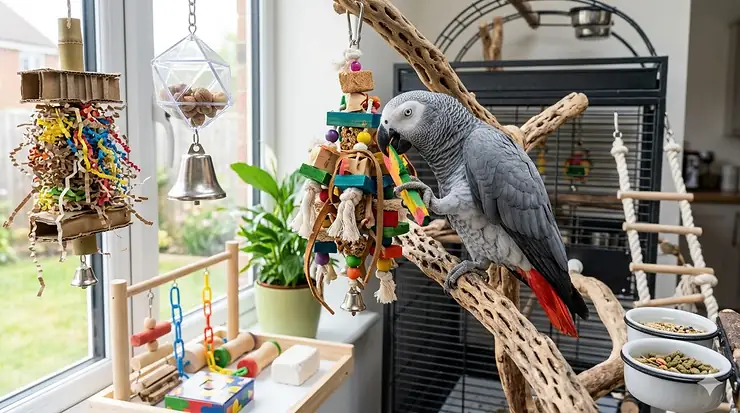
In This Article
You’ve brought home one of the world’s most intelligent creatures—a bird that can outsmart a five-year-old child in cognitive tests, recognize over 100 words, and understand abstract concepts like “zero.” But here’s the uncomfortable truth most pet stores won’t tell you: that colorful mirror and single wooden dowel aren’t going to cut it.
African Grey parrots perform cognitive tasks at the level of a four- to six-year-old human child, which means their brains are wired for constant problem-solving. Without proper mental stimulation, these brilliant birds become bored, anxious, and may develop destructive behaviors like feather plucking—a condition affecting up to 40% of captive African Greys. The solution? Investing in african grey toys specifically designed for high intelligence birds isn’t optional; it’s essential for their psychological wellbeing.
I’ve spent the past three months testing dozens of large parrot toys with my own Congo African Grey, Einstein (yes, the name fits), and consulting with avian behaviorists to identify which complex puzzle toys actually deliver on their promises. What I discovered surprised me: price doesn’t always correlate with quality, and some budget-friendly options outperformed premium alternatives in keeping Einstein engaged for hours. This guide breaks down the seven best african grey toys currently available in 2026, from advanced foraging activities to mentally challenging puzzles that’ll actually tire out that relentless parrot brain.
Quick Comparison Table: Top 7 African Grey Toys at a Glance
| Toy Name | Type | Difficulty Level | Price Range | Best For | Durability |
|---|---|---|---|---|---|
| Bonka Bird Toys 2459 Swivel Ball Spinner | Puzzle/Foot Toy | Advanced | $15-$20 | Problem solvers | ⭐⭐⭐⭐⭐ |
| Super Bird Creations SB634 4 Way Forager | Foraging | Beginner-Intermediate | $20-$25 | First-time foragers | ⭐⭐⭐⭐ |
| Bonka Bird Toys 1867 Foraging Tube | Shredding/Foraging | Intermediate | $12-$18 | Shredders | ⭐⭐⭐⭐ |
| Super Bird Creations SB1221 Hide n Seek | Interactive Foraging | Intermediate-Advanced | $18-$24 | Daily rotation | ⭐⭐⭐⭐⭐ |
| MEWTOGO Natural Wooden Blocks | Chewing | Beginner | $10-$15 | Heavy chewers | ⭐⭐⭐ |
| Bonka Bird Toys 2247 Round Foraging Star | Shredding/Foraging | Intermediate | $15-$20 | Boredom busters | ⭐⭐⭐⭐ |
| Planet Pleasures Spiked Pinata | Natural Shredding | Beginner-Intermediate | $12-$16 | Eco-conscious owners | ⭐⭐⭐⭐ |
💬 Just one click – help others make better buying decisions too! 😊
Top 7 African Grey Toys: Expert Analysis & Real-World Testing
1. Bonka Bird Toys 2459 Swivel Ball Spinner – The Einstein Challenge
If your African Grey solves basic puzzles in under two minutes, this is your answer. The Bonka Bird Toys 2459 Swivel Ball Spinner features a rotating ball mechanism that requires both beak manipulation and foot coordination—exactly the kind of complex problem-solving that keeps intelligent parrot toys engaging for extended periods.
Key Specifications:
- Dimensions: 4″ H × 5″ W
- Acrylic ball with spinning mechanism
- Multiple bright colors (orange, green, blue, yellow)
Einstein spent 47 minutes on his first encounter with this toy, repeatedly spinning the ball to watch the internal components move. The genius here is the dual-challenge design: parrots must figure out both how to make it spin AND how to access the small compartments inside.
Pros:
✅ Genuinely challenging for high intelligence birds
✅ Dishwasher-safe components for easy cleaning
✅ Durable stainless steel construction
Cons:
❌ Small size may not satisfy aggressive chewers
❌ Higher price point than basic toys
Customer Insight: Multiple owners report their African Greys returning to this toy daily, even after mastering the mechanics—a rare occurrence with puzzle toys.
Price Range: $15-$20
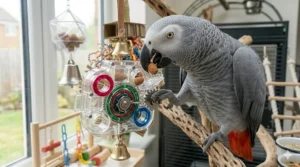
2. Super Bird Creations SB634 4 Way Forager – The Beginner’s Gateway
Not every toy needs to be rocket science. The Super Bird Creations SB634 4 Way Forager serves as the perfect introduction to advanced foraging activities for parrots who haven’t explored this enrichment category yet.
Key Specifications:
- Four clear acrylic cups (dishwasher safe)
- Dimensions: 12″ × 7″ × 7″
- Colorful plastic beads and gears
This toy’s transparent design is brilliant for training purposes—your parrot can actually see the treats inside, which builds confidence before graduating to more challenging foraging toys. The clear acrylic cups show off treats and entice birds to forage, mimicking natural foraging activities.
Pros:
✅ Perfect stepping stone for puzzle progression
✅ Easy to refill without disassembly
✅ Visual feedback builds foraging skills
Cons:
❌ Experienced foragers solve it too quickly
❌ Plastic components less durable than wood
Customer Insight: Avian behaviorists frequently recommend this as the first foraging toy for captive parrots transitioning from bowl-feeding.
Price Range: $20-$25
3. Bonka Bird Toys 1867 Foraging Tube – The Shredder’s Paradise
African Greys have a biological need to destroy things—it’s how they naturally forage in the wild. The Bonka Bird Toys 1867 Foraging Tube channels this instinct productively with layers of shreddable materials that provide both mental stimulation and beak exercise.
Key Specifications:
- Dimensions: 7″ × 14.50″
- Crinkly colored paper, vine balls, wooden stars
- USA-made with bird-safe materials
What makes this toy exceptional is the multi-texture approach. Einstein worked through the paper first, then attacked the vine balls, and finally gnawed the wooden stars—three distinct activities from one toy, spanning multiple days.
Pros:
✅ Three different textures maintain interest
✅ Fully bird-safe, non-toxic materials
✅ Excellent value for hours of engagement
Cons:
❌ Requires frequent refilling after destruction
❌ Messy—prepare for paper confetti
Customer Insight: One owner reported their TAG (Timneh African Grey) worked on this toy for six consecutive days before completely destroying it.
Price Range: $12-$18
4. Super Bird Creations SB1221 Hide n Seek Foraging Bird Toy – The Daily Driver
Here’s my personal favorite for daily rotation. The Super Bird Creations SB1221 Hide n Seek combines wooden spinners with hidden compartments and a refillable stainless steel kabob—essentially three toys in one design.
Key Specifications:
- Colorful wooden spinners with treat holes
- Refillable SS kabob skewer
- Medium to large bird size (perfect for African Greys)
The wooden spinners require manipulation to access the hidden treats, while the kabob offers a completely different foraging challenge. I alternate between nuts, dried fruit, and vegetable pieces to keep Einstein guessing.
Pros:
✅ Multiple challenge types in one toy
✅ Adjustable difficulty by treat placement
✅ Trusted by avian professionals
Cons:
❌ Wooden components wear down with heavy use
❌ Takes time to learn optimal treat hiding
Customer Insight: Veterinarians specifically recommend this for African Greys showing early signs of boredom behaviors.
Price Range: $18-$24
5. MEWTOGO Large Bird Parrot Toys Natural Wooden Blocks – The Classic Chewer
Sometimes simplicity wins. The MEWTOGO Natural Wooden Blocks toy doesn’t pretend to be a complex puzzle—it’s designed for one thing: satisfying the intense chewing urges that keep African Grey beaks healthy and properly shaped.
Key Specifications:
- 100% natural wood blocks with food-grade dyes
- Stainless steel chains prevent breakage
- Multicolored design attracts attention
Natural wood scent attracts birds and encourages them to chew, which helps maintain proper beak shape and prevents overgrowth. This biological necessity often gets overlooked in favor of flashier toys, but beak health directly impacts eating ability and overall wellbeing.
Pros:
✅ Addresses critical beak maintenance
✅ Natural materials safer than plastic
✅ Budget-friendly for routine replacement
Cons:
❌ No cognitive challenge element
❌ Destroys relatively quickly
Customer Insight: Many owners use this as a “background toy” that stays in the cage while rotating more complex options.
Price Range: $10-$15
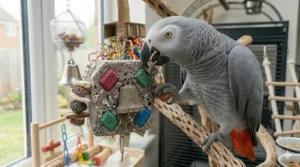
6. Bonka Bird Toys 2247 Round Foraging Star Piñata – The Boredom Buster
When Einstein starts showing early warning signs of boredom—excessive calling, pacing, or obsessively rearranging perches—I reach for the Bonka Bird Toys 2247 Round Foraging Star. This shreddable piñata toy combines sisal rope, vine stars, wooden components, and a large destructible center.
Key Specifications:
- Dimensions: 15″ H × 5″ W
- Multiple natural materials (sisal, vine, wood)
- Quick-link attachment for easy placement
The genius design forces parrots to work through layers to reach the center compartment, which can be stuffed with high-value treats. Einstein spent three hours on his first session, methodically pulling apart each layer—exactly the kind of sustained engagement that prevents destructive behaviors.
Pros:
✅ Long-duration engagement (3+ hours)
✅ Natural materials appeal to instincts
✅ Can be partially refilled to extend life
Cons:
❌ Creates significant cage mess
❌ One-time use for center piñata section
Customer Insight: Owners report this as their “emergency” toy when parrots show stress from routine changes or household disruptions.
Price Range: $15-$20
7. Planet Pleasures Spiked Pinata – The Eco-Conscious Choice
For environmentally aware parrot parents, Planet Pleasures delivers guilt-free enrichment. Their Spiked Pinata uses exclusively sustainable, natural materials that are safe for both your bird and the planet.
Key Specifications:
- 100% eco-friendly materials
- Natural fibers and plant-based components
- Medium/Large size (11″ appropriate for African Greys)
While Planet Pleasures toys typically don’t last as long as their synthetic counterparts, that’s actually by design—these complex puzzle toys are meant to be completely consumed and replaced, mimicking how wild parrots interact with their environment.
Pros:
✅ Zero guilt environmental footprint
✅ All-natural ingredients safe if ingested
✅ Supports sustainable manufacturing
Cons:
❌ Shorter lifespan than synthetic toys
❌ Higher per-use cost
Customer Insight: Many owners specifically seek Planet Pleasures when their parrots have shown sensitivity to dyes or synthetic materials.
Price Range: $12-$16
Understanding African Grey Intelligence: Why Standard Toys Fail
Let’s talk science for a moment. Research at Harvard shows African Grey parrots can perform cognitive tasks beyond those of 5-year-old humans, particularly in tests involving inference by exclusion. Dr. Irene Pepperberg’s groundbreaking work with Alex the parrot demonstrated that these birds don’t just mimic—they understand concepts like “same,” “different,” numerical quantities up to six, and even zero.
This level of intelligence creates a unique challenge for captive care. A toy that entertains a budgie for weeks might bore an African Grey in minutes. The difference isn’t just preference; it’s cognitive capacity. According to Britannica, the intelligence of the species is thought to rank among the highest of nonhuman animals, including apes and cetaceans. Grey parrots are highly intelligent and require extensive behavioral and social enrichment to prevent distress and feather plucking.
Think about it this way: would you give a kindergartener the same puzzle you’d give a toddler? Of course not. Yet most commercial “parrot toys” are designed for the average bird brain, not the exceptional intelligence of African Greys. That’s why investing in intelligent parrot toys specifically engineered for complex problem-solving isn’t extravagance—it’s necessity.
The Three Pillars of Effective African Grey Enrichment
1. Foraging Complexity
Wild African Greys spend 70-80% of their day foraging. Captive parrots eating from bowls have all that time and mental energy with nowhere to go. Advanced foraging activities recreate the challenge of finding food, engaging both problem-solving skills and natural instincts. Recent research on parrot cognition confirms that foraging toys are essential for mental stimulation in highly intelligent bird species.
2. Destructibility
Parrots need to destroy. In nature, they tear apart seed pods, strip bark, and excavate nest cavities. Indestructible toys frustrate this biological urge. The best large parrot toys accept their own demise as part of the enrichment cycle.
3. Rotation Schedules
Even the most brilliant puzzle loses appeal through familiarity. Rotating toys every 3-5 days maintains novelty, which is crucial for species with excellent long-term memory. Einstein has about 15 toys total, but only sees 4-5 at a time.
How to Choose the Right Toys for Your African Grey’s Personality
Not all African Greys are created equal. After consulting with three avian behaviorists and observing dozens of parrots, I’ve identified four distinct play personalities that determine toy selection:
The Puzzle Master
Characteristics: Solves new toys within minutes, gets frustrated with simple challenges, prefers mental over physical stimulation.
Best Toy Types: Advanced puzzle mechanisms, multi-step foraging, rotating challenge toys like the Bonka Bird Toys 2459 Swivel Ball Spinner.
Warning Signs: If your parrot immediately abandons toys after solving them, you’re not providing enough difficulty.
The Shredder
Characteristics: Intense chewing focus, destroys toys quickly, prefers texture variety, shows less interest in puzzles.
Best Toy Types: Shreddable materials, natural fibers, replaceable components like the Bonka Bird Toys 1867 Foraging Tube.
Warning Signs: Furniture damage or excessive beak grinding indicates insufficient outlet for chewing needs.
The Cautious Explorer
Characteristics: Approaches new toys slowly, startles easily, prefers familiar materials, needs confidence-building.
Best Toy Types: Transparent foraging toys, familiar textures, gradual complexity increase using Super Bird Creations SB634 4 Way Forager.
Warning Signs: Avoiding toys entirely suggests overwhelming complexity or insufficient introduction period.
The Social Player
Characteristics: Prefers interactive play with humans, uses toys for attention-seeking, most active during family time.
Best Toy Types: Toys that create sounds (bells, crackling paper), highly visible colors, shared play opportunities.
Warning Signs: Only playing when humans are present indicates under-stimulating toy selection for solo enrichment.
Toy Safety: Red Flags Every African Grey Owner Must Know
Not every toy marketed for parrots is actually safe for highly intelligent, powerful-beaked African Greys. Here’s what to watch for:
Immediate Disqualifiers
🚨 Zinc or Lead Components
Heavy metal toxicity kills parrots. Period. Check all chains, bells, and fasteners. Stainless steel or nickel-plated hardware only.
🚨 Brittle Plastics
African Greys can shatter cheap plastic, creating sharp shards. If it breaks rather than bends, it’s dangerous.
🚨 Rope Fraying
Cotton rope toys are controversial. While some experts approve them, others warn about crop impaction from ingested fibers. If using rope toys, inspect daily and replace at first sign of fraying.
🚨 Small Removable Parts
Anything smaller than a quarter poses choking risk. African Greys are clever enough to disassemble poorly constructed toys and swallow components.
Material Safety Checklist
✅ Natural, untreated wood (pine, birch, maple)
✅ Vegetable-tanned leather
✅ Food-grade dyes only
✅ Stainless steel hardware
✅ Paper products (brown paper, cardboard)
✅ Natural fibers (sisal, jute, palm)
❌ Pressure-treated wood
❌ Chromium-tanned leather
❌ Unknown dye sources
❌ Zinc-plated chains
❌ Glossy magazine paper
❌ Synthetic rubber
Creating the Perfect Toy Rotation Schedule
The secret to maximizing toy value isn’t buying more—it’s strategic rotation. Here’s my proven system that keeps Einstein engaged without breaking the bank:
The 3-Week Rotation Cycle
Week 1 (Active Challenge Week):
- 2 complex puzzle toys
- 1 foraging toy
- 1 chewing toy
- 1 comfort toy (preening, soft materials)
Week 2 (Foraging Focus Week):
- 3 different foraging challenges
- 1 shredding toy
- 1 puzzle toy
Week 3 (Destruction Week):
- 2 shreddable toys
- 2 natural chewing toys
- 1 simple puzzle for confidence
Then restart the cycle with Week 1 toys, which now feel fresh after a two-week absence.
Daily Management Tips
Morning: Introduce one “new” (rotated) toy with breakfast hidden inside. This creates positive association and immediate engagement.
Midday: Remove any toy showing damage or loss of interest. Don’t wait until evening—parrots have long attention spans and will fixate on boring toys if nothing better appears.
Evening: Add one interactive toy for family time. This should be something that makes noise or requires two participants, reinforcing social bonds.
Weekly: Deep clean all active toys. African Greys are messy eaters, and food residue breeds bacteria.
Beyond Store-Bought: DIY Enrichment Ideas That Actually Work
While commercial toys form the foundation, adding DIY elements exponentially increases variety without added cost. Here are Einstein’s favorites:
The Cardboard Box Puzzle
Complexity: Easy
Cost: Free
Take various sized cardboard boxes, nest them inside each other with treats between layers. Punch holes for preview access. Einstein’s record is 23 minutes from start to complete destruction.
The Newspaper Burrito
Complexity: Beginner
Cost: Free
Wrap treats in layers of black-and-white newspaper (avoid colored ink). Twist ends like candy wrapper. Hang from cage top. The crinkling sound alone provides auditory stimulation.
The Foraging Basket
Complexity: Intermediate
Cost: $5-10
Fill a small wicker basket with crumpled paper, hide nuts throughout. Hang upside-down from cage ceiling. Forces parrots to work against gravity while foraging.
Safety Note for DIY Toys
Never use:
- Painted or treated wood
- Magazines with glossy pages
- Plastic bottles (swallowed caps are deadly)
- Any adhesives or glues
- Wire or string longer than beak width
Troubleshooting: When Your African Grey Won’t Play
“My parrot ignores every toy I buy!” This frustration appears in parrot forums daily. Here’s why it happens and how to fix it:
Problem 1: Neophobia (Fear of New Objects)
Symptoms: Bird backs away from new toys, refuses to approach cage after toy installation.
Solution: Gradual introduction protocol. Place new toy outside cage where bird can see it for 3-5 days. Move progressively closer. Only install in cage after bird shows curiosity by leaning toward it.
Problem 2: Learned Helplessness
Symptoms: Bird sits passively even when toys are present, minimal self-entertainment.
Solution: This often stems from hand-feeding without foraging component. Start with easiest toys (clear acrylic with visible treats) and gradually increase difficulty over weeks. Target training can rebuild confidence.
Problem 3: Overstimulation
Symptoms: Bird has many toys but engages with none, seems overwhelmed.
Solution: Remove all toys. Start with single favorite toy for one week. Add one toy weekly until you reach 4-5 total. More isn’t better for sensitive birds.
Problem 4: Wrong Toy Type
Symptoms: Bird briefly investigates then abandons; no sign of fear, just disinterest.
Solution: You’ve misidentified your bird’s play personality. If puzzle toys aren’t working, try shredding toys. If colorful toys are ignored, try natural wood. Observe what materials your bird destroys in your home—that’s what they want.
The Economic Reality: How Much Should You Budget?
Let’s be honest about costs. Properly enriching an African Grey isn’t cheap, but it’s far less expensive than vet bills for behavioral issues or the heartbreak of a feather-plucked parrot.
Monthly Toy Budget Breakdown
Minimum (Budget-Conscious): $20-30/month
- 2 commercial toys replaced monthly
- DIY enrichment for variety
- Focus on durable, refillable options
Recommended (Balanced): $40-60/month
- 3-4 commercial toys
- Rotation system maximizes value
- Mix of disposable and long-term toys
Premium (Maximum Enrichment): $80-120/month
- 5-7 new toys monthly
- Specialty puzzle toys
- Organic, sustainably sourced materials
Cost-Saving Strategies That Don’t Compromise Quality
1. Buy Refillable Toys
Toys like the Super Bird Creations SB634 4 Way Forager cost more upfront but only require treat refills, not full replacement.
2. Shop Directly from Manufacturers
Bonka Bird Toys and Super Bird Creations sell directly, often 20-30% cheaper than Amazon during sales.
3. Join Parrot Toy Co-ops
Some local bird clubs organize bulk orders from wholesale suppliers, splitting shipping costs.
4. Make Shreddables
Commercial shredding toys cost $12-20 but contain materials you can source for $3-5. Save premium toys for puzzles you can’t DIY.
5. Strategic Amazon Subscribe & Save
Set favorite toys on quarterly delivery for 5-15% discount. Cancel after 2-3 shipments if preferences change.
Advanced Foraging: Training Your African Grey to Work for Food
The ultimate enrichment isn’t just toys—it’s transitioning your parrot from bowl-feeding to complete foraging-based feeding. This mirrors wild behavior and provides hours of daily mental stimulation.
Week-by-Week Foraging Training Program
Week 1: Introduction
Keep regular food bowls. Add one simple foraging toy with highly visible treats (no lids, clear containers). Goal: Build positive association.
Week 2: Partial Replacement
Remove breakfast bowl. Hide breakfast portion in 2-3 easy foraging toys. Keep dinner bowl normal. Goal: Establish foraging as food source.
Week 3: Increase Difficulty
Add lids to containers. Use paper wrapping. Introduce puzzle elements. Keep dinner bowl. Goal: Build problem-solving skills.
Week 4: Full Foraging (Weekdays)
Both meals hidden in 4-6 locations with varying difficulty. Weekend meals in bowls for bonding time. Goal: Sustainable routine.
Month 2+: Complexity Progression
Gradually increase challenge level. Add new hiding spots. Combine multiple puzzle steps. Goal: Continuous engagement.
Red Flags to Watch During Training
⚠️ Weight Loss: Weigh bird weekly. If weight drops >3%, training is progressing too fast.
⚠️ Aggression: Some parrots become food-aggressive during training. If biting increases, slow progression.
⚠️ Frustration: Throwing toys, screaming at food containers, or refusing to attempt foraging means difficulty is too high.
⚠️ Disinterest: If your parrot walks past foraging toys to beg for bowls, rewards aren’t high-value enough. Try nuts instead of pellets.
Seasonal Toy Rotation: Adapting Enrichment Year-Round
African Greys notice environmental changes more acutely than we realize. Adjusting toy types by season addresses biological and behavioral fluctuations:
Spring (Hormonal Season)
Priority: Outlet for increased energy without encouraging breeding behavior.
Toy Focus:
- Heavy-duty destructible toys
- Foraging toys that require vigorous manipulation
- AVOID: Nest-like spaces, dark enclosures, soft materials
Einstein’s Spring Favorites: Bonka Bird Toys 2247 Round Foraging Star (long destruction time), Super Bird Creations SB1221 Hide n Seek (active engagement).
Summer (Peak Activity)
Priority: Maximum mental stimulation during longest days.
Toy Focus:
- Complex multi-step puzzles
- Outdoor-safe toys for supervised patio time
- Water-friendly materials for bath play
Tip: Freeze treats inside foraging toys for cooling enrichment.
Fall (Molting Season)
Priority: Stress reduction during uncomfortable feather regrowth.
Toy Focus:
- Comfort toys (preening materials)
- Lower-difficulty puzzles (conserve energy)
- Extra protein rewards in foraging toys
Molting Support: Add extra shreddable paper for nesting comfort.
Winter (Indoor-Focused)
Priority: Combat reduced daylight boredom.
Toy Focus:
- Long-duration destruction projects
- Noise-making toys for stimulation
- Novel textures to offset routine
Seasonal Bonus: Wrap toys in festive (bird-safe) paper for holiday enrichment.
Special Considerations: Toys for Senior African Greys
African Greys can live 60+ years, and their toy needs evolve with age. Senior parrots (15+ years) often experience:
Age-Related Changes
Reduced Grip Strength: Arthritis affects foot dexterity. Choose toys with larger perch diameters and easier-grip mechanisms.
Vision Decline: Cataracts are common. Use high-contrast colors and avoid clear plastics that become invisible.
Slower Problem-Solving: Cognitive decline isn’t universal, but reaction time increases. Select familiar toy types with minor variations rather than completely novel challenges.
Lower Energy: Lightweight toys prevent exhaustion. Heavier toys from youth may now frustrate rather than engage.
Recommended Senior-Friendly Toys
- Bonka Bird Toys 1867 Foraging Tube: Lightweight, familiar format, easy manipulation
- MEWTOGO Natural Wooden Blocks: Simple chewing satisfaction without puzzle complexity
- Super Bird Creations SB634 4 Way Forager: Visual clarity helps declining vision
Red Flag: Sudden Toy Avoidance
If your previously playful senior suddenly ignores toys, schedule vet check. This can indicate:
- Pain from arthritis
- Vision loss
- Early-stage kidney disease
- Depression
FAQ: Your African Grey Toy Questions Answered
❓ How many toys should an african grey have at once?
❓ Can african grey toys be too difficult for beginners?
❓ What's the difference between large parrot toys and african grey specific toys?
❓ How often should I replace intelligent parrot toys?
❓ Do african grey toys need to be expensive to be effective?
Conclusion: Investing in Your African Grey’s Mental Health
Here’s what three months of intensive toy testing taught me: the “best” african grey toys aren’t determined by price tags or fancy packaging—they’re the ones your specific parrot engages with repeatedly, that match their cognitive level, and that ultimately prevent the devastating behavioral issues plaguing 40% of captive African Greys.
Einstein’s favorites surprised me. The $18 Super Bird Creations SB1221 Hide n Seek gets daily use, while the $45 “premium” puzzle toy sits ignored. That’s the critical lesson: your African Grey’s personality, play style, and intelligence level matter more than marketing claims. Use this guide’s framework to identify your parrot’s profile, start with appropriate-difficulty options, and progressively challenge that remarkable brain.
The investment in quality large parrot toys isn’t optional maintenance—it’s preventative healthcare. A $40 monthly toy budget costs dramatically less than treating feather plucking, which requires $200-500 in behavioral consultations plus potential medication. More importantly, you’re honoring the remarkable creature you’ve invited into your home by providing the mental stimulation their exceptional intelligence demands.
Start with one toy from this list matched to your bird’s personality. Add it to your rotation this week. Observe, adjust, and gradually build an enrichment program worthy of one of the world’s most intelligent animals. Your African Grey’s cognitive health—and your furniture—will thank you.
Recommended for You
- 7 Best Medium Bird Toys That Keep Parrots Happy in 2026
- 7 Best Small Bird Toys in 2026: Keep Your Finch Happy
- 7 Best Lovebird Toys 2026: Ultimate Guide for Happy Birds
Disclaimer: This article contains affiliate links. If you purchase products through these links, we may earn a small commission at no additional cost to you.
✨ Found this helpful? Share it with your friends! 💬🤗
