
In This Article
If you’ve ever watched your parrot shred a phone book with more enthusiasm than a toddler opening birthday presents, you already know something crucial: birds don’t just need toys, they crave them. But here’s what most bird owners overlook—not all toys are created equal, and cheap alternatives can actually harm your feathered friend more than help them.
Super bird creations toys have dominated the avian enrichment market for over 30 years, and there’s a good reason veterinarians keep them in their own birds’ cages. These aren’t just colorful distractions hanging in your bird’s space; they’re scientifically designed enrichment tools that address the hardwired behavioral needs every parrot carries from their wild ancestry. In the wild, parrots spend up to 70% of their day searching for food, and when captivity removes that challenge, behavioral problems like feather plucking, screaming, and aggression often follow.
What makes Super Bird Creations stand out from the sea of bird toy manufacturers flooding Amazon? It starts with their Colorado-based manufacturing facility where every toy undergoes field testing with their own flock before reaching your bird. The company responsibly sources materials, prioritizes bird-safe components, and designs toys that actually satisfy instinctual drives rather than just looking pretty in photos. Whether you’re shopping for a tiny budgie or a massive macaw, understanding which super bird creations toys work best for your specific situation can mean the difference between a content companion and a frustrated feather-plucker.
Quick Comparison: Top Super Bird Creations Toys at a Glance
| Product Name | Best For | Bird Size | Primary Feature | Price Range |
|---|---|---|---|---|
| SB1107 Bagel Cascade | Heavy chewers | Large (Greys, Amazons) | 24 refillable cardboard bagels | $15-$22 |
| SB634 4 Way Forager | Foraging beginners | Medium/Large | Clear acrylic treat cups | $18-$25 |
| SB878 4 Way Fun | Mechanical minds | Medium/Large | Spinning gears & moving parts | $12-$18 |
| SB770 Puzzle Play | Interactive play | Medium/Large | Rattle-like construction | $10-$16 |
| SB541 Crinkle Crinkle Little Star | Small bird foraging | Small (Cockatiels, Lovebirds) | Crinkle paper texture | $6-$10 |
| SB872 Mini Xmas Tree | Destructible fun | Small/Medium | Natural vine cone | $8-$12 |
| SB586 X-mas Star | Light play | Small (Parakeets, Parrotlets) | Vine stars with danglers | $7-$11 |
Looking at this breakdown, you’ll notice Super Bird Creations doesn’t follow the “one size fits all” approach that plagues cheaper brands. The Bagel Cascade offers serious destruction potential for large beaks, while the Crinkle Crinkle Little Star provides appropriately-scaled enrichment for birds who’d be overwhelmed by massive toys. What the price ranges tell you is equally important—these aren’t disposable decorations. The refillable design of products like the Bagel Cascade means your initial investment extends months beyond what you’d get from basic toys that get shredded in days.
💬 Just one click — help others make better buying decisions too!😊
Top 7 Super Bird Creations Toys: Expert Analysis & Real-World Performance
1. Super Bird Creations SB1107 Bagel Cascade — The Chewing Champion
If your African Grey treats furniture like a personal woodworking project, the Bagel Cascade might just save your dining room chairs. This large bird toy features 24 compressed cardboard “bagels” stacked on a durable plastic core, creating a 15″ x 4.5″ tower of destructible satisfaction.
Real-World Performance: What sets this apart from generic cardboard toys is the density and durability of the bagels themselves. Unlike flimsy paper products that disappear in minutes, each bagel provides genuine resistance—your bird actually has to work to peel and shred the layers. The plastic core survives the destruction, meaning you can refill it with replacement bagels (sold separately) rather than buying an entirely new toy every month. For birds who spend 8-10 hours alone while their humans work, this creates hours of independent entertainment.
Who This Suits Best: Large parrots (Amazons, African Greys, Eclectus, small Cockatoos, Mini Macaws) who demonstrate strong chewing behavior. If your bird has ever demolished a wooden perch or chewed through cage bars, this provides an appropriate outlet for that destructive energy. Budget-conscious owners particularly appreciate the refillable design—the total cost of ownership over six months typically runs 60% less than buying disposable toys monthly.
Customer Insight Summary: African Grey owners consistently report their birds become obsessed with peeling the bagel layers, often working on the same toy for weeks. One common observation: birds seem to enjoy the physical act of spinning and swinging from the bagel rings as much as the chewing itself, adding an exercise component.
✅ Pros:
- Refillable design drastically reduces long-term costs
- Provides legitimate physical workout for large beaks
- Bright colors (blue, green, purple, orange, red, yellow) maintain visual interest
❌ Cons:
- Initial setup requires hanging space (15″ vertical clearance)
- Some birds ignore cardboard textures entirely
Value Verdict: In the $15-$22 range, this delivers exceptional cost-per-use for dedicated chewers, though non-chewing birds won’t engage with it.
2. Super Bird Creations SB634 4 Way Forager — Gateway to Foraging Mastery
The 4 Way Forager tackles one of captive parrot keeping’s biggest challenges: replicating the food-search behaviors that consume most of a wild bird’s day. This medium/large toy (12″ x 7″ x 7″) features four clear acrylic cups suspended from colorful plastic chains, surrounded by beads, discs, and gears in attention-grabbing colors.
What Makes This Work: The genius lies in the crystal-clear cups—your bird can see the treats inside, creating motivation without the frustration that can come from opaque foraging toys. The dishwasher-safe acrylic means you’re not dealing with mold or bacterial buildup that plagues toys with hidden compartments. For birds new to foraging, this represents an ideal first step because the challenge level is manageable rather than overwhelming.
Target Audience: This is specifically designed for foraging beginners—birds who’ve only ever eaten from a food dish and need gradual introduction to working for meals. It suits Ringnecks, medium Conures, Quakers, Caiques, Pionus, Senegals, Amazons, African Greys, Eclectus, small Cockatoos, and Mini Macaws. If you’re trying to address boredom behaviors in a bird who’s never foraged before, start here rather than jumping to complex puzzle feeders.
Real Experiences: Bird owners note this toy often becomes a favorite hang-out spot even after treats are gone—the moving parts and chewable beads provide secondary entertainment. Several customers mention their birds learned to forage from this toy in under a week, then graduated to more challenging options.
✅ Pros:
- Clear cups eliminate guesswork for foraging novices
- Easy to clean (dishwasher safe) prevents hygiene issues
- Multiple cup placement encourages cage exploration
❌ Cons:
- Advanced foragers find it too simple after mastering the concept
- Acrylic components can crack if dropped during rough play
Price & Value: At $18-$25, it represents a smart investment for behavior modification, though experienced foragers will need upgrades within 2-3 months.
3. Super Bird Creations SB878 4 Way Fun — For Birds Who Love Puzzles
Some parrots approach toys like engineers examining a new machine—they want to understand how things move, spin, and connect. The 4 Way Fun caters specifically to these mechanically-inclined minds with plastic chains loaded with bagel tubes, waffle wafers, and star rings, all dangling from a PVC cross topped with a gear wheel and jumbo bead.
The Engineering Appeal: What most Amazon listings won’t tell you is that toys with spinning, moveable parts tap into problem-solving behaviors parrots use in the wild when manipulating seed pods and extracting nuts from shells. The translucent acrylic pacifier dangling from the bottom catches light and creates visual interest that static toys simply can’t match. The durable PVC core means advanced DIY bird owners can eventually refill this with custom toy parts, extending its lifespan indefinitely.
Perfect Match For: Quakers, Caiques, and African Greys known for their curiosity and manipulation skills. Medium to large birds (11″ x 4.5″ dimensions) who get bored with simple chew toys and need cognitive challenges alongside physical activity. If your bird has ever figured out how to open cage latches or unscrew water bottles, this matches their intelligence level.
Feedback Patterns: Mechanical toys polarize bird populations—some become completely obsessed while others ignore them entirely. Multiple reviewers mention their birds spend 20-30 minutes daily just manipulating the spinning parts without any food reward involved, suggesting genuine problem-solving satisfaction.
✅ Pros:
- Multiple moving parts provide extended engagement
- Refillable core supports sustainable toy rotation
- Encourages both mental stimulation and physical exercise
❌ Cons:
- Birds who prefer destructible materials may not engage
- Smaller components require periodic safety inspection
Cost Analysis: The $12-$18 price point offers excellent value for intelligent breeds, though simple-minded chewers might ignore the mechanical features entirely.
4. Super Bird Creations SB770 Puzzle Play — The Rattle Master
Think of the Puzzle Play as a bird-sized percussion instrument that doubles as a problem-solving challenge. This medium/large toy (13″ x 4″) combines high-impact beads, gear wheels, baby links, and soft plastic pieces into a rattle-like construction that jingles with a liberty bell.
Sensory Integration: What makes this different from generic hanging toys is the auditory feedback—every beak bop and swing creates sound, reinforcing interaction. For birds who respond strongly to auditory stimulation (African Greys, Quakers, many Amazons), this creates a self-rewarding play cycle. The varied textures—from smooth plastic to softer silicone-like components—also address tactile exploration needs that single-material toys miss.
Ideal Candidates: Medium to large parrots who enjoy noise-making and mechanical manipulation. Particularly effective for birds showing signs of understimulation who need varied sensory input. Not recommended for noise-sensitive households or birds with sound phobias.
User Reports: Owners frequently mention this becomes a “comfort toy” for their birds—something they return to repeatedly even when other options are available. The combination of visual movement, tactile variety, and sound seems to create particular appeal for Quaker parrots based on review patterns.
✅ Pros:
- Multi-sensory engagement (visual, tactile, auditory)
- Durable construction withstands aggressive play
- Moderate size fits most cage configurations
❌ Cons:
- Bell noise might annoy human household members
- Limited destructible components for chew-focused birds
Investment Perspective: At $10-$16, this offers solid mid-range value for sensory-driven birds, though pure chewers may want additional options.
5. Super Bird Creations SB541 Crinkle Crinkle Little Star — Small Bird Foraging Excellence
Small birds often get stuck with scaled-down versions of toys designed for larger species, but the Crinkle Crinkle Little Star was purpose-built for the unique needs of parrotlets, cockatiels, and lovebirds. At just 6″ x 2″, it provides appropriately-sized foraging and chewing challenges.
Size-Appropriate Design: The crinkle paper texture creates noise with minimal effort—crucial for smaller beaks that can’t manipulate heavy components. The compact design prevents the overwhelm larger toys can cause in timid small species. What’s particularly clever is how the foraging elements are scaled to seed-sized treats rather than requiring large pellets that tiny birds can’t manage.
Target Birds: Small species including parrotlets, parakeets, cockatiels, and lovebirds. Especially valuable for birds transitioning from pet store environments where enrichment is minimal—this provides gentle introduction to interactive toys without intimidation.
Owner Experiences: Cockatiel owners consistently praise this for occupying birds during work hours without creating loud noise. The crinkle texture seems particularly appealing to species that enjoy shredding paper in wild contexts.
✅ Pros:
- Perfectly sized for small beak strength
- Quiet operation compared to bell-heavy toys
- Budget-friendly entry point to foraging
❌ Cons:
- Gets destroyed faster than durable options
- Very small birds (finches) might still find it oversized
Price Reality: The $6-$10 range makes this disposable-friendly—replace monthly without guilt.
6. Super Bird Creations SB872 Mini Xmas Tree — Natural Material Champion
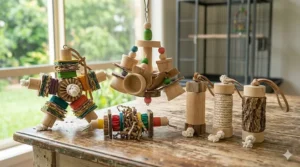
For birds who gravitate toward natural textures over plastic, the Mini Xmas Tree delivers vine cone construction adorned with a vine star and colorful plastic bead “ornaments” (7″ x 2″). This small/medium toy bridges the gap between manufactured toys and natural branch play.
Natural Behavior Connection: Vine materials mimic the bark and branch textures parrots encounter in wild environments. The varied density of vine versus plastic creates textural complexity that engages both chewing and tactile exploration. Unlike all-plastic toys, the organic components provide genuine destruction satisfaction for species programmed to strip bark and chew wood.
Best Suited For: Small to medium birds (parrotlets through Quakers) who show preference for natural materials, wooden perches, or palm fronds. Birds with suspected plastic sensitivities or those showing disinterest in all-synthetic toys often respond well to this hybrid approach.
Customer Patterns: Reviews frequently mention birds who ignored plastic toys becoming engaged with this natural-based option. The colorful beads seem to draw initial attention, then birds discover the more satisfying vine-chewing underneath.
✅ Pros:
- Natural materials appeal to texture-sensitive birds
- Lightweight construction suits gentle play styles
- Seasonal design adds visual cage interest
❌ Cons:
- Natural components degrade faster than synthetics
- Smaller size limits appeal for larger species
Value Proposition: At $8-$12, consider this a monthly consumable for dedicated chewers rather than a long-term investment.
7. Super Bird Creations SB586 X-mas Star — Lightweight Starter Toy
The X-mas Star represents the entry level of super bird creations toys—perfect for very small birds or introducing new toys to cautious species. Two crunchy vine stars decorated with dangling mini pacifiers (4.5″ x 3″) provide gentle introduction to interactive play.
Minimal Intimidation Factor: For birds who panic at large, complex toys, this offers non-threatening engagement. The lightweight vine stars move easily with minimal effort, building confidence in birds who’ve had limited toy exposure. The small pacifiers catch light and create gentle visual interest without overwhelming nervous individuals.
Target Demographic: Parrotlets, parakeets, cockatiels, lovebirds, and similarly sized birds. Particularly valuable for newly adopted birds still adjusting to captive environments, or species known for toy neophobia (fear of new things).
Adoption Stories: Multiple rescue organization volunteers mention using this toy to assess whether birds have ever engaged with enrichment—the simple design reveals whether lack of engagement stems from fear, lack of experience, or genuine disinterest.
✅ Pros:
- Non-threatening introduction to toy interaction
- Ultra-lightweight prevents injury risk
- Affordable experimentation for uncertain adopters
❌ Cons:
- Very limited complexity for experienced toy users
- Destroys quickly under regular use
Budget Angle: The $7-$11 price point makes this a risk-free first purchase when gauging a new bird’s toy preferences.
First 30 Days With Your New Super Bird Creations Toy: A Setup & Optimization Guide
Week 1: Introduction Without Pressure
The biggest mistake new bird owners make is shoving a brand-new toy directly into a bird’s face and expecting instant enthusiasm. Research has demonstrated that parrots without access to foraging can become bored, frustrated, and develop harmful behaviors, yet many birds raised in commercial settings have zero experience with toys at all.
Start by placing the new super bird creations toy outside the cage where your bird can observe it from a safe distance for 2-3 days. This reduces neophobia (fear of new things) that’s hardwired into prey species. You’re letting the bird’s natural curiosity build rather than forcing interaction. During this observation period, handle the toy yourself—play with the moving parts, make the bells ring, demonstrate it’s safe through your own interaction.
After 3-4 days of observation, move the toy to the outside of the cage bars where your bird can reach through to investigate without the commitment of full cage integration. Watch for positive signs: leaning toward the toy, vocalizing at it, reaching through bars to touch components.
Week 2-3: Strategic Placement Inside the Cage
Once your bird shows curiosity rather than fear, install the toy in a non-threatening location. Here’s what most guides miss: don’t hang it directly above the food dish or favorite perch—that creates territorial conflict. Instead, position it in a neutral zone where your bird can choose to engage or ignore it. For foraging toys like the 4 Way Forager, start with high-value treats your bird already loves rather than introducing new foods simultaneously.
If you’re working with a mechanical toy like the 4 Way Fun or Puzzle Play, spend 5-10 minutes daily demonstrating interaction yourself. Birds learn through social observation—your enthusiasm while spinning gears or bopping beads communicates “this is fun and safe.” Don’t force interaction; simply model the behavior and retreat.
Week 4: Optimization & Rotation Strategy
By the fourth week, you should see consistent engagement—or recognize this particular toy doesn’t suit your bird’s preferences. For successfully integrated toys, begin optimization: refill foraging cups with varied treats, rotate the toy’s cage position weekly to prevent habituation, and observe peak engagement times (morning vs. afternoon).
The critical insight that separates expert bird owners from novices is this: toy rotation prevents habituation faster than buying more toys. Keep 3-4 super bird creations toys in rotation, swapping them weekly so each one remains novel. A toy that bores your bird on day 45 becomes exciting again after 2-3 weeks of absence. This approach costs less and maintains higher engagement than constantly purchasing new options.
Common Mistakes to Avoid:
Mistake #1: Leaving destroyed toys in the cage. Once a foraging toy is empty or a chewable is 70% demolished, remove it. The presence of “solved” puzzles or destroyed items reduces motivation to engage with new challenges.
Mistake #2: Mixing too many toy types at once. If your bird has simultaneous access to foraging toys, chewing toys, mechanical toys, and comfort toys, decision paralysis can occur—especially in anxious individuals. Start with 1-2 toys, observe engagement, then add variety.
Mistake #3: Ignoring size recommendations. The “large bird” designation on products like the Bagel Cascade isn’t just suggestion—small beaks literally can’t manipulate components designed for African Greys. Using oversized toys creates frustration; undersized toys present choking hazards.
Mistake #4: Assuming silence means satisfaction. Some birds engage with toys quietly; others ignore them completely. The difference: quiet engagement includes focused attention, gentle manipulation, and regular return visits. Ignored toys collect dust and droppings without any wear patterns.
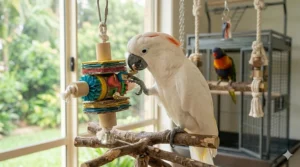
Understanding Bird Size Categories: Why Super Bird Creations Gets This Right
One frustration bird owners face with generic toys is vague sizing that forces guessing games. Super Bird Creations eliminates this confusion with specific size categories based on actual beak strength and cage proportions rather than arbitrary small/medium/large labels.
Small Bird Category (SB541 Crinkle Crinkle Little Star, SB586 X-mas Star)
Target Species: Parrotlets, parakeets (budgies), cockatiels, lovebirds
Physical Dimensions: Typically 4-7 inches, weighing under 3 ounces
Component Sizing: Designed for beaks generating under 150 PSI bite force
What makes these appropriate isn’t just smaller overall size—it’s the component proportions. The vine thickness in the X-mas Star is specifically calibrated for beaks that measure 8-12mm wide. Plastic rings and beads are sized so small birds can grip and manipulate them without jaw strain. Compare this to budget toys marked “small” that simply shrink large-bird designs without adjusting component relationships, creating toys that look proportional but function poorly.
Small/Medium Category (SB872 Mini Xmas Tree)
Target Species: Upper end of small birds (large cockatiels) through medium conures, Quakers, ringnecks
Bridge Function: Addresses the gap where birds have outgrown parrotlet toys but aren’t ready for Amazon-sized options
This category represents Super Bird Creations’ attention to real-world bird keeping—many homes have mixed flocks, and toys in this range work for multiple birds simultaneously. The 7″ x 2″ dimensions of the Mini Xmas Tree fit in cages sized for 200-400 gram birds without overwhelming space.
Medium/Large Category (SB878 4 Way Fun, SB770 Puzzle Play, SB634 4 Way Forager)
Target Species: Ringnecks, medium conures, Quakers, Caiques, Pionus, Senegals
Growing Room: Also suitable for smaller members of large species (young Amazons, African Greys)
Component Strength: Built for 150-300 PSI bite force
Here’s where cheap toys fail catastrophically—they use thin chains and weak connectors that medium birds destroy in hours. Super Bird Creations uses industrial-grade metal quick links and reinforced plastic chains that withstand daily manipulation from species known for destructive testing of every cage component.
Large Bird Category (SB1107 Bagel Cascade, plus any Large-designated toys)
Target Species: Amazons, African Greys, Eclectus, small Cockatoos, Mini Macaws
Heavy-Duty Construction: Designed for 300-500+ PSI bite force
Longevity Focus: Built to survive weeks or months of aggressive chewing
The Bagel Cascade’s 15-inch length and durable plastic core exemplify large-bird toy requirements. These birds don’t just chew for entertainment—they can demolish hardwood perches, crack nuts that require hammers, and test every connection point for structural weakness. Toys designed for this category must accommodate both the physical power and the problem-solving intelligence these species bring to destruction tasks.
Super Bird Creations Toys vs. Traditional Alternatives: The Real-World Difference
Most bird owners eventually ask: “Why spend $12-25 on a Super Bird Creations toy when I can get three similar-looking toys for the same price from generic brands?” The answer reveals itself in the first month of use, but understanding the differences upfront saves money and protects your bird.
Manufacturing Quality & Safety Standards
Super Bird Creations proudly assembles their products in Colorado, USA, with components that undergo toxicity testing and field trials. Their 30+ year track record means materials selection has been refined based on three decades of bird interactions—they know which dyes remain colorfast under beak moisture, which metals resist corrosion from droppings, and which plastics withstand repeated impacts without fragmenting.
Generic manufacturers, particularly those overseas with minimal regulation, often use whatever materials achieve the lowest price point. This manifests as flaking paint that birds ingest, metal chains that rust within weeks (creating sharp edges), and plastic components that crack into sharp shards. The first time a budget toy sends you to the avian vet for crop impaction or metal poisoning, the “savings” evaporate into hundred-dollar medical bills.
Behavioral Design vs. Visual Design
Here’s the fundamental philosophical difference: Super Bird Creations designs toys for birds, while generic manufacturers design for bird owners. Notice how super bird creations foraging toys use clear acrylic cups—this serves the bird’s learning process, not aesthetic preferences. Notice how their chewing toys feature varied textures (smooth plastic mixed with rough vine)—this addresses tactile exploration needs, not color coordination with cage décor.
Budget alternatives prioritize looking attractive in Amazon photos. They use excessive ribbons and bright colors that photograph well but offer limited behavioral value. A toy that’s 80% ribbons might look impressive hanging in a cage, but it provides only shredding satisfaction without the foraging, manipulation, or problem-solving components that address the multiple behavioral needs parrots demonstrate.
Total Cost of Ownership: The 6-Month Analysis
Let’s compare real numbers using a medium-sized Quaker parrot as our example:
Generic Toy Path (6 months):
- Month 1-2: Three $8 toys @ $24 total (all destroyed by day 45)
- Month 3-4: Three more $8 toys @ $24 (destroyed by day 90)
- Month 5-6: Three more $8 toys @ $24 (destroyed by day 135)
- Total investment: $72
- Vet visit for string ingestion (month 4): $150
- Total cost: $222
Super Bird Creations Path (6 months):
- Initial purchase: SB634 4 Way Forager ($22), SB878 4 Way Fun ($15), SB872 Mini Xmas Tree ($10) = $47
- Month 3 rotation additions: Two more comparable toys @ $30
- Replacement vine components (month 5): $8
- Total cost: $85
- Vet visits: $0
The math becomes even more favorable when you factor in the refillable designs. The Bagel Cascade’s replacement bagels cost roughly $12 for a pack that refills the toy 4-5 times—extending a single toy’s functional life to 6+ months for heavy chewers.
Design Innovation Examples
Compare the 4 Way Forager to a generic foraging box. The generic version typically features opaque compartments requiring birds to blindly search—this works for advanced foragers but causes frustration in beginners who give up and ignore the toy. Super Bird Creations’ clear cups let birds see the reward, maintaining motivation while still requiring effort to access treats. This single design choice, based on understanding bird learning psychology, makes the difference between a toy that gets used daily versus one that sits ignored until you remove it.
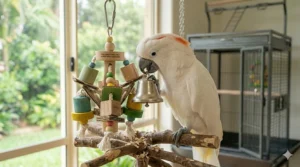
Real-World Scenario Guide: Matching Toys to Your Specific Situation
Scenario 1: The New Rescue Bird Who’s Never Seen a Toy
Challenge: Bird shows fear response to any hanging object, likely had zero enrichment in previous environment.
Solution Path: SB586 X-mas Star → wait 2-3 weeks → SB872 Mini Xmas Tree → monitor 4 weeks → introduce foraging option
Start with the absolute least threatening option. The X-mas Star’s small size and minimal movement create low fear response while establishing “things hanging in cage = safe.” Natural vine materials often feel more familiar to birds than all-plastic constructions. After fear subsides, introduce slightly larger options. Only after consistent engagement with non-foraging toys should you introduce foraging challenges—attempting foraging before toy comfort is established usually fails.
Timeline: Expect 2-3 months before complex toys like the 4 Way Forager become appropriate.
Scenario 2: The Chronic Screamer During Work Hours
Challenge: Bird has adequate food, water, cage space, but screams for attention during 8-hour workday absences.
Solution Path: SB634 4 Way Forager + SB1107 Bagel Cascade + toy rotation system
Screaming for attention often masks boredom and understimulation. The foraging approach replicates wild time-investment behaviors—a properly loaded 4 Way Forager occupies 15-30 minutes of active problem-solving. Pair this with the Bagel Cascade for physical outlet and you’ve created 1-2 hours of self-directed activity. The key is reloading foraging toys nightly so your bird wakes to fresh challenges rather than yesterday’s solved puzzles.
Expected Results: 40-60% reduction in attention-seeking vocalizations within 3-4 weeks, based on typical behavioral modification timelines.
Scenario 3: The Feather Plucker
Challenge: Bird has developed feather-destructive behaviors; veterinary exam ruled out medical causes.
Solution Path: Multi-sensory approach combining SB770 Puzzle Play + natural material options + professional consultation
Feather plucking rarely has simple toy-based solutions, but enrichment forms part of comprehensive behavior modification. The Puzzle Play’s varied textures and sounds provide alternative tactile/oral stimulation. Natural materials (vine-based toys) give birds appropriate destruction outlets. However, any established feather plucking requires professional avian behaviorist consultation—toys support but don’t replace qualified intervention.
Realistic Expectations: Toys may reduce plucking episodes by 20-30% but won’t solve underlying anxiety, hormonal, or environmental issues without additional intervention.
Scenario 4: The Multi-Bird Household
Challenge: Three birds (cockatiel, Quaker, African Grey) share play space; need toys appropriate for mixed flock.
Solution Path: Separate small-bird and large-bird cages, shared play gym with SB878 4 Way Fun + duplicate foraging options per bird
The mechanical nature of the 4 Way Fun works across size ranges since interaction doesn’t require specific beak strength—even the cockatiel can manipulate spinning components. However, provide size-appropriate foraging and chewing toys in individual cages to prevent resource guarding. Dominant birds (often the Quaker in this mix) will monopolize single foraging sources, leaving subordinate flock members without enrichment.
Implementation Note: Never assume toys can be shared equally—provide duplicates to prevent competition-based stress.
Scenario 5: The Budget-Conscious Owner of a Destructive Macaw
Challenge: Large parrot destroys expensive toys within days; owner can’t sustain $50-100 monthly toy budget.
Solution Path: SB1107 Bagel Cascade + DIY refillable approach + toy rotation
Focus initial investment on refillable/renewable designs. The Bagel Cascade with replacement bagels creates months of use from a single toy. Between refills, rotate the toy out for 2-3 weeks—returning it creates renewed interest. Supplement with appropriate DIY options (untreated wood blocks, paper bags with treats) between purchased toy cycles.
Cost Reality: Strategic purchasing of 3-4 refillable super bird creations toys, rotated properly, maintains enrichment for under $20 monthly including replacement components.
The Science Behind Why Super Bird Creations Toys Actually Work
You might wonder why avian veterinarians recommend super bird creations toys specifically rather than generic alternatives. The answer lies in behavioral science that most toy manufacturers completely ignore.
Foraging as Psychological Necessity
In the wild, parrots (scientifically classified as Psittaciformes) dedicate 60-70% of their active hours to food-related activities—searching, extracting, processing, and consuming. Research published by Cambridge University’s Animal Welfare journal demonstrates that parrots provided with foraging enrichment show significantly increased allopreening (social bonding behavior) and decreased stereotypic behaviors compared to birds eating from static dishes. This isn’t about physical nutrition—it addresses the psychological drive to work for food that captivity typically eliminates.
Super Bird Creations’ foraging toys like the 4 Way Forager specifically target this need by requiring birds to search (clear cups reveal treat locations), procure (cups must be accessed through manipulation), and extract (treats don’t fall freely). According to findings from the Rhode Island Parrot Rescue’s foraging research, birds without appropriate foraging opportunities develop boredom-based behaviors including feather plucking, excessive vocalization, and aggression at rates 3-4 times higher than enriched birds.
Contrafreeloading: The Choice to Work
Here’s a fascinating phenomenon researchers have identified: given the choice between freely available food and identical food that requires effort to obtain, many parrots choose to work for it. This “contrafreeloading” behavior suggests the act of foraging itself provides reward beyond the food—it satisfies an instinctual drive that captivity otherwise suppresses. Super bird creations foraging toys tap into this by maintaining food access while adding appropriate challenge levels.
Destruction as Emotional Regulation
Why do parrots destroy things? Beyond beak maintenance, research indicates destructive behavior serves emotional regulation functions similar to how stressed humans might tap fingers or chew gum. The varied textures in super bird creations toys—from soft vine to resistant cardboard to hard plastic—provide appropriate outlets that prevent redirection toward feathers, skin, or household items.
A study from the IAABC Foundation Journal on parrot enrichment found that African Greys provided with destructible enrichment showed 60% less inactive behavior (standing, sleeping) and 77% more active behavior during enrichment availability compared to baseline periods. The Bagel Cascade’s cardboard composition specifically addresses this need for appropriate destruction.
Cognitive Engagement & Problem-Solving
Parrots rank among Earth’s most intelligent animals—comparable to primates in certain cognitive tasks. The mechanical toys like the 4 Way Fun and Puzzle Play engage problem-solving abilities that static perches and food dishes completely bypass. Research on avian cognition shows birds provided with puzzle-based enrichment demonstrate reduced fear responses to novelty and increased exploratory behavior, suggesting cognitive challenges build confidence alongside entertainment.
How to Choose the Right Super Bird Creations Toy: A Decision Framework
Step 1: Identify Your Bird’s Dominant Behavioral Drive
Observe your bird for 3-5 days and track which activities occupy most non-sleeping time:
If primarily chewing/shredding: Focus on destructible options (Bagel Cascade, Mini Xmas Tree, any vine-based toys)
If primarily manipulating/exploring: Choose mechanical options (4 Way Fun, Puzzle Play)
If food-focused with minimal toy interest: Start with transparent foraging (4 Way Forager) before advancing to complex options
If anxious/fearful: Begin with lightweight, small, non-threatening options (X-mas Star) before introducing larger toys
Step 2: Consider Cage Architecture & Space
Measure your bird’s cage interior and identify toy mounting locations:
Vertical clearance: The Bagel Cascade’s 15″ length requires specific vertical space
Horizontal spread: Foraging toys with multiple cups (4 Way Forager) need horizontal clearance to prevent constant contact with cage walls
Mounting points: Count available suitable locations—toys should never crowd perches or block food/water access
Step 3: Assess Current Enrichment Gaps
What does your bird currently lack?
No foraging opportunities: Prioritize 4 Way Forager
Limited destruction outlets: Add Bagel Cascade or natural material options
Understimulation during alone time: Combine mechanical and foraging options
Excessive fear responses: Use confidence-building smaller toys first
Step 4: Factor in Replacement Cost & Sustainability
Refillable designs (Bagel Cascade): Higher initial cost but lower long-term expense—ideal for budget-conscious owners of destructive birds
Consumable designs (X-mas Star, Mini Xmas Tree): Lower initial cost but requires regular replacement—works for rotating variety seekers
Durable mechanical (4 Way Fun, Puzzle Play): Mid-range cost with longest lifespan for non-destructive interactors
Step 5: Start With One and Observe
Resist buying complete toy collections initially. Purchase one super bird creations toy that best matches steps 1-4, observe for 2-3 weeks, then add complementary options based on engagement patterns. This prevents wasting money on toy types your specific bird ignores while building a collection of proven engagement tools.
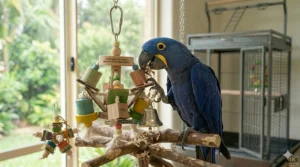
Common Mistakes When Buying Super Bird Creations Toys (And How to Avoid Them)
Mistake #1: Size Mismatching Based on Physical Bird Size Alone
The Error: Choosing “large bird” toys for an African Grey simply because Greys are large, ignoring individual personality and beak strength.
Why It Fails: A timid Grey raised in minimal-enrichment environments might feel overwhelmed by massive toys regardless of species-typical size. Conversely, an exceptionally destructive Quaker (medium bird) might demolish “medium” toys in hours and need large-bird options.
The Fix: Start one size category below species-typical recommendations for new-to-toys birds. Upgrade after consistent engagement rather than assuming species alone determines appropriate sizing.
Mistake #2: Buying Foraging Toys for Non-Foragers
The Error: Purchasing the 4 Way Forager for a bird who’s never encountered food outside a dish, expecting instant engagement.
Why It Fails: Foraging is a learned skill in captivity. Birds raised commercially often have zero experience with working for food and may literally not understand the concept of food hidden in toys.
The Fix: Introduce foraging gradually. Start with treats partially visible (clear cups work perfectly), then progress to fully-hidden challenges. Expect a learning curve of 2-4 weeks before complex foraging becomes natural.
Mistake #3: Leaving Destroyed Toys as “Decoration”
The Error: Keeping a 90%-shredded Bagel Cascade hanging in the cage because “there’s still a bit left.”
Why It Fails: Completely destroyed toys signal “solved puzzle”—they reduce motivation to engage with new challenges. Additionally, worn toys can develop sharp edges or exposed metal that creates injury risks.
The Fix: Remove toys when they reach 70% destruction or when all foraging components are empty. Rotate them out for 3-4 weeks before re-introducing (after refilling when applicable).
Mistake #4: Ignoring Toy Placement Psychology
The Error: Hanging new toys directly above food dishes or in favorite sleeping spots, creating territorial stress.
Why It Fails: Birds defend certain cage areas—forcing new objects into these territories triggers avoidance or aggression rather than curiosity.
The Fix: Place new toys in neutral zones away from food, water, and preferred perches. Allow birds to choose engagement rather than forcing proximity. After acceptance, you can relocate toys to optimize space.
Mistake #5: Assuming All Birds in a Species Love the Same Toys
The Error: Reading that “African Greys love the Bagel Cascade” and expecting your Grey to automatically engage.
Why It Fails: Individual personality variance within species often exceeds differences between species. Some Greys prefer mechanical puzzles; others want pure destruction; some ignore toys entirely without extensive conditioning.
The Fix: Test one toy, observe individual response, adjust accordingly. Don’t persist with toy types your specific bird rejects just because “the species is supposed to like this.”
Frequently Asked Questions About Super Bird Creations Toys
❓ Are super bird creations toys safe for birds who eat everything they destroy?
❓ Can I wash and reuse super bird creations foraging toys like the 4 Way Forager?
❓ How often should I replace super bird creations toys?
❓ Will super bird creations toys fit in my specific cage model?
❓ Do USA made bird toys actually matter compared to imported alternatives?
Conclusion: Investing in Your Bird’s Mental Health Through Quality Enrichment
After analyzing seven super bird creations toys across multiple size categories and behavioral needs, one pattern emerges consistently: these aren’t decorative cage fillers—they’re behavioral intervention tools that address specific psychological requirements captivity creates.
The difference between a bored, frustrated parrot and an engaged, content companion often comes down to whether their environment addresses instinctual drives for foraging, destruction, manipulation, and problem-solving. Super bird creations toys provide structured ways to meet these needs without requiring a free-flight aviary or eight hours daily of human interaction.
For owners transitioning from budget toys to quality enrichment, start with one or two options that best match your bird’s demonstrated preferences—whether that’s the destructive satisfaction of the Bagel Cascade, the problem-solving appeal of mechanical toys like 4 Way Fun, or the gentle introduction of foraging through the 4 Way Forager. Observe, adjust, and build your bird’s toy collection based on actual engagement rather than assumptions about what “should” work.
The 30+ year track record of Super Bird Creations reflects not just manufacturing quality but genuine understanding of avian behavioral needs. When veterinarians purchase these toys for their own birds and sanctuaries stock them for rescued parrots, that professional endorsement speaks louder than any marketing claim. Your bird deserves enrichment designed by people who understand the difference between colorful decoration and genuine behavioral support—and that’s exactly what this Colorado-based company delivers.
✨ Don’t Miss These Exclusive Deals!
🔍 Take your parrot enrichment to the next level with these carefully selected products. Click on any highlighted item to check current pricing and availability. These tools will help you create authentic behavioral engagement your feathered friend will love!
Recommended for You
- 7 Best Bird Grooming Perches That Actually Work – 2026
- 7 Best Pumice Perch for Birds in 2026
- 7 Best Rope Perch for Birds – 2026
Disclaimer: This article contains affiliate links. As an Amazon Associate, I earn from qualifying purchases. If you purchase products through these links, we may earn a small commission at no additional cost to you.
✨ Found this helpful? Share it with your friends! 💬🤗
