
In This Article
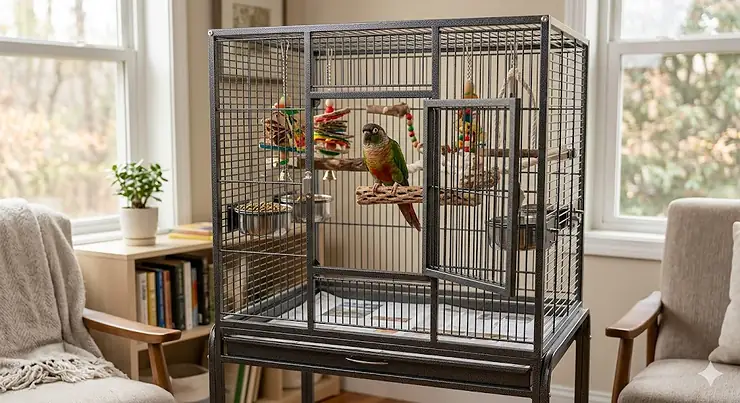
Conures are the friends who show up uninvited, rearrange your furniture, and somehow make your house better for it. They’re loud, they’re nosy, they dangle upside down from their cage roof like tiny feathered bats, and they will absolutely chew through anything that isn’t metal or your patience. So when it’s time to pick out their home base, you can’t just grab whatever’s on sale at the pet store and call it a day.
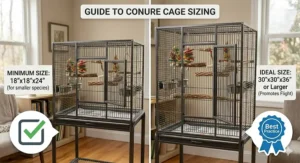
A conure cage buying guide really boils down to three questions: is it big enough, is it safe enough, and will it survive contact with a beak that can crack a sunflower seed in half a second. Get those three right and everything else — color, style, whether it matches your living room — is just garnish.
I went looking at what’s actually for sale right now, not a list recycled from 2019, and pulled together seven cages that real conure owners are putting in their homes today. Some are budget-minded. One is a borderline showpiece. All of them can do the job if you match them to the right bird and the right space. Let’s get into it.
Quick Comparison Table
| Cage | Dimensions (L x W x H) | Bar Spacing | Best For | Price Range |
|---|---|---|---|---|
| Yaheetech 61″ Playtop | 26″ x 26″ x 61.5″ | 0.6″ | Best all-around pick | $140–$180 |
| Prevue Hendryx Wrought Iron Flight Cage (5 Ft X-Large) | ~37″ x 23″ x 60″+ | ~1/2″–5/8″ | Best for larger/multiple conures | $280–$380 |
| VIVOHOME 54″ Flat Top | 24″ x 22″ x 54″ | ~3/4″ | Best budget full-size | $110–$150 |
| VEVOR 64″ Open Top | 18″ x 14″ x 64″ | 0.4″ | Best for supervised free time | $130–$170 |
| Prevue Pet Select 3151 | 18″ x 18″ x 32″ | 3/4″ | Best compact/single-conure | $90–$130 |
| A&E Cage Co. Triple Stack 36″x24″ | 36″ x 24″ x 76″ | 3/4″ | Best for pairs or breeders | $300–$400 |
| VIVOHOME 19″ Travel Carrier | ~19″ total | N/A (solid construction) | Best travel/vet-visit cage | $40–$60 |
A few things jump out once you line these up side by side. The price spread is enormous — you can spend the cost of the Prevue flight cage almost three times over and still have cash left for the VIVOHOME travel carrier. That’s not a coincidence; it tracks almost exactly with floor space and build quality. Notice also that bar spacing doesn’t scale neatly with price. The VEVOR, one of the cheaper full-size options, actually has tighter bars than the pricier A&E unit, which matters more for a small green-cheek conure than for a chunkier Patagonian conure.
💬 Just one click — help others make better buying decisions too!😊
✨ Don’t Miss These Exclusive Deals!
🦜 Take your conure’s living situation to the next level with these picks. Click through on any highlighted cage to check current pricing and availability before you commit — these prices move fast, especially around the holidays.
Top 7 Conure Cages: Expert Analysis
1. Yaheetech 61-inch Playtop Wrought Iron Large Parrot Cage
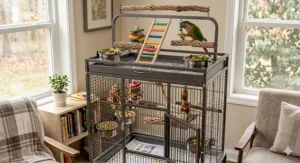
The standout feature here isn’t the size, it’s the rooftop. Yaheetech 61-inch Playtop gives your conure an actual second living zone on top of the cage, complete with a ladder and a wood dowel perch, so the bird has somewhere to go during supervised out-of-cage time instead of careening around your kitchen looking for trouble.
The cage itself measures 26″ x 26″ x 61.5″, with 0.6-inch bar spacing — wide enough that it won’t feel claustrophobic to a sun conure or quaker parakeet, but tight enough that a green-cheek isn’t going to slip a head through and panic. What that bar spacing means in practice: it sits right at the edge of “fine for most conures” and “too wide for the smallest ones,” so if you’ve got a tiny green-cheek who likes to test boundaries, watch the first few days closely.
What most buyers overlook about this model is the locking system split between the main door and the four separate feeder doors. The main door uses a button lock, which is conure-resistant in a way that simple slide latches aren’t — and if you’ve ever had a conure figure out a latch, you know exactly why that distinction earns its keep.
Owners consistently mention how much their birds use the playtop area, sometimes more than the interior of the cage itself, which is either a feature or a mild personal insult depending on how you look at it.
✅ Pros: Genuinely useful playtop, secure button lock, easy-roll casters
❌ Cons: Bar spacing borderline for the smallest conure species
Price range: $140–$180. For a cage with a dedicated play structure built in, that’s solid value — you’d otherwise be buying a separate play stand.
2. Prevue Hendryx Wrought Iron Flight Cage (5 Ft X-Large)
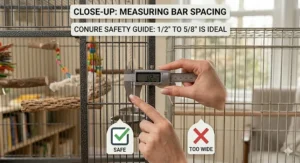
If the Yaheetech is the practical daily driver, the Prevue Hendryx Wrought Iron Flight Cage is the one you buy when you’ve decided your conure deserves an upgrade in life. This is a five-foot, X-Large flight cage built from solid wrought iron with a hammertone black finish, and it’s designed with horizontal flying room in mind rather than just vertical climbing space — which, if you’ve read anything about conure behavior, is exactly the priority you want.
The spec sheet won’t tell you this, but the two large front doors paired with six smaller side access doors change your whole daily routine. You’re not wrestling one big door open every time you need to swap a water dish; you pop a side door, do the job, and move on. Three full-width wood dowel perches and four trough-style food and water cups round out the interior, and the lockable metal floor grille combined with a pull-out debris tray makes weekly cleaning closer to a five-minute chore than a production.
In my experience, this is the cage people buy once and don’t replace for a decade. The integrated stand includes a built-in storage shelf, so your seed, toys, and cleaning supplies live right next to the cage instead of cluttering a side table.
✅ Pros: True flight-cage proportions, side-door access, durable wrought iron build
❌ Cons: Expensive; large footprint requires real floor space
Price range: $280–$380. It’s the priciest cage on this list, and it’s priced like what it is — a long-term investment piece rather than a starter cage.
3. VIVOHOME 54-inch Wrought Iron Large Bird Flight Cage
This is the cage I’d point a first-time conure owner toward if their budget has a ceiling. The VIVOHOME 54-inch comes in at roughly 24″ x 22″ x 54″, built on a sturdy low-carbon steel frame with a hammer-pattern, non-toxic paint finish that resists the scratching and chewing a bored conure will absolutely test it with.
The flat-top design is the trade-off here — no playtop ladder situation like the Yaheetech — but what most reviewers miss is that the flat top is actually a feature for some setups: you get a clear surface to hang extra toys or set a small potted plant without it interfering with a play structure. The cage ships with four plastic food boxes and two wood perches, plus a pull-out tray for cleaning, and a latch design specifically built to resist a conure popping the door open on its own, which is not a universal feature at this price point.
Who this is for: budget-conscious buyers with a single green-cheek or smaller sun conure who want a full-size cage without flight-cage pricing.
✅ Pros: Strong value for full interior dimensions, anti-chew paint finish, secure latch
❌ Cons: No dedicated play area on top
Price range: $110–$150. For the floor space you’re getting, this is one of the better dollar-per-square-inch options on the list.
4. VEVOR 64-inch Open Top Large Parrot Bird Cage
The VEVOR 64-inch Open Top takes a different approach entirely — instead of a closed playtop with a roof, the entire top of the cage opens up, turning the whole unit into a tall, open perching tower during the day and a secure enclosure at night when you close it back up.
At 0.4-inch bar spacing, this is one of the tighter options on this list, which actually makes it a strong pick if you’ve got a smaller conure species or you’re housing a conure alongside lovebirds or cockatiels in a shared space. The drawer-style base with a grid grille keeps droppings separated from the bird’s living space, and the four side feeding doors mean you’re not opening the main door just to refill water.
What stands out in practical use is the open-top design’s flexibility: close it for a secure overnight cage, open it for supervised daytime perching, and the included storage shelf on the rolling stand keeps cleaning supplies within arm’s reach. The trade-off is that “open top” only works if you’re supervising — it’s not a roam-free situation, it’s a controlled one.
✅ Pros: Tight bar spacing, flexible open/closed design, rolling stand with storage
❌ Cons: Narrower footprint than some competitors; not ideal for larger Aratinga-type conures
Price range: $130–$170. A fair price for a cage that effectively does double duty as both an enclosure and a supervised perch tower.
5. Prevue Pet Products Wrought Iron Select Bird Cage (3151)
Apartment living, smaller conure, or just don’t have room for a five-foot flight cage? The Prevue Pet Select 3151 is the compact answer. Interior dimensions land at 18″ x 18″ x 32″, with an upper play area featuring two arched ladders and 0.75-inch bar spacing.
Here’s the practical interpretation that matters: 0.75-inch spacing is on the wider end for conures, which makes this cage a better match for a single sun conure or jenday than for a smaller green-cheek that could test the limits of those bars. Prevue’s own product literature confirms the bar spacing on this particular Select Series cage, so this isn’t a guessing game — it’s a known fit issue you should plan around rather than discover later.
The cage includes four stainless steel feeder cups, a pull-out drawer and grille combo for cleaning, and two perches. It’s a smart pick for someone who wants a name-brand, well-built cage without committing to flight-cage square footage — just match the bird to the bar spacing, not the other way around.
✅ Pros: Compact footprint, name-brand build quality, easy-clean pull-out tray
❌ Cons: Bar spacing too wide for the smallest conure species
Price range: $90–$130. Solid value if your space (or your specific conure species) calls for something smaller.

6. A&E Cage Co. Triple Stack Cage, 36″x24″
If you’re housing a bonded pair of conures, or you’ve got ambitions toward breeding, the A&E Cage Co. Triple Stack is built for exactly that. Exterior dimensions run 36″ x 24″ x 76″ with a 21-inch interior height and 3/4-inch bar spacing — and the “triple stack” name refers to its modular, multi-unit design, which lets you separate birds when needed without buying three completely separate cages.
What most single-bird owners overlook here is that this isn’t really a casual purchase — it’s infrastructure. The stacked configuration means you can isolate a sick bird, introduce a new pair gradually, or simply run a small home aviary setup without your living room turning into an avian zoo. The 3/4-inch bar spacing matches what aviary and rescue groups commonly recommend for medium conure species like sun and Jenday conures.
This is a buy-it-once piece of equipment for someone serious about conure-keeping at a slightly larger scale than “one pet bird in the corner of the living room.”
✅ Pros: Modular multi-bird design, generous interior height, durable construction
❌ Cons: Large footprint and price tag overkill for a single pet conure
Price range: $300–$400. Priced like the specialty equipment it is, not like a casual impulse buy.
7. VIVOHOME 19-inch Wrought Iron Bird Travel Carrier
Every conure owner eventually needs this cage, even if they don’t think they do yet. The VIVOHOME 19-inch Travel Carrier is built specifically for vet visits, short trips, or temporary housing during a cage cleaning deep-dive — not as a primary residence.
The advice readers don’t get from the Amazon listing alone: a travel cage isn’t optional gear, it’s a safety requirement. If you ever need to evacuate during a storm, isolate a sick bird from a flock, or transport your conure to an avian vet, trying to improvise with a cardboard box or a too-small carrier is how injuries happen. This unit’s wrought iron build is sturdy enough for short-duration use, with handle-carry design that keeps the bird secure during movement.
This isn’t a cage you compare on bar spacing or floor space — it’s a cage you compare on “will it survive being grabbed and carried out the door in an emergency,” and this one does.
✅ Pros: Purpose-built for transport, sturdy despite compact size, affordable
❌ Cons: Not suitable as a primary or long-term enclosure
Price range: $40–$60. Cheap insurance for a situation you hope you never need but will be grateful for when you do.
How to Choose a Conure Cage
Before you scroll back up and start comparing specs, run through this five-step framework. It’ll save you from buying twice.
- Identify your conure’s actual size. A green-cheek and a Patagonian conure are both “conures” but might as well be different species when it comes to cage needs. Smaller conures need tighter bar spacing; bigger ones need more floor space.
- Measure your available floor space first, budget second. A gorgeous flight cage that doesn’t fit your room isn’t a gorgeous flight cage, it’s a return shipping label.
- Prioritize horizontal space over height. Conures fly and glide more than they climb straight up, so a wide, squat cage almost always beats a tall, narrow one.
- Match bar spacing to your specific bird, not the species in general. When in doubt, go tighter rather than wider — a slightly cramped fit is safer than a bird that can wedge its head between bars.
- Decide if you need a single cage or a system. One conure, one bored weekend hobbyist energy level, and a small apartment usually means a compact cage. A bonded pair or breeding setup means you’re shopping for infrastructure, not just a cage.
Conure Cage Size Guide: How Much Space Does Your Bird Actually Need
What is the minimum size for a conure cage? Most avian sources put the floor at roughly 20″ x 20″ x 30″ for smaller conure species, scaling up to 30″ x 30″ or larger for big-bodied species like the Patagonian conure. Bigger is always better — there’s no documented downside to more space, only to less.
The Merck Veterinary Manual puts it in terms that scale to any bird’s body, regardless of species: a cage should give the bird at least one and a half times its wingspan in every direction, so it can stretch fully without touching the bars. For a conure, that translates to noticeably more room than the bird’s body alone would suggest — these are active flyers, not perchers content to sit still all day.
| Conure Size | Example Species | Minimum Cage Footprint |
|---|---|---|
| Small | Green-cheek, maroon-bellied | 20″ x 20″ |
| Medium | Sun, Jenday, Nanday | 24″ x 24″ |
| Large | Patagonian | 30″ x 30″ |
Looking at that table, the practical takeaway is simple: don’t size your cage off a chart alone if you can afford to go bigger. A cage at the bare minimum works, but most behavioral problems in caged conures — feather plucking, excessive screaming, cage aggression — show up disproportionately in birds kept at or near minimum space for years on end.
Bar Spacing and Cage Materials: What Actually Keeps Your Conure Safe
Bar spacing gets treated like a minor spec, but it’s arguably the single most important safety number on the whole listing. Too wide, and a curious conure can wedge its head through and panic — sometimes fatally. Too narrow, and a larger bird can’t grip the bars properly to climb, which sounds minor but actually affects daily mobility and mental stimulation.
For smaller conures (green-cheek, maroon-bellied, black-cap), look for spacing in the 3/8″ to 1/2″ range. Medium conures (sun, Jenday, Nanday) do well with 1/2″ to 3/4″. Larger species can handle 3/4″ to as much as 7/8″ without risk. The Wikipedia entry on conures is a useful primer if you’re trying to figure out which genus your particular bird falls into, since “conure” isn’t a strict scientific category — it’s an aviculture catch-all covering dozens of species across several genera.
Material matters almost as much as spacing. Powder-coated steel is the budget-friendly standard and works fine as long as the coating is even and free of bubbles. Wrought iron, which shows up on several cages in this guide, resists bending and lasts considerably longer under a determined beak. One material to actively avoid: anything zinc-coated or galvanized. Birds that chew on galvanized bars are at risk of zinc toxicosis, which is a real and avoidable danger — always check that a cage’s finish is explicitly labeled bird-safe.
Setting Up Your New Cage: A Practical Usage Guide
Getting the cage home is step one. Setting it up wrong is how a perfectly good cage becomes a source of stress for your bird in the first month.
Start with placement: away from direct kitchen fumes, drafts, and direct blasting AC or heat vents, but still in a room where your family spends time — conures are social birds and isolation is rough on them psychologically. Add perches of varying diameters and textures rather than uniform dowels; foot health depends on variety, not just quantity. Stagger toys at different heights instead of clustering them all in one corner, which encourages the bird to actually move around the cage rather than camp on one perch.
In the first 30 days, resist the urge to rearrange constantly. Conures are curious but also creatures of habit, and a cage that changes layout every week prevents them from building the confidence that comes with familiarity. Clean the tray and grille weekly at minimum, more often if you notice odor building up faster than expected — that’s usually a sign the cage is slightly undersized for how much the bird is eating and moving.
Real-World Scenarios: Matching the Cage to Your Life
The apartment-dwelling first-timer with one green-cheek conure: Go with the Prevue Pet Select 3151 or the VIVOHOME 54-inch. Compact, budget-conscious, and the bar spacing on the VIVOHOME in particular handles a smaller bird safely without eating up half your living room.
The experienced owner with a sun conure who free-ranges supervised: The Yaheetech 61-inch Playtop or the VEVOR 64-inch Open Top both shine here — the dedicated upper perching areas give the bird somewhere productive to go during out-of-cage hours instead of treating your curtains like a jungle gym.
The household with a bonded pair, or someone dipping a toe into small-scale breeding: The A&E Triple Stack or the Prevue Hendryx Flight Cage are the only two on this list with the floor space and structural seriousness to handle multiple birds long-term without anyone feeling cramped.
Common Mistakes When Buying a Conure Cage
The single most common mistake is buying based on the bird’s current size rather than its adult size — conures don’t grow dramatically after weaning, but owners frequently underestimate how much space an active adult bird actually uses compared to a juvenile still settling in.
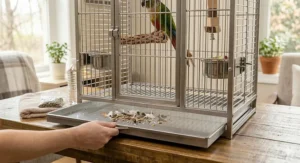
The second mistake is ignoring bar spacing in favor of overall dimensions. A massive cage with bars too wide for your specific conure species is a hazard dressed up as generosity. Third: skipping the locking mechanism check. Conures are notoriously good at popping simple slide latches, and a cage that looks secure on paper can turn into a daily escape-and-recapture routine within a week. Finally, people consistently underestimate cleaning frequency — a cage that looks easy to clean in product photos can turn into a 20-minute chore if the tray design is awkward, so factor that into your actual time budget, not just the upfront price.
✨ Don’t Miss These Exclusive Deals!
🔍 Take a closer look at the cages above before you decide — checking current availability now means you’re not stuck waiting on backorders once you’ve made up your mind.
Conure Cage vs. Flight Cage vs. Travel Carrier: What’s the Difference
These terms get used loosely, and that looseness causes buying mistakes. A standard conure cage is built for daily living — eating, sleeping, climbing, short bursts of activity. A flight cage, like the Prevue Hendryx model on this list, is built with horizontal space specifically sized for actual wing-flapping flight, not just climbing room; it’s a meaningfully bigger commitment in both price and footprint. A travel carrier, like the VIVOHOME 19-inch, isn’t meant for daily living at all — it’s short-duration transport gear, full stop.
The mistake people make is assuming a bigger cage automatically qualifies as a flight cage, or that a travel carrier can double as a backup home cage in a pinch. Neither holds up. If your conure spends meaningful daily time in the cage rather than out of it, a true flight cage earns its higher price tag through better long-term welfare outcomes — documented behavioral issues like feather plucking correlate with insufficient daily flight room, not just insufficient floor space.
Long-Term Cost and Maintenance
The sticker price is the smallest piece of the real cost. Replacement perches wear out and need swapping every few months depending on how aggressively your bird chews. Feeder cups, especially plastic ones, crack and need replacing more often than owners expect. Powder-coated cages need occasional touch-up if the coating chips, since exposed metal underneath can rust.
Looking at the comparison table from earlier, the cheaper cages on this list — the VIVOHOME 54-inch and the VEVOR 64-inch — actually hold up reasonably well on long-term cost because their construction, while less premium than the Prevue Hendryx, doesn’t carry proportionally higher maintenance needs. The real long-term value gap shows up with the A&E Triple Stack and Prevue Flight Cage: higher upfront cost, but wrought iron construction that resists the wear-and-tear cycle far longer than painted steel, which can offset the price difference over a five-to-ten-year ownership window.
Features That Actually Matter (And Ones That Don’t)
Bar spacing matters. Lock security matters. Tray accessibility for cleaning matters. Floor space matters more than height. Those four things separate a genuinely good cage from a mediocre one regardless of price point.
What doesn’t matter nearly as much as marketing suggests: color (birds don’t care, though it might affect how visible droppings are against the finish), included toy quantity (you’ll replace most of them anyway with ones your specific bird actually likes), and “designer” aesthetic touches that add cost without adding function. If a listing spends more time talking about how a cage looks in your living room than how it keeps your bird safe, that’s worth noticing.
Cage Placement and Safety in Your Home
Where you put the cage matters almost as much as which cage you buy. Avoid kitchens entirely if possible — non-stick cookware releases fumes when overheated that are genuinely dangerous to birds’ respiratory systems, and conures’ efficient lungs make them more sensitive than most pets in the house. Keep the cage away from windows that get intense direct afternoon sun without any shade option, and away from doors that create cold drafts in winter.
Stability matters too, especially for the taller cages on this list like the Prevue Hendryx and Yaheetech models — make sure the rolling casters are locked when the cage is stationary, since an active conure climbing aggressively on one side can shift an unlocked cage more than people expect.

❓ FAQ
❓ What is the minimum cage size for a conure?
❓ How do I choose conure cage bar spacing?
❓ Are conure-proof cage locks really necessary?
❓ What conure cage features actually matter most?
❓ How often should I do conure cage setup tips like rearranging or cleaning?
Conclusion
A good conure cage isn’t really about luxury features or how it photographs for Instagram. It’s about floor space your bird will actually use, bar spacing that matches their specific size, and a lock they can’t out-think on a bored Tuesday afternoon. Whether you land on the all-around Yaheetech, splurge on the Prevue Hendryx flight cage, or go practical with the VIVOHOME budget pick, the right choice comes down to matching the cage to your actual bird and your actual space — not the other way around.
Get that match right, and the cage stops being furniture you maintain and starts being a genuinely good home for a bird that, frankly, deserves one.
✨ Don’t Miss These Exclusive Deals!
🦜 Ready to upgrade your conure’s space? Check current pricing and availability on any of the cages above — these spots tend to sell out fast once the good reviews start rolling in.
Recommended for You
- Top Rated Conure Cages: 7 Best Picks for 2026
- 7 Best Wrought Iron Cockatiel Cages in 2026
- 7 Best Cockatiel Cage with Play Top: Expert Picks 2026
Disclaimer: This article contains affiliate links. As an Amazon Associate, I earn from qualifying purchases. If you purchase products through these links, we may earn a small commission at no additional cost to you.
✨ Found this helpful? Share it with your friends! 💬🤗
