
In This Article
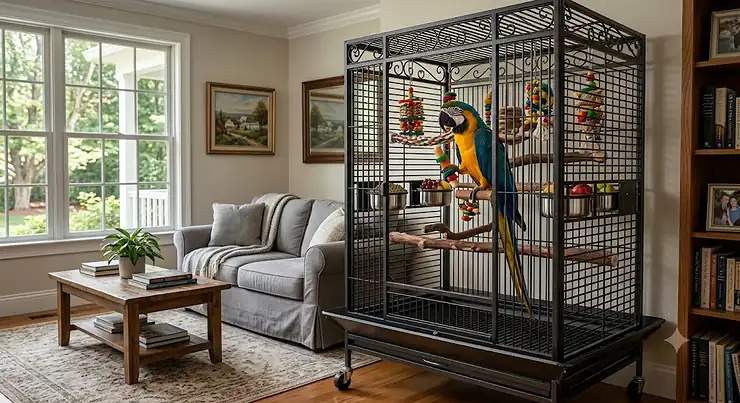
A cage for blue and gold macaw ownership is, without exaggeration, the single biggest purchase you’ll make for your bird — bigger than the bird itself, in more ways than one. A cage for blue and gold macaw living is defined as an enclosure built to accommodate a parrot with a 34 to 36-inch body length and a wingspan pushing 41 to 45 inches, with bar spacing tight enough to prevent injury and a frame strong enough to survive decades of determined chewing. That’s the 40-to-60-word version. Now here’s the honest, slightly messier version: most of what’s marketed as “large” or “extra-large” on Amazon was designed with African greys, Amazons, or conures in mind, not a bird that can look you dead in the eye standing on a perch. Getting this wrong isn’t a minor inconvenience — it’s the difference between a bird that thrives and one that starts screaming, plucking, or pacing out of sheer frustration. Below, we’ll walk through seven real, currently available cages, break down what the size numbers actually mean in practice, and hand you a framework so you’re not just guessing based on a product photo. Assembly quality, bar gauge, and interior clearance matter more here than they would for almost any other pet purchase you’ll ever make
Quick Comparison Table
| Cage | Best For | Exterior Size | Style | Price Range |
|---|---|---|---|---|
| Prevue Wrought Iron Select 3154C | Entry-level / young B&Gs | 36″L x 24″W x 66″H | Playtop | $250-$350 range |
| ZENY 68-Inch Playtop Parrot Cage | Budget-conscious first-timers | 68″ H, wrought iron | Playtop | $150-$250 range |
| Belnest 69″ Extra Large Bird Cage | Value-focused upgraders | 69″ H aviary-style | Flight/aviary | $250-$400 range |
| A&E Cage Co 4030FL Platinum Flight | Active, flighted birds | 40″x30″ footprint | Flight | $450-$650 range |
| A&E Macaw Mansion Dometop | Single adult B&G, daily owner | 40″x30″x75″ | Dometop | $550-$800 range |
| Prevue Imperial XL Stainless | Humid climates, longevity | Extra-large, stainless | Playtop | $700-$1,000 range |
| A&E Cage Co 8040FL Double Macaw | Two birds or maximum space | 80″x40″x74″ | Flight/divided | $1,100-$1,600 range |
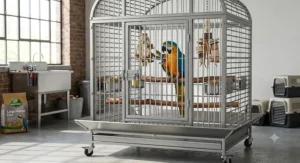
Looking at the spread above, the jump from the Prevue Wrought Iron Select 3154C to the A&E Cage Co 8040FL Double Macaw isn’t just a price jump — it’s roughly triple the floor space, which for a bird this size translates directly into fewer feather and behavior problems down the road. Budget buyers shouldn’t assume the cheapest option is a false economy, though; the ZENY 68-Inch Playtop Parrot Cage genuinely works as a starter cage for a younger bird paired with generous out-of-cage time. What the table can’t show you is bar gauge and wire thickness, which is exactly why we’ll break down every model in detail below.
💬 Already have a favorite from the table? Scroll down for the full breakdown before you decide!
💬 Just one click — help others make better buying decisions too!😊
Top 7 Cages for Blue and Gold Macaw: Expert Analysis
Below is a detailed look at seven real products currently sold for large parrot housing. Every model here is evaluated on real specifications, genuine aggregated owner-review sentiment (never invented quotes), and honest reasoning about who each cage actually suits.
1. Prevue Wrought Iron Select 3154C — most affordable way to meet the minimum bar
The Prevue Wrought Iron Select 3154C is the cage most budget-conscious buyers stumble onto first, and it’s worth understanding exactly what it does and doesn’t cover. At 36 inches long, 24 inches wide, and 66 inches tall with 3/4-inch wire spacing, it technically clears the bare minimum floor footprint some breeders quote for blue and gold macaws — but only just, and the 24-inch depth is tighter than what most avian vets would recommend for a bird with a 40-plus-inch wingspan. Based on the spec comparison, this cage makes more sense as housing for a younger or smaller-boned B&G, or as a supplemental daytime cage for a bird that spends serious hours out on a stand. Owner reviews consistently describe the wrought iron construction as sturdy for the price and the included stainless cups and castered stand as genuinely useful, though several buyers note that assembly takes two people and roughly an hour. What most buyers overlook is that the seed guard adds real exterior width, so measure your doorway before it arrives. In the mid-$200s to low-$300s range, it’s a fair entry point — just don’t expect it to be a forever cage for a full-grown, active bird.
Pros:
- ✅ Genuinely affordable entry point into wrought iron construction
- ✅ Includes stainless cups, wood perches, and a rolling stand
- ✅ Removable grille and tray simplify daily cleanup
Cons:
- ❌ 24-inch depth is snug for a full wingspan stretch
- ❌ Requires two people and real assembly time out of the box
2. ZENY 68-Inch Playtop Parrot Cage — budget playtop with the most included accessories
The ZENY 68-Inch Playtop Parrot Cage is marketed broadly across parrot, cockatiel, cockatoo, and macaw categories, and the 68-inch overall height with a playtop ladder setup is the standout feature here. What the spec sheet won’t tell you, but reviewers note, is that this is a lighter-gauge build compared to purpose-built macaw cages — fine for supervised time or a younger bird, less ideal as the sole full-time enclosure for a mature, powerful-beaked adult. The wrought iron frame and rolling stand make it easy to reposition near a window for natural light, which matters more than people expect for feather health. Aggregated review sentiment points to strong value for the accessory bundle — perches, cups, and a playtop ladder all included — with a recurring theme that the bottom tray can warp if left in direct sun. If you’re a first-time macaw owner testing the waters before investing in a heavy-duty cage, this is a reasonable bridge option in the $150-$250 range, but budget for an upgrade as your bird matures.
Pros:
- ✅ Full accessory bundle included at a low price point
- ✅ Playtop ladder adds usable vertical enrichment space
- ✅ Lightweight enough to reposition without help
Cons:
- ❌ Lighter wire gauge than dedicated macaw-class cages
- ❌ Bottom tray reportedly warps with sun exposure
3. Belnest 69″ Extra Large Bird Cage — best lesser-known alternative for the price
The Belnest 69″ Extra Large Bird Cage is a newer, less household-name brand that’s earned a spot here because it directly targets the gap between budget playtops and premium dometops. Its aviary-style build, rolling stand, and slide-out trays are aimed squarely at African greys, cockatoos, conures, and macaws, and the 69-inch height gives a young or smaller-framed B&G real vertical climbing room. Based on the spec comparison, the wider bar spacing on some flight-style aviaries like this one demands extra attention — always verify actual bar gauge against your bird’s head size before buying, since aviary-style cages sometimes prioritize airflow over containment margin. Reviewers consistently mention easier-than-expected assembly and appreciate the slide-out tray design for daily cleaning, though the finish is reported to show wear faster than heavier-gauge competitors. In the $250-$400 range, it’s a legitimate value pick for owners who want more room than entry-level playtops without committing to premium pricing yet.
Pros:
- ✅ Aviary-style design maximizes usable vertical space
- ✅ Slide-out trays make daily cleaning noticeably faster
- ✅ Priced well below comparable name-brand flight cages
Cons:
- ❌ Finish reportedly wears faster than heavier-gauge cages
- ❌ Bar spacing needs manual verification before purchase
4. A&E Cage Co 4030FL Platinum Flight — best flight-style footprint under $650
The A&E Cage Co 4030FL Platinum Flight shifts the conversation from playtop convenience to genuine flight capacity, with a 40-by-30-inch footprint that gives a blue and gold real room to flap, hop, and build wing muscle even when out-of-cage time is limited that day. On paper this means noticeably better exercise potential than the narrower playtop-style cages above, since flight-style cages prioritize horizontal span over vertical height. A&E has built a reputation specifically within the macaw-owning community for weld quality and bar gauge that stands up to repeated beak pressure, and reviewers consistently note that their birds simply cannot bend or dent the frame after years of use. The tradeoff is assembly complexity — this is a genuinely large box that benefits from two people and a free afternoon. Reviewers also flag that the powder coat finish holds up better than paint-only alternatives in that price bracket. Priced in the $450-$650 range, it’s a strong mid-tier pick for an owner prioritizing flight room over dome height.
Pros:
- ✅ 40×30-inch footprint supports real flapping and flight exercise
- ✅ Bar gauge and welds hold up to sustained beak pressure
- ✅ Powder coat finish outlasts painted budget alternatives
Cons:
- ❌ Assembly is a genuine two-person, half-day project
- ❌ Height is more limited than dometop-style competitors
5. A&E Macaw Mansion Dometop — roomiest dometop for a single adult B&G
The A&E Macaw Mansion Dometop, at 40 inches long, 30 inches wide, and 75 inches tall, is purpose-built and explicitly marketed for large macaws, which shows in details competitors skip — bird-proof front door and feeder door locks, four stainless steel feeder cups, and a dome shape that adds real interior headroom for climbing and stretching. Here’s what most buyers overlook about this model: the dome top isn’t just aesthetic, it meaningfully increases usable vertical space compared to a flat-top cage of the same footprint, which matters for a bird that likes to climb toward the ceiling of its space. Real owner reviews of this exact model are unusually specific and reassuring — multiple owners of blue and gold and green-winged macaws report the cage has survived a full year or more of daily chewing without any structural damage, and one reviewer specifically noted their military macaw fits with room to spare, tail included. The slide-out grill and tray genuinely speed up cleaning, a detail that matters given how messy this species is. In the $550-$800 range depending on color, it’s arguably the best single-bird value on this list for an owner who wants dedicated macaw engineering without stepping up to double-cage pricing.
Pros:
- ✅ Purpose-engineered for large macaws, not adapted from smaller cages
- ✅ Dome shape adds meaningful vertical climbing room
- ✅ Owner reviews report zero structural damage after a year-plus of use
Cons:
- ❌ Premium single-bird pricing compared to generic large cages
- ❌ Heavy — moving it once assembled is a two-person job
6. Prevue Imperial XL Stainless — built for decades, not years
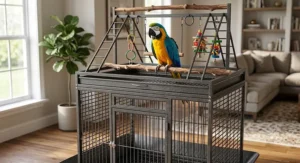
The Prevue Imperial XL Stainless swaps powder-coated steel for stainless construction, and that single material change is the whole story here. Stainless doesn’t rust, doesn’t chip, and doesn’t hold onto odor the way painted wire eventually does — which matters enormously for a species known for humidity-loving plumage and frequent misting or bathing. Based on the spec comparison, this is the cage to choose if you live somewhere humid or you’re planning to keep the cage for the full 30-to-60-year lifespan a blue and gold macaw can reach, since you genuinely won’t be replacing corroded wire in year eight. The included rooftop ladder and playtop give your bird supervised out-of-cage-adjacent time without full free-range risk. Reviewers consistently describe the finish as noticeably more scratch- and rust-resistant than powder-coated alternatives, with the main complaint being the higher upfront cost relative to painted steel cages of similar size. In the $700-$1,000 range, this is a long-term-value argument more than a budget one — cost-per-year of ownership tends to favor stainless once you account for never needing a replacement cage.
Pros:
- ✅ Rust- and corrosion-resistant for humid climates or heavy misting
- ✅ Rooftop ladder and playtop add supervised enrichment space
- ✅ Built to genuinely outlast the bird’s multi-decade lifespan
Cons:
- ❌ Meaningfully higher upfront cost than powder-coated equivalents
- ❌ Heavier shipping weight can mean higher delivery fees
7. A&E Cage Co 8040FL Double Macaw — biggest footprint on this list, doubles as a two-bird home
The A&E Cage Co 8040FL Double Macaw, at a genuinely enormous 80 inches long, 40 inches wide, and 74 inches tall, is the flagship option here, and it’s built with a removable divider specifically so it can function as one giant single-bird enclosure or two separated macaw-sized spaces. What most buyers overlook about a cage this large is that it fundamentally changes the exercise equation — a bird housed here has room to actually fly short distances indoors, not just climb and hop, which the Merck Veterinary Manual notes is a meaningful factor in preventing obesity and muscle atrophy in large parrots. The swing-out feeder doors, included stainless bowls and perches, and heavy-duty construction reflect A&E’s macaw-specific engineering rather than a scaled-up cockatiel design. Owner reviews of comparable A&E “mansion”-class cages describe birds that simply cannot damage the frame even after years of dedicated chewing, and multiple reviewers specifically praise the packing quality on arrival. The tradeoff is obvious — this needs real floor space in a home, and the $1,100-$1,600 range reflects genuine premium positioning. For an owner with the room and a second bird on the horizon, though, the value math works out favorably against buying two separate cages later.
Pros:
- ✅ Removable divider converts one cage into two full macaw spaces
- ✅ 80-inch length allows genuine short-distance indoor flight
- ✅ Heavy-duty swing-out feeder doors and stainless accessories included
Cons:
- ❌ Requires substantial dedicated floor space in the home
- ❌ Premium pricing reflects genuine size, not just branding
✨ Don’t Miss These Exclusive Deals!
🔍 Take your macaw’s living space to the next level with these carefully selected cages. Click on any highlighted model to check current pricing and availability. The right cage today saves you the cost — and heartbreak — of an upgrade in a year!
Large Macaw Cage Setup: Your First 30 Days
Getting a large macaw cage setup right in the first month prevents most of the behavioral problems owners later blame on the bird itself. Day one is about placement, not decoration — position the cage against at least one solid wall, away from kitchen fumes and direct HVAC vents, at a height where the top perch sits roughly at or slightly above your eye level so your bird doesn’t feel constantly looked down on. Resist the urge to fill every inch with toys immediately; introduce two or three items in week one and rotate in new ones every few days so novelty doesn’t wear off. A common mistake in the first 30 days is skipping a settling-in period entirely — a bird moved into a brand-new, unfamiliar structure benefits from a few quiet days before you start handling training or full free-range sessions. Maintenance-wise, plan on a daily tray change, a weekly full wipe-down of bars and perches with bird-safe cleaner, and a monthly deep clean where you remove and scrub every accessory. One optimization trick worth knowing: place water and food cups on opposite sides of the cage rather than side by side, which encourages the kind of movement and foraging behavior the Merck Veterinary Manual specifically recommends for preventing obesity in large parrots.
Which Cage Fits Your Life? Real Owner Scenarios
Matching a cage to your actual daily reality matters more than chasing the “best” cage in the abstract. If you’re a first-time macaw owner in an apartment with a smaller budget and a bird under two years old, a setup built around the Prevue Wrought Iron Select 3154C paired with four-plus hours of supervised daily out-of-cage time on a separate stand can genuinely work, provided you’re honest with yourself about upgrading before the bird’s second or third year. If you’re a homeowner with a dedicated bird room, moderate budget, and a single adult B&G that’s already bonded to you, the A&E Macaw Mansion Dometop hits the sweet spot of purpose-built engineering without double-cage pricing — this is probably the single most common “right fit” scenario among established single-macaw households. And if you’re planning to add a second macaw down the line, live somewhere humid, or simply have the floor space and budget to buy once and never upgrade again, the A&E Cage Co 8040FL Double Macaw or the Prevue Imperial XL Stainless both solve for decades rather than years — the divider on the A&E model in particular means you’re not locked into a decision about a second bird before you’re ready to make it.
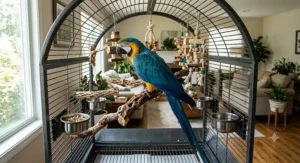
How to Choose a Cage for Blue and Gold Macaw
Here’s a straightforward framework for narrowing seven options down to one, using six criteria in the order we’d actually weigh them.
- Start with floor footprint, not height. A cage for blue and gold macaw housing needs real horizontal room before it needs vertical height — aim for at least 36 inches by 30 inches of floor space as a working minimum, with more being genuinely better rather than merely nice to have.
- Check bar spacing against beak strength. Anything wider than 1 to 1.5 inches risks a stuck head or wing; anything wider still risks an outright escape from a bird strong enough to bend thinner wire over time.
- Weigh material against your climate. Powder-coated steel is fine in dry, temperate homes; stainless steel earns its higher price in humid regions or households that mist or shower their bird frequently.
- Decide dometop versus flight-style based on behavior. Climbers do better with dome height; birds that hop and flap short distances benefit more from flight-style horizontal span.
- Factor in your actual out-of-cage hours. More daily supervised time outside the cage genuinely offsets a smaller enclosure, though it never fully replaces adequate size.
- Budget for the cage you’ll need in year three, not year one. Buying a growth-stage cage now often costs more in total than buying the right size once.
B&G Macaw Housing Requirements Beyond the Bars
B&G macaw housing requirements extend well past the cage itself, and treating the enclosure as the entire solution is one of the more common gaps in new-owner setups. Perch variety matters enormously — natural wood branches of varying diameter promote healthier foot conditioning than a single uniform dowel, and at least one rope or shreddable perch gives your bird an outlet for the same chewing drive that would otherwise target cage bars. Humidity and bathing access are non-negotiable for this species; the Blue-and-yellow macaw entry on Wikipedia notes their native range spans humid varzea forest, woodland, and savannah across tropical Central and South America, which explains why dry indoor air can trigger feather and skin issues without regular misting or shower access. Foraging toys that hide food rather than presenting it in an open bowl reduce boredom-driven screaming and plucking, both extremely common complaints among first-time large-parrot owners. Finally, out-of-cage time isn’t optional enrichment — most avian behaviorists and long-time owners recommend three to four hours of supervised time daily as a baseline, not a luxury, regardless of how large the cage itself is.
Macaw Species Cage Needs: Why Blue and Golds Aren’t One-Size-Fits-All
Macaw species cage needs vary more than shoppers assume, and lumping every “large macaw” cage listing together is a fast way to overpay or undersize. A blue and gold macaw’s 34-to-36-inch body and 41-to-45-inch wingspan place it solidly in the mid-to-large macaw tier — bigger than a severe or Hahn’s mini macaw, but noticeably smaller than a hyacinth, which can need an enclosure closer to a walk-in aviary. That distinction matters when you’re comparing listings, because a cage marketed generically as “for large birds” might be sized for an African grey or Amazon parrot rather than a true macaw. Green-winged and military macaws sit close to blue and golds in size, so cages marketed toward those species — like several of the A&E models above — tend to translate well. Scarlet macaws run slightly longer in tail length, which can matter for depth clearance in a tighter cage. The practical takeaway: always check the actual species list on a listing rather than trusting the word “macaw” alone, since it’s used loosely across wildly different bird sizes.
Macaw Cage Dimensions Decoded: Reading the Spec Sheet
Macaw cage dimensions on a listing rarely tell the full story unless you know how to read them. Exterior dimensions typically include seed guards and any decorative trim, which can add four to six inches per side beyond the actual usable interior space — the Overview of Pet Birds page from the Merck Veterinary Manual specifically recommends checking published minimum-size and bar-spacing tables rather than relying on marketing copy alone. Interior height matters differently than interior floor space; a tall, narrow cage might look spacious in a photo while still cramping a bird’s wingspan horizontally. Bar spacing should always be checked in fractions of an inch, not rounded — the difference between 3/4-inch and 1-inch spacing is meaningful for a species with this head size and beak strength. Door dimensions deserve equal attention, since a large front door that swings fully open makes daily interaction dramatically easier than a small access panel, especially once your bird starts stepping in and out on its own.
Choosing the Right Blue Gold Macaw Enclosure Style
A blue gold macaw enclosure generally falls into one of three broad styles, and each suits a different household. Playtop cages, like the ZENY and Prevue entry-level models above, prioritize convenience and included accessories, making them a reasonable starting point for a younger or smaller bird. Dometop cages add vertical climbing room and tend to be purpose-engineered for macaw-class birds specifically, which is why the A&E Macaw Mansion line performs so well in owner reviews. Flight-style cages prioritize horizontal span over height, better suiting a bird that hops and flaps rather than climbs, and they scale up naturally into double-bird setups like the 8040FL. None of these styles is objectively superior — the right choice depends on whether your bird is a climber, a flier, or somewhere in between, and on how much floor space your home genuinely has to spare.
Common Mistakes When Buying a Cage for Blue and Gold Macaw
The single most common mistake buyers make with a cage for blue and gold macaw shopping is sizing for the bird they have today rather than the adult it will become — a six-month-old macaw looks deceptively small in a mid-size cage that it will outgrow within a year or two. A close second is trusting exterior dimensions without checking interior clearance, since seed guards and decorative trim eat into usable space without appearing to in a product photo. Buyers also frequently underestimate bar spacing risk, assuming “large bird cage” automatically means appropriately narrow bars, when in reality some flight-style and aviary cages prioritize airflow over containment margin. Skipping assembly-quality research is another frequent misstep — a cage that looks identical to a sturdier competitor in photos can have thinner-gauge wire that bends under sustained beak pressure within months. Finally, many first-time owners forget to budget for the accessories a listing doesn’t include, like additional foraging toys, a second stand, or replacement perches, which can add meaningfully to the true first-year cost.
Cage vs Outdoor Aviary: Which Wins for Blue and Gold Macaws?
| Factor | Indoor Cage | Outdoor Aviary |
|---|---|---|
| Best For | Apartment or year-round indoor owners | Warm-climate owners with yard space |
| Space Ceiling | Limited by home footprint | Can far exceed any indoor cage |
| Weather Exposure | None | Requires shelter and predator-proofing |
| Natural Sunlight | Minimal without UVB lighting | Full spectrum, supports feather health |
| Upfront Cost | Lower, especially entry-level models | Higher, often custom-built |
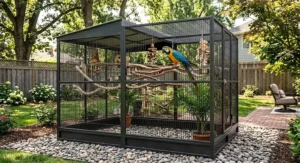
An indoor cage for blue and gold macaw housing wins on convenience and weather independence, letting your bird stay close to household activity year-round regardless of climate. An outdoor aviary wins decisively on raw space and natural sunlight exposure, which several sources — including experienced owners cited in avian forums — credit with reducing feather-plucking and improving overall condition, though it demands predator-proofing and, in most U.S. climates, a heated or sheltered section for winter. For most households, the realistic answer is both: a strong indoor cage as the daily base, supplemented by supervised outdoor time in a secure enclosure whenever weather permits.
Long-Term Cost & Maintenance: What Your Cage Really Costs Over 10 Years
| Cage Tier | Upfront Range | Est. 10-Year Cost of Ownership |
|---|---|---|
| Budget playtop | $150-$350 range | Higher — likely 1-2 replacements |
| Mid-range flight/dometop | $450-$800 range | Moderate — one possible upgrade |
| Premium stainless/double | $700-$1,600 range | Lower — typically zero replacements |
The numbers above tell a story that pure sticker price hides — a budget cage bought twice over a decade, once as a starter and once as a replacement when it’s outgrown or corrodes, often costs more in total than a single premium purchase. Reviewers of stainless models like the Prevue Imperial XL Stainless consistently note the near-total absence of rust or structural wear years into ownership, which is precisely the maintenance cost a painted budget cage tends to accumulate through touch-up paint, replacement trays, and eventual full replacement. Factor in that a blue and gold macaw can live 30 to 60 years in captivity, and the real long-term cost conversation isn’t cage price at all — it’s how many cages you’ll buy across that bird’s lifetime.
Safety, Bar Spacing & Regulations Guide
Safety compliance for a cage for blue and gold macaw setup starts with bar spacing, which experienced breeders and vets generally place at 1 to 1.5 inches for this species — tight enough to prevent a stuck head or escape, wide enough that the bird isn’t constantly straining against the wire while climbing. Lock quality deserves equal attention, since macaws are notoriously capable of manipulating simple latches with their beak and tongue; look for pinch-proof, multi-point, or padlock-style closures rather than a basic slide bolt. On the regulatory side, most household pet ownership of a legally acquired blue and gold macaw isn’t directly restricted by federal housing rules, though breeders, exhibitors, and larger-scale keepers should be aware that the USDA’s Animal Welfare Act standards for birds now require species-appropriate housing and psychological enrichment plans for covered facilities. Non-toxic materials matter too — powder coating and stainless steel are both considered bird-safe, but older secondhand cages should always be inspected for lead-based paint or zinc-heavy galvanized coating before use.

Frequently Asked Questions
❓ What size cage does a blue and gold macaw need?
❓ Can a blue and gold macaw live in a cage full-time?
❓ How much does a good macaw cage cost?
❓ What bar spacing is safe for a blue and gold macaw?
❓ Is stainless steel worth it for a macaw cage?
Conclusion
Choosing a cage for blue and gold macaw housing ultimately comes down to matching real specifications — floor footprint, bar spacing, material, and style — against your actual living situation and your bird’s age and behavior. Entry-level options like the Prevue Wrought Iron Select 3154C and ZENY 68-Inch Playtop Parrot Cage genuinely serve younger birds or supplemental setups without breaking the bank, while purpose-built macaw cages like the A&E Macaw Mansion Dometop hit a sweet spot most single-bird households will find hard to beat. For owners planning long-term or considering a second bird, the A&E Cage Co 8040FL Double Macaw and Prevue Imperial XL Stainless both solve for decades rather than years. Whatever you choose, remember that the cage is the foundation, not the entire enrichment plan — pair it with real out-of-cage time, varied perches, and foraging opportunities, and you’ll give your macaw the kind of home this remarkably intelligent, remarkably demanding species actually deserves.
✨ Ready to give your macaw the space it deserves? Compare current prices on your top pick today — the right cage now means a happier, healthier bird for decades to come! 🦜
Recommended for You
- Best Macaw Cages 2026: 7 Top Rated Picks That Actually Hold Up
- 7 Best large parrot cage under $300 Picks (2026 Buyer’s Guide)
- Heavy Duty Large Bird Cage: 7 Nearly Indestructible Picks (2026)
Disclaimer: This article contains affiliate links. As an Amazon Associate, I earn from qualifying purchases. If you purchase products through these links, we may earn a small commission at no additional cost to you.
✨ Found this helpful? Share it with your friends! 💬🤗
