
In This Article
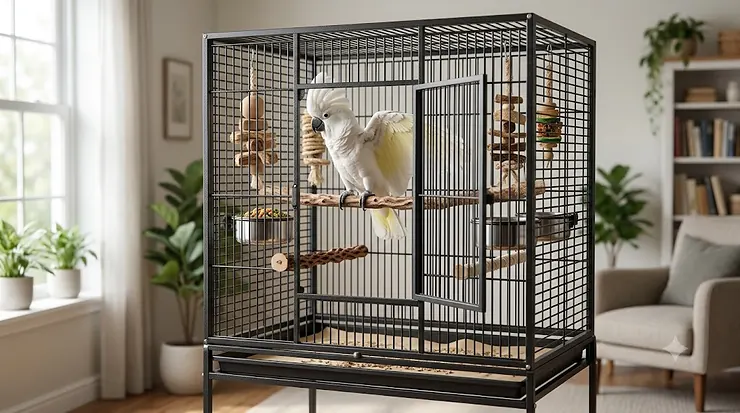
Somewhere between the pet store clerk who swears a 32-inch cage is “plenty” and the rescue volunteer who insists nothing under a walk-in closet will do, most new cockatoo owners just freeze up. Cockatoo cage minimum size sounds like it should have one tidy answer. It doesn’t — not exactly — but it does have a floor, and that floor is higher than almost anyone expects walking into this hobby. A cockatoo isn’t a slightly-bigger parakeet. It’s a two-to-three-pound bundle of curiosity, muscle, and opinions, and its housing needs to reflect that or you’ll be dealing with screaming, feather plucking, and a bird that’s basically climbing the walls of a home it can’t stretch out in.
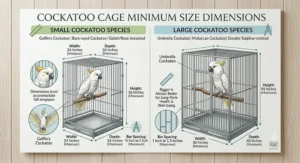
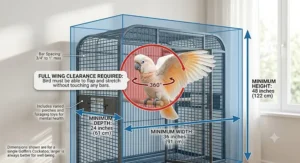
This guide walks through what avian professionals actually mean by “minimum,” why the number changes depending on which cockatoo species is involved, and where real, currently sold cages land on that spectrum. According to the Merck Veterinary Manual, a bird’s enclosure should measure at least one and a half times its wingspan in every direction, and that’s before you even start thinking about toys, perches, or a second bird sharing the space. We’ll get into all seven cockatoo cage requirements that matter, seven real cages spanning budget to premium, and the everyday decisions — bar spacing, floor space, placement — that separate a cage your cockatoo tolerates from one it actually thrives in.
Quick Comparison Table
Before we dig into the full breakdown, here’s the fast version for anyone skimming on their lunch break.
| Cage | Best For | Approx. Dimensions | Price Range |
|---|---|---|---|
| Prevue Hendryx Wrought Iron Select 3153COCO | Small cockatoos / tight budgets | 30″L x 22″W x 63″H | Under $250 |
| Yaheetech 69-inch Wrought Iron Rolling Cage | First-time owners wanting value | 26″L x 20″W x 69″H | $200-$300 range |
| Prevue Hendryx Wrought Iron Flight Cage (5 Ft X-Large) | Active climbers needing width | 31″L x 21″W x 60″H | $250-$350 range |
| King’s Cages SLP 4030 Superior Line | Umbrella and Goffin’s cockatoos | 40″L x 30″W x 68″H | $500-$700 range |
| A&E Cage Co. Double Macaw Cage (Divider Model) | Two-bird households | 36″L x 24″W x 76″H | $400-$600 range |
| King’s Cages SLT 6432 Superior Line | Moluccan and umbrella cockatoos | 64″L x 32″W x 70″H | Over $1,000 |
| A&E Cage Co. 8040FL Double Macaw Cage | Largest cockatoos, multi-bird setups | 80″L x 40″W x 74″H | Over $1,500 |
Notice the pattern: as budget climbs, so does floor footprint — not just height. That’s not a coincidence, and it’s not marketing fluff either. Cockatoos are floor-and-wall climbers as much as they are fliers, so a tall, skinny cage that looks impressive in a living room can still shortchange a bird on the horizontal room it actually uses most. The A&E Cage Co. 8040FL and King’s Cages SLT 6432 sit at the premium end precisely because they treat width and depth as seriously as height, while the Prevue Hendryx 3153COCO earns its budget spot by still clearing the minimum bar for smaller cockatoo species without asking you to remortgage anything.
💬 Found the cage that fits your space? Tap through to check today’s price before it changes
Top 7 Cockatoo Cages: Expert Analysis
Choosing a cage isn’t just about clearing a minimum number — it’s about matching the cage to the specific cockatoo species, your living space, and how much cleanup you’re willing to sign up for. Here are seven real, currently available cages that cover the full range from “responsible starter setup” to “this bird will never outgrow it.”
1. Prevue Hendryx Wrought Iron Select 3153COCO — best entry point for smaller cockatoo species
This 30″L x 22″W x 63″H cage is one of the few budget-tier options that doesn’t quietly shrink the footprint to hit a lower price. The height does a lot of the heavy lifting here, giving a Goffin’s or a well-behaved cockatiel-adjacent species room to climb vertically even when floor space is modest. Bar spacing lands in the 3/4-inch range typical of this product line, which matters enormously — anything wider risks a curious beak or head getting wedged between bars.
Based on the spec comparison, this cage is best suited to smaller cockatoo species or as a transitional cage for a young bird that hasn’t reached full adult size yet — it’s genuinely undersized for a Moluccan or umbrella cockatoo. Reviewers consistently note the powder-coated wrought iron construction holds up better than expected against beak damage, though a few mention the play-top ladder feels flimsy under a determined climber. What most buyers overlook is that the rolling casters make repositioning near a window for daylight far easier than lifting a static cage.
Pros:
- ✅ Genuinely sturdy wrought iron build for the price
- ✅ Play-top adds vertical enrichment space
- ✅ Rolling casters simplify repositioning
Cons:
- ❌ Too small for full-size Moluccan or umbrella cockatoos
- ❌ Play-top ladder attachment feels less durable
Priced under $250 at most retailers, this is a reasonable value pick if your bird is a smaller cockatoo species — but treat it as a floor, not a ceiling.
2. Yaheetech 69-inch Wrought Iron Rolling Cage — most budget-friendly height-forward option
At roughly 26″L x 20″W x 69″H, the Yaheetech leans hard into vertical space, which suits cockatoos’ love of climbing but doesn’t fully solve the horizontal room problem larger species need. The wrought iron frame with a rolling stand keeps assembly straightforward, and the slide-out tray underneath is a genuine time-saver on messy mornings.
Here’s what to weigh: the 69-inch height gives a bird plenty of climbing surface, but the footprint is closer to what’s recommended for African greys or small-to-mid cockatoos than for a full-grown Moluccan. Aggregated review sentiment across major retailers points to strong marks for ease of cleaning and stability once assembled, with a recurring complaint about the stock perches being too thin for a cockatoo’s grip strength — most owners end up swapping them out immediately.
Pros:
- ✅ Tall design encourages natural climbing behavior
- ✅ Slide-out tray speeds up daily cleaning
- ✅ Rolling stand makes relocation painless
Cons:
- ❌ Stock perches too thin for cockatoo-strength grip
- ❌ Footprint tight for larger cockatoo species
In the $200-$300 range, it’s a smart pick for owners on a tight budget who plan to supplement with generous daily out-of-cage time.
3. Prevue Hendryx Wrought Iron Flight Cage, 5 Ft X-Large — best horizontal flight space per dollar
This flight-style cage runs about 31″L x 21″W x 60″H, with a design philosophy built around horizontal movement rather than sheer height. Reviewers describe the hammertone black finish as scratch-resistant even after months of beak attention, which is no small thing with a cockatoo in the house.
On paper, this means a bird gets more room to hop wing-tip to wing-tip rather than just climbing up and down — a distinction that matters because cockatoos are surprisingly ground- and perch-oriented compared to smaller parrots that fly more. What most buyers overlook about this model is that the horizontal bar orientation on the sides doubles as a built-in climbing wall, effectively adding usable space the dimensions alone don’t capture. Aggregated feedback flags the assembly instructions as sparse, with several owners recommending a second set of hands for the initial build.
Pros:
- ✅ Horizontal bars add functional climbing space
- ✅ Scratch-resistant hammertone finish holds up well
- ✅ Rolling stand included for easy repositioning
Cons:
- ❌ Assembly instructions are notably thin
- ❌ Still snug for full-grown large cockatoo species
Expect to pay in the $250-$350 range, making this one of the better cost-per-square-foot options for mid-size cockatoos.
4. A&E Cage Co. Double Macaw Cage with Removable Divider — most flexible for future multi-bird households
Exterior dimensions come in at 36″L x 24″W x 76″H with 3/4-inch bar spacing, and the standout feature is right there in the name: a removable divider that lets the cage function as one large enclosure or two separate ones. That’s a meaningfully different value proposition than a fixed single-bird cage.
Based on the spec comparison, the interior height of 21 inches per divided section plus the overall 76-inch total height means even the “split” configuration keeps each bird in genuinely usable space, not a cramped afterthought. Reviewers consistently praise the bird-proof locks — a real concern with cockatoos, notorious escape artists who treat cage latches as puzzles to be solved. A common theme in owner feedback is that the horizontal side bars provide excellent climbing texture, though a few buyers note the swing-out feeder doors require a firm hand to operate smoothly at first.
Pros:
- ✅ Removable divider adapts to one or two birds
- ✅ Bird-proof locks resist cockatoo escape attempts
- ✅ Horizontal side bars add climbing surface
Cons:
- ❌ Feeder doors need a firm hand initially
- ❌ Divided configuration still cozy for full-grown birds
Typically found in the $400-$600 range, this is a strong pick for anyone who suspects a second bird is in their future.
5. King’s Cages SLP 4030 Superior Line — best all-around cage for Goffin’s and Umbrella cockatoos
At 40″L x 30″W x 68″H, this is where the numbers start genuinely matching what avian professionals recommend for mid-size to large cockatoo species. King’s Cages has built a reputation — deserved, based on the spec sheet — for thicker gauge steel and more robust welds than most mass-market competitors.
What the spec sheet won’t tell you, but reviewers note, is that the coppertone powder coat resists the kind of beak-gouging that leaves cheaper cages looking wrecked within a year. Here’s what to weigh: the 30-inch depth gives a bird enough room to fully extend both wings without touching bars on either side, which is the exact threshold the Association of Avian Veterinarians points to when discussing minimum housing standards. Aggregated customer sentiment is strongly positive on durability, with the recurring caveat that shipping weight and size make delivery logistics a genuine consideration — this isn’t a cage that shows up in a small box.
Pros:
- ✅ Dimensions align with vet-recommended minimums for large parrots
- ✅ Heavy-gauge steel resists beak damage long-term
- ✅ Reputation for superior welds versus mass-market cages
Cons:
- ❌ Heavy and awkward to have delivered/assembled solo
- ❌ Premium build means premium price bracket
Sitting in the $500-$700 range, this is arguably the sweet spot for anyone housing a single Goffin’s, umbrella, or similarly sized cockatoo long-term.
6. King’s Cages SLT 6432 Superior Line — best for Moluccan and other large-bodied cockatoos
This is a genuinely large enclosure at 64″L x 32″W x 70″H, with bar spacing typically in the 1 to 1.25-inch range appropriate for the strongest beaks in the cockatoo family. It’s built for birds that need serious floor space, not just height.
Based on the spec comparison, the 64-inch length is the standout number — it’s wide enough to let a Moluccan cockatoo, one of the larger species with a correspondingly long wingspan, move laterally without constantly bumping bars. Reviewers consistently describe this as “the last cage” they bought for their bird, meaning they didn’t have to upgrade again as the bird matured or became more active. A common complaint in user reviews centers on the coppertone finish showing wear faster in high-humidity climates, which is worth factoring in if you live somewhere genuinely muggy.
Pros:
- ✅ Floor space matches large-cockatoo wingspan needs
- ✅ Frequently described as a permanent, no-upgrade cage
- ✅ Heavy-duty construction suited to powerful beaks
Cons:
- ❌ Finish can show wear faster in humid climates
- ❌ Requires significant dedicated floor space in the home
At over $1,000, this sits firmly in premium territory, but the cost-per-year math works out favorably if it truly becomes a bird’s forever cage.
7. A&E Cage Co. 8040FL Double Macaw Cage — largest footprint on this list, ideal for multi-bird or exceptionally large cockatoos
The 8040FL is massive: 80″L x 40″W x 74″H with a 61-inch interior height and four swing-out feeder doors. This is less a cage and more a room-within-a-room, and it’s designed with a removable divider so it can house two large birds separately or one bird in an enormous shared space.
What most buyers overlook about this model is that the four independent feeder doors mean daily maintenance doesn’t require opening the main access doors at all — a genuine safety upgrade for reducing accidental-escape risk with cockatoos, who are famously observant about door mechanics. Reviewers consistently highlight the sheer scale as the standout feature, describing it as more aviary than cage. Aggregated sentiment does flag the assembly time as substantial, with several buyers recommending blocking out a full afternoon and having a helper on hand.
Pros:
- ✅ Feeder doors reduce need to open main access points
- ✅ Divider allows flexible one- or two-bird configurations
- ✅ Interior height supports full wing extension and climbing
Cons:
- ❌ Assembly is a genuine half-day project
- ❌ Requires a dedicated room or large wall section
Priced over $1,500, this is squarely a premium investment, best suited to owners with the space and the multi-bird ambitions to justify it.
Practical Usage Guide: Setting Up a Cockatoo Cage the Right Way
Buying the right size is only step one. The first month of setup determines whether your bird settles in or spends weeks pacing and screaming at furniture that hasn’t moved. Start by placing the cage against a wall — cockatoos feel exposed with open sides on more than one direction, and that vulnerability shows up fast as anxious behavior. Position it in a room where the family actually spends time, not a spare bedroom; cockatoos are flock animals emotionally, and isolation is one of the fastest routes to feather plucking.
Stagger perch heights and diameters rather than installing three identical dowels — varied grip widths keep foot muscles healthier over years of use, not just weeks. Expect a full cleaning cycle (tray, grates, bowls) every one to two days minimum; cockatoos are notoriously messy eaters who fling food with real enthusiasm, and a dirty cage bottom becomes a bacterial problem fast. A common first-30-days mistake is under-toying the cage because owners assume the bird needs time to “settle in” first — the opposite is usually true. An under-stimulated cockatoo in a new environment is far more likely to develop anxious habits than one with rotating chew toys from day one. Finally, resist the urge to rearrange perches and toys every week during the adjustment period; consistency in the first month builds the sense of territorial security that everything else depends on.
✨ Don’t Miss These Exclusive Deals!
🔍 Take your cockatoo’s living space to the next level with these carefully selected cages. Click on any highlighted product name above to check current pricing and availability. The right cage today saves you an expensive upgrade — and a stressed-out bird — down the road!
Real-World Scenarios: Matching the Cage to the Cockatoo
Picture three different households, because the “right” cage genuinely depends on who’s living in it. First, there’s the apartment-dwelling first-time owner with a young Goffin’s cockatoo and a tight 400-square-foot living room — for them, the Prevue Hendryx Wrought Iron Flight Cage makes sense: enough horizontal room for a smaller species, a footprint that doesn’t dominate the apartment, and a price that doesn’t wipe out the emergency vet fund before it’s even needed.
Second, consider the family with an adult umbrella cockatoo who’s already shown signs of restlessness in an outgrown cage — budget stretches further here, and the King’s Cages SLP 4030 matches both the vet-recommended dimensions for that species and a household ready to commit to a single, serious, long-term enclosure. Third, picture the experienced bird keeper adding a second Moluccan cockatoo to an existing household — this is exactly the scenario the A&E Cage Co. 8040FL or the divider-equipped double macaw cage were built for, letting two large, food-motivated birds coexist without territorial feeder-door battles. In every case, the deciding factor isn’t just the bird’s current size — it’s the trajectory: how big the species gets, how much space the room allows, and how much daily out-of-cage time is realistically on offer.
What Is Cockatoo Cage Minimum Size?
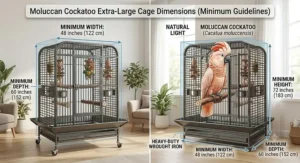
Cockatoo cage minimum size refers to the smallest enclosure dimensions that still let a cockatoo fully extend both wings, move between perches, and stand upright without touching the top — generally starting around 36 inches wide by 48 inches tall for smaller species, and scaling up to 48 inches by 60 inches or more for Moluccans and umbrella cockatoos.
That’s the textbook definition, but the honest answer is messier. The Merck Veterinary Manual frames the rule as one and a half times wingspan in every direction as an absolute floor — not a target. In practice, cockatoo space needs go beyond a single formula because species within the cockatoo family vary enormously: a Goffin’s cockatoo tops out noticeably smaller than a Moluccan, and treating them identically on a cage-size chart does both birds a disservice. The honest takeaway is that “minimum” should be read as “the smallest acceptable starting point before you start actively looking to upgrade,” not as a comfortable long-term target.
How to Choose a Cockatoo Cage: 6 Cockatoo Cage Requirements That Matter
- Match width and depth to wingspan, not just height. A tall, narrow cage looks impressive but shortchanges the horizontal movement cockatoos actually use most day to day.
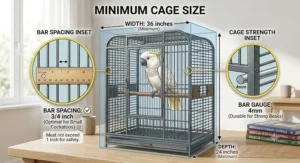
- Check bar spacing against beak strength. Most cockatoos need 3/4 to 1.25-inch spacing depending on species size — too wide risks head entrapment, too narrow risks beak damage from constant gnawing.
- Prioritize easy-access cleaning points. Slide-out trays and swing-out feeder doors aren’t luxuries; with a bird this messy, they’re the difference between a five-minute routine and a twenty-minute one.
- Confirm the material can survive years of beak pressure. Powder-coated wrought iron or stainless steel outlasts cheaper coatings that flake and expose birds to ingestible material.
- Plan for growth, not just current size. A young cockatoo will reach adult size within a couple of years — buying for “now” often means buying twice.
- Factor in your home’s actual floor space honestly. The Association of Avian Veterinarians notes that many commercially advertised cages are simply too small for birds to express natural behavior — don’t let a compact living room push you toward a compact cage.
Common Mistakes When Buying a Cockatoo Cage
The single most common misstep is buying to the room instead of buying to the bird — picking whichever cage visually fits the available corner rather than checking it against actual proper cockatoo housing standards for the species involved. A close second is underestimating growth: a six-month-old Moluccan cockatoo looks deceptively modest next to the cage recommended for its adult size, and owners frequently assume they can “upgrade later,” which often means never. Buyers also regularly overlook bar spacing in favor of overall footprint, not realizing that a cage with the right dimensions but the wrong bar gauge can still be genuinely unsafe. Another frequent error is skipping the divider question entirely — buying a single-bird cage without considering whether a second cockatoo might join the household within a few years, which usually means an expensive redo rather than a simple addition. Finally, plenty of owners buy based on price alone and skip researching the brand’s reputation for weld quality and coating durability, only to find themselves replacing a “bargain” cage within eighteen months.
Cockatoo Cage vs. DIY Aviary: Which Actually Serves Proper Cockatoo Housing Better?
| Factor | Manufactured Cage | DIY / Custom Aviary |
|---|---|---|
| Best For | Indoor single or dual-bird setups | Owners with dedicated outdoor/sunroom space |
| Setup Time | Hours to half a day | Days to weeks |
| Upfront Cost | Moderate to high | Highly variable, often higher long-term |
| Customization | Limited to manufacturer design | Fully customizable to species and space |
| Portability | Movable with rolling casters | Typically fixed/permanent |
A manufactured cage like the King’s Cages SLT 6432 wins on convenience and predictable safety engineering — bird-proof locks and tested bar spacing are already solved problems. A custom aviary wins on raw square footage and the ability to design around an unusual room, but it demands real construction knowledge to avoid safety gaps a commercial cage wouldn’t have. For most owners, a properly sized manufactured cage supplemented by generous daily out-of-cage time strikes the more realistic balance between cost, safety, and floor space.
💬 Weighing your options? A quick tap on any cage above pulls up current availability so you can compare for yourself.
What to Expect: Real-World Performance
On paper, the difference between a 40-inch-wide cage and a 64-inch-wide one sounds incremental. In practice, owners consistently report a visible behavioral shift once a bird moves into genuinely adequate space — less pacing along the same three inches of perch, more spontaneous play with toys placed at different heights, and noticeably less contact-calling distress when a person briefly leaves the room. Reviewers of the larger King’s Cages and A&E models frequently describe their birds as “settling” within days rather than weeks, which lines up with what avian behaviorists generally observe: space isn’t just about physical comfort, it directly affects a highly intelligent bird’s stress baseline. Conversely, cages at the smaller end of acceptable — even when technically meeting minimum standards for a given species — tend to draw more mixed feedback, with some owners reporting good outcomes and others noting increased screaming that resolved only after upgrading.
Safety, Regulations, and Compliance for Proper Cockatoo Housing
There’s no federal law in the U.S. dictating a specific cockatoo cage minimum size for private pet ownership, which is exactly why professional guidelines carry so much weight. Bar spacing remains the single most safety-critical spec: too wide, and a cockatoo’s head or wing can wedge between bars during an aggressive climb; too narrow relative to beak strength, and constant chewing accelerates coating wear, exposing metal that shouldn’t be ingested. Placement matters too — avoid direct sunlight through glass (it creates a greenhouse effect fast), kitchens (nonstick cookware fumes are genuinely dangerous to birds), and drafty doorways. According to a University of British Columbia companion-parrot welfare resource, increasing cage size and varying perch placement measurably supports natural climbing and flight behavior, reinforcing that space isn’t a cosmetic upgrade — it’s a welfare requirement with real behavioral consequences documented in the literature. Read more on companion parrot enrichment research here.
Cockatoo Cage Dimensions by Species: Proper Cockatoo Cage Standards
Not every cockatoo needs the same footprint, and lumping all 21 species under one blanket recommendation is where a lot of confusion starts. Cockatoos range from the relatively compact Goffin’s cockatoo to considerably larger Moluccan and umbrella cockatoos, and cage standards should scale accordingly. As a general framework: smaller cockatoo species do reasonably well starting around 36 inches wide by 48 inches tall, provided depth isn’t sacrificed to hit that width number. Larger species — Moluccan, umbrella, and similarly sized cockatoos — genuinely need enclosures closer to 48 inches wide by 60 inches tall as an honest floor, with plenty of owners and professionals recommending going noticeably beyond that whenever budget and space allow. The consistent theme across every credible source is the same: there is no such thing as too much space for a cockatoo, only budgets and rooms that run out first.
Long-Term Cost and Maintenance
The cheapest cage on this list isn’t necessarily the cheapest option over five years. A budget cage with a coating that flakes within eighteen months often gets replaced — meaning the true cost includes a second purchase plus the hassle of transitioning a bird to unfamiliar housing mid-life. Higher-end cages like the King’s Cages SLT 6432 or A&E Cage Co. 8040FL carry a steeper upfront number, but reviewers consistently describe them as the last cage they needed to buy, which changes the cost-per-year math considerably once you account for a cockatoo’s multi-decade lifespan. Ongoing costs beyond the cage itself include replacement perches (cockatoos destroy wood perches faster than almost any other pet bird), toy rotation, and occasional bowl or tray replacement. Budgeting an extra 10-15% of the cage’s price annually for consumables and replacement parts is a reasonable planning figure for most owners.
Frequently Asked Questions
❓ How big should a cockatoo cage be at minimum?
❓ Can two cockatoos share one cage?
❓ What bar spacing is safe for a cockatoo cage?
❓ How often should a cockatoo cage be cleaned?
❓ Is a bigger cage always better for a cockatoo?
Conclusion
Cockatoo cage minimum size isn’t a single magic number so much as a floor that shifts depending on species, and getting it right the first time saves money, stress, and a bird that’s noticeably happier in its own skin. Whether you land on the budget-friendly Prevue Hendryx Wrought Iron Select 3153COCO for a smaller species or commit to the room-filling A&E Cage Co. 8040FL for a full-grown Moluccan, the underlying principle stays the same: match the cage to the bird’s actual adult size and behavior, not just the corner of the living room you had in mind. Bar spacing, floor footprint, and material durability all matter as much as the headline dimensions, and every credible source lands on the same conclusion — when in doubt, size up.
Recommended for You
- Top Rated Cockatoo Cages: 7 Best Picks for 2026
- 7 Best Macaw Cage Under $500 Picks (2026): Real Deals, Real Space
- 7 Best Stainless Steel Macaw Cages for 2026
Disclaimer: This article contains affiliate links. As an Amazon Associate, I earn from qualifying purchases. If you purchase products through these links, we may earn a small commission at no additional cost to you.
✨ Found this helpful? Share it with your friends! 💬🤗
