
In This Article
You’ve filled your bird feeder with premium seed, hung it in the perfect spot, and waited eagerly for the first visitors. But within days, you notice something frustrating: your lawn is buried under a blanket of discarded seed hulls, sprouting weeds are taking over your flower beds, and you’re spending way more on birdseed than you ever expected.
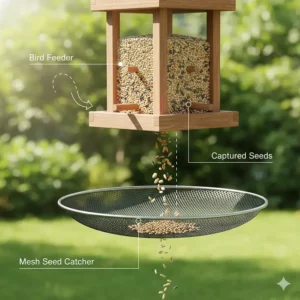
I’ve been there too. After spending hundreds on birdseed only to watch most of it hit the ground, I discovered the game-changing solution that transformed my backyard bird feeding experience: the bird feeder seed catcher.
A bird feeder seed catcher is exactly what it sounds like—a platform or tray positioned below your feeder to catch spilled seeds, hulls, and debris before they reach the ground. But these simple accessories do so much more than keep your yard tidy. According to research, they can capture up to 90% of wasted seed, effectively cutting your birdseed budget by nearly one-third. They also double as platform feeders, attracting ground-feeding species like cardinals, doves, and juncos that might otherwise skip your yard.
The Wild Bird Feeding Institute reports that nearly 59 million Americans feed birds, spending approximately $4 billion on birdseed annually. Yet much of that investment literally goes to waste without proper seed management. Whether you’re battling germinating seeds, frustrated by constant cleanup, or simply want to make your bird feeding station more efficient, the right seed catcher changes everything.
In this comprehensive guide, I’ll walk you through the seven best bird feeder seed catcher options for 2025, from budget-friendly trays to premium pole-mounted systems. You’ll discover which styles work best for different feeder types, how to choose the right size for your setup, and insider tips for maximizing both bird activity and seed savings.
Quick Comparison Table: Top Bird Feeder Seed Catchers at a Glance
| Product | Diameter | Best For | Price Range | Key Feature |
|---|---|---|---|---|
| Songbird Essentials Seed Hoop | 24″ | Maximum coverage | $30-$40 | Catches 90% of spilled seed |
| Brome Seed Buster Tray | 20.5″ | Pole-mounted feeders | $60-$75 | Lifetime warranty, dual-purpose |
| Droll Yankees A-6 Seed Tray | 7.5″ | Tube feeders | $12-$18 | Made in USA, easy attachment |
| Aspects Round Seed Tray | 8.5″ | Aspects feeders | $15-$22 | UV-stabilized, lifetime guarantee |
| iBorn Seed Catcher Feeder | 8″ | All-in-one solution | $35-$45 | Integrated 6-port feeder |
| Universal Hanging Tray | 12″ | Versatile use | $15-$25 | Fits most feeder styles |
| Large Adjustable Platform | 24″ | Heavy seed volume | $20-$35 | Polyester material, foldable |
💬 Just one click – help others make better buying decisions too!😊
Top 7 Bird Feeder Seed Catchers: Expert Analysis
1. Songbird Essentials SEIA30024 Seed Hoop – Best Overall Performance
The Songbird Essentials SEIA30024 Seed Hoop stands out as the industry leader for serious bird enthusiasts. This 24-inch diameter seed catcher attaches to virtually any feeder style and genuinely catches up to 90% of spilled seed—a claim backed by countless customer reviews.
Key Specifications:
- 24″ diameter provides extensive coverage
- Universal attachment system fits most feeders
- Weather-resistant construction
- Doubles as platform feeder
Price Range: $30-$40
Customer feedback consistently praises its effectiveness at reducing lawn damage and weed growth. One reviewer mentioned saving approximately one-third of their seed budget after installation. The wraparound design also creates additional perching space for larger birds like cardinals and mourning doves.
✅ Pros:
- Exceptional seed-catching efficiency
- Prevents lawn and garden damage
- Attracts ground-feeding bird species
❌ Cons:
- Larger size may overwhelm small feeders
- Requires adequate clearance below feeder
2. Brome Seed Buster Tray – Premium Pole-Mounted Solution
For pole-mounted feeding stations, nothing beats the Brome Seed Buster Tray. This innovative design functions as both a seed catcher and platform feeder, with a generous 20.5-inch diameter and 2-inch depth that holds up to 7.75 quarts of seed.
Key Specifications:
- 20.5″ diameter x 2″ depth
- Fits 7/8″ to 1″ diameter poles
- Patent-pending two-piece design
- UV-stabilized durable plastic
Price Range: $60-$75
The Brome Seed Buster features adjustable collars that let you position the tray at any height without disassembling your pole. The rolled edge provides comfortable perching for birds, while drainage holes keep seeds fresh and dry. Backed by a lifetime warranty, this represents a long-term investment in your bird feeding station.
✅ Pros:
- Lifetime manufacturer warranty
- Easy cleaning without pole removal
- Acts as squirrel baffle when positioned correctly
❌ Cons:
- Higher price point
- Requires compatible pole system
3. Droll Yankees A-6 Seed Tray – Best Budget Option
The Droll Yankees A-6 Seed Tray proves you don’t need to spend a fortune for quality seed management. This 7.5-inch clear polycarbonate tray attaches to Droll Yankees and compatible feeders with a simple threaded plug—no tools required.
Key Specifications:
- 7.5″ diameter
- UV-stabilized polycarbonate construction
- Tool-free installation
- Made in USA
Price Range: $12-$18
Despite its compact size, the A-6 effectively catches spilled seed while transforming tube feeders into platforms that attract cardinals, blue jays, and other perching birds. The clear material won’t yellow from sunlight exposure, and drainage holes prevent water accumulation.
✅ Pros:
- Affordable entry point
- American-made quality
- Simple installation process
❌ Cons:
- Limited coverage area
- Only fits feeders with 1/2″ threaded base
4. Aspects Round Seed Tray – Best for Brand Integration
Designed specifically for Aspects tube feeders, the Aspects Round Seed Tray comes in 8.5-inch and 10-inch diameter options. This brand-specific design ensures perfect compatibility and seamless aesthetics with your existing feeding station.
Key Specifications:
- Available in 8.5″ or 10″ diameters
- Fits 2-3/4″ diameter Aspects feeders
- Includes decorative finial
- Lifetime guarantee
Price Range: $15-$22
The tray attaches quickly with a threaded nut and includes a lip to contain seed hulls. Like all Aspects products, it’s manufactured in the USA from UV-stabilized materials designed to withstand years of outdoor use.
✅ Pros:
- Perfect fit for Aspects feeders
- Lifetime manufacturer guarantee
- Attractive design with finial
❌ Cons:
- Limited compatibility with other brands
- Mid-range pricing for smaller size
5. iBorn Bird Feeders Seed Catcher – Best All-in-One Design
The iBorn Bird Feeders Seed Catcher takes a different approach by integrating the seed catcher directly into a complete feeding system. This 14-inch aluminum feeder features six feeding ports with an 8-inch seed catcher tray built right in.
Key Specifications:
- 8″ diameter integrated seed catcher
- 6 feeding ports with perches
- Aluminum construction with multiple finishes
- Double-row drainage holes
Price Range: $35-$45
Available in brushed copper, green, and black nickel finishes, this feeder eliminates compatibility concerns by combining feeder and catcher in one unit. The metal construction resists squirrel damage better than plastic alternatives, and the built-in tray reduces waste by approximately 33% according to customer reports.
✅ Pros:
- No compatibility issues
- Durable metal construction
- Saves time and money on seed waste
❌ Cons:
- Requires replacing entire unit if one component fails
- Heavier than traditional tube feeders
6. Universal Bird Seed Catcher Tray – Best Versatile Option
This 12-inch Universal Bird Seed Catcher Tray earns its name through exceptional compatibility with most hanging feeders. The mesh platform design provides drainage while the adjustable hanging system fits various feeder configurations.
Key Specifications:
- 12″ diameter mesh platform
- Universal hanging hooks and chains
- Three drainage holes
- Black powder-coated finish
Price Range: $15-$25
Customers appreciate the bird-friendly black chains that don’t create reflective glare, reducing stress for visiting birds. The open mesh design allows rain to drain quickly while catching seeds and hulls effectively.
✅ Pros:
- Fits most feeder types
- Excellent drainage
- Non-reflective hardware
❌ Cons:
- Shorter chain length may require extensions
- Mesh spacing allows smaller seeds through
7. Large Adjustable Platform Seed Catcher – Best for High-Volume Feeders
For feeding stations that attract dozens of birds daily, the 24-inch Large Adjustable Platform Seed Catcher provides maximum capacity. This heavy-duty polyester tray with adjustable hanging hoop accommodates high seed volume and multiple birds simultaneously.
Key Specifications:
- 24″ diameter with 4″ anti-spill height
- Durable weather-resistant polyester
- Adjustable hanging hoop
- Foldable for storage
Price Range: $20-$35
The generous size creates a true platform feeding environment that appeals to ground feeders, while the anti-spill sides contain even the messiest eaters. The polyester material withstands various weather conditions and folds flat for seasonal storage.
✅ Pros:
- Massive capacity for busy feeders
- Weather-resistant materials
- Easy storage when not in use
❌ Cons:
- Size may be excessive for small yards
- Heavier when wet
✨ Don’t Miss These Exclusive Deals!
🔍 Take your backyard bird watching to the next level with these carefully selected products. Click on any highlighted item to check current pricing and availability. These tools will help you create authentic bird-feeding experiences your family will love!
Understanding Bird Feeder Seed Catchers: More Than Just Mess Control
A bird feeder seed catcher serves multiple critical functions in your backyard bird habitat. While most people initially purchase them to reduce mess, research from the Cornell Lab of Ornithology reveals that seed catchers significantly impact both bird behavior and conservation outcomes.
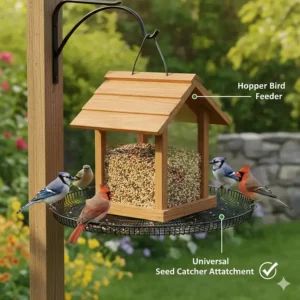
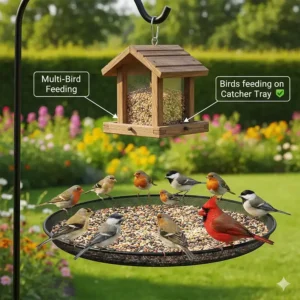
These platforms transform traditional tube or hopper feeders into dual-purpose feeding stations. Ground-feeding species like dark-eyed juncos, white-throated sparrows, and mourning doves prefer stable, flat surfaces for dining. By adding a seed catcher beneath your existing feeder, you effectively double your station’s appeal to a broader range of species.
The financial benefits prove equally compelling. Seed waste represents one of the largest ongoing expenses in bird feeding. Birds naturally hull sunflower seeds and discard what they don’t immediately consume. Without a catcher, this seed falls to the ground where it either rots, sprouts into weeds, or attracts rodents. According to the U.S. Fish and Wildlife Service, proper seed management practices can reduce waste by up to 50%, translating to hundreds of dollars in annual savings for dedicated bird feeders.
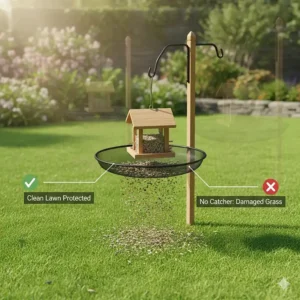
Environmental considerations also factor into the equation. Spilled birdseed creates several yard maintenance challenges. Sunflower hulls contain allelopathic compounds that inhibit grass growth, creating dead patches in your lawn. Mixed seed blends often include millet and other grains that readily germinate, producing unwanted weeds that require constant removal. Seed catchers prevent both issues by containing debris until you can properly dispose of it.
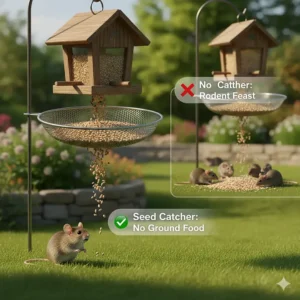
From a conservation perspective, concentrated ground seed attracts unwanted visitors. Rats, mice, and other rodents learn to visit feeding areas nightly, potentially spreading disease and damaging property. By catching seed before it reaches the ground, you eliminate this food source and discourage rodent activity around your home.
How to Choose the Right Bird Feeder Seed Catcher for Your Setup
Step 1: Measure Your Current Feeder Dimensions
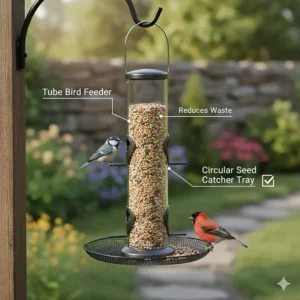
Start by measuring your feeder’s diameter at its widest point. Your seed catcher should extend at least 2-4 inches beyond the feeder on all sides to effectively catch ejected seeds. A 4-inch tube feeder pairs well with an 8-10 inch catcher, while 6-inch feeders need 12-14 inch catchers.
Step 2: Determine Your Mounting Method
Different mounting styles require specific catcher types. Hanging feeders work with suspended trays that attach via hooks or chains. Pole-mounted systems need catchers with center couplers that slide onto the pole. Shepherd’s hook feeders offer the most flexibility, accommodating both hanging and pole-mounted catcher styles.
Step 3: Consider Your Primary Bird Species
Species preferences should influence your selection. If you want to attract ground-feeders like cardinals and doves, choose larger diameter trays (16-24 inches) with rolled edges for comfortable perching. For smaller songbirds, 8-12 inch catchers provide adequate space without feeling overwhelming.
Step 4: Evaluate Material Durability
Climate impacts material performance significantly. UV-stabilized polycarbonate resists yellowing and cracking in intense sunlight. Metal trays withstand squirrel damage but may rust in humid environments. Polyester fabric options fold for storage but require more frequent replacement in harsh weather.
Step 5: Calculate Your Budget and Long-Term Value
Initial investment varies widely, from $12 budget trays to $75 premium systems. However, calculate potential seed savings when comparing options. A $60 catcher that saves $20 monthly in wasted seed pays for itself within three months, making it more economical than a $15 catcher that only reduces waste by 20%.
Bird Feeder Tray vs Traditional Ground Feeding: Side-by-Side Comparison
| Feature | Bird Feeder Tray | Ground Feeding |
|---|---|---|
| Seed Waste | Catches 70-90% of spills | 100% waste potential |
| Lawn Impact | Minimal to none | Dead patches, weed growth |
| Rodent Attraction | Significantly reduced | High attraction |
| Disease Risk | Lower (elevated, drainable) | Higher (contact with ground) |
| Bird Species Attracted | Both perchers & ground-feeders | Primarily ground-feeders |
| Maintenance | Easy cleaning, contained | Daily sweeping required |
Installation and Maintenance: Getting the Most from Your Bird Feeder Seed Catcher
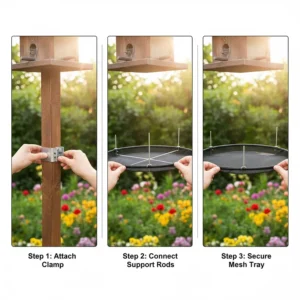
Proper installation ensures maximum effectiveness from your seed catcher investment. Most models attach within minutes, but following best practices prevents common frustrations.
For hanging feeders, suspend the catcher 6-12 inches below the feeder bottom using S-hooks or included chains. This spacing allows birds to feed comfortably while ensuring ejected seeds land in the tray. Too close creates crowding; too far reduces catching efficiency.
Pole-mounted catchers require measuring your pole diameter before purchase. Standard poles measure 7/8 to 1 inch outer diameter, but verify before ordering. Slide the catcher onto the pole at the desired height, then tighten the collar or set screw to secure it in place. Position it 2-4 feet above ground level to discourage jumping squirrels while remaining accessible for refilling.
Maintenance simplicity varies by design. Solid trays require weekly cleaning to remove accumulated seed hulls and bird droppings. Use a stiff brush and garden hose to scrub away debris, then allow the tray to air dry completely before reinstalling. The National Wildlife Federation recommends cleaning all feeding surfaces with a 10% bleach solution monthly to prevent disease transmission.
Mesh or perforated trays drain naturally but benefit from periodic inspection. Remove trapped hulls that block drainage holes to prevent water accumulation. During wet seasons, check drainage after heavy rains to ensure water isn’t pooling.
Seasonal adjustments optimize year-round performance. In fall and winter, when birds consume more food, empty and refill the catcher weekly. Spring and summer require less frequent attention but watch for mold growth during humid periods. Many bird watchers remove catchers during migration seasons to thoroughly clean and sanitize all equipment.
The Science Behind Seed Waste: Why Birds Are Messy Eaters
Understanding bird feeding behavior explains why catchers prove so effective. Birds don’t waste seed intentionally—their feeding mechanics simply create spillage.
Seed hulling creates the primary waste stream. Sunflower-loving species like chickadees and nuthatches grab a seed, fly to a nearby perch, crack the hull, extract the kernel, and drop the empty shell. Studies show hulls represent 35-40% of whole sunflower seed weight, meaning nearly half of what you purchase ends up as waste without ever being consumed.
Selective feeding compounds the problem. Presented with mixed seed blends, birds toss aside less-preferred varieties searching for favorites. Millet, wheat, and filler grains often land on the ground untouched. According to research published by Virginia Tech, birds may reject 60-70% of mixed seed blend contents, depending on composition.
Aggressive feeding behavior increases spillage rates. Dominant birds literally shoulder aside competitors at feeders, knocking seeds loose in the process. During peak feeding times—early morning and late afternoon—this jostling multiplies waste exponentially. Seed catchers positioned below capture this chaos, allowing subdominant birds to safely feed on dropped seeds.
Weather conditions also influence waste levels. Wind blows lightweight hulls and small seeds off feeding ports before birds can access them. Rain makes seed slippery, increasing accidental drops. Snow accumulation on feeder surfaces causes birds to knock seed loose while clearing their landing zones.
Protecting Your Lawn and Garden: The Hidden Benefits of Bird Feeder Trays
Beyond seed savings, catchers provide crucial protection for your landscaping. Concentrated seed accumulation beneath feeders creates multiple horticultural problems that surprise many bird enthusiasts.
Allelopathy represents the most insidious threat. Sunflower hulls contain chemical compounds that actively inhibit grass germination and growth. Just a few weeks of accumulation creates visible dead zones in your lawn—brown circles directly beneath feeders that persist even after you remove the debris. These chemicals leach into soil, requiring months to dissipate naturally.
Weed invasions follow close behind. Birdseed blends contain numerous grain varieties that readily germinate when moisture and warmth align. Millet, sorghum, and wheat transform into aggressive weeds that spread throughout flower beds and lawns. I’ve personally battled volunteer millet taking over vegetable gardens after just one season without a seed catcher.
Fungal and bacterial growth thrives in decomposing seed piles. Moist, rotting seed creates ideal conditions for mold colonies that can sicken both birds and humans. The Cornell Lab of Ornithology has documented disease outbreaks linked to contaminated ground feeding areas, emphasizing the importance of keeping seed off soil surfaces.
Pest attraction extends beyond rodents. Raccoons, opossums, and skunks investigate concentrated seed deposits nightly. These nocturnal visitors tear up lawns digging for scattered seeds, leave droppings, and potentially encounter pets with unfortunate results. Seed catchers eliminate the attractant before wildlife discovers it.
Maximizing Bird Diversity: How Seed Catchers Attract More Species
Strategic seed catcher placement significantly impacts bird diversity at your feeding station. Different species exhibit distinct feeding preferences that catchers can either accommodate or exclude.
Platform preference varies by bird morphology. Cardinals possess powerful legs suited for perching on wide, stable surfaces. Their short, thick beaks excel at cracking large seeds accessed from flat trays. Conversely, nuthatches and chickadees prefer vertical surfaces and small perches, making them less likely to use expansive catchers as primary feeding locations.
Height considerations prove equally important. Ground-foraging species like juncos and towhees rarely venture above 3 feet for food. Positioning your catcher lower attracts these species while potentially deterating aerial feeders that prefer elevation as predator protection. Experiment with multiple height levels to satisfy diverse preferences.
Tray depth affects accessibility for different bill lengths. Shallow catchers (under 1 inch deep) work well for small songbirds with delicate bills. Deeper trays (2+ inches) better serve larger species like jays and doves that can reach down to access seed at the bottom. Consider species in your region when selecting depth.
Edge design influences perching comfort. Rolled or beveled edges provide secure footing for birds with larger feet, while thin, straight edges suit smaller species. Some premium catchers feature multiple edge styles to accommodate the broadest range of visitors.
Combining catcher styles creates comprehensive feeding stations. I use a large, shallow tray beneath my main feeder for ground-feeders, plus a smaller, deeper catcher mid-height for medium-sized perching birds. This layered approach has increased my yard’s bird diversity from 8 species to 17 over two seasons.
Cost Analysis: How Much Money Do Bird Feeder Seed Catchers Actually Save?
Calculating return on investment for seed catchers requires examining actual consumption versus waste rates. Real-world data provides compelling evidence for these accessories’ economic value.
Baseline waste measurements reveal alarming numbers. Without catchers, typical tube feeders lose 30-40% of dispensed seed to spillage and hulling. Platform feeders without edges perform even worse, wasting 50-60% as wind and bird activity scatter seed. For someone spending $30 monthly on seed, that represents $9-$18 evaporating into wasted bird food.
High-quality catchers reduce waste to 5-15% depending on design and bird activity levels. The Songbird Essentials Seed Hoop’s 90% capture rate means only 10% of seed reaches the ground—a dramatic improvement. Applied to that same $30 monthly seed budget, waste drops from $12 to just $3, saving $9 each month.
Annual savings compound significantly. That $9 monthly savings totals $108 yearly—enough to purchase multiple feeders or stock up during seasonal seed sales. Over a catcher’s typical 5-10 year lifespan, you’re looking at $540-$1,080 in prevented waste, far exceeding even premium catcher costs.
Hidden savings emerge from reduced lawn maintenance. Without catchers, you’ll spend hours hand-pulling volunteer weeds, reseeding dead grass patches, and potentially hiring landscaping services to address damage. These costs rarely factor into bird feeding budgets but represent real expenses that catchers prevent.
✨ Don’t Miss These Exclusive Deals!
🔍 Take your backyard bird watching to the next level with these carefully selected products. Click on any highlighted item to check current pricing and availability. These tools will help you create authentic bird-feeding experiences your family will love!
Common Mistakes to Avoid with Bird Feeder Seed Catchers
Even experienced bird enthusiasts make errors that reduce catcher effectiveness. Recognizing these pitfalls helps you maximize your investment from day one.
Undersizing ranks as the most frequent mistake. Many people choose catchers barely larger than their feeders, assuming slight overhang suffices. Birds eject seeds with surprising force, easily clearing 4-6 inches beyond feeder edges. Always size up when deciding between two catcher dimensions.
Improper spacing creates accessibility issues. Hanging catchers too close to feeder bottoms crowds birds and makes seed access difficult. Conversely, excessive gap distance allows seeds to bounce off catcher edges instead of landing inside. The sweet spot ranges from 6-12 inches depending on feeder and catcher sizes.
Neglecting drainage leads to waterlogged seed that birds avoid and that quickly molds. Even if your catcher includes drainage holes, check monthly to ensure they remain clear. Seed hulls and debris gradually clog perforations, transforming catchers into standing water collection basins.
Ignoring compatibility causes installation headaches. Pole-mounted catchers must match your pole diameter precisely or they’ll slip, tilt, or refuse to install entirely. Hanging catchers need appropriate attachment hardware for your specific feeder bail design. Always verify compatibility before purchasing.
Infrequent cleaning undermines health benefits that catchers otherwise provide. Bird droppings accumulate on tray surfaces, creating disease transmission risks. The National Wildlife Federation recommends weekly removal of debris and monthly deep cleaning with mild disinfectant solutions.
Seasonal Considerations: Adapting Your Bird Feeder Tray Through the Year
Bird feeding dynamics shift dramatically across seasons, requiring different approaches to catcher management for optimal results.
Spring Migration Strategies
Spring brings hungry migrants passing through on northward journeys. Energy demands peak during this period, making abundant food sources critical. Position larger catchers to accommodate increased bird numbers and higher seed consumption. Clean catchers thoroughly between cold and warm seasons to prevent disease transmission as bird populations concentrate.
Summer Maintenance
Warm weather creates unique challenges. Seed spoils rapidly in heat and humidity, requiring more frequent catcher cleaning. Watch for mold growth on accumulated hulls and debris. Some bird watchers reduce seed offerings during summer when natural food abounds, making smaller catchers more appropriate.
Fall Preparation
Autumn signals preparation for winter’s demands. Birds begin caching behavior, hiding seeds for later consumption. This increases spillage as they transport seeds away from feeders. Larger catchers catch overflow from intensified feeding activity. Deep-clean all equipment before winter’s colder temperatures make maintenance less pleasant.
Winter Feeding
Cold-weather feeding reaches peak importance when natural food sources disappear. Birds require 30-40% more calories to maintain body temperature, dramatically increasing feeder traffic. Maximum-capacity catchers prevent waste of expensive seed during your busiest feeding season. Monitor for ice accumulation that can damage plastic catchers or create slippery surfaces deterring birds.
❓ FAQ: Your Bird Feeder Seed Catcher Questions Answered
- 7 Best Raccoon Resistant Bird Feeders That Work 2025
- 7 Top-Rated Raccoon Baffle for Bird Feeder in 2025 – Expert Guide
- 7 Best Squirrel Proof Bird Feeder Poles That Work (2025)
Conclusion: Investing in Smarter Bird Feeding
Choosing the right bird feeder seed catcher transforms your backyard bird habitat from frustrating money pit to efficient wildlife sanctuary. The seven options profiled here represent the best solutions for 2025, each excelling in specific applications.
For maximum coverage and waste reduction, the Songbird Essentials Seed Hoop delivers unmatched performance at a reasonable price point. Its 90% capture rate and universal compatibility make it my top recommendation for most bird feeders.
Budget-conscious feeders should start with the Droll Yankees A-6 Seed Tray. At under $20, this American-made accessory proves that effective seed management doesn’t require major investment.
Those with pole-mounted feeding stations benefit most from the Brome Seed Buster, despite its higher cost. The lifetime warranty and dual-purpose design justify the premium price for serious bird enthusiasts.
Remember that seed catchers deliver benefits beyond financial savings. They protect your lawn, reduce pest attraction, expand bird diversity, and create more enjoyable viewing experiences. The initial investment pays dividends through reduced maintenance, prevented landscaping damage, and enriched wildlife connections.
As conservation research from Virginia Tech emphasizes, thoughtful bird feeding practices benefit both birds and humans. Seed catchers represent responsible stewardship, minimizing waste while maximizing positive impacts for the 3 billion birds North America has lost since 1970.
Whether you install one catcher or outfit every feeder in your yard, you’re making a meaningful choice that supports bird health, saves money, and protects your outdoor spaces. That’s conservation you can see results from every single day.
Recommended for You
- 7 Best Raccoon Resistant Bird Feeders That Work 2025
- 7 Top-Rated Raccoon Baffle for Bird Feeder in 2025 – Expert Guide
- 7 Best Squirrel Proof Bird Feeder Poles That Work (2025)
Disclaimer: This article contains affiliate links. If you purchase products through these links, we may earn a small commission at no additional cost to you.
✨ Found this helpful? Share it with your friends! 💬🤗
