
In This Article
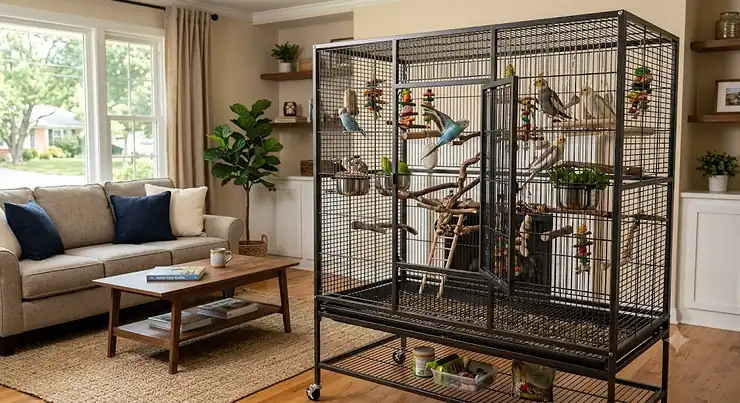
If you’ve ever watched a budgie try to “fly” across a standard starter cage and land somewhere between the water dish and the bars three inches later, you already understand the problem. Most cages sold as bird homes are built for storage, not flight. That’s the gap flight cages for birds are meant to close — enclosures wide enough that a bird can actually get airborne, bank a turn, and land somewhere that isn’t a wall.

A flight cage for birds is a wide, horizontally-oriented enclosure — typically at least 30 to 37 inches long — designed to give small and medium birds enough uninterrupted lateral space to fly short distances rather than just hop between two perches. It’s less about height and more about room to move sideways, the way birds actually travel.
We spent time cross-referencing real Amazon listings, manufacturer spec sheets, and aggregated owner feedback across dozens of models to land on seven that actually deliver — not just cages with “flight” slapped on the box. You’ll find budget-friendly stackable options, mid-range wrought iron standbys, and a couple of premium picks worth the extra investment. Along the way we’ll cover bar spacing, horizontal flight space, real setup mistakes, and how to read dimensions so you’re not fooled by a tall cage that’s actually cramped. By the end, you should know exactly which flight cage fits your bird, your budget, and your living room.
Quick Comparison Table
Before we go deep on all seven, here’s the fast version — useful if you’re standing in your living room trying to figure out whether something will even fit.
| Product | Length | Bar Spacing | Best For |
|---|---|---|---|
| Prevue Hendryx F050 | 37″ | 1/2″ | Premium build, multiple small-to-medium birds |
| Yaheetech 69″ 3-Tier | 32″ (3 levels) | 0.4″ | Large flocks, multi-bird households |
| Yaheetech 54″ Wrought Iron | 31.5″ | 3/8″ | Best all-around mid-range pick |
| VEVOR 30″ Stackable | 30″ | 1/2″ | Budget-conscious, apartment starters |
| VINGLI 53″ | 27″ | 1/2″ | Budget wrought iron with rolling wheels |
| Vision Premier Aviary Mini | 20″ | N/A (acrylic panel) | Finches and canaries, vertical flyers |
| 42″ Stackable Breeder Cage | 42″ (per compartment) | 1/2″ | Horizontal flight space, breeding pairs |
A quick look at this table tells you most of what you need before committing real money: the Yaheetech 69″ 3-Tier and the Prevue Hendryx F050 dominate on raw footprint, while the VEVOR 30″ Stackable and VINGLI 53″ give you real flight-cage bar spacing without the premium price tag. Bar spacing matters just as much as length — anything wider than 1/2 inch is a genuine escape and injury risk for budgies, finches, or lovebirds, so don’t let a bigger number on the box distract you from that detail. If you’re housing a breeding pair or want dedicated horizontal room, the 42″ Stackable Breeder Cage earns its spot for length alone, even though it looks less flashy than the others.
💬 Found a cage that fits? Share this comparison with another bird owner who’s still using a cage that’s too small!
Top Rated Flight Cages for Birds: Our Top 7 Picks
Here’s the full breakdown — real specs, honest analysis, and what actual owners report after living with these cages day to day.
1. Prevue Hendryx F050 — most durable premium build
The standout here is the wrought iron frame, which simply outlasts the wire-and-weld construction found on cheaper cages by years, not months.
At 37 inches long, 23 inches wide, and 60 inches tall (interior floor space of roughly 36 by 22 inches), the Prevue Hendryx F050 gives small-to-medium birds genuine lateral room to fly, not just climb. The 1/2-inch bar spacing keeps budgies, cockatiels, canaries, and lovebirds secure without sacrificing visibility, and the hammertone black powder coat resists the corrosion that mist baths and food splatter cause on lesser finishes. Based on the spec comparison, this is the cage to buy if you want something that’s still structurally sound in five years — the gauge-8-and-12 wire construction is noticeably heavier than most cages in its size class.
Reviewers consistently report that assembly takes about 30 minutes solo, and multiple owners specifically mention the crescent locks holding up against cockatiels and lovebirds that have defeated simpler latches on other cages. A common thread in aggregated feedback is genuine surprise at how differently a bird behaves once moved into it — more vocalizing, more wing-flapping, more perch-to-perch movement, which lines up with what avian behaviorists say about undersized housing suppressing natural activity.
Pros:
- ✅ Wrought iron build feels substantially sturdier than wire cages
- ✅ Rolling casters make repositioning near windows effortless
- ✅ Pull-out grille and tray simplify daily cleaning
Cons:
- ❌ Only available in one hammertone black finish
- ❌ Bottom storage shelf adds bulk to the footprint
Priced in the mid-$100s to upper-$100s range depending on retailer promotions, the Prevue Hendryx F050 is a strong value if you’re housing more than one small bird long-term — check current price before buying since Amazon listings fluctuate.
2. Yaheetech 69″ 3-Tier Flight Cage — best for multi-bird flocks
What immediately sets this apart is the three-tier vertical layout, which effectively gives you three separate flight zones stacked instead of one cramped shared space.
Measuring roughly 32 inches wide by 18.5 inches deep and 69 inches tall with 0.4-inch bar spacing, this cage is built around volume rather than a single flat footprint. Each tier connects via ladders, and the ten total feeder doors — eight front, two side — mean multiple birds can each claim their own feeding station instead of competing over one dish. What most buyers overlook about multi-tier cages like this is that the vertical separation actually reduces territorial squabbling between birds far more effectively than adding perches to a single-level cage would.
Aggregated review sentiment sits around 4.7 stars across more than 1,600 ratings, and a recurring theme is that owners housing four or more budgies alongside a pair of cockatiels report the space holding up without crowding. Some reviewers do note the assembly instructions could be clearer for first-timers.
Pros:
- ✅ Three-tier design effectively triples usable floor space
- ✅ Ten feeder doors reduce food competition in multi-bird homes
- ✅ Detachable rolling stand includes a bonus storage shelf
Cons:
- ❌ Assembly instructions are reportedly confusing for first-timers
- ❌ Overall footprint is large — measure your space carefully first
Expect a price in the $200-$260 range at the time of research, which is reasonable given the sheer floor space across three levels — a strong pick if you’re consolidating a growing flock into one Yaheetech enclosure instead of several small cages.
3. Yaheetech 54″ Wrought Iron Flight Cage — best all-around mid-range pick
The 3/8-inch bar spacing is the headline feature here — noticeably tighter than most cages at this price, which matters more than people expect for smaller-beaked birds like finches sharing space with conures.
At 24.69 pounds with a hammertone black powder-coated finish, this model strikes a balance most competitors miss: light enough to reposition solo, heavy enough to feel stable once the 360-degree swivel casters are locked. Reviewers who measured bar gaps with digital calipers found consistent spacing under 0.4 inches throughout the frame, which is a meaningfully better tolerance than the marketing copy alone would suggest. Here’s what to weigh: the front door opening is large enough to comfortably fit a hand for toy-hanging and perch adjustments, a small detail that saves real frustration during daily upkeep.
A common complaint in user reviews is limited color options, but almost no one flags structural issues after extended use, which says more about long-term reliability than any single glowing testimonial would.
Pros:
- ✅ Tight 3/8″ bar spacing suits small and medium birds alike
- ✅ Smooth-rolling casters work on both carpet and hardwood
- ✅ Large front door simplifies toy changes and cleaning
Cons:
- ❌ Limited to one or two finish options
- ❌ Included perches are dowel-style, not ideal long-term
At around $120-$160, the Yaheetech 54″ Wrought Iron Flight Cage is arguably the best value-per-inch pick on this whole list for a single conure, cockatiel, or pair of lovebirds.
4. VEVOR 30″ Stackable Flight Cage — best budget entry point
The stackable design is the real hook — you can start with one unit and physically stack a second on top later without buying an entirely new cage.
Measuring 30 inches with a flat-top wrought iron frame, slide-out tray, and included plastic feeders, this cage covers the essentials without the premium finish of the pricier options above. On paper this means you’re trading some long-term durability for a genuinely low entry price, which is a fair trade for a first-time owner testing whether a bird enjoys extra flight room before investing further. Reviewers frequently mention the slide-out tray as a real time-saver during daily cleaning, and the included casters make it easy to move between rooms for sunlight.
What reviewers note less favorably is that the powder coating shows wear faster than the Yaheetech or Prevue lines under heavy daily mist-bath use, which tracks with the lower material grade at this price point.
Pros:
- ✅ Stackable design allows expansion without a full replacement
- ✅ Slide-out tray and handle simplify cleaning and moving
- ✅ Genuinely budget-friendly entry into real flight-cage sizing
Cons:
- ❌ Finish wears faster than premium wrought iron competitors
- ❌ Fewer accessory extras included compared to pricier models
Typically listed in the $80-$110 range, the VEVOR 30″ Stackable Flight Cage is the most sensible starting point if you’re not ready to commit to a $200 setup yet.
5. VINGLI 53″ Flight Cage — budget wrought iron with wheels
The standout advantage is length-per-dollar — 53 inches of overall footprint at a price that undercuts most cages in its size class.
Built from durable wrought iron with a slide-out tray and rolling wheels, the VINGLI 53″ targets owners who want real horizontal room for parakeets, lovebirds, cockatiels, and budgies without paying premium-brand pricing. Based on the spec comparison against pricier alternatives, the trade-off is mostly cosmetic — a simpler black finish and fewer included accessories — rather than a meaningful drop in structural safety. Reviewers frequently cite the wheels as sturdier than expected for the price, holding up on both tile and carpet without wobbling.
A recurring theme in aggregated feedback is that first-time bird owners specifically appreciate the straightforward assembly, though a handful of buyers mention the tray occasionally sticks if not aligned precisely on reinsertion.
Pros:
- ✅ Long footprint relative to its budget price point
- ✅ Rolling wheels stay stable across different flooring types
- ✅ Straightforward assembly praised by first-time owners
Cons:
- ❌ Slide-out tray can stick if not aligned carefully
- ❌ Fewer bundled accessories than premium competitors
At roughly $110-$150, the VINGLI 53″ Flight Cage delivers genuine horizontal flight space without premium-brand markup — a smart pick if length matters more to you than finish quality.

6. Vision Premier Aviary Mini — best for finches and canaries
Unlike every other cage on this list, the standout here is the acrylic front panel paired with stainless steel construction — a completely different build philosophy aimed at vertical flyers rather than horizontal ones.
At 20 by 12 by 30 inches, this cage emphasizes height over width, which sounds counterintuitive in a flight-cage roundup until you consider that finches and canaries are naturally more vertical in their movement patterns than budgies or cockatiels. The clear acrylic front keeps the interior visible while eliminating the bar-spacing question entirely for the front panel, and the stainless steel resists corrosion better than powder-coated steel over the long run. What most buyers overlook about finch housing specifically is that these birds actually benefit from taller, narrower spaces more than the wide-format cages that dominate this category.
Because this is a smaller-volume specialty product, verified aggregated review data is thinner than for the mass-market Yaheetech and Prevue lines — worth noting honestly rather than inventing sentiment that doesn’t exist. What is verifiable is the stainless build quality, which independently reviewed listings consistently praise for finish and rust resistance.
Pros:
- ✅ Stainless steel resists rust better than painted alternatives
- ✅ Acrylic front panel gives a completely unobstructed view
- ✅ Adjustable perches suit varied finch and canary sizes
Cons:
- ❌ Smaller footprint than true horizontal flight cages
- ❌ Limited independently verified review volume so far
Expect a price in the $150-$200 range, positioning the Vision Premier Aviary Mini as a specialty premium pick rather than a general-purpose flight cage.
7. 42″ Stackable Center Divided Breeder Cage — best for horizontal flight space
The center divider is the defining feature — it converts one long enclosure into two separate horizontal flight zones, useful for breeding pairs or birds that need to be housed separately but nearby.
At 42 inches of wrought iron construction with a divided interior, this cage is built explicitly around the principle that horizontal flight space matters more than height for species like cockatiels, budgies, and lovebirds. Reviewers consistently note that the divider panel is easy to remove entirely if you’d rather run it as one continuous 42-inch flight space for a single bird or bonded pair. Here’s what to weigh: because it’s marketed toward aviary and breeding use, it includes fewer “lifestyle” accessories like play tops, but the core structural footprint is genuinely excellent for lateral flight.
A common complaint in aggregated feedback is that the included perches feel like an afterthought compared to the cage itself, and several owners report swapping them out immediately for natural wood alternatives.
Pros:
- ✅ Removable divider adapts from two zones to one flight space
- ✅ Genuinely long horizontal footprint at 42 inches
- ✅ Wrought iron build holds up well for aviary-style use
Cons:
- ❌ Included perches are widely considered low quality
- ❌ Fewer lifestyle accessories than mainstream flight cages
Priced around $130-$180 for the single unit, the 42″ Stackable Center Divided Breeder Cage is the strongest pick specifically if horizontal flight space is your priority over vertical or aesthetic features.
Bird Flight Cage Setup: A Practical Guide
Getting the cage itself right is only half the job — how you set it up determines whether your bird actually uses that flight space. Start by placing the cage against a wall (birds feel safer with their back covered) rather than in the center of a room, and keep it away from kitchens, since fumes from nonstick cookware and aerosols are genuinely dangerous to birds. During the first 30 days, resist the urge to over-decorate: too many perches and toys crowded into a flight cage actually defeats the purpose by blocking the very flight path you bought the bigger cage for. Position perches at varying heights near the two short ends rather than scattered randomly, so your bird has a clear lateral flight line between them.
A common first-time mistake is leaving factory dowel perches in place indefinitely — swap at least one for a natural wood perch of varying diameter within the first week, since uniform dowels contribute to pressure-related foot problems over time. Clean the slide-out tray every one to two days and do a full wipe-down of bars and perches weekly; ammonia buildup from droppings is a genuine respiratory hazard in an enclosure this size if neglected. Finally, introduce the cage gradually if your bird is coming from a smaller enclosure — some birds are initially hesitant to fly across unfamiliar open space and need a few days of encouragement with treats placed at the far perch before they use the full width confidently.
Real-World Scenarios: Matching Cages to Bird Owners
Picture a college student in a studio apartment with one budgie and limited floor space — the VEVOR 30″ Stackable Flight Cage fits that life almost perfectly, since it delivers genuine flight-cage bar spacing in a compact footprint, and the stackable design means a second unit can be added later without starting over. Now picture a retired couple with a small flock of four budgies and two cockatiels who finally have room in a spare room for something substantial — the Yaheetech 69″ 3-Tier Flight Cage is built for exactly that scenario, giving each pair its own tier and its own feeding station without daily territorial conflict.
Consider a third case: a breeder or serious hobbyist housing a bonded pair that occasionally needs temporary separation — the 42″ Stackable Center Divided Breeder Cage solves that specific problem with its removable divider, functioning as either one long flight space or two supervised zones depending on the week. In each case, the “best” cage isn’t the most expensive one; it’s the one whose dimensions and features actually match how many birds you have, how much floor space you can spare, and how your household routine works day to day.
Problem → Solution: Fixing Common Flight Cage Issues
Bar spacing too wide for a small finch that keeps testing gaps with its head? Move to a cage rated 1/2 inch or tighter, like the Prevue Hendryx F050 or 42″ Stackable Center Divided Breeder Cage, rather than trying to patch gaps with tape or wire, which introduces new hazards. Cage feels cramped despite technically meeting minimum dimensions? The issue is usually clutter, not size — remove excess toys and perches blocking the flight path down the center of the enclosure. Tray sticking or hard to slide, as some VINGLI 53″ owners report? Lightly wipe the tray rails with a dry cloth weekly; grime buildup, not a manufacturing flaw, is the usual culprit.
Bird refusing to use the new, larger flight space? This is common in birds transitioning from small cages — place favorite treats at the far end for a week to build confidence flying the full distance. Multiple birds squabbling over one feeding station in a single-level cage? Consider a multi-tier option like the Yaheetech 69″ 3-Tier Flight Cage, which physically separates feeding zones rather than relying on birds to share peacefully.
How to Choose Flight Cages for Birds
- Start with your bird’s wingspan, not your budget. The Association of Avian Veterinarians recommends a minimum enclosure size of 1.5 to 2 times a bird’s wingspan in every direction — measure before you shop, not after.
- Prioritize length over height. Birds fly side to side far more naturally than up and down, so a wide, low cage almost always beats a tall, narrow one for actual flight use.
- Match bar spacing to species. Finches and budgies need 1/2 inch or tighter; anything wider risks head or wing entrapment.
- Check material and finish honestly. Wrought iron with powder coating outlasts thin wire, especially with daily mist baths or multiple birds.
- Factor in cleaning access. Slide-out trays and pull-out grilles save real time daily — don’t underestimate this after the novelty of a new cage wears off.
- Plan for multiple birds from day one. If you expect to add a second or third bird, buy the tier or size up now rather than replacing the whole cage later.
- Verify mobility needs. Rolling casters matter more than they seem to if you plan to move the cage for sunlight or cleaning access.
Indoor Flight Cage vs Outdoor Aviary
An indoor flight cage and an outdoor aviary solve overlapping but genuinely different problems. Indoor flight cages, like the seven featured here, prioritize a controlled climate, protection from predators and weather, and proximity to household activity that keeps social species like cockatiels and lovebirds mentally engaged. Outdoor aviaries offer dramatically more space and natural sunlight, which supports vitamin D synthesis and more vigorous flight, but they introduce real risks — temperature swings, mosquito-borne illness exposure, and predator stress that indoor setups simply don’t have to manage.
For most American households, an indoor flight cage in the 30-to-70-inch range covered in this guide is the more practical choice, especially in climates with real winters where an outdoor structure would sit empty half the year. Owners in consistently warm regions with secure outdoor space may reasonably supplement an indoor cage with supervised aviary time, but replacing indoor housing entirely with an aviary is rarely realistic for pet birds that also need daily human interaction.

Horizontal Flight Space: Why Width Beats Height
It’s tempting to judge a cage by its tallest dimension, but avian veterinary guidance consistently points the other direction. As one veterinary housing resource explains, cages should generally be longer than they are tall, because birds fly from side to side rather than vertically, with finches and canaries in particular favoring that back-and-forth pattern between perches. This is exactly why the 42″ Stackable Center Divided Breeder Cage and VINGLI 53″ outperform taller, narrower cages of similar total volume — a 60-inch-tall cage with a 20-inch footprint sounds impressive on paper but actually restricts flight far more than a 40-inch-long cage half that height.
The practical takeaway: when comparing two cages with similar total interior volume, choose the one with more length, not more height, unless you’re specifically housing a vertically-oriented species like the finches and canaries suited to the Vision Premier Aviary Mini.
Flight Cage Dimensions by Species
| Species | Minimum Length | Minimum Bar Spacing | Notes |
|---|---|---|---|
| Budgerigar / small parakeet | 24-30″ | 1/2″ or less | Prioritize width over height |
| Cockatiel | 31-37″ | 1/2″ | Horizontal fliers — length matters most |
| Lovebird | 30-37″ | 1/2″ | Similar needs to cockatiels, slightly hardier |
| Finch / Canary | 20-27″ | 3/8″-1/2″ | Benefit from vertical space more than others |
| Small conure | 32-42″ | 1/2″-5/8″ | Needs both length and durable bar strength |
Reading this table, it’s clear that dimension requirements scale with species-specific flight patterns rather than simple body size alone — a canary and a budgie are similarly sized, but the canary’s more vertical flight tendencies mean it tolerates a taller, narrower cage far better than a cockatiel or lovebird would. If you’re housing mixed species, always size the cage to whichever bird has the largest minimum requirement, not the average.
Large Flight Cage Reviews: What Real Owners Report
Aggregated feedback across the models in this guide reveals a consistent pattern worth knowing before you buy. Owners overwhelmingly report that the single biggest satisfaction driver isn’t a specific feature — it’s visibly increased activity in their bird after the upgrade, described repeatedly as more wing-flapping, vocalizing, and perch-hopping than the previous smaller cage allowed. On the Yaheetech 69″ 3-Tier Flight Cage specifically, the volume of feedback (over 1,600 ratings averaging 4.7 stars) gives unusually reliable signal compared to lower-volume specialty products like the Vision Premier Aviary Mini, where verified review data is genuinely thinner.
A recurring critical theme across nearly every brand, not just one, is that included dowel perches and basic plastic feeders are considered afterthoughts compared to the cage structure itself — a pattern strong enough that budgeting separately for natural wood perches seems to be near-universal advice among experienced owners regardless of which cage they bought.
Common Mistakes When Buying Flight Cages for Birds
The most frequent mistake is buying based on height alone because it looks impressive in a product photo, when horizontal length is what actually determines usable flight space. A close second is ignoring bar spacing in favor of overall size — a cage can be enormous and still be genuinely dangerous if the bars are spaced for a much larger bird than you own. Buyers also commonly underestimate how much clutter reduces effective flight space; cramming in every toy and perch from a previous smaller cage into a new flight cage can recreate the same restricted movement you were trying to escape.
Another overlooked error is skipping the math on multiple birds — a cage rated appropriately for one bird is rarely appropriately sized for three, yet many owners assume “large” automatically means “large enough for my whole flock.” Finally, some buyers focus entirely on price and skip researching the manufacturer’s material quality, which is exactly the gap the honest spec-and-review analysis throughout this guide is meant to close.
Safety, Regulations & Compliance Guide
While the United States has no single federal statute dictating minimum pet bird cage dimensions the way some countries’ agricultural codes do, the general concept of an aviary as a structure built to allow genuine flight rather than mere containment has shaped how the veterinary community frames “adequate” housing. In practice, most U.S. guidance comes from professional veterinary bodies rather than statute — the Association of Avian Veterinarians’ wingspan-based sizing rule functions as the de facto industry standard that responsible manufacturers and rescues reference.
Beyond dimensions, safety compliance means checking that any cage you buy uses lead-free, zinc-free powder coating — reputable manufacturers like Prevue and Yaheetech explicitly state this in their specs, and it’s worth verifying for any lesser-known brand before buying. Locking mechanisms matter just as much as material safety; crescent locks and arc-shaped wire latches, featured on several cages in this guide, specifically address the well-documented problem of intelligent parrots and cockatiels learning to open simple hook latches.
Long-Term Cost & Maintenance
Sticker price is only part of the real cost of a flight cage. Replacement perches, feeders, and periodic tray liners add up over a cage’s multi-year lifespan, and cheaper cages with lower-grade finishes may eventually need touch-up paint or full replacement sooner than a wrought iron model like the Prevue Hendryx F050. Looking at total cost of ownership, a $150 cage that lasts eight years with minimal upkeep is a better value than an $80 cage requiring replacement every two to three years due to rust or bar damage from a persistent chewer.
Maintenance time is the other hidden cost worth weighing. Cages with slide-out trays and pull-out grilles, present on most of the models here, cut daily cleaning time significantly compared to older-style cages requiring full disassembly to reach droppings — a difference that adds up to real hours saved annually.
Features That Actually Matter (And Those That Don’t)
Bar spacing, overall length, tray design, and lock security are the features genuinely worth prioritizing — everything else is largely aesthetic. Play tops look appealing in photos but are rarely used the way marketing suggests, since most owners report their birds preferring dedicated out-of-cage play stands instead. Multiple color options sound nice but have zero impact on bird welfare or safety, so don’t let finish color push you toward a structurally weaker cage. Included accessories like basic plastic perches and feeders are worth almost nothing in practice — as the review data throughout this guide shows, nearly every experienced owner replaces them within the first month regardless of brand.

Frequently Asked Questions
❓ What is a flight cage for birds?
❓ How big should a flight cage be for a budgie?
❓ Is a flight cage better than a regular bird cage?
❓ What bar spacing is safe for finches?
❓ Can multiple birds share one flight cage?
Conclusion
Choosing among flight cages for birds really comes down to three honest questions: how many birds you’re housing, how much floor space you actually have, and how much horizontal room your species needs to fly the way nature intended. The Prevue Hendryx F050 and Yaheetech 69″ 3-Tier Flight Cage lead this list for build quality and multi-bird capacity, while the VEVOR 30″ Stackable and VINGLI 53″ prove you don’t need a premium budget to get genuine flight-cage dimensions and safe bar spacing.
Whatever you land on, resist the urge to judge a cage by height alone — length is what actually lets your bird fly the way it’s built to, and that single detail separates a real flight cage from a tall box with bars. Measure your space, check the bar spacing against your species, and pick the cage that fits both your bird and your living room honestly.
✨ Don’t Miss These Exclusive Deals!
🔍 Take your bird’s living space to the next level with these carefully selected flight cages. Click on any highlighted pick to check current pricing and availability, and give your feathered friend the room they deserve to actually fly.
Recommended for You
- Walk In Bird Cage for Macaw: 7 Best Options Reviewed (2026)
- Cockatoo Cage Minimum Size: 7 Picks That Actually Fit (2026)
- Top Rated Cockatoo Cages: 7 Best Picks for 2026
Disclaimer: This article contains affiliate links. As an Amazon Associate, I earn from qualifying purchases. If you purchase products through these links, we may earn a small commission at no additional cost to you.
✨ Found this helpful? Share it with your friends! 💬🤗
