
In This Article
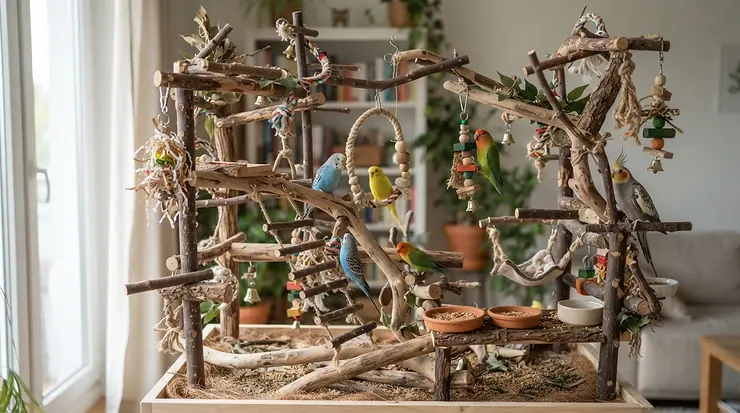
Walk into any serious bird room and you’ll spot the same gnarled, coffee-colored branches propping up cockatiels, greys, and the occasional grumpy macaw. That’s a java wood bird stand, and it’s become the default upgrade from plain dowel perches for one simple reason: birds actually use their feet differently on it. A java wood bird stand is a play perch or floor tree built from the retired branches of non-fruit-bearing coffee (java) trees, prized for its irregular diameter, rough bark, and sustainable sourcing. If you’ve been scrolling through natural java perch reviews trying to figure out which tree is worth the money, you’re in good company — this is one of the most searched-for bird furniture categories on Amazon, and also one of the most confusing, because “java tree” covers everything from a $15 clip-on branch to a six-foot floor sculpture.
This guide breaks down seven real, currently available java wood bird stands, pulled from actual product listings and manufacturer specs rather than marketing copy. We looked at branch diameter (which matters more than most buyers realize — more on that later), base construction, weight capacity, and what owners actually report after months of use. Along the way we’ll dig into how Coffea arabica, the coffee species whose retired branches supply most of this wood, ends up in your living room, why a java wood play stand behaves so differently from a straight dowel, and how to pick the right size for your specific flock. No fluff, no invented five-star anecdotes — just a straight comparison so you can make a call that your bird’s feet will actually thank you for.
Quick Comparison Table
| Stand | Best For | Height/Size Range | Branch Diameter | Price Range |
|---|---|---|---|---|
| Prevue Pet Products Coffeawood Java Tree Minis Small Tabletop Playstand | Budgies, lovebirds, canaries | 13.75″–18″ H | 3/16″–13/16″ | Under $60 |
| A&E Cage Co. Java Wood Multi Branch Perch (Small) | In-cage accent perch, small birds | 16″ L | ~1.2″ | Under $25 |
| Prevue Pet Products Coffeawood Java Tree Small Floor Playstand | Small-to-medium mixed flocks | 59″–63″ H | 3/8″–1″ | $90–$140 range |
| A&E Cage Company AE250M Java Wood Tree | Medium birds needing wing room | 38″x24″x61″ | ~3/4″–1.5″ | $140–$200 range |
| Prevue Pet Products Coffeawood Java Tree Medium Floor Playstand | Cockatiels, conures, Quaker parrots | 59″–63″ H | 3/4″–1 3/8″ | $170–$230 range |
| Prevue Pet Products Coffeawood Java Tree Large Floor Playstand | African greys, Amazons, eclectus | 59″–63″ H | 1 1/8″–1 3/4″ | $230–$320 range |
| A&E Cage Company AE250L Java Wood Tree | Large parrots, heavier-duty base | 40″x24″x61″ | ~1.5″–2″ | $260–$350 range |
Looking at this lineup, the split is really about branch diameter matching foot size, not brand loyalty. The Prevue Pet Products Coffeawood Java Tree Minis Small Tabletop Playstand and the A&E Cage Co. Java Wood Multi Branch Perch (Small) are the entry points for anyone with a budgie or lovebird who just wants something better than a plastic dowel. Once you move into cockatiel and conure territory, the Prevue Pet Products Coffeawood Java Tree Medium Floor Playstand and A&E Cage Company AE250M Java Wood Tree start competing directly on branch thickness and base footprint, while the two large-bird options exist mainly to survive an African grey’s beak and body weight without wobbling.
💬 Just one click — help others make better buying decisions too!😊
Top 7 Java Wood Bird Stands: Expert Analysis
1. Prevue Pet Products Coffeawood Java Tree Minis Small Tabletop Playstand — smallest footprint for tabletop cages
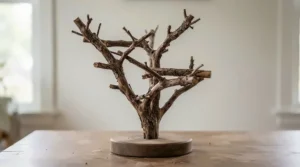
This one solves a specific problem: most java wood play stand options are floor units that eat up a corner of the room, but this Minis version is built to sit on a table or dresser instead. At 15.8″ long, 10.6″ wide, and 18″ tall, it fits where a full floor tree simply can’t. The branch diameter runs 3/16″ to 13/16″, which is appropriately thin for finches, canaries, lovebirds, and budgies — a branch this size would be far too flimsy for a cockatiel, but it’s exactly right for the toe span of smaller species.
Based on the spec comparison with larger units in this lineup, the single food/water cup and two eye screws for hanging toys are modest, but that matches the scale of the birds it’s designed for. Reviewers consistently note that no two units look alike, since each tree is a genuinely unique natural branch formation rather than a molded copy — a detail Amazon listings mention but rarely explain the appeal of.
Additionally, the rubber-footed base protects furniture, which matters if this is going on a real tabletop rather than a cage top. What most buyers overlook about this model is that its small size makes it ideal as a rotation perch, giving a caged bird a second texture and surface option outside the cage without committing to a large floor tree.
Pros:
- ✅ Compact enough for tabletops and small rooms
- ✅ Genuinely unique branch shape on every unit
- ✅ Rubber feet protect furniture surfaces
Cons:
- ❌ Too small in scale for anything past a lovebird
- ❌ Single feeding cup limits multi-bird use
At under $60, this is one of the more affordable ways to add real java wood play stand texture to a small bird’s routine, and it’s a reasonable value pick if you’re testing whether your bird takes to natural branch perching before investing in a floor model.

2. A&E Cage Co. Java Wood Multi Branch Perch (Small) — cheapest way to add java wood to any cage
Not every household has room for a floor stand, and this 16-inch multi-branch perch is the answer for people who just want java wood texture inside an existing cage. It mounts directly to cage bars rather than standing independently, which keeps the footprint at essentially zero. A&E Cage Co. sources this from the same non-fruit-bearing coffee tree branches used across the java wood category, meaning the environmental pitch — repurposing wood that would otherwise be cleared to make room for productive trees — applies here too, just at accessory scale.
Here’s what to weigh: because it’s a single mounted branch rather than a multi-level tree, it doesn’t offer the climbing variety of a full playstand, but it does deliver the varied-diameter branch surface that matters for foot health, which a straight dowel perch simply can’t replicate. Reviewers consistently report that the natural bark texture holds up well to daily chewing without splintering quickly, though a few users on similar A&E java wood perches mention the branch selection can run thinner or thicker than expected since each piece is naturally sourced.
For buyers who already have a cage full of standard perches, swapping one out for this multi-branch option is the lowest-cost way to introduce foot-health variety without a full stand purchase.
Pros:
- ✅ Very low price point for genuine java wood
- ✅ Mounts inside existing cages, no floor space needed
- ✅ Varied branch diameter supports foot health
Cons:
- ❌ No multi-level climbing structure
- ❌ Branch shape varies unpredictably between units
Priced well under $25, this is the budget-conscious entry point into natural wood bird stand territory — not a showpiece, but a legitimate upgrade for a cage that’s currently all dowels.
3. Prevue Pet Products Coffeawood Java Tree Small Floor Playstand — rolling floor stand for small-to-medium flocks
This is where java wood bird stand shopping starts feeling like furniture shopping. The base measures 39.75″ long by 22.875″ wide, tree height ranges 59″ to 63″, and it ships with pre-mounted rolling casters — a detail that matters more than it sounds, because being able to roll this between rooms means it actually gets used daily instead of becoming a static corner piece.
Branch diameter runs 3/8″ to 1″, which Prevue positions for finches, canaries, lovebirds, budgies, parakeets, cockatiels, caiques, and Quaker parrots — a wide range that works because the branch taper naturally varies along its length. On paper this means one tree can comfortably host a mixed flock of small-to-medium birds without anyone being stuck on an ill-fitting surface. Two food/water cups and four eye screws for hanging toys round out the functional side.
The spec sheet won’t tell you this, but user reports across similar Prevue floor units suggest assembly is straightforward with the included hardware, and the casters genuinely reduce the friction of moving a 40-pound tree solo. As a natural java perch reviews staple, this size sits in a sweet spot: substantial enough to feel like a real piece of aviary furniture, but not so large it demands a dedicated room.
Pros:
- ✅ Casters make repositioning realistic, not theoretical
- ✅ Branch range suits several small-to-medium species
- ✅ Two feeding cups support multi-bird households
Cons:
- ❌ Around 40 lbs, awkward for one person to assemble alone
- ❌ Branch density and shape vary tree to tree
In the $90–$140 range, this floor stand delivers strong value for households with a mixed flock of smaller birds who want one shared java tree perch rather than several separate accessories.
4. A&E Cage Company AE250M Java Wood Tree — widest branch spacing for wing-flapping room
A&E’s medium java wood tree takes a different design philosophy than Prevue’s floor units: rather than densely packed branches, it emphasizes open space between limbs, sized at 38″ by 24″ by 61″ boxed. That spacing exists for a reason most buyers don’t think about until they see it in action — birds need room to flap and stretch without hitting a branch mid-motion, and cramped trees can actually discourage the exercise they’re meant to encourage.
The base is built from stained Kamper wood sourced from Kalimantan, giving the unit a more finished, furniture-grade look than some java tree competitors, which matters if this is going in a living room rather than a bird room. Based on the spec comparison with Prevue’s medium offering, A&E’s branch diameter runs comparably thick, generally suited to cockatiels, conures, and similarly sized parrots.
What most buyers overlook about this model is that the wider branch spacing, while great for wing exercise, also means the footprint per usable perching surface is slightly less efficient than a densely branched tree — you’re trading perch density for movement space. Reviewers on A&E’s java wood line consistently mention the craftsmanship of the base as a highlight, alongside occasional notes about longer-than-expected shipping windows for a made-to-order natural product.
Pros:
- ✅ Generous branch spacing for wing-flapping exercise
- ✅ Finished Kamper wood base looks furniture-grade
- ✅ Comparable branch thickness to Prevue’s medium tier
Cons:
- ❌ Less perch density per square foot than tighter trees
- ❌ Shipping timelines can run longer for natural stock
Sitting in the $140–$200 range, this is the pick for owners prioritizing an active, wing-stretching environment over maximum perching surface — a genuinely different design tradeoff, not just a rebrand of the same tree.
5. Prevue Pet Products Coffeawood Java Tree Medium Floor Playstand — best branch thickness for cockatiels and conures
Model 22624 is Prevue’s answer to the “my cockatiel outgrew the small tree” problem. Branch diameter jumps to 3/4″ through 1 3/8″, specifically calibrated for cockatiels, conures, caiques, and Quaker parrots — species whose feet need noticeably more grip surface than a budgie but aren’t yet in African grey territory.
The base stays at the same 39.75″ by 22.875″ footprint as the small model, with tree height again ranging 59″ to 63″, so it fits the same floor space while offering a meaningfully different branch experience. At roughly 50 lbs, it’s heavier than the small floor unit, which honestly translates to a sturdier, less tippy stand — a real consideration for birds that like to bounce or lunge while climbing. Two food/water cups and four eye screws for hanging toys carry over from the small model.
What the spec sheet won’t tell you, but user reports on similar Prevue trees suggest, is that the added weight and thicker branch base noticeably reduce wobble compared to lighter java wood play stand alternatives, which matters for skittish birds that startle at movement. This is arguably the most broadly recommended size in the natural java perch reviews space for anyone with a single cockatiel-to-conure-sized bird.
Pros:
- ✅ Branch thickness matched precisely to mid-size parrots
- ✅ Extra weight reduces wobble during active climbing
- ✅ Same footprint as the small model, more capability
Cons:
- ❌ Heavier tree makes solo assembly more difficult
- ❌ Overkill in scale for finches or budgies
Expect to pay in the $170–$230 range, and for most single-bird households with a mid-size parrot, this is the most defensible middle-tier pick in the entire java wood bird stand category.
6. Prevue Pet Products Coffeawood Java Tree Large Floor Playstand — thickest branches built for big-beak power
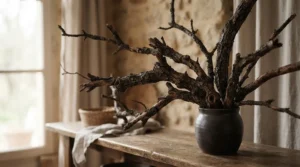
Model 22625 exists for one reason: African greys, Amazons, eclectus, and smaller macaws will destroy anything not built to survive them, and this tree’s 1 1/8″ to 1 3/4″ branch diameter is Prevue’s response. At around 55 lbs, it’s the heaviest unit in the lineup, and that mass isn’t incidental — big parrots put real lateral force on a perch when they climb, lunge, or grab with their beak for leverage, and a lighter tree simply tips.
The base retains the familiar 39.75″ by 22.875″ footprint with pre-mounted rolling casters, so despite the weight, repositioning doesn’t require disassembly. Reviewers consistently note that this specific tree holds up well to heavy beak use over time compared to thinner natural branch products, though as with all java wood, individual trees vary since no two are cut from the same limb.
Based on the spec comparison with the medium model, the branch diameter increase here isn’t subtle — it’s roughly double, which reflects how much more grip surface a large parrot’s foot actually needs to avoid pressure points on the ball of the foot. One honest caveat worth flagging: because natural branches vary, buyers report an occasional unit with fewer usable branches than photos suggest, which is a known quirk of naturally sourced java wood rather than a defect.
Pros:
- ✅ Branch diameter built for large parrot grip strength
- ✅ Substantial base weight resists tipping under heavy use
- ✅ Casters preserved despite the increased weight
Cons:
- ❌ Branch count can vary and occasionally disappoints
- ❌ Heaviest unit here, genuinely a two-person assembly
In the $230–$320 range, this is a premium buy, but for large parrot owners it’s arguably the single most justified expense in this whole roundup — a properly sized perch surface is directly tied to foot health at this bird size.
7. A&E Cage Company AE250L Java Wood Tree — heaviest-duty base for large parrots
A&E’s large java wood tree runs 40″ by 24″ by 61″ boxed, and it leans into the same Kamper wood base construction as its medium sibling, just scaled up structurally to handle large-parrot stress loads. The branch diameter sits in a comparable range to Prevue’s large model, generally thick enough for African greys, Amazons, and similarly sized birds, though as with any naturally sourced java tree, exact branch count and thickness vary unit to unit.
Here’s what to weigh against the Prevue large model: A&E’s finished base construction tends to read as more polished furniture-grade, which matters if this stand is living in a shared space rather than a dedicated bird room, while Prevue’s casters give it a mobility edge A&E’s boxed design doesn’t emphasize as heavily.
Reviewers on A&E’s java wood tree line have noted genuine affection for how the tree looks in a living room, alongside candid feedback that natural branch trees are priced at a premium precisely because no two are alike — a tradeoff buyers seem to accept once they see the actual piece. For anyone weighing top rated java tree stands specifically in the large-bird category, this and the Prevue large model are the two most defensible choices, and the decision often comes down to whether mobility (Prevue) or finished aesthetics (A&E) matters more to your space.
Pros:
- ✅ Structurally reinforced for large-parrot stress loads
- ✅ Furniture-grade finished base construction
- ✅ Branch thickness matched to large-bird grip needs
Cons:
- ❌ Premium pricing reflects natural-material scarcity
- ❌ Less emphasis on mobility than caster-equipped alternatives
Priced around $260–$350, this is a direct large-bird competitor to the Prevue large model, and the right choice mostly comes down to whether you value a rolling base or a more finished, stationary showpiece more.
Practical Usage Guide: Setup, Care, and the First 30 Days
Getting a java wood bird stand right starts before your bird ever touches it. On arrival, inspect every branch for loose bark, splinters, or sharp broken edges — natural wood ships as-is, and minor rough spots are normal, but anything genuinely sharp should be sanded down before use. Assembly on the floor models typically just requires the included hardware and no power tools; overtightening the food cup mounts directly against a branch is a common mistake that can crack the wood, so snug is enough. Place the stand somewhere with natural light exposure but out of direct blasting sun or drafts, and resist the urge to relocate it constantly during the first week — birds are naturally cautious around new furniture, and a stationary introduction period builds confidence faster than a stand that keeps moving. Expect a gradual acclimation: some birds hop on within hours, others take several days of the stand simply existing in their sightline before they’ll approach it. During the first 30 days, inspect weekly for any bark loosening from chewing, since active chewers can work through soft sections faster than expected. A light wipe-down with a damp cloth and mild, bird-safe soap handles routine cleaning; avoid soaking the wood, which can encourage mold in the branch’s natural cracks and fissures over time. Rotate toy placement on the eye screws every couple of weeks to keep the environment stimulating rather than static — a java wood play stand’s whole value proposition is variety, and letting it become visually “invisible” to your bird defeats that purpose. One optimization trick worth knowing: lightly misting the branches with plain water once a week can help preserve the wood’s natural texture and make it slightly more appealing to chew, mimicking the moisture level of fresh-cut branches without oversaturating the base.
Real-World Scenarios: Which Stand Fits Your Situation
Picture three very different bird households, because the “best” java wood bird stand genuinely depends on who’s climbing it. First, the apartment-dwelling budgie owner with limited floor space and a tight budget: the Prevue Pet Products Coffeawood Java Tree Minis Small Tabletop Playstand or the A&E Cage Co. Java Wood Multi Branch Perch (Small) solves this cleanly, since both deliver genuine java wood texture without demanding a dedicated floor footprint, and the price point stays approachable for a first-time upgrade. Second, consider the family with a rescued conure who spends most of the day out of the cage and needs somewhere central to hang out while the household moves around: the Prevue Pet Products Coffeawood Java Tree Medium Floor Playstand fits this scenario well, thanks to branch thickness matched to conure-sized feet and enough base weight to handle an active, occasionally startled bird without tipping. Third, imagine a household with an established African grey that’s outgrown every perch thrown at it and has strong opinions about stability: here the choice narrows to the Prevue Pet Products Coffeawood Java Tree Large Floor Playstand or the A&E Cage Company AE250L Java Wood Tree, where the decision genuinely comes down to whether mobility or finished aesthetics matters more in that specific room. In every case, frequency of use matters as much as bird size — a stand that only comes out occasionally can be smaller and lighter than one meant to anchor a bird’s entire day, since daily heavy use rewards the sturdier, higher branch-diameter options across this lineup.
Problem → Solution: Fixing Common Java Wood Stand Issues
Even a well-chosen natural wood bird stand runs into predictable snags, so here’s how to handle the most common ones. Problem one: the stand wobbles when your bird lands with force. Solution: check that all base hardware is fully seated (not overtightened, just seated), and consider adding a small amount of weight low on the base structure if the model doesn’t include enough mass for your bird’s size. Problem two: bark starts peeling in one specific spot within weeks. Solution: this is typically just an active chewer finding a soft section — gently trim the loosened bark with clean scissors rather than letting your bird ingest large peeled pieces, since occasional over-chewing on one branch is normal and not a defect. Problem three: your bird avoids the stand entirely despite a smooth introduction. Solution: try relocating food or a favorite toy onto the stand temporarily to build a positive association, since fear of new furniture is common and usually resolves with patience rather than force. Problem four: cracks appear in the wood after a few months. Solution: minor surface cracking is a normal characteristic of natural branch material and generally doesn’t affect structural integrity unless it runs through a load-bearing section — inspect any deep crack near a joint before continued heavy use. Problem five: multiple birds compete aggressively for the same branch. Solution: add a second lower-diameter perch nearby so a subordinate bird has an accessible alternative, since flock hierarchy conflicts often resolve once options exist rather than forcing birds to share one preferred spot.
How to Choose a Java Wood Bird Stand
Picking the right java wood bird stand comes down to a short, practical checklist rather than guesswork. First, measure your bird’s foot span and match it against branch diameter — the goal, according to the widely cited “75% rule” among avian care resources, is a perch your bird’s toes can wrap roughly three-quarters of the way around, which supports healthy grip and joint movement. Second, confirm your available floor space or tabletop clearance before ordering, since these units range from a 15-inch tabletop model to a 40-inch floor tree. Third, factor in weight capacity relative to how forcefully your species lands and climbs, since a lightweight stand under an energetic large parrot is a stability risk. Fourth, decide whether mobility (casters) or a stationary, finished look matters more for your room, since that’s the real differentiator between comparable Prevue and A&E models. Fifth, check the number of food/water cup mounts if the stand will double as a feeding station outside the cage. Sixth, look at eye screw placement for hanging enrichment toys, since a stand with no easy hanging points limits how much you can rotate stimulation. Seventh, budget realistically: natural java wood carries a premium over dowel or PVC perches precisely because no two trees are identical, and that scarcity is reflected in price ranges across every tier in this guide.
Java Tree Perch vs. Rope and Plastic Perches
The comparison that actually matters isn’t java wood versus a different java wood — it’s java wood versus the rope and plastic perches most cages ship with by default. A java tree perch offers genuinely varied diameter along a single branch, which forces a bird’s foot to shift grip constantly, exercising muscles and joints that a uniform-diameter dowel simply never engages. Rope perches, by contrast, offer a soft, consistent grip that many birds enjoy, but poorly chosen perches are a known contributor to bumblefoot and other foot injuries, and rope’s uniform give doesn’t replicate the natural variability of a branch. Plastic perches are the least favorable of the three from a foot-health standpoint — slick, uniform, and offering zero chewing satisfaction — though they’re easiest to clean and disinfect, which matters in a multi-bird aviary setting. Java wood wins decisively on enrichment and natural chewing behavior, but it demands more maintenance vigilance (checking for splinters, monitoring bark wear) than rope or plastic ever will. The most balanced setups avian care resources generally recommend actually mix all three: a java wood or natural branch perch for daytime activity and chewing, a rope perch for a softer sleeping spot, and perhaps one plastic perch positioned for easy cleaning near food areas — rotation and variety, not a single “best” material, is what genuinely protects long-term foot health.
What to Expect: Real-World Performance
Specs on a page don’t tell you what living with a java wood bird stand actually feels like day to day. Expect visible wear within the first few months if your bird is an active chewer — this isn’t a flaw, it’s the wood doing exactly what it’s supposed to do, offering a legitimate chewing outlet instead of your furniture. Expect some mess: bark flakes and small wood shavings will accumulate under the stand, and a simple mat or tray underneath saves considerable cleanup time. Expect your bird’s grip and confidence on varied branches to noticeably improve over weeks compared to a straight dowel, particularly in younger birds still developing foot strength and balance. Expect natural color variation and unique branch shapes to mean your stand never looks quite like the stock photo — this surprises first-time buyers more than any other detail, but it’s inherent to genuinely natural, non-manufactured wood. Expect the base, especially on caster-equipped models, to hold up better structurally than the branches themselves over a multi-year timeline, since the branches take the brunt of chewing and climbing stress while the base largely just needs to stay stable.
Java Wood Bird Stands for Different Bird Types
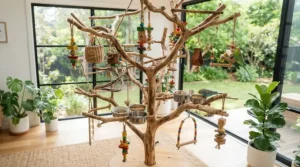
Not every bird uses a java wood bird stand the same way, and matching stand to species meaningfully changes the experience. Small birds like budgies, lovebirds, and canaries do best on the thinner-branch tabletop and multi-branch accessory options, where branch diameter matches their smaller foot span without forcing an awkward overextended grip. Mid-size birds — cockatiels, conures, caiques, and Quaker parrots — get the most out of the medium floor playstands, where branch thickness in the 3/4″ to 1 3/8″ range supports confident grip without straining smaller joints. Large parrots — African greys, Amazons, eclectus, and smaller macaws — genuinely need the large-tier stands’ thicker branches and heavier bases, both for foot-pressure distribution and structural stability against a stronger bird’s climbing force. Multi-bird households face a different calculus entirely: a single medium floor stand with varied branch diameter along its length can often serve a mixed flock better than several single-purpose perches, since birds will naturally gravitate to the branch section that fits them best. Senior or arthritic birds of any size benefit particularly from natural branch variety, since the constantly shifting diameter reduces the risk of any single pressure point becoming chronically irritated compared to a uniform perch surface.
Long-Term Cost & Maintenance
A java wood bird stand’s sticker price is only part of the total cost of ownership story. On the low end, accessory perches under $25 essentially have no ongoing cost beyond eventual replacement once chewed through, which for an active bird might mean a swap every several months. Mid-range and premium floor trees, running from roughly $90 up to $350, represent a larger upfront investment but typically last multiple years with basic maintenance, since the structural base outlives the branches’ surface wear by a wide margin. Ongoing costs are minimal: no filters, no batteries, no replacement parts beyond occasionally trimming loosened bark. Compare this to the alternative of continually replacing cheap dowel or plastic perches that birds destroy in weeks, and the value proposition shifts — a $200 medium java tree that lasts three years with periodic branch touch-ups often works out cheaper per month of use than a cycle of $15 perches replaced monthly. The real ROI case for a floor-model java wood bird stand isn’t the upfront price at all; it’s the reduced replacement frequency and the foot-health benefit of proper branch variety, which can meaningfully reduce avian vet visits related to pressure sores over the stand’s lifespan.
Common Mistakes When Buying a Java Wood Bird Stand
The most frequent mistake is buying based on the tree’s visual appeal rather than branch diameter matched to bird size — a gorgeous, thick-branched large tree is simply the wrong purchase for a budgie, regardless of how good it looks in photos. A close second is underestimating footprint: buyers see “medium” in a product name and assume it’s compact, when several of these floor units run nearly 40 inches across. Another common error is assuming all java wood is interchangeable between brands — while Prevue and A&E source similar coffee-tree branches, base construction, caster inclusion, and finished aesthetics genuinely differ, and picking blind between them ignores real functional tradeoffs. Buyers also frequently skip reading weight capacity relative to their specific bird’s size and behavior, then are surprised when an energetic landing tips a lighter unit. Finally, a subtle but costly mistake is expecting a photo-perfect match to the listing image — since every tree is a unique natural branch formation, expecting an identical replica of the product photo sets unrealistic expectations for what is, by design, a one-of-a-kind item.
Safety, Sourcing, and What the Label Doesn’t Tell You
Java wood’s sustainability pitch rests on sourcing branches from non-productive coffee trees — plants past their commercial fruiting life that would otherwise be cleared to make room for new cultivation. That’s a genuinely defensible environmental angle, though buyers should still confirm any stand they purchase is untreated and free of pesticide residue, since natural branch material should never have been sprayed with pesticides before it reaches a bird’s beak. Reputable manufacturers source specifically for pet use, but as a general safety habit, inspect any new natural wood item for splinters or sharp breaks before your bird has access to it, and keep monitoring for signs of foot stress on any unfamiliar perch surface, since even a well-chosen stand needs a settling-in period. If you notice discoloration, mold in deep cracks, or an unusual odor developing in humid conditions, that’s a sign the wood needs to be relocated to a drier spot or retired.

Frequently Asked Questions
❓ Is java wood safe for parrots?
❓ What size java tree perch does my bird need?
❓ How long does a java wood play stand typically last?
❓ Can I clean a java wood bird stand with soap and water?
❓ What makes an organic bird stand different from a treated wood perch?
Conclusion
Choosing among these seven java wood bird stands really comes down to matching branch diameter and base weight to your specific bird, not chasing the most expensive or most photogenic option. Budget-conscious owners of small birds do well with the Prevue Pet Products Coffeawood Java Tree Minis Small Tabletop Playstand or the A&E Cage Co. Java Wood Multi Branch Perch (Small), both of which deliver genuine java wood texture without a large floor commitment. Mid-size flocks get the best value from the Prevue Pet Products Coffeawood Java Tree Small Floor Playstand, the A&E Cage Company AE250M Java Wood Tree, or the Prevue Pet Products Coffeawood Java Tree Medium Floor Playstand, depending on whether you prioritize wing-flapping space, branch thickness, or overall stability. Large parrot owners should focus squarely on the Prevue Pet Products Coffeawood Java Tree Large Floor Playstand or the A&E Cage Company AE250L Java Wood Tree, where the decision mostly hinges on mobility versus finished aesthetics rather than any dramatic performance gap. Whichever you choose, remember that natural wood variation is a feature, not a defect — no two trees will ever look quite like the listing photo, and that’s exactly what makes them worth the premium over uniform dowel and plastic alternatives.
Recommended for You
- T-Stand With Food Bowls: 7 Best Picks for Parrots in 2026
- 7 Best Rolling Bird T-Stands of 2026: Ranked & Reviewed
- T-Stand for Macaw: 7 Best Picks in 2026
Disclaimer: This article contains affiliate links. As an Amazon Associate, I earn from qualifying purchases. If you purchase products through these links, we may earn a small commission at no additional cost to you.
✨ Found this helpful? Share it with your friends! 💬🤗
