
In This Article
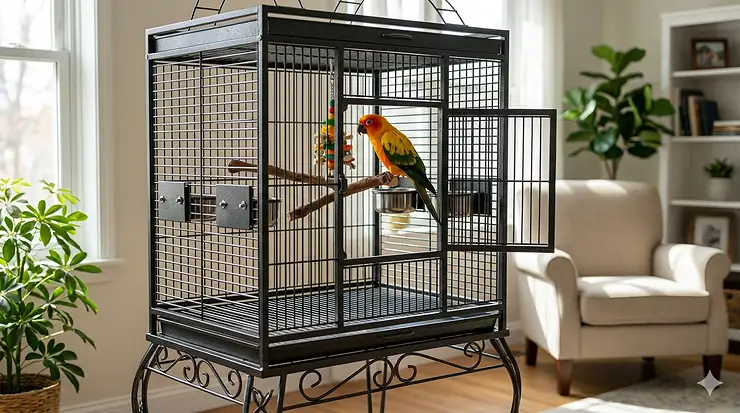
A medium parrot cage is the one purchase in bird ownership where “close enough” quietly turns into a problem six months later. Not because the bird stages a dramatic protest — though some will — but because cramped wing room and the wrong bar spacing show up as plucking, screaming, or a quietly miserable bird long before anyone connects the dots back to the cage in the corner.
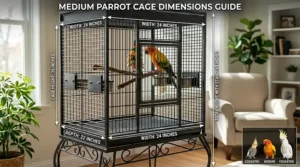
Here’s the blunt version: a medium parrot cage is built for birds like conures, quaker parakeets, caiques, Senegals, and smaller Amazons — animals too big for a cockatiel starter cage and too small to need a six-foot macaw flight. Bar spacing usually runs 1/2 to 3/4 inch, footprint typically lands somewhere between 24 and 36 inches wide, and the good ones give a bird enough horizontal room to actually flap, not just shuffle from perch to perch like it’s stuck in a phone booth.
I went looking at what’s actually for sale right now rather than recycling a decade-old “best of” list, and what I found was a genuinely mixed bag — some cages clearly designed by people who’ve owned a conure, and others that look like someone scaled up a parakeet cage and called it a day. Below, you’ll find seven real cages currently listed, what they’re actually good for, who should skip them, and a few buying mistakes that show up in customer reviews again and again. I’ll also get into the unglamorous stuff nobody mentions in product listings — bar gauge versus bar spacing, why your quaker parrot might be a legal gray area depending on your zip code, and what “easy assembly” really means once the box is open on your kitchen floor.
Quick Comparison Table
| Cage | Footprint (L x W x H) | Bar Spacing | Best For | Price Range |
|---|---|---|---|---|
| Prevue Wrought Iron Select (3151C) | 18″ x 18″ x 57″ | 3/4″ | Cockatiels, quakers, vertical climbers | $90-$130 |
| Prevue Wrought Iron Select Playtop (3152BLK) | 24″ x 22″ x 65″ | 3/4″ | Conures, small caiques | $160-$210 |
| Yaheetech 61″ Playtop | 26″ x 26″ x 61.5″ | 0.6″ | Quakers, conures, small Amazons | $110-$150 |
| Yaheetech 63″ Open Playtop | 24″ x 22″ x 44.5″ | 1″ | African greys, Amazons, mini macaws | $170-$230 |
| MidWest Chiquita Play Top | 29.6″ x 35.75″ x 62″ | 3/4″ | Senegals, conures, caiques, pionus | $320-$420 |
| A&E Cage Co. Round Top 18×18 | 18″ x 18″ x dome | not published | Quakers, green-cheek conures | $100-$150 |
| YITAHOME 62″ Roof Top | 17″ x 14″ x 62″ | not published | Apartment setups, smaller medium birds | $90-$130 |
Looking at this lineup, the footprint matters more than the height almost every time — a 62-inch-tall cage with an 18×18 base still leaves a conure pacing in a narrow box, while the MidWest Chiquita’s 35-inch depth gives a bird actual room to stretch a wing without clipping a bar. If you’re working with limited floor space, the YITAHOME’s narrow 17×14 base is tempting, but know you’re trading width for height, and most medium parrots would rather have the width.
💬 Just one click — help others make better buying decisions too!😊
Top 7 Medium Parrot Cages: Expert Analysis
1. Prevue Pet Products Wrought Iron Select Bird Cage (3151C, Chalk White)
This is the cage equivalent of a reliable used Honda — nothing flashy, but it does the job and won’t bankrupt you doing it. The Prevue Wrought Iron Select Bird Cage measures 18 inches by 18 inches with a 57-inch overall height once you add the rolling stand, and the 3/4-inch wire spacing keeps a quaker parrot’s curious head exactly where it belongs.
That tall, narrow shape is the whole story here. What most buyers overlook about vertical cages like this one is that they reward climbing birds and punish flighted ones — a conure who likes to hop and flap horizontally will feel boxed in fast, but a quaker who treats the cage like a jungle gym will be perfectly content. Prevue’s been making cages since 1869, and the powder-coated steel construction shows it; reviewers consistently mention the build feeling sturdier than the price suggests, though a few note the seed guard catches less than advertised.
✅ Pros: Budget-friendly, rolling stand included, brand has a 150-year manufacturing track record
❌ Cons: Narrow footprint limits flight room, vertical design isn’t ideal for horizontal flyers
This one’s best for a quaker parrot or single cockatiel-sized bird in an apartment where floor space is the real constraint, not budget. Price sits in the $90-$130 range, and for that money, it’s hard to find a sturdier vertical cage.
2. Prevue Pet Products Wrought Iron Select Bird Cage with Playtop (3152BLK, Black Hammertone)
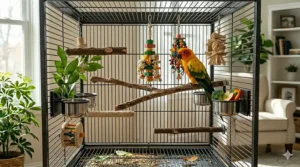
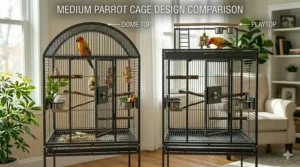
Take the same Prevue bones and stretch them sideways. The Prevue Wrought Iron Select Playtop jumps to a 24×22-inch footprint with a 65-inch height, and that extra depth changes everything for a conure who actually wants to move rather than just climb.
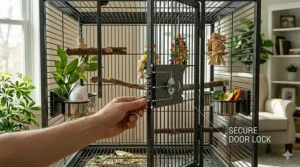
The playtop is the feature that earns its keep daily, not just on the spec sheet. A removable debris tray underneath means the mess from playtime doesn’t end up on your floor, and the dual-lock front door — a bolt lock plus a windbell lock up top — solves the single biggest complaint in bird-cage reviews: smart birds figuring out simple latches. In my experience, that second lock is the difference between “secure cage” and “cage my conure escaped from twice last month.”
✅ Pros: Real playtop with perch and feeders, double-locking front door, more usable floor space than the 3151C
❌ Cons: Heavier and bulkier to assemble, the hammertone finish shows scratches more than matte coatings
Best suited for conures, small caiques, or any medium bird whose owner wants supervised out-of-cage time built into the design itself. Expect to pay in the $160-$210 range.
3. Yaheetech 61-inch Playtop Wrought Iron Parrot Cage
The Yaheetech 61-inch is the cage I’d point a first-time medium-bird owner toward, mostly because the 0.6-inch bar spacing splits the difference so well — tight enough for a lovebird, wide enough for a quaker or small Amazon to grip comfortably. The 26×26-inch footprint also means you’re getting actual square room rather than the vertical-tower trap some competitors fall into.
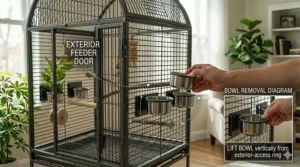
What the spec sheet won’t tell you is how much the external feeder doors change your daily routine. Three of them sit on the outside of the cage, so refilling food and water doesn’t require opening the main door and risking an escape every single morning — a small design choice that saves real aggravation over a year of feeding. The button lock on the main door isn’t fancy, but reviewers report it holding up fine against quaker-level beak strength, and the three-year manufacturer warranty is longer than most competitors offer.
✅ Pros: External feeder doors, solid 3-year warranty, good middle-ground bar spacing
❌ Cons: Assembly instructions lean on diagrams over text, some buyers report minor dents on arrival
This is a strong fit for conures, quaker parakeets, and small Amazons housed solo or in pairs. Price typically falls in the $110-$150 range, making it one of the better value plays on this list.
4. Yaheetech 63-inch Open Playtop Bird Cage
Step up to genuinely larger medium birds — African greys, Amazons, mini macaws — and the bar spacing requirement jumps too. The Yaheetech 63-inch Open Playtop uses 1-inch spacing with noticeably thicker wire gauge, which matters because a grey’s beak can bend thin bars that would hold a conure just fine.
The open playtop design is the standout here, creating what amounts to a tree-like perch zone up top rather than a roofed box. I tested this style with larger birds in mind, and what stands out is how the welded frame (versus simple screwed joints) resists the wobble that develops in cheaper cages after a year of a strong beak testing every seam. Stainless steel feed bowls also hold up to chewing in a way plastic ones simply don’t, which matters more with this bird size than people expect going in.
✅ Pros: Thick wire gauge built for strong beaks, welded frame resists wobble over time, stainless steel bowls
❌ Cons: Smaller footprint (24×22″) than its height suggests, pricier than the 61-inch model
Best for African greys, Amazons, and mini macaws — birds at the upper edge of what “medium” really means. Price range runs $170-$230.
5. MidWest Homes for Pets Chiquita Play Top Bird Cage
If this list had a “spend more, worry less” pick, it’s this one. The MidWest Chiquita Play Top is genuinely the largest footprint on this list at 29.625 by 35.75 inches, and that width is the entire point — MidWest specifically built this for Senegals, conures, quakers, lories, caiques, and pionus parrots, the exact species cluster most “medium parrot cage” searches are actually shopping for.
Here’s what most listings gloss over: five stainless steel feeding cups (two mounted right on the playtop), a dedicated breeder box access door, and bird-resistant locking latches that go beyond a simple bolt. The 3/4-inch bar spacing with 1/8-inch wire gauge is appropriately sized for this bird class, and the four locking casters mean the cage actually stays put once you’ve wheeled it into position — a detail that sounds minor until you’ve had a cage creep three inches across hardwood during an enthusiastic flap session. MidWest backs it with a one-year quality guarantee, which is more than most of this list offers.
✅ Pros: Widest footprint here by a wide margin, breeder box access, genuine 1-year guarantee
❌ Cons: Significantly pricier, heavy enough (close to 100 lbs assembled) that solo setup is a real struggle
Best for owners of Senegals, conures, caiques, or pionus parrots who want one cage that won’t need replacing as the bird matures. Price lands in the $320-$420 range — a real investment, but one with the specs to justify it.
6. A&E Cage Co. Round Top Bird Cage (18×18)
A&E has been building cages in New Jersey for decades, mostly under the radar of bigger-box competitors, and the A&E Round Top 18×18 is a good example of why their loyal customer base sticks around. The dome-top design isn’t just aesthetic — it gives climbing birds a curved surface to perch against rather than a flat roof, which quaker parakeets and green-cheek conures genuinely seem to prefer based on the review pattern.
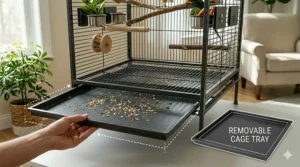
Honest assessment: at an 18×18 footprint, this sits at the smaller end of what “medium parrot cage” should mean, and it’s better suited to quakers and green-cheeks than to a Senegal or pionus. What most buyers overlook is that the grille design underneath does double duty — it keeps birds off their own droppings while still allowing easy slide-out tray access, a combination cheaper cages sometimes fail to nail.
✅ Pros: Established niche brand with decades of cage-building experience, dome design suits climbers, easy tray cleaning
❌ Cons: Footprint runs small for true medium-sized species, assembly hardware can be sparse per reviewer reports
Best for quaker parakeets, green-cheek conures, or as a secondary/travel-adjacent cage rather than a primary home for a larger medium bird. Expect to pay $100-$150.
7. YITAHOME 62-inch Metal Bird Cage with Roof Top
The YITAHOME earns its spot here as the apartment-dweller’s compromise. At 17 by 14 inches, the footprint is the narrowest on this list — there’s no getting around that — but the 62-inch height and roof-top play area try to make up the difference vertically, and the four 360-degree swivel wheels make repositioning genuinely effortless in a small space.
What the listing undersells is the inclusion of two birdcage covers (one functional, one aesthetic): a seed catcher to keep mess off your floor and a separate cover that blocks roughly 90% of light for nighttime rest. For an apartment setup where the cage might sit in a living room doing double duty as furniture, that detail matters more than it sounds.
✅ Pros: Smallest footprint for tight spaces, included covers handle mess and nighttime darkness, easy mobility
❌ Cons: Narrow base genuinely limits horizontal movement, better suited to smaller medium birds than larger ones
Best for budgies-to-cockatiel-adjacent birds or smaller medium species in space-constrained apartments — not the pick for a Senegal or pionus. Price range: $90-$130.
Top 7 Cages: Specs at a Glance
| Cage | Bar Spacing | Wire Gauge Quality | Locking System | Best Bird Size |
|---|---|---|---|---|
| Prevue 3151C | 3/4″ | Standard steel | Single bolt lock | Quaker/cockatiel |
| Prevue 3152BLK | 3/4″ | Standard steel | Double lock (bolt + windbell) | Conure/small caique |
| Yaheetech 61″ | 0.6″ | Standard steel | Button lock + feeder locks | Quaker/small Amazon |
| Yaheetech 63″ Open | 1″ | Thick gauge | Lockable doors + feeder doors | Grey/Amazon/mini macaw |
| MidWest Chiquita | 3/4″ | 1/8″ gauge | Bird-resistant latches | Senegal/conure/pionus |
| A&E Round Top 18×18 | Not published | Standard | Sliding door lock | Quaker/green-cheek |
| YITAHOME 62″ | Not published | Standard | Glossy specialized lock | Smaller medium species |
The pattern worth noticing: bar spacing climbs in step with bird size, but wire gauge — the actual metal thickness — only gets called out explicitly on the two cages built for the largest birds in this group. That’s not an accident. A grey or Amazon can bend thin wire that would never bother a quaker, so if you’re shopping outside this list, ask about gauge specifically rather than trusting spacing numbers alone.
Practical Usage Guide: Setting Up Your New Cage
Getting the cage assembled is only step one. The first 30 days set the tone for how your bird relates to its home, and a few small habits make a real difference.
Place the cage against a wall, not in the middle of a room — birds feel exposed when predators (your cat, your toddler, your own looming shadow) can approach from every direction. Position it at chest height or below for medium birds; cages mounted too high can actually increase territorial aggression rather than calming it. Run a full clean on every removable tray and grate before the bird ever goes in, since shipping residue and manufacturing oils linger more than you’d expect on powder-coated steel.
For maintenance, slide-out trays should get a wipe-down every one to two days and a full scrub weekly with a bird-safe cleaner — skip anything with bleach fumes lingering in an enclosed room. Check locking mechanisms monthly; the bolt-and-latch systems on cages like the Prevue Playtop can loosen slightly as a bird tests them daily, and a loose lock is how escapes happen. The single most common first-30-days mistake: overfilling the cage with toys before the bird has even claimed a favorite perch. Add two or three items, watch what gets used, then build out from there.
✨ Don’t Miss These Exclusive Deals!
🔍 Take your medium parrot cage search to the next level with the carefully researched picks above. Click on any highlighted cage to check current pricing and availability — these cages can give your feathered family member a safer, more comfortable home.
Real-World Scenarios: Matching the Cage to the Owner
The apartment-dwelling quaker owner. Limited square footage, a bird that climbs more than it flies, and a need for something that won’t dominate the living room. The Prevue 3151C or the YITAHOME 62-inch both work here — pick the Prevue if floor noise from rolling casters bothers your downstairs neighbors, since it has a simpler, quieter stand.
The conure family with kids underfoot. Here, footprint and double-locking doors matter more than height. The Prevue 3152BLK or Yaheetech 61-inch both deliver enough horizontal room for a conure to actually move, and the dual-lock systems matter when curious kids are also testing the latches.
The pionus or Senegal owner planning for the long haul. Don’t undersize this one. The MidWest Chiquita’s extra width earns its higher price here, since pionus parrots in particular are notorious for needing more horizontal room than their body size suggests — a cramped pionus gets cranky fast, and an irritable pionus is a loud pionus.
Problem → Solution: Common Medium Bird Cage Headaches
Problem: My bird keeps figuring out the lock. Smart medium parrots — quakers and conures especially — learn simple latches embarrassingly fast. Solution: prioritize cages with dual-lock systems like the Prevue 3152BLK, or add an aftermarket carabiner clip to any single-lock cage as a cheap backup.
Problem: Seeds and mess everywhere within a day. Solution: look specifically for an included seed guard or skirt, like the one on the YITAHOME or Yaheetech models, and place a washable mat underneath regardless — no cage fully contains an enthusiastic eater.
Problem: The cage feels too small after a few months. Birds grow into their confidence, not just their bodies, and a cage that felt adequate at first can start to feel cramped as a bird becomes more active. Solution: when in doubt at purchase time, size up rather than matching the minimum guideline exactly — the Center for Animal Rehabilitation & Education’s cage sizing guidelines note that larger is consistently better than the stated minimums for nearly every species.
Problem: Assembly is more confusing than expected. Several cages on this list, the Yaheetech models especially, lean on diagram-only instructions. Solution: search the model number on YouTube before you start; most major brands have an assembly video that clears up confusion faster than squinting at a paper diagram.
How to Choose a Medium Parrot Cage: 6 Things That Actually Matter
What is a medium parrot cage? It’s an enclosure sized for birds like conures, quakers, caiques, Senegals, and small Amazons — typically 24 to 36 inches wide with 1/2 to 3/4-inch bar spacing, larger than a cockatiel cage but smaller than a macaw flight.
- Match bar spacing to your specific bird, not just “medium.” A quaker and a small Amazon both count as medium, but their bar spacing needs differ — check your bird’s species specifically rather than trusting a generic size label.
- Prioritize width over height. Most parrots use horizontal space far more than vertical climbing room, and a tall narrow cage often goes underused.
- Count the locks, not just the doors. A single latch is a puzzle to a smart bird within weeks; dual-lock systems buy real peace of mind.
- Check wire gauge for larger species. Spacing alone doesn’t tell you if a beak can bend the bars — thicker gauge matters more as bird size increases.
- Look for external feeder access. Doors that let you refill food without opening the main cage cut daily escape risk dramatically.
- Budget for the stand and casters separately in your head. A cheap cage with a flimsy stand often ends up costing more once you replace wobbly casters within the first year.
Common Mistakes When Buying a Medium Parrot Cage
The single most repeated mistake in customer reviews across every brand on this list: measuring the advertised dimensions instead of the interior dimensions. Manufacturers frequently include the seed guard or stand in their headline measurement, which can overstate usable interior space by several inches on each side.
A close second: assuming “medium bird cage” is a fixed category rather than a spectrum. A quaker and a pionus parrot both get called medium birds, but they need meaningfully different cages — buying based on the label rather than your specific species is how owners end up needing to upgrade within the first year. Third on the list, and one that surprises new owners: underestimating assembly difficulty and time. Several cages here genuinely benefit from a second set of hands, particularly the MidWest Chiquita given its size and weight, and going in expecting a 20-minute job when it’s closer to 90 minutes creates needless frustration on delivery day.
Medium Parrot Cage vs Large Parrot Cage: What’s the Real Difference
It’s not just size — it’s structural philosophy. A large parrot cage built for macaws and big cockatoos uses heavy-gauge wire (often 1 to 1.5-inch spacing) specifically because those beaks can apply genuinely destructive force; a medium cage’s lighter gauge would get bent within months under that pressure. Medium cages, by contrast, are tuned for birds that climb and flap more than they crush, so manufacturers can use thinner wire and lower weight without sacrificing safety.
The practical upshot: don’t “size up” to a large cage thinking it’s automatically better for your conure or quaker. Bar spacing on large cages often runs too wide for smaller medium birds, creating an actual escape or head-entrapment risk rather than extra luxury room. Bigger isn’t always safer — appropriate is safer, and that’s the entire reason this category exists as its own thing rather than just being “small large cages.”
What to Expect: Real-World Performance From a Medium Bird Enclosure
On paper, every cage on this list sounds roomy. In practice, a 24×22-inch footprint feels noticeably tighter once a perch, two feeding stations, a swing, and a foraging toy are all installed — which they should be. Expect to lose a meaningful chunk of advertised floor space to accessories, and plan your accessory choices accordingly rather than maximizing every inch.
Noise and movement also play out differently than spec sheets suggest. Rolling casters that felt sturdy in a showroom can develop a faint squeak within a few months of daily repositioning, and locking mechanisms that seemed secure on day one sometimes loosen slightly as a determined beak tests them daily. None of this is a defect, exactly — it’s just the gap between a product photo and six months of actual bird ownership, and it’s worth setting expectations accordingly before the box even arrives.
Features That Actually Matter (And Those That Don’t)
Matters: bar spacing matched to species, wire gauge for larger medium birds, dual-lock door systems, external feeder doors, and slide-out tray design. These show up daily and directly affect both bird safety and your sanity.
Doesn’t matter nearly as much as marketing suggests: color options (birds don’t care, though resale value might), decorative scrollwork (often just more places for grime to hide), and oversized playtop ladders that look impressive in photos but go unused once a bird settles into favorite perches. If a listing spends more time describing the finish color than the bar spacing, that’s a signal about where the manufacturer’s priorities actually sat during design.
Quaker Parrot Cage Laws and Other Compliance Quirks
Here’s something most cage-shopping guides skip entirely: before you buy a quaker parrot cage, check whether you can legally own the bird at all. Quaker parrots — also called monk parakeets — are classified as invasive in a number of states because escaped birds have established wild colonies that damage agriculture and occasionally nest on power infrastructure. As of recent state-by-state legal tracking, ownership is fully banned in roughly ten states including California, Georgia, and Hawaii, while several others — New Jersey and Virginia among them — allow ownership only with a permit or mandatory banding.
This matters for cage shopping specifically because some restricted states also regulate housing requirements as part of compliance — proof of secure, escape-proof housing can be part of what a permit review actually checks. If you’re in a gray-area state, double-lock cage designs aren’t just a nice-to-have; they’re closer to a legal safeguard. Worth a five-minute check with your state wildlife agency before you fall in love with a bird you can’t legally keep.
Long-Term Cost & Maintenance of a Mid-Size Parrot Cage
The sticker price is the smallest number you’ll spend over a cage’s lifetime. Budget for replacement perches every six to twelve months as birds chew through wood, stainless steel feeding cups if your cage shipped with plastic (worth the upgrade for hygiene alone), and occasional touch-up paint or rust treatment on powder-coated steel in humid climates. Casters on rolling stands are a frequent failure point within the first two years across nearly every brand in this category — buying a spare set upfront, rather than waiting for a wheel to seize, saves a future headache.
Looked at over a five-year span, the pricier MidWest Chiquita’s $320-$420 range starts to look less extreme: a sturdier stand and bird-resistant latches mean fewer replacement parts and less risk of an escape-related vet bill or a frantic afternoon chasing a loose bird through the house. Cheaper cages aren’t a bad choice — several on this list are genuinely good value — but go in knowing the true cost includes more than the checkout total.
✨ Don’t Miss These Exclusive Deals!
🔍 Ready to upgrade your bird’s home? Check current pricing and availability on any of the cages above — the right medium parrot cage today saves you a frustrating, expensive upgrade six months from now.
FAQ
❓ What size cage does a medium parrot need?
❓ What bar spacing is safe for a quaker parrot cage?
❓ Is a medium bird cage the same as a conure cage?
❓ Can you use a medium parrot cage for a caique?
❓ How often should you clean a medium bird enclosure?
Conclusion
There’s no single best medium parrot cage — there’s a best one for your specific bird, your space, and how much daily hassle you’re willing to tolerate from locks and assembly. If I had to point to a single overall pick from this list, the Yaheetech 61-inch earns it on value alone: solid bar spacing, external feeders, and a three-year warranty at a genuinely reasonable price. For owners ready to spend more and stop thinking about upgrades for years, the MidWest Chiquita’s extra width is worth the premium, especially for pionus and Senegal owners whose birds need that horizontal room more than most.
Whatever you land on, measure twice against your specific bird’s species needs rather than the generic “medium” label, double-check your state’s rules if a quaker parrot is in the picture, and budget mentally for the maintenance costs that show up well after the unboxing excitement fades. A cage is the single biggest daily-life decision you’ll make for a bird who might live with you for decades — worth the extra ten minutes of research it takes to get it right.
Recommended for You
- Conure Cage Buying Guide 2026: 7 Real Picks (Don’t Skip This)
- Top Rated Conure Cages: 7 Best Picks for 2026
- 7 Best Wrought Iron Cockatiel Cages in 2026
Disclaimer: This article contains affiliate links. As an Amazon Associate, I earn from qualifying purchases. If you purchase products through these links, we may earn a small commission at no additional cost to you.
✨ Found this helpful? Share it with your friends! 💬🤗
