
In This Article
A java tree stand for macaw owners isn’t just furniture — it’s the one piece of gear that decides whether your bird spends the afternoon happily gnawing on bark or systematically dismantling your bookshelf instead. If you’ve never shopped for one, here’s the short version: a java tree stand for macaw use is a play perch carved from a single retired coffee (java) tree trunk, prized for gnarled, variable-diameter branches that mimic wild foraging terrain far better than a dowel ever could. It sounds simple. It is not simple to pick the right one, because “java tree” covers everything from a $120 tabletop toy to a thousand-dollar double-trunk monster built for two green-wings at once.
I’ve spent the last few weeks pulling apart specs, cross-referencing owner feedback across Amazon, Petco, and Wayfair listings, and mapping out which stands actually survive contact with a determined macaw beak versus which ones look great in product photos and fall apart by month three. What you’re getting below isn’t a rewritten product listing — it’s a buyer’s breakdown built around one blunt question: does this specific stand justify what it costs, for your specific bird and your specific space?
Macaws, as a group, are among the most physically powerful parrots kept as pets — a trait that spans several genera native to forested regions of Mexico, Central America, and South America. That evolutionary background matters here, because it’s exactly why a flimsy stand doesn’t cut it. We’ll get into all seven picks, three comparison tables, and the sizing and safety details that most listings skip entirely.
Quick Comparison Table
Before the deep dive, here’s the fast version for anyone who just wants the shortlist. Every price below is a range, not a fixed number, since retailer pricing shifts constantly — always check the current price before buying.
| Stand | Best For | Size Range | Price Range |
|---|---|---|---|
| Prevue Coffeawood Java Tree Minis (22634) | Budget / mini macaws | Tabletop, 22.5″L x 14.5″W x 24″H | $120-$170 range |
| A&E Cage Company Medium Java Tree (AE200M) | Value floor stand | 48″L x 28″W x 66″H | $300-$400 range |
| Prevue Coffeawood Java Tree Floor Playstand (22623) | Catch-tray convenience | Floor, mid-size footprint | $270-$320 range |
| Windy City Parrot Java Wood Play Stand 500L | Apartment tabletop | 28.75″L x 18.5″W base | $200-$280 range |
| A&E Cage Company Large Java Tree (AE200L) | Full-size all-rounder | 48″L x 32″W x 66″H | $400-$550 range |
| Talis-Us Java Wood Perch Tree Stand | Premium natural build | Large, Kamper wood base | $320-$420 range |
| A&E Cage Company Large Double Java Tree (AE400L) | Extra-large / heavy duty | 73″L x 36″W x 66″H | $1,100-$1,400 range |
Looking at the spread, there’s no single “best” — the Prevue Coffeawood Java Tree Minis wins on price and footprint for a young or smaller macaw, the A&E Cage Company Large Java Tree is the safest all-around bet for a full-grown bird, and the A&E Cage Company Large Double Java Tree exists for households running two macaws or a genuinely enormous one, like a hyacinth. Budget alone shouldn’t decide this — branch diameter and base stability matter more for a bird that can generate real bite force.
💬 One click here could save you hours of comparison shopping — jump to any pick above to check today’s availability.
Top 7 Java Tree Stands for Macaws: Expert Analysis
Here’s the full rundown. Each pick below includes real specs, an honest read on who it fits, and aggregated review themes pulled from the retailers where each product is actually sold — not invented testimonials.
1. Prevue Coffeawood Java Tree Minis Medium Tabletop Playstand (22634) — best budget entry for mini macaws
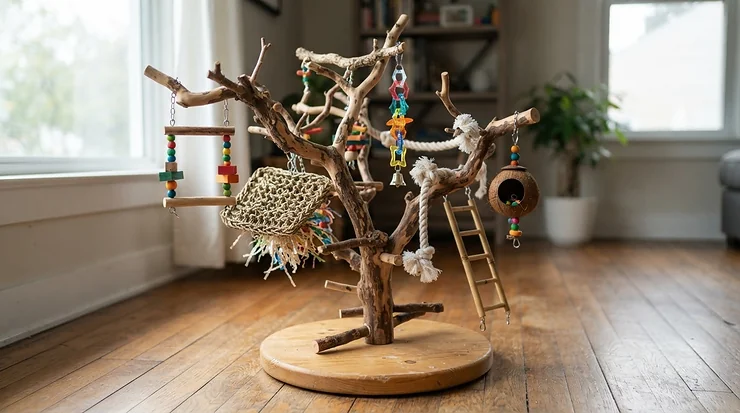
This is the smallest true java product on the list, and it earns its spot by being an honest, no-frills starting point rather than pretending to be more than it is. At 22.5″ long, 14.5″ wide, and 24″ tall, it’s built to sit on a tabletop or low dresser rather than the floor.
The branch diameters on the Minis line run noticeably thinner than the full-size A&E or Talis-Us trees, which matters more than it sounds — a branch that’s too thin makes it harder for a bigger macaw to grip comfortably, while a mini macaw or a young bird still growing into its feet does fine on it. It ships with an attached bowl for food or water, and because every tree is cut from a different retired coffee trunk, no two units are shaped identically.
Based on the spec comparison against the rest of this list, this stand is really a fit for two situations: households with a mini macaw (Hahn’s, noble, or severe macaw) as the primary bird, or owners of a larger macaw who want a supplementary perch near a desk rather than a full floor centerpiece. Reviewers of the broader Coffeawood Minis line commonly note the branches run thinner and springier than expected for bigger birds, so a full-size blue-and-gold or green-wing will likely outgrow it fast.
Pros:
- ✅ Compact footprint fits desks, dressers, and small rooms
- ✅ Genuine java wood texture supports natural foot exercise
- ✅ Attached bowl included at this price point
Cons:
- ❌ Branches too thin for a full-size adult macaw
- ❌ No wheels, so repositioning means lifting the whole unit
At the time of research, this stand sits in the $120-$170 range, making it one of the few genuine java options under $200 — a reasonable value verdict for a mini macaw or a secondary desk perch, but not a primary stand for a big bird.
2. A&E Cage Company Medium Single Java Wood Tree (AE200M) — best value floor stand for growing macaws
The AE200M is A&E’s mid-size floor unit, and it’s the point where “tabletop toy” turns into “actual furniture.” Listed dimensions run around 48″ long by 28″ wide by 66″ tall, though — and this applies to every java tree on this list — actual branch layout varies tree to tree because each one is cut from a genuine retired coffee trunk rather than molded.
What that variability buys you is real gripping texture: branches taper and twist rather than running a uniform diameter, which is closer to what a macaw’s feet evolved to grip in the wild than any straight dowel perch. Based on the spec sheet, the base footprint here is sized for a bird that needs room to flap and shift its weight without knocking the whole tree over, which is a real risk with lighter stands once a macaw starts throwing its weight around during play.
Owner feedback on A&E’s java line, which spans this size and its siblings, repeatedly mentions two things: the trees are genuinely sturdy once assembled, and the included cups occasionally arrive as substituted stainless steel rather than the pictured java-wood bowls, since A&E swaps materials when supply runs short. Some buyers also mention minor cosmetic touch-up — sanding a stray paint mark before first use — as a normal part of unboxing a hand-finished natural product.
Pros:
- ✅ Solid base resists tipping during active play
- ✅ Varied branch widths mimic natural wild perching
- ✅ Proven track record across thousands of A&E units sold
Cons:
- ❌ Cups may ship as substituted stainless steel, not java
- ❌ Requires assembly and floor space commitment
In the $300-$400 range at the time of research, this is the stand I’d point a first-time macaw owner toward if the full Large model feels like overkill for a younger or smaller-bodied macaw.
3. Prevue Coffeawood Java Tree Floor Playstand, Style #2 (22623) — best for easy cleanup
This is Prevue’s step up from the tabletop Minis into an actual floor stand, and the standout here is the built-in catch design paired with a stone-style bowl rather than a flimsy plastic cup. If you’ve ever swept java wood shavings and seed hulls off a hardwood floor twice a day, you already know why a catch tray earns its own bullet point.
The stoneware bowl is a small but genuinely practical touch — it sits heavier and more securely in its mount than the thin metal cups some competitors substitute, and it’s less prone to tipping when a macaw leans on it mid-forage. Based on the build description, the branch structure follows the same “single retired coffee tree” sourcing as every other java product here, so expect the same natural variation in shape from unit to unit.
What most buyers overlook about this model is that “Style #2” specifically denotes the floor version with feet rather than a tabletop base — worth double-checking before ordering if you’re comparing multiple Prevue SKUs, since the naming across their java lineup gets confusing fast.
Pros:
- ✅ Stoneware bowl feels sturdier than thin metal cups
- ✅ Floor design frees up tabletop and counter space
- ✅ Genuine java branch texture for foot conditioning
Cons:
- ❌ SKU naming across Prevue’s java line is easy to mix up
- ❌ Mid-pack pricing without a major size advantage
Landing in the $270-$320 range, this is a fair middle-ground pick if bowl quality and easy cleanup matter more to you than raw size.
4. Windy City Parrot Java Wood Play Stand Tree Table Top 500L — best tabletop pick for apartment macaw owners
This tabletop model punches above its category by including two eye screws specifically for hanging toys alongside the standard dual food/water cup — a small addition, but one that changes how much enrichment you can pack onto a smaller footprint. The base measures roughly 28.75″ long by 18.5″ wide, with an overall stand height around 27″.
Here’s what the spec sheet won’t tell you outright: a tabletop java stand this size works best as a supervised out-of-cage perch rather than a bird’s only enrichment source, precisely because it’s sized for medium-to-large birds like Amazons and smaller macaws rather than a full-grown blue-and-gold or scarlet. The thicker branch diameter listed for this size class is genuinely a step up from entry-level tabletop units, which matters for foot comfort during longer perching sessions.
Reviewers shopping this size class of tabletop java stand consistently flag the toy-hanging eye screws as the differentiator versus cheaper tabletop competitors that skip them entirely, since without dedicated hardware you’re stuck tying toys directly to branches, which wears the wood faster.
Pros:
- ✅ Built-in eye screws simplify hanging toys and swings
- ✅ Thicker branch diameter than most tabletop competitors
- ✅ Compact enough for apartments without sacrificing sturdiness
Cons:
- ❌ Sized for smaller macaws, not full-size blue-and-golds
- ❌ Tabletop design still needs a stable surface underneath
At $200-$280 at the time of research, this is a strong space-conscious pick, but check your macaw’s size against the branch diameter before committing.
5. A&E Cage Company Large Single Java Wood Tree (AE200L) — best all-rounder for full-size macaws
If you only read one product entry on this list, make it this one — the AE200L is the stand most full-grown macaw owners actually end up buying, and for good reason. Dimensions run roughly 48″ long by 32″ wide by 66″ tall, a meaningful width increase over the Medium model that translates directly into base stability under a bird that can weigh over two pounds and move with real force.
Based on the spec comparison against the Medium AE200M, the extra four inches of width isn’t cosmetic — it lowers the stand’s center of gravity relative to its height, which is exactly the kind of detail that prevents a top-heavy tip-over when a macaw lands hard after a hop or flutter. Owner reports across multiple retail listings for this size class describe the tree as sturdy once built, with branch diameters wide enough for a blue-and-gold or green-wing macaw to grip comfortably rather than perch on tiptoe.
The aggregated complaint pattern worth flagging honestly: because every java tree is a genuine natural product, buyers occasionally report the shipped unit’s branch layout looking different from the reference photo, and freight delivery on units this size sometimes arrives via pallet rather than a standard parcel carrier — something to plan for logistically, not a defect.
Pros:
- ✅ Wider base meaningfully improves tip resistance
- ✅ Branch diameter comfortably fits full-size macaw feet
- ✅ Long track record as the go-to full-size java pick
Cons:
- ❌ Natural variation means your unit won’t match photos exactly
- ❌ Heavy enough to require freight delivery in some cases
In the $400-$550 range, this is the stand I’d call the safest default purchase for a single full-grown macaw, budget allowing.
6. Talis-Us Java Wood Parrot Bird Perch Tree Stand (Large) — best for sustainably sourced natural build
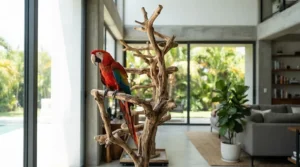
Talis-Us positions this large java tree around sourcing transparency, and the details back it up: the base uses Kamper hardwood harvested from Kalimantan, paired with java wood branches that the brand markets specifically as suited to “cockatoo and macaw size birds” rather than a one-size-fits-all claim.
What most buyers overlook about sourcing-forward listings like this one is that the wood itself doesn’t perform differently just because it’s marketed with eco credentials — the real functional benefit is that Kamper wood is a genuinely dense hardwood, which means the base resists gouging and chewing at the joints better than softer composite bases used on some budget competitors. Branch spacing on the large size class is described as intentionally wide, giving a macaw room to fully extend its wings while perched — a detail smaller tabletop units simply can’t offer.
Verifiable review volume specific to this exact listing is limited compared to the long-established A&E and Prevue lines, so rather than invent sentiment that doesn’t exist, it’s worth noting plainly: judge this one primarily on its published build specs and brand sourcing claims until a larger review base accumulates, and lean on the A&E or Prevue picks above if you want a longer purchase history to reference first.
Pros:
- ✅ Kamper hardwood base resists chew damage at joints
- ✅ Wide branch spacing allows full wing extension
- ✅ Sourcing transparency uncommon among budget competitors
Cons:
- ❌ Smaller public review base than A&E or Prevue lines
- ❌ Premium sourcing story adds cost without changing core function
At $320-$420 at the time of research, this is a solid pick if sourcing transparency and branch spacing matter to you more than a long public review history.
7. A&E Cage Company Large Double Java Tree (AE400L) — best extra-large heavy duty stand for big households
This is the flagship, and it’s built for exactly one scenario: you either own two macaws that need to coexist on shared enrichment furniture, or you own one genuinely massive bird — a hyacinth, a green-wing, or a Catalina hybrid — that outgrows every single-trunk option on this list. At 73″ long, 36″ wide, and 66″ tall, the AE400L isn’t subtle, and it isn’t meant to be.
Based on the spec comparison, the defining feature isn’t just the size — it’s the dual-trunk design, which lets two birds perch and forage independently without competing for the same branch real estate, a detail that matters more than raw square footage when you’re managing bird-to-bird dynamics in a shared space. Owner accounts describing multi-macaw households consistently cite the craftsmanship of how the two trunks interlock at the base as noticeably more refined than simply bolting two single trees together, which is the crude workaround some owners try before eventually upgrading to a purpose-built double.
The honest tradeoff here is logistics, not quality: at this size and weight, delivery happens via freight pallet rather than a standard doorstep drop, and you’ll want help unloading and assembling it. This is squarely the heavy duty java stand pick on this list — built for households where a lighter, single-trunk stand simply won’t survive the combined wear of two macaws.
Pros:
- ✅ Dual-trunk layout supports two macaws simultaneously
- ✅ Widest, most stable base of any stand on this list
- ✅ Refined interlocking base construction versus DIY double setups
Cons:
- ❌ Requires freight delivery and assembly help
- ❌ Premium price puts it out of reach for casual buyers
At $1,100-$1,400 at the time of research, this is a genuine investment piece — but for a two-macaw household or an oversized bird, it’s often cheaper long-term than replacing a smaller stand that gets destroyed within a year.
Large Java Wood Stand vs Extra Large Java Stand: Sizing Guide for Macaws
Sizing confusion is probably the single most common mistake in this category, so let’s untangle it. A large java wood stand — think the A&E Cage Company Large Single Java Wood Tree or the Talis-Us Java Wood Parrot Bird Perch Tree Stand — is built around a roughly 48″ tall, 28-32″ wide footprint. That’s the correct size class for one adult macaw of typical size: blue-and-gold, green-wing, military, or severe macaw.
An extra large java stand, by contrast, means something structurally different, not just a bigger number on a tape measure. The A&E Cage Company Large Double Java Tree at 73″ long and 36″ wide isn’t a scaled-up single tree — it’s a dual-trunk system engineered to support two birds’ combined weight and movement without the base becoming unstable. If you’re shopping specifically for a hyacinth macaw, a genuinely oversized individual bird, or a two-macaw household, treat “extra large” as its own category with its own delivery logistics, not just “large, but pricier.”
Here’s the practical rule of thumb: measure your bird’s wingspan fully extended, add at least 12 inches of clearance on each side for the base footprint, and only then decide between a large single stand and an extra-large double. Skipping this step is exactly how owners end up returning a stand that looked fine in photos but crowds a macaw the second it stretches its wings.
✨ Not sure which size fits your bird? Compare the full spec breakdown above before you commit to a footprint you can’t return easily.
Macaw Java Tree Perch vs Macaw Natural Perch: What’s the Difference
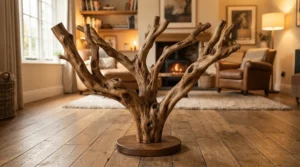
These two terms get used almost interchangeably online, but there’s a real distinction worth understanding before you buy. A macaw java tree perch specifically refers to branches harvested from the java (coffee) tree — dense, twisted, variable-diameter wood that’s become the industry standard because it resists splintering and chewing damage better than most alternatives while still giving a macaw satisfying material to gnaw on.
A macaw natural perch is the broader category — it includes java wood, but also grapevine, manzanita, dragonwood, and other rot-resistant hardwoods sold as standalone branches rather than assembled trees. The practical difference matters most for owners supplementing a java tree stand: if your macaw is aggressively chewing through java branches faster than expected, rotating in a natural perch made from a different hardwood, like manzanita, gives their beak a different texture and hardness to work against, which several parrot forums note slows down destructive chewing simply by introducing variety.
Reviewers of both java tree stands and standalone natural perches on this list — particularly the A&E Cage Company Medium Single Java Wood Tree and the Windy City Parrot Java Wood Play Stand — report that mixing branch materials rather than relying on java wood exclusively keeps a macaw’s interest longer and reduces how quickly any single perch gets destroyed.
Heavy Duty Java Stand: Why Build Quality Matters More Than Looks
A heavy duty java stand isn’t defined by size alone — it’s defined by how the base is engineered to handle the specific physical force a macaw generates. Macaws don’t just perch quietly; they lean, flap, launch, and occasionally throw their full body weight sideways during play, and a stand with a narrow or lightweight base will eventually tip regardless of how thick the branches look.
Based on the spec comparison across this list, three features separate a genuinely heavy duty design from a stand that merely looks sturdy in photos: base width relative to overall height (wider and lower beats tall and narrow), the density of the base wood itself (Kamper hardwood, as used in the Talis-Us Java Wood Parrot Bird Perch Tree Stand, resists gouging better than softer composite bases), and how the trunk connects to the base — bolted or interlocked joints, like those on the A&E Cage Company Large Double Java Tree, hold up far longer than glued or friction-fit connections.
What most buyers overlook is that heavy duty doesn’t automatically mean “buy the biggest one available.” A single macaw doesn’t need the AE400L’s dual-trunk footprint — it needs a stand sized correctly for one bird with a base built to that bird’s actual force output. Oversizing wastes money; undersizing risks a tip-over. Match the build quality to your bird’s size and behavior, not to the biggest number on the page.
Practical Usage Guide: Setting Up Your Macaw Tree Stand
Getting a java tree stand right isn’t just about the purchase — setup and the first month matter just as much for how well it holds up.
Placement first. Position any macaw tree stand at least a few feet from walls and furniture your bird could reach mid-flap, and away from direct heating vents, which can dry out and crack java wood branches over time. A stable, level floor surface matters more than most owners expect — even a slight lean on carpet padding can make a tall stand feel unsteady to a bird testing it for the first time.
The first 30 days. Expect a macaw to test-chew every accessible branch tip within the first week — this is normal exploratory behavior, not a sign the wood is defective. Physical enrichment items like natural perches help a bird express normal chewing, climbing, and curiosity instincts, so resist the urge to intervene unless chewing targets the structural joints rather than branch tips. Rotate toy placement on the eye screws or hooks weekly during this period to keep the stand feeling novel rather than static furniture.
Ongoing maintenance. Wipe branches down monthly with a damp cloth and mild, bird-safe soap rather than harsh cleaners, which can strip the wood’s natural oils. Check bolt or joint tightness on floor stands every few months, since repeated flapping and landing gradually loosens hardware on even well-built units like the A&E Cage Company Large Single Java Wood Tree. Replace bowls the moment they crack rather than waiting, since a cracked ceramic or stone bowl can injure a curious beak.
Common first-month mistake. Owners frequently place a brand-new stand directly next to the cage and expect immediate adoption — but many macaws need the stand introduced gradually, sometimes with a favorite treat placed on it for several days before the bird voluntarily climbs on.
Real-World Scenarios: Matching Macaw Owners to the Right Stand
The apartment-dwelling first-time owner. If you’ve just brought home a mini macaw and live in a one-bedroom apartment, floor space is your limiting factor, not budget. The Prevue Coffeawood Java Tree Minis Medium Tabletop Playstand fits a dresser or side table without dominating the room, and the branch diameter suits a smaller-bodied macaw perfectly at this life stage.
The established owner upgrading from a metal stand. Say you’ve had your blue-and-gold macaw for three years on a basic metal play gym, and it’s showing wear at the joints. This is the classic case for the A&E Cage Company Large Single Java Wood Tree — enough branch variety and base stability to be a genuine upgrade, at a price point that doesn’t require freight delivery logistics.
The multi-macaw household. If you’re managing two macaws that need to share floor space without competing over a single perch, retrofitting two separate stands into one room usually backfires — birds squabble over proximity even with separate furniture. The A&E Cage Company Large Double Java Tree solves this directly by giving each bird its own trunk within a shared, stable base, which several multi-macaw owners describe as noticeably reducing perch-related conflict compared to two standalone stands crammed into the same space.
Buyer’s Decision Framework for Java Tree Stands
Use this as a quick priority checklist rather than reading every product entry again:
- If you own one mini or young macaw and space is tight — choose a tabletop model like the Prevue Coffeawood Java Tree Minis because branch diameter and footprint matter more than raw size at this life stage.
- If you own one full-size adult macaw and want the safest default — choose the A&E Cage Company Large Single Java Wood Tree because its wider base directly addresses tip-over risk without overspending on capacity you don’t need.
- If bowl quality and easy cleanup matter to you — choose the Prevue Coffeawood Java Tree Floor Playstand for its stoneware bowl and catch-friendly floor design.
- If you live in an apartment and need a smaller footprint without sacrificing sturdiness — choose the Windy City Parrot Java Wood Play Stand 500L for its built-in toy hooks and tabletop convenience.
- If sourcing transparency and branch spacing top your priority list — choose the Talis-Us Java Wood Parrot Bird Perch Tree Stand for its Kamper hardwood base and wide branch layout.
- If you own two macaws or one oversized bird — choose the A&E Cage Company Large Double Java Tree, because a single-trunk stand simply wasn’t engineered for that combined load.
How to Choose a Java Tree Stand for Macaw Ownership
Cutting through the marketing, here’s the actual decision process worth following, step by step:
- Measure your bird’s wingspan first. A macaw’s fully extended wingspan should clear the stand’s base with room to spare — this single measurement eliminates half the options on any shopping page immediately.
- Check branch diameter, not just overall size. A large stand with thin branches is worse for foot comfort than a smaller stand with appropriately thick, varied branches.
- Confirm base width relative to height. A tall, narrow stand is a tip-over risk regardless of how attractive the branch structure looks in photos.
- Decide floor versus tabletop based on real available space, not aspirational space — an oversized stand crammed into a corner gets used less than a correctly sized one in an open area.
- Factor in delivery logistics for anything over roughly 60 pounds. Freight delivery on the larger stands, like the AE400L, requires planning for unloading help that a standard parcel delivery doesn’t.
- Read aggregated review themes, not star ratings alone. A 4.3-star average with recurring joint-tightness complaints tells you more than the number itself.
- Budget for bowl or hardware replacement over time, since cups and joints wear faster than the branches themselves on a heavily used stand.
Common Mistakes When Buying a Java Wood Stand
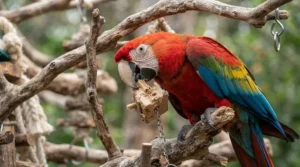
Buying based on branch photos alone. Because every java tree is cut from a genuine natural trunk, the specific unit that ships to you won’t match the reference photo exactly — treat photos as a style guide, not a literal preview.
Ignoring base width in favor of height. A taller stand looks more impressive but isn’t automatically better; base width relative to height is the actual predictor of tip resistance, and it’s easy to overlook when scanning listings quickly.
Skipping the delivery logistics question. Larger stands like the A&E Cage Company Large Double Java Tree ship via freight pallet, not standard parcel carrier — buyers who don’t check this in advance are sometimes caught off guard needing help unloading on delivery day.
Assuming “java wood” means uniform quality across every seller. Base wood species, joint construction, and finishing quality vary meaningfully between brands even when the branch material is the same java wood — the base is where cheaper competitors cut corners most often.
Underestimating a growing macaw. A stand sized for a young bird gets outgrown faster than owners expect; if your macaw is still maturing, sizing slightly up front often costs less than buying twice.
Java Tree Stand vs Traditional Metal Play Stands
| Factor | Java Tree Stand | Traditional Metal Play Stand |
|---|---|---|
| Foot health | Varied natural diameters exercise feet | Uniform diameter, less foot variety |
| Chew resistance | Absorbs chewing; branches wear over years | Powder coat chips, exposing metal |
| Weight/stability | Heavy wood base resists tipping | Often lighter, can tip more easily |
| Aesthetic | Natural, furniture-like appearance | Utilitarian, industrial look |
| Best For | Long-term primary enrichment perch | Portable or travel-friendly setups |
The core tradeoff comes down to longevity versus portability. A java tree stand generally outlasts a metal equivalent because there’s no coating to chip and expose bare metal to a macaw’s beak — a genuine safety consideration, since ingested paint or coating flakes are a real health concern. Metal stands still win on portability and lower upfront cost, which makes them reasonable for travel setups or a temporary perch rather than a primary enrichment piece. If you’re choosing a single long-term stand for a permanent spot in your home, the wood option wins on nearly every axis except price and portability.
Features That Actually Matter (And Those That Don’t)
Actually matters: branch diameter variety. Providing perches of a variety of shapes, textures, materials, and diameters supports natural foot health — this is the single biggest functional differentiator between java tree stands and it’s worth prioritizing over almost every other spec.
Actually matters: base-to-height ratio. As covered above, this predicts tip resistance more reliably than weight alone.
Doesn’t matter much: exact branch count. Marketing sometimes touts a specific number of branches, but a tree with fewer, well-placed thick branches often serves a macaw better than one with many thin, closely spaced branches that limit foot placement options.
Doesn’t matter much: matching wood tone to your décor. Because every java tree varies naturally, chasing a specific shade is a losing game — focus on structural specs instead and let the aesthetic be a bonus.
Somewhat matters: included bowl material. Stoneware, like on the Prevue Coffeawood Java Tree Floor Playstand, holds up better than thin metal cups, but a mediocre included bowl is an easy, inexpensive swap after purchase — it shouldn’t be a dealbreaker on an otherwise well-built stand.
Long-Term Cost & Maintenance
Thinking in total cost of ownership rather than sticker price changes the math on this category considerably. A budget tabletop stand around $150 that a macaw outgrows or destroys within a year effectively costs more per year of use than a $450 stand, like the A&E Cage Company Large Single Java Wood Tree, that lasts three to five years with basic maintenance.
| Ownership Factor | Budget Tabletop | Mid-Range Floor Stand | Premium/Extra-Large |
|---|---|---|---|
| Typical lifespan | 1-2 years | 3-5 years | 5+ years |
| Replacement bowls/hardware | $15-$30/year | $20-$40/year | $30-$60/year |
| Cost per year of use (rough) | Higher | Moderate | Lowest long-term |
| Best For | Short-term or secondary perch | Single-bird households | Multi-bird or heavy-use homes |
Read plainly, the table shows that upfront price and long-term value aren’t the same axis at all — the A&E Cage Company Large Double Java Tree‘s steep sticker price amortizes reasonably well across a two-macaw household precisely because it’s replacing what would otherwise be two separate stands needing their own maintenance cycles. Budget stands still make sense as a deliberate short-term or secondary purchase; the mistake is buying one as your only long-term stand for a full-size macaw and being surprised when it doesn’t last.
Safety, Regulations & Compliance for Macaw Owners
This section matters more than most buyers realize, because macaw ownership itself intersects with wildlife regulation in ways that a java tree stand doesn’t, but that responsible owners should still understand. Many macaw species are protected under international trade agreements — the hyacinth macaw, for example, is protected under Appendix I of the Convention on International Trade in Endangered Species of Wild Fauna and Flora, which restricts commercial trade in wild-caught birds, though captive-bred individuals sold domestically are generally unaffected by these restrictions. If you’re acquiring a macaw, confirming its captive-bred status and paperwork matters well before you’re shopping for a stand.
On the equipment side, a few safety basics apply across every stand on this list: check that bowls are lead-free and chew-safe, inspect joints for splintering rather than clean chewing wear, and avoid stands treated with any varnish or sealant not explicitly labeled bird-safe, since macaws will inevitably test every surface with their beak. Population pressures on wild macaw species have historically come from deforestation, hunting, and predation rather than the responsible pet trade, but it’s still worth buying from sellers who are transparent about sourcing, like the Talis-Us Java Wood Parrot Bird Perch Tree Stand‘s stated Kalimantan sourcing, rather than opaque listings with no origin information at all.
Finally, if you’re placing a stand outdoors or on a balcony, check local regulations on outdoor pet bird enclosures, since rules vary meaningfully by municipality and homeowners’ association.
Frequently Asked Questions
❓ How big should a java tree stand for macaw be?
❓ Can a java wood stand handle a macaw's beak strength?
❓ Is a large java wood stand enough, or do I need extra large?
❓ What's the difference between a macaw java tree perch and a macaw natural perch?
❓ Do heavy duty java stands need special delivery?
Conclusion
Picking the right java tree stand for macaw ownership really comes down to three honest questions: how big is your bird right now and how big will it get, how much floor or table space can you actually dedicate, and how much are you willing to spend upfront to avoid replacing a stand within a year. The Prevue Coffeawood Java Tree Minis and A&E Cage Company Medium Single Java Wood Tree cover the budget-to-mid range for younger or smaller macaws, the A&E Cage Company Large Single Java Wood Tree remains the safest all-around choice for a typical full-grown macaw, and the A&E Cage Company Large Double Java Tree exists specifically for households that have genuinely outgrown a single-trunk setup.
None of these are flashy purchases, but they’re the kind of gear decision that pays off quietly for years — fewer destroyed toys, fewer tip-over scares, and a bird that actually uses its stand instead of ignoring it after week two. Whichever pick fits your situation, prioritize branch diameter and base stability over aesthetics, and budget for the maintenance basics covered above from day one.
✨ Ready to give your macaw a stand built to actually last? Check current availability on today’s top pick above before prices shift. 🦜
Recommended for You
- Java Wood Bird Stand: 7 Top-Rated Picks Reviewed (2026)
- T-Stand With Food Bowls: 7 Best Picks for Parrots in 2026
- 7 Best Rolling Bird T-Stands of 2026: Ranked & Reviewed
Disclaimer: This article contains affiliate links. As an Amazon Associate, I earn from qualifying purchases. If you purchase products through these links, we may earn a small commission at no additional cost to you.
✨ Found this helpful? Share it with your friends! 💬🤗
