
In This Article
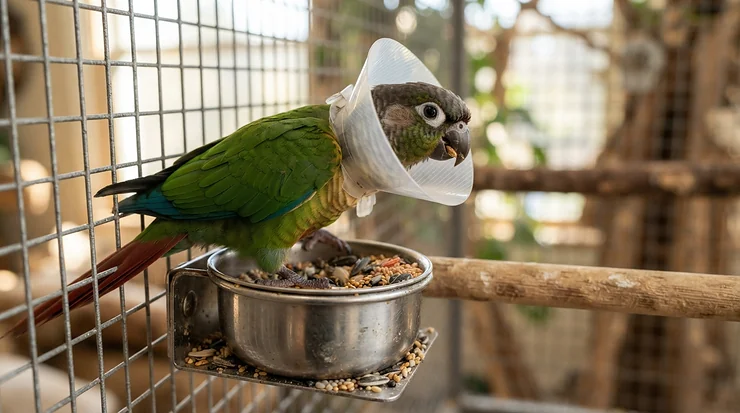
Few things sting like watching your bird dismantle its own plumage. One week there’s a bare patch on the chest. The next, there’s a raw, pink wound and a parrot who looks at you as if you did something wrong. If you’ve landed here, you’re probably weighing an e-collar for bird feather plucking, and that’s a reasonable move when handled with care.
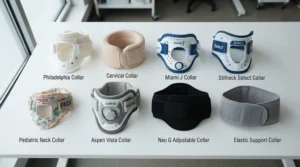
Here’s the honest framing up front. According to UC Davis veterinary guidance, collars suit short-term prevention and are a last resort, because they don’t fix the underlying problem. Think of one as a cast, not a cure. It protects the skin and follicles while you and your avian vet work on the real cause.
This guide ranks seven real products, from soft fleece cones to a clear Lexan shield, and explains what each spec means in practice. It also compares collars with bitter sprays, walks through severe feather-plucking causes, and gives collar acclimation tips you won’t find on a product page. Prices below are ranges only, so check current listings before you buy.
Quick Comparison: Which E-Collar for Bird Feather Plucking Fits Your Bird?
| Product | Type | Best For | Price Range |
|---|---|---|---|
| UnRuffledRx Velcro Cone | Soft 4-layer fleece cone | Mild-to-moderate plucking in one area | Varies by size; check current price |
| UnRuffledRx Fringy Cone | Structured fleece cone with insert | Severe plucking and skin damage | Varies by size; check current price |
| Fringy Neck Wrap | Soft neck wrap | Neck, chest, shoulder, or leg fixation | Varies by size; check current price |
| Saf-T Shield | Clear Lexan shield, padded neck | Short-term post-injury protection | Low-$20s to about $30 |
| Huggle Soft Neck Collar | Soft neck collar | Severe pluckers who need a soft option | Varies by size; check current price |
| BeakGuard Vest | Body vest | Chest and body chewing | Varies by size; check current price |
| Bubbles Beak Boutique Slip-On | Handmade slip-on fleece collar | Macaws with mild-to-severe plucking | Around $40 |
The big divide is severity. For birds fixated on a single spot, the soft options (UnRuffledRx Velcro Cone, Fringy Neck Wrap) carry the least stress. When skin is already broken, the structured picks (UnRuffledRx Fringy Cone, Saf-T Shield) earn their weight. The BeakGuard Vest is the odd one out, since it covers the body and does nothing for the neck.
💬 Just one click — help others make better buying decisions too!😊
Top 7 E-Collars for Bird Feather Plucking: Expert Analysis
1. UnRuffledRx Velcro Cone — softest all-day option for mild pluckers
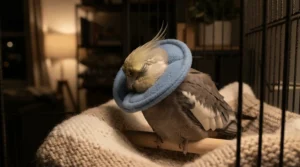
This is the gentle entry point. The maker describes four layers of thick fleece forming a flexible cone with a hook-and-loop closure, positioned for light-to-moderate plucking where the bird fixates on one area without open wounds.
Why does that matter? Fleece is quiet and has no hard edge, so it won’t clack against cage bars or startle a nervous bird the way rigid plastic can. The maker itself says it may not suit sickly or senior birds, or birds plucking across several areas.
Based on the maker’s guidance and the spec comparison, this is a sensible first collar for early-stage pluckers. It’s a poor choice for a bird that already has skin damage. The listing won’t say it outright, but fleece is chewable, so a determined bird may defeat it.
Reviewers on the maker’s store (134 reviews listed for this collar) describe fast acceptance. One cockatiel owner reports their bird got used to it in about a day.
Pros:
- ✅ Quiet, lightweight fleece many birds tolerate quickly
- ✅ Hook-and-loop closure for adjustable fit
- ✅ Machine-friendly, soft materials with no hard edges
Cons:
- ❌ Not suited to open wounds or skin damage
- ❌ Determined chewers can defeat soft fleece
Pricing depends on size, so check the current price. For a mild plucker, this is the most sensible value in the lineup.
2. UnRuffledRx Fringy Cone — structured barrier for severe pluckers
Where the UnRuffledRx Velcro Cone relies on softness, this one adds structure. It’s a flared fleece cone with a reinforced insert, two seam lines for sizing tweaks, and machine-washable construction. The small size is slightly over 30 grams.
That reinforcement is the point. A floppy collar lets a flexible neck bend around it, while a stiffer flare keeps the beak farther from the skin. The maker positions it for severe plucking and self-mutilation cycles, which matches the veterinary logic that collars belong with high-risk birds.
My take on the numbers: this is the right type of collar for a bird with wounds, but it isn’t a guarantee. The maker openly warns that severe pluckers can be relentless about removing collars.
Reviewers on the maker’s store (129 reviews listed) are largely positive. One describes a severe mutilation case healing under it, and another settled on it after trying several collars on their vet’s suggestion. A few mention the neck diameter running short or the collar eventually being chewed.
Pros:
- ✅ Reinforced flare blocks reach better than plain fleece
- ✅ Seam lines allow sizing adjustments
- ✅ Washable, padded, and far lighter than most plastic
Cons:
- ❌ Heavier feel than the basic Velcro cone
- ❌ Fit can run short on larger necks
Check current pricing for your size. For birds with wounds, it’s worth the premium over mild-duty soft collars.
3. Fringy Neck Wrap — closest fit for neck and chest fixation
Not every plucker needs a cone. The Fringy Neck Wrap is a soft, structured wrap with stacked fleece layers and fringe, closed with hook-and-loop. The maker says it limits how far the bird can turn its neck, making the problem spot harder to reach.
Why choose it? A cone changes how the bird moves through the whole cage, while a closer-fitting wrap restricts neck bend with less bulk. That can feel less alien, though only for birds fixated on the neck, shoulder, upper chest, legs, or under-wing.
On paper this suits early-to-moderate damage. The maker is clear that it doesn’t correct the root cause and isn’t intended for severe self-harm where the bird can’t stop itself.
The store lists 96 reviews. One buyer calls it nice and soft and says their bird handled it well. I couldn’t verify a broader rating, so treat that as one data point.
Pros:
- ✅ Closer fit with less bulk than a cone
- ✅ Soft layers feel less intrusive to many birds
- ✅ Targets neck, chest, shoulder, and leg access
Cons:
- ❌ Not intended for severe self-harm
- ❌ Beak access may remain on some body areas
Price varies by size, so check the current listing. Good value for a bird with a single fixation spot.
4. Saf-T Shield — clear, light shield for short-term protection
This is the classic hard-style option, built from clear Lexan with a dual padded neckline and metal snaps. The seller says the clear material won’t impair peripheral vision, which matters because panic is a real risk when a bird can’t see around itself.
The maker positions it for short-term traumatic or surgical recovery. One buyer noted it weighs less than half of fabric-type collars, and that’s the trade: low weight and visibility versus the chewable neckline.
Based on the specs, it’s the best match for a defined healing window, such as after a wound or procedure. Sizes run from 404X to 412X, so measure before ordering, because the seller’s size guide matters here.
Roughly seven in ten of the 81 reviews on the seller’s site are five-star. Complaints repeat, though: one owner of a parakeet found it too heavy, and another’s bird ripped the rubber cushioning within about half an hour.
Pros:
- ✅ Clear Lexan keeps peripheral vision open
- ✅ Very light compared with fabric collars
- ✅ Metal snaps and padded neckline
Cons:
- ❌ Padded neckline can be chewed off
- ❌ Smallest size runs heavy for tiny birds
Expect roughly the low-$20s to about $30 depending on size. Solid value for short-term recovery, and weaker as a long-term plucking solution.
5. Huggle Soft Neck Collar — soft neck collar aimed at severe pluckers
The Huggle Soft Neck Collar for Severe Feather Plucking is a soft collar designed for the heavy end of the problem. I couldn’t verify detailed material specs, so the real insight comes from reviewers.
A cockatoo owner on the seller’s store says their bird can function like a normal bird with it on, though it feels a little heavy on the neck. Another wishes for a longer closure piece for fine-tuning the fit.
Here’s what to weigh: heavy-feeling soft collars can be a double-edged sword. They offer strong blocking, but a bird that tires of the weight may fight it harder. Fit adjustability is the make-or-break detail, so measure carefully.
This is a candidate when a soft option is preferred over a hard shield but a basic fleece cone isn’t enough. Evidence is thinner than for the other picks, which is why it ranks fifth.
Pros:
- ✅ Soft construction aimed at severe pluckers
- ✅ Reviewer reports bird functions normally
- ✅ Alternative to rigid plastic
Cons:
- ❌ Reported heavy feel on the neck
- ❌ Reviewer wanted more closure length
Check current pricing for your size. Reasonable value if sizing fits, but confirm return terms.
6. BeakGuard Vest — body cover for chest chewers
A vest isn’t a collar, but it belongs here because chest and body chewing sometimes defeat neck-only gear. The BeakGuard Vest covers the torso (the seller’s page lists 55 reviews) and pairs with the seller’s cone collars for added protection.
What does that mean in practice? A vest prevents the beak from reaching the breast, but it doesn’t stop a determined bird from going for the neck or from picking at the vest itself.
Reviewer sentiment shows exactly that tension. One owner reported their parrot picked a tiny hole and recommended using vest and collar together, and another said their bird removed it within a day. Still, a third called it good for keeping a bird safe from picking at itself.
My read: treat it as a layered-defense tool for an established chest mutilator, ideally under veterinary direction, because a vest that comes off or gets chewed becomes a hazard.
Pros:
- ✅ Covers chest and body areas collars can’t
- ✅ Works as part of a layered setup
- ✅ Helpful for birds mutilating the breast
Cons:
- ❌ Some birds remove it quickly
- ❌ Chewed holes can appear
Price varies by size, so check the current listing. Value depends heavily on whether your bird tolerates wearing it.
7. Bubbles Beak Boutique Slip-On — handmade collar for macaws
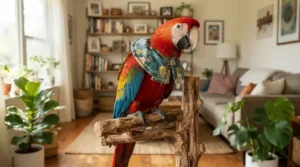
This one is a verified Amazon listing: a handmade slip-on fleece collar sized for macaws, in a category (large parrots) where mass-market options thin out. It’s offered in a 4-layer version for mild pluckers and a 7-layer version for severe pluckers.
The slip-on design means no hook-and-loop, buttons, or snaps. For a macaw that picks at closures, that’s a thoughtful touch. The neck hole is about 2 inches in diameter and the whole collar about 11.5 inches across.
The seller is upfront that it does not protect the neck itself. That’s a major caveat for neck pluckers, though not for birds going after the chest or wings.
At the last listing check, it showed about a 3.6-star average from 25 ratings. That’s middling, so read recent reviews before buying.
Pros:
- ✅ Sized specifically for large macaws
- ✅ No closures a clever beak can pick
- ✅ Two layer options by severity
Cons:
- ❌ Does not protect the neck itself
- ❌ Only a middling rating at last check
Around $40 at the time of research. Fair for a handmade macaw-specific item, but verify current availability and reviews.
What Is an E-Collar for Bird Feather Plucking?
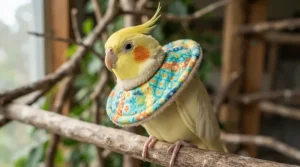
An e-collar for bird feather plucking is a protective neck or body device, usually a soft cone, wrap, or clear shield, that limits how far a bird’s beak can reach. It’s used short-term to interrupt plucking and let skin and follicles recover while the underlying cause is investigated.
That definition hides an important distinction. The name comes from the “Elizabethan collar” used on dogs, but bird versions have evolved considerably. Patent literature describes how traditional hard cones can be bottom-heavy, make it hard for a bird to hold its head up, and even snag in cage bars, which can cause panic and injury. That’s why most modern designs use soft fabric or ultra-light plastic.
An anti-pluck collar for parrots is simply the parrot-sized version of the same idea. Look for tight neck fit, light weight, and clear sight lines. Skip anything rigid, heavy, or fitted with sharp edges.
Severe Feather-Plucking Causes: What a Collar Can’t Fix
Understanding severe feather-plucking causes changes how you use a collar. A Royal Veterinary College factsheet describes disease-related plucking as the most common type, with purely psychological plucking less common. That surprises many owners who assume boredom is the whole story.
Medical contributors include skin or feather-follicle inflammation, parasites, toxin exposure, infection, nutritional problems, and liver disease. Many affected birds eat mostly seed, which can leave them undernourished.
Behavioral contributors, per UC Davis, include lack of stimulation, sleep deprivation, sexual frustration, and stressors such as other pets, noise, or changes at home. UC Davis recommends 10-12 hours of uninterrupted sleep.
Here’s what the spec sheet can’t tell you: plucking is often self-reinforcing. Even after the original trigger is removed, the habit can persist. That’s exactly why a vet-guided plan, not a collar alone, is the real treatment.
How to Choose an E-Collar for Bird Feather Plucking
- Get a vet exam first. Rule out medical causes before assuming behavior; a collar over untreated disease only masks the symptom.
- Match severity to structure. Mild, single-spot plucking suits soft fleece, while wounds call for a structured or clear shield.
- Measure the neck precisely. Too loose and the bird slips it; too tight and breathing or swallowing suffers.
- Check weight against bird size. A collar a parakeet can’t hold its head up under is a failure, no matter how well made.
- Look at closures. Clever beaks defeat hook-and-loop, so consider slip-on designs or moleskin reinforcement.
- Confirm eating and drinking. If the bird can’t reach food and water, the collar is wrong.
- Plan the exit. Decide with your vet how and when the collar comes off.
Anti-Pluck Collar vs Bitter Spray Comparison
The anti-pluck collar vs bitter spray comparison comes down to a physical barrier versus a taste deterrent. Both treat symptoms, not causes.
| Factor | Collar | Bitter Spray |
|---|---|---|
| How it works | Blocks beak access | Makes feathers taste bad |
| Best for | Active damage, skin risk | Early or mild chewing |
| Main risk | Stress, mobility limits | Ingestion, respiratory sensitivity |
| Defeated by | Chewing, removal | Birds that ignore the taste |
| Best For | Severe or wounded birds | Mild habit-stage birds |
Looking at the comparison above, a collar offers more reliable blocking when skin is at stake, while a spray is gentler and less restrictive. Sprays also carry quirks of their own, since birds preen and can ingest what’s on their feathers. One specialty seller argues that fragranced sprays can irritate a parrot’s sensitive respiratory system, so ask your vet before spraying anything near the face.
Some products pair the two: the seller of the Saf-T Shield suggests deterring collar chewing with a bird-safe bitter spray. That’s a sensible niche use, applied to the collar rather than the bird.
✨ Don’t Miss These Carefully Selected Options!
🔍 Take your plan to the next level by matching the collar to your bird’s severity. Click any highlighted product to check current pricing and availability, then build the setup your vet approves for your feathered friend!
Bitter Spray to Stop Feather Plucking Reviews: What Owners Actually Report
Searching for bitter spray to stop feather plucking reviews turns up two names repeatedly: Versele-Laga No-Pick and Grannick’s Bitter Apple for Birds. Both are marketed as deterrents.
The Versele-Laga No-Pick is described as water-based with denatonium benzoate, an intensely bitter compound also found in anti-nail-biting varnishes. Retailer directions say to spray feathers once daily and avoid the eyes and beak. A reviewer who tried it on a different problem, cockatiels destroying houseplants, found it didn’t deter the birds. They noted most reviewers were satisfied with it for plucking, though some were not.
Reviews of Grannick’s Bitter Apple for Birds are mixed. One 2018 marketplace buyer reported their African grey was still plucking wing feathers after two weeks of use. Another forum poster called it popular among some owners for chewing, but raised safety questions.
The pattern across reviews: sprays may help mild habit-stage chewing, but they rarely resolve entrenched plucking. Even a chicken-keeping guide describes bitter sprays as a deterrent rather than a cure, and says the cause still needs investigating. Consult your vet before using one.
Top Bird Collars for Self-Mutilation Prevention
Self-mutilation, where a bird breaks the skin, is different from feather loss. If you see open wounds, bleeding, or deep digging, call an avian vet promptly.
For top bird collars for self-mutilation prevention, structure matters most. Among the seven picks, the UnRuffledRx Fringy Cone and the Saf-T Shield are positioned for the most serious cases. The BeakGuard Vest adds body coverage, and one reviewer’s experience suggests pairing it with a collar.
| Product | Severity Match | Weak Spot | Best For |
|---|---|---|---|
| UnRuffledRx Fringy Cone | Severe | Eventually chewed by some | Wounded birds needing a barrier |
| Saf-T Shield | Short-term severe | Neckline chewed | Healing windows after injury |
| BeakGuard Vest | Chest mutilation | Holes, removal | Layered protection with a collar |
| Huggle Soft Neck Collar | Severe (soft) | Heavy feel reported | Owners avoiding hard plastic |
Looking at this table, the UnRuffledRx Fringy Cone is the most balanced for sustained wear, while the Saf-T Shield shines for short, defined recoveries. The BeakGuard Vest makes sense only when the chest is the target. The Huggle Soft Neck Collar is worth a try when softness is a priority, but the evidence is thinner.
Vet-Recommended Collar Use: What the Veterinary Sources Say
Vet-recommended collar use looks cautious rather than enthusiastic. UC Davis calls collars a last resort for short-term prevention, usually indicated when a bird is at risk of damaging its skin. It also warns that collars inhibit mobility and may hinder food access.
A University of Liverpool practice sheet adds that relapses are common and that feather plucking usually has multiple contributing factors. An avian-behavior letter published in Watchbird takes a practical middle view: a temporarily prescribed collar can help break a chronic cycle, allowing meaningful regrowth while a full environment-and-behavior program is built, but behavior often resumes once it’s removed.
Even with a good prognosis, UC Davis notes follicle damage may be permanent, which is a strong argument for acting early. To find a qualified avian vet, the Association of Avian Veterinarians is the standard starting point.
Practically, that means: get an exam, choose the collar with your vet, set a review date, and treat the collar as one tool in a larger plan covering diet, sleep, enrichment, and stress.

Collar Acclimation Tips: Getting Your Bird to Accept It
Collar acclimation tips matter more than brand choice, because a bird that panics defeats any design. Treat the first week like a slow introduction, not a fitting.
Step 1: Introduce it visually. Leave the collar near the cage for a day or two so it becomes part of the furniture.
Step 2: Pair it with something good. Offer favorite treats while the collar is nearby, so it predicts rewards rather than restraint.
Step 3: Try short, supervised sessions. Fit it when you have time to watch. Sellers like BirdSupplies.com suggest trying it during quality time and confirming the bird can move, eat, and drink comfortably.
Step 4: Check the basics immediately. Can the bird reach its food bowl, water, and perch? A forum owner described an Amazon parrot whose collar blocked eating, which is a failure you catch on day one.
Step 5: Extend wear time gradually. Increase duration only when your bird is calm. Many birds adapt within days, according to one seller, though yours may not.
Step 6: Redirect instead of reacting. Offer foraging toys when the bird fusses at the collar. Avoid scolding or fussing.
Step 7: Reinforce weak points. Moleskin on closures, or a bird-safe bitter spray on the collar itself, can discourage chewing.
Real-World Scenarios: Matching the Collar to Your Situation
Scenario 1: The apartment cockatiel with a chest patch. A small bird, one fixated spot, no wounds, a calm owner who’s home evenings. The UnRuffledRx Velcro Cone or Fringy Neck Wrap fits best. Introduce it slowly, then review progress with the vet within a couple of weeks.
Scenario 2: The cockatoo with open skin. A heavier bird, active self-mutilation, and a vet visit already booked. The UnRuffledRx Fringy Cone is the stronger starting point, with the BeakGuard Vest considered if the chest is the target. Budget for replacements, since determined birds wear collars out.
Scenario 3: The macaw with wing and chest picking. The neck is clear, but the beak wanders. The Bubbles Beak Boutique Slip-On is sized for macaws, but remember it doesn’t protect the neck. Confirm with your vet whether the neck is actually a problem area.
Scenario 4: Post-injury recovery for a small parrot. A short healing window, a need to monitor the wound, and a bird that panics easily. The Saf-T Shield‘s clear design lets you watch the site, and the seller positions it for exactly this. Measure carefully, because a too-heavy fit on tiny birds is a documented complaint.
Problem → Solution Guide: When the Collar Isn’t Working
The bird chews the collar. Add moleskin to chewable edges or closures, and consider a bird-safe bitter spray on the collar. If chewing persists, tell your vet, because a shredded collar can injure the neck.
The bird won’t eat or drink. Raise or move bowls and watch closely. If intake drops, remove the collar and call your vet; UC Davis flags food access as a known risk.
The bird panics or flops. Stop, remove it, and restart acclimation more slowly. Patent literature describes frenzied reactions as the worst collar failures.
The bird shifts to a new plucking spot. That’s common, and a sign the collar blocked one area but not the drive. Add a layer (a vest, say) only on your vet’s advice.
Plucking resumes when the collar comes off. Expected in many cases. This is why the underlying plan, covering diet, sleep, and enrichment, is the real work.
Common Mistakes When Buying an E-Collar for Bird Feather Plucking
The most common mistake is skipping the vet. A collar over untreated disease hides a problem that gets worse underneath.
Second is buying by price. Generic marketplace cones appear in the roughly $5-$22 range, and some may fit well, but sizing guidance and reviews are thin or absent. One listing I saw had no ratings yet, so you’re guessing.
Third is ignoring size. A collar that’s too long, too heavy, or too short in diameter fails in different ways, all of them stressful.
Fourth is expecting a cure. UC Davis is explicit that collars don’t address underlying causes, and the Watchbird writer notes behavior often resumes when they come off.
Fifth is leaving it on blindly. Plan regular checks of the neck skin, appetite, and droppings, and discuss a removal timeline.
Long-Term Cost & Maintenance
The upfront price is the small part. Soft collars wear out, so budget for replacements, especially with a chewer. The Saf-T Shield runs in the low-$20s to about $30 and may need a new padded neckline if chewed, while the Bubbles Beak Boutique Slip-On sits around $40 but isn’t designed for neck protection.
Washing matters too. Fleece collars need regular cleaning to keep skin healthy. The seller of the UnRuffledRx Fringy Cone describes it as machine-washable, which cuts upkeep.
Then there’s the bigger cost: vet exams, testing, diet changes, and enrichment. Total ownership cost is dominated by diagnosing the cause, not buying the collar. A cheap collar that fails and delays treatment costs more than a good one used correctly.
FAQ: Bird Collar Questions Owners Ask
❓ Can a parrot sleep in an e-collar?
❓ How long should a bird wear a collar for plucking?
❓ Is a hard plastic cone safe for parrots?
❓ Will my bird's feathers grow back after plucking stops?
❓ Should I use a bitter spray together with a collar?
Conclusion
The right e-collar for bird feather plucking can protect skin, interrupt a habit, and buy you time. For mild, single-spot cases, the UnRuffledRx Velcro Cone or Fringy Neck Wrap is the gentlest start. For wounds, the UnRuffledRx Fringy Cone or Saf-T Shield offers stronger blocking, and the BeakGuard Vest adds body coverage when the chest is the target. Macaw owners should look closely at the Bubbles Beak Boutique Slip-On, remembering its neck limitation. The Huggle Soft Neck Collar is a reasonable soft option with thinner evidence behind it.
Whichever you choose, the pattern across veterinary sources is consistent: collars treat symptoms, causes need diagnosing, and plucking often involves several factors at once. Your bird isn’t being difficult. It’s telling you something is off. Start with an avian vet, use the collar as a bridge while you fix diet, sleep, stress, and enrichment, and plan the exit from day one.
✨ Ready to protect your bird’s feathers?
🦜 Check current pricing and availability on the options above, talk to your avian vet, and take the first step toward a calmer, fully feathered friend today!
Recommended for You
- Feather Conditioning Spray Reviews For Birds: 7 Best Picks (2026)
- Feather Supplement For Macaws: 7 Best Picks For 2026
- Bird Grit for Digestion: 7 Best Picks & Honest Truths (2026)
Disclaimer: This article contains affiliate links. As an Amazon Associate, I earn from qualifying purchases. If you purchase products through these links, we may earn a small commission at no additional cost to you.
✨ Found this helpful? Share it with your friends! 💬
