
In This Article
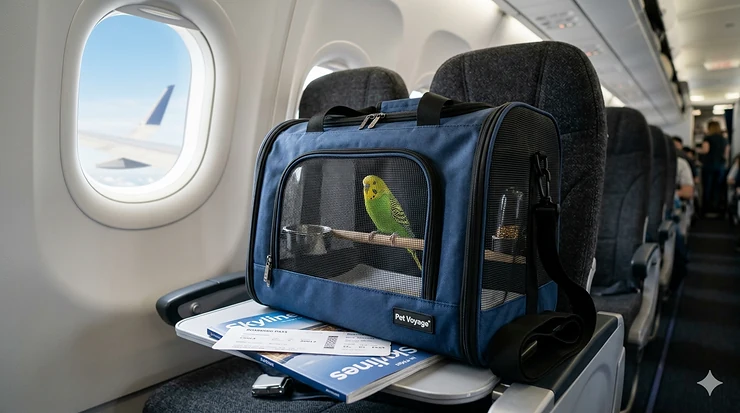
Flying with a bird is one of those travel experiences that sounds simple until you’re standing at the gate, carrier in hand, realizing your beloved cockatiel is about ten inches too tall for the under-seat space. Trust me — that moment of panic is completely avoidable. The right airline approved bird carrier doesn’t just keep your feathered companion safe; it keeps you sane through security, boarding, and that inevitable two-hour tarmac delay.
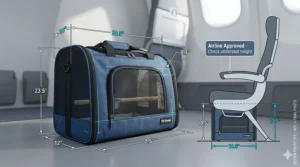
Here’s what most buyers don’t realize: not every carrier labeled “airline approved” will actually pass muster at check-in. Airlines like Delta, United, and Southwest each maintain their own dimensional requirements — most cap in-cabin carriers at roughly 18″ × 11″ × 11″ — and a bag that fits under a Boeing 737 seat may not fit under an Airbus A320. So the phrase “airline approved” is, frankly, a bit of marketing shorthand. What it really means is designed to comply with common airline under-seat dimensions. Your mileage will vary, and you should always call your specific carrier before booking.
That said, the carriers on this list have been carefully selected based on dimensional compliance, ventilation quality, structural integrity, ease of cleaning, and real buyer feedback from verified Amazon purchasers. I’ve looked at budget-friendly soft carriers, premium multi-position backpacks, and hard-sided options — because no two birds (or budgets) are alike. Whether you’re flying cross-country with a parakeet or taking your conure to the vet across town, there’s a perfect match below.
According to USDA APHIS regulations, birds traveling domestically within the U.S. must be in good health and free from signs of communicable disease, and some international destinations require an official health certificate — always check requirements early.
Quick Comparison Table: Top Airline Approved Bird Carriers (2026)
| Product | Dimensions | Style | Best For | Price Range |
|---|---|---|---|---|
| Suertree Airline Approved Bird Carrier | 15.5″ × 10.2″ × 10.8″ | Soft tote/bag | Budget, small birds | $35–$55 |
| Texsens Bird Carrier Backpack | 13″ × 13″ × 16.1″ | Backpack | Cockatiels, conures | $45–$65 |
| Halinfer Bird Backpack Carrier | ~14″ × 10″ × 16″ | Backpack | Hands-free travel | $35–$55 |
| ORIZZP Bird Travel Carrier | ~15″ × 10″ × 11″ | Soft tote | Airline cabin, small birds | $30–$50 |
| Celltei Pak-o-Bird (Small) | 14″ × 10″ × 13″ | Multi-wear | African Greys, Amazons | $80–$130 |
| Prevue Pet Products Playtop #1307 | 18.75″ × 14.87″ × 18″ | Hard-sided | Car travel, vet visits | $65–$95 |
| Kreachur Bird Backpack Carrier | ~12″ × 10″ × 15″ | Backpack | Hiking, camping, vet | $35–$55 |
Table analysis: The Suertree and ORIZZP are your safest bets if strict under-seat compliance is your top priority — both sit comfortably within the 18″ × 11″ × 11″ sweet spot most airlines require. The Celltei Pak-o-Bird commands a higher price, but it’s the only carrier here designed to be worn three different ways, making it the go-to for frequent flyers and larger bird species. The Prevue #1307 is technically oversized for in-cabin use, but its hard-sided steel construction makes it unbeatable for road trips, vet runs, and emergencies.
💬 Just one click — help others make better buying decisions too! 😊
Top 7 Airline Approved Bird Carriers: Expert Analysis
1. Suertree Bird Carrier Airline Approved — Best Overall Under-Seat Fit
If you only read one entry on this list, make it this one. The Suertree is built around a single smart insight: Delta Air Lines lists its official under-seat limit as 18″ × 11″ × 11″, so Suertree engineered this carrier to land at 15.5″ × 10.2″ × 10.8″ — giving you a comfortable margin on all three dimensions rather than gambling at the boundary. That’s not a coincidence; that’s thoughtful design.
The standout feature is the 304-grade stainless steel mesh on the side panel. This isn’t the kind of soft mesh that a determined cockatoo can chew through in twenty minutes — it’s the same food-safe steel grade used in kitchen equipment. For bird owners who’ve watched their pets demolish “durable” nylon mesh like it was tissue paper, this is genuinely revelatory. Ventilation is excellent through both the mesh panel and a rollable sunshade window, so your bird gets airflow without the stress of watching airport crowds blur past.
Included accessories — a water bottle, a removable food bowl, and a perch — make this a complete travel kit rather than just a bag. In my experience, most budget carriers make you hunt for compatible accessories separately, which is an annoyance nobody needs on travel day.
Customers report their small parrots and parakeets travel noticeably calmer in this carrier compared to wire cages, likely because the soft walls dampen external noise and vibration.
✅ Stainless steel mesh is chew-proof and bird-safe
✅ Dimensions fit most major airline under-seat spaces with margin
✅ Includes water bottle, food bowl, and perch — no extra purchases needed
❌ Not ideal for birds over 350g or medium-sized parrots
❌ Shoulder strap padding is minimal for longer carries
Price range: $35–$55 | Verdict: Best value for the serious traveler who needs dimensional certainty.

2. Texsens Bird Carrier Backpack — Best for Cockatiels & Small Conures
The Texsens is the kind of carrier that bird owners stumble across and wonder how they survived without it. At 13″ × 13″ × 16.1″, it’s worth noting upfront: the 16.1″ height pushes past some airlines’ 11″ height limits. So why is it on an airline-approved list? Because that height measurement runs vertically when worn as a backpack — and when placed on its side to slide under a seat, the effective under-seat profile drops to 13″ × 13″, which clears most aircraft. Always verify with your airline, but many frequent bird-traveling owners use exactly this approach.
What makes the Texsens genuinely special is its interior engineering. Three sides of breathable mesh provide airflow that rivals leaving your bird in an open-air aviary, while the 180-degree transparent PVC front panel lets your bird see out — and lets you monitor their stress level — without opening the carrier. Stress is a real health risk for birds in transit; the American Veterinary Medical Association notes that avian stress during travel can manifest as feather plucking, aggression, and immune suppression. The Texsens addresses this with a fabric shade cover that drops instantly when your bird is overstimulated, creating a calm dark den effect.
Two perches of different diameters cater to different foot sizes — a detail that cheaper carriers skip entirely. There’s also a toy-hanging loop inside, which is the kind of feature that sounds gimmicky until you realize a bored conure in a carrier is approximately the loudest thing in the history of aviation.
Customers consistently praise the ease of convincing skeptical birds to enter voluntarily, citing the extra side entrance and toy loop as game-changers.
✅ Shade curtain dramatically reduces bird stress in busy environments
✅ Toy hanging loop keeps birds occupied during long flights
✅ 3-side mesh ventilation keeps even active birds cool
❌ Height dimension requires thoughtful positioning for strict under-seat compliance
❌ Cleaning requires a bit more disassembly than simpler designs
Price range: $45–$65 | Verdict: Best for owners of mid-sized birds who prioritize enrichment during travel.
3. Halinfer Bird Backpack Carrier with Stand Perch — Best Hands-Free Design
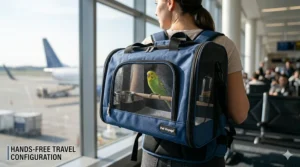
Here’s where the Halinfer earns its spot: it’s the only carrier in this price tier designed to be worn either as a traditional backpack or chest-mounted as a front pack. Hands-free travel with a bird carrier sounds like a minor luxury until you’re navigating an airport with rolling luggage in one hand and a boarding pass in the other. Suddenly it becomes essential.
The three-sided mesh ventilation provides aggressive airflow — Halinfer doesn’t hedge here. Mesh runs along both sides and the back panel, creating cross-draft that genuinely prevents overheating, even in the warm, humid conditions you’ll find in a crowded terminal. The fabric shade cover slides down over the front clear panel when needed, which doubles as a privacy screen. Birds, like humans, get overwhelmed by visual chaos. Having a one-touch blackout option is thoughtful design, not theater.
The included stainless steel tray sits at the base and slides out for cleaning — important, because anyone who tells you their bird never has travel accidents has simply not traveled enough. The wooden stand perch keeps your bird upright and stable during movement, which is more stress-reducing than it sounds; a perch-less carrier forces birds to brace on a flat floor for hours, which fatigues their feet and elevates cortisol levels.
Customers report that even nervous birds calm down quickly once wearing it, citing the closeness to the human body as reassuring for highly bonded parrots.
✅ Front-pack and backpack wearing modes — genuinely versatile
✅ Aggressive three-side ventilation prevents overheating
✅ Stainless steel tray removes in seconds for easy cleaning
❌ The transparent front panel can fog in very humid conditions
❌ Sizing skews toward small-medium birds; larger parrots will feel cramped
Price range: $35–$55 | Verdict: Perfect for bonded bird owners who want their companion close during the whole journe
4. ORIZZP Bird Travel Carrier with Stand Perch — Best Straightforward Airline Cabin Carrier
Sometimes you don’t need bells and whistles. Sometimes you just need a well-built, properly dimensioned airline approved bird carrier that does exactly what it promises and doesn’t fuss. The ORIZZP delivers that.
The 2021 upgraded ventilation system is what separates this from its predecessors and competitors in the same price bracket. There are four leaf-shaped mesh vents on top, a full-side mesh panel with direct-access opening (so you can check on your bird mid-flight without unzipping the entire carrier), plus additional grommets on the front and back panels for supplemental airflow. That’s seven distinct airflow points on a carrier that costs under $50. The spec sheet doesn’t tell you this, but that level of ventilation is particularly valuable during long boarding waits on hot tarmacs — exactly the moment when poorly ventilated carriers become genuinely dangerous.
The anti-scratch mesh material and stainless steel base plate are both pet-safe and USDA-compliant. The stainless plate is a detail I appreciate: it prevents the carrier floor from sagging under the bird’s weight, which creates the unstable rocking sensation that spooks birds during movement.
Customers note that the carrier looks unassuming enough to not draw extra airline staff scrutiny at the gate — a practical benefit that frequent bird flyers will appreciate.
✅ Seven airflow points — exceptional ventilation for an under-$50 carrier
✅ Side access opening avoids full unzipping during in-flight checks
✅ Stable stainless steel base plate eliminates floor sag
❌ No included water bottle; you’ll need to add one
❌ The shoulder strap adjustment hardware feels less premium than the bag itself
Price range: $30–$50 | Verdict: Best no-nonsense in-cabin carrier for budget-conscious first-time bird flyers.
5. Celltei Pak-o-Bird PB001 (Small & Medium Sizes) — Best Premium Multi-Wear Carrier
This is the carrier that bird trainers, avian vets, and multi-bird households quietly recommend to each other while everyone else is buying the bargain options. The Celltei Pak-o-Bird isn’t the cheapest carrier on this list by a significant margin — small runs $80–$100, medium climbs to $110–$130 — but it operates in a different category entirely.
Built from 1680-denier nylon (the same heavy-duty fabric used in quality luggage) with either nylon or stainless steel mesh panels, the Pak-o-Bird is engineered to last years, not months. It wears three ways: backpack, front pack, and shoulder carry. The Small size measures 14″ × 10″ × 13″, which fits comfortably under most airline seats. The Medium is 18″ × 12″ × 13″, which pushes dimensional limits for in-cabin travel — better suited for larger birds like African Greys, Amazons, and small Amazons that technically need the space but may require cargo placement on stricter airlines.
What most buyers overlook about the Pak-o-Bird is its multiple adjustable perch positions. The Small has four perch height settings (4.5″, 6.25″, 8″, and 9.75″ from the floor), which allows you to set the perch precisely where your bird naturally prefers to stand. This single feature reduces the white-knuckle grip birds do when the perch is too high or too low for their body proportions — and less grip tension means less stress. Two 5 oz. stainless steel feed cups are included and detach for easy filling.
Customers with African Greys and Amazons praise this carrier’s ability to handle large, destructive birds without seam failures or zipper damage over time.
✅ 1680-denier nylon withstands even beak-active large parrots
✅ Multiple perch heights for precise bird comfort — rare at any price
✅ Three wearing modes; stainless steel mesh option for determined chewers
❌ Premium pricing is a real barrier for casual or one-time flyers
❌ Medium size may require check-in verification with specific airlines before flying
Price range: $80–$130 (varies by size and mesh type) | Verdict: The long-term investment for frequent flyers and larger bird species.

6. Prevue Pet Products Playtop Travel Carrier #1307 — Best Hard-Sided for Car & Vet Travel
Full transparency: at 18.75″ × 14.87″ × 18″, the Prevue #1307 is oversized for under-seat airline use. I’m including it because plenty of readers searching “airline approved bird carrier” also need a carrier that works for road trips, vet emergencies, and evacuations — and the Prevue is exceptional at all three.
The powder-coated steel construction is rust-resistant and significantly lighter than it looks, but still provides the kind of structural rigidity that soft carriers cannot. This matters enormously during a car journey where the carrier might tip, slide, or take a bump. The Prevue’s star feature: welded seat belt bracket collars built directly into the frame. You thread your car’s seat belt through them, buckle it, and your bird is as safely restrained as a passenger. No rigging, no improvised bungee cord solutions, no hoping it doesn’t slide off the seat.
The bird-proof door lock is genuinely bird-proof — tested against parakeets, lovebirds, and even the notoriously clever conure. The lock-in-place stainless steel cups cannot be dislodged even by birds who treat their cage accessories as a personal demolition project. The included rope perch inside and wooden playtop perch outside make this a dual-function unit: travel cage and temporary activity center when you arrive.
Customers consistently note that nervous birds settle faster in the Prevue than in soft carriers, citing the stable hard walls as creating a more predictable, cage-like environment.
✅ Welded seat belt brackets are a safety feature no soft carrier can match
✅ Hard-sided construction protects birds if carrier tips or is dropped
✅ Doubles as a temporary travel cage upon arrival at destination
❌ Oversized for airline under-seat cabin travel on most routes
❌ 15 lbs. empty — heavier than soft carriers, especially felt on long carries
Price range: $65–$95 | Verdict: Non-negotiable for road trips, vet visits, and emergency evacuation planning.
7. Kreachur Bird Backpack Carrier Travel Cage — Best Clear-Window Budget Backpack
The Kreachur occupies a sweet spot that’s genuinely underserved: a backpack-style bird carrier with a large clear bubble window, a breathable mesh top, a removable stainless steel tray, and a wooden perch — all under $55. It’s the kind of find that makes you wonder what exactly the more expensive versions are charging for.
The clear bubble window is the defining feature here. While most mesh carriers require your bird to experience the full sensory chaos of the outside world at all times, the Kreachur’s window creates a filtered visual experience — birds can observe movement and light without being overwhelmed by direct eye contact from strangers. This is particularly valuable for species like Quakers and Caiques who are social but can tip into overstimulation quickly. Dimensions fall in the 12″ × 10″ × 15″ range, which makes it workable for airlines when positioned correctly, though you should confirm with your carrier.
The stainless steel tray at the base removes without tools for cleaning — an everyday convenience that becomes critical when you’re dealing with a stressed bird mid-journey. The mesh top provides ventilation where it matters most: directly above the bird, where heat rises and stagnant air accumulates.
Customers note that the carrier holds up well over multiple uses, with zippers and perch mounts remaining solid after months of regular trips.
✅ Large clear window balances visibility and sensory protection
✅ Removable stainless steel tray cleans in seconds
✅ Competitive price for the feature set provided
❌ Height dimension requires careful positioning for strict under-seat compliance
❌ Perch diameter suits smaller birds best; larger conures may prefer a thicker diameter
Price range: $35–$55 | Verdict: Best value clear-window option for small to medium bird
✨ Don’t Miss These Exclusive Deals!
🔍 Take your bird travel game to the next level with these expertly selected carriers. Click any highlighted product name to check current pricing and availability. The right carrier means a calmer bird, less airport drama, and a journey you’ll actually want to repeat! 🦜✈️
How to Choose the Right Airline Approved Bird Carrier: 7 Things That Actually Matter
Picking an airline approved bird carrier is more nuanced than matching a size number. Here’s what I’d evaluate if I were buying today.
1. Verify dimensions against your specific airline’s requirements. Most major U.S. carriers cap in-cabin soft-sided pet carriers at around 18″ × 11″ × 11″, but there are exceptions. Delta’s current guideline, for instance, sets the limit at 18″ × 11″ × 11″. Always call the airline’s special services desk before booking, not the day of departure.
2. Prioritize ventilation based on your climate and route. A carrier with two mesh panels is fine for a 90-minute domestic hop in winter. Flying Dallas to Miami in July with a 2-hour tarmac delay? You want a carrier with three or more ventilation points, and you want to pre-verify with gate staff.
3. Match the carrier style to your bird’s temperament. Anxious, easily startled birds (many cockatiels and smaller parrots) benefit from carriers with shade covers they can retreat behind. Curious, social birds (most conures, lovebirds) often do better in clear-panel carriers where they can observe their environment.
4. Weight matters — but bird weight and carrier weight together. A 3 lb. carrier carrying a 400g cockatiel gets heavy fast over a 4-hour travel day. Factor in both.
5. Insist on a removable, wipeable tray. Travel accidents happen. A tray that lifts out in five seconds is the difference between a minor inconvenience and a very unpleasant rest of your trip.
6. Check perch diameter against your bird’s foot size. Birds with small feet (budgies, parrotlets) need thin perches (0.4″–0.5″ diameter). Larger birds need 0.6″–0.75″ or thicker. A perch that’s too thick forces an unnatural foot splay that causes fatigue and discomfort over a long journey.
7. Budget for the carrier your frequency of use deserves. Flying twice a year? The ORIZZP or Suertree will serve you beautifully. Flying monthly? The Celltei Pak-o-Bird’s superior build quality pays for itself within a year in avoided replacements.
Flying with a Bird: What Actually Happens at the Airport (And How to Prepare)
Let’s talk about the parts that travel guides usually skip — because the gap between buying an airline approved bird carrier and successfully using one at 6 a.m. is wider than most people expect.
At TSA security: TSA guidelines require you to remove your bird from the carrier and hold your bird (leashed or securely in your hands) while the empty carrier goes through the X-ray machine. This is non-negotiable. Practice this at home at least once before your trip — you want your bird accustomed to being briefly transferred before doing it in front of a line of impatient travelers.
Before the flight — the 48-hour prep window. Place the carrier in your living space 2–3 days before departure. Put your bird’s familiar toys and a treat inside. Let them explore it on their own terms. A carrier that smells like home is dramatically less stressful than a novel plastic-smelling box produced at the airport.
Food and water timing. Reduce food intake 4–6 hours before the flight to minimize digestive activity (and accidents), but don’t fast your bird completely. Water should be available until 2 hours before boarding. Dehydration at altitude is a real risk for small birds.
Day-of stress signals to watch for: Feather fluffing, eyes half-closed, rapid breathing, or repeated alarm calls are signs your bird is overstimulated. Pull down the shade cover, speak softly, and if available, cover the entire carrier with a light breathable cloth for added acoustic dampening.
What to tell airline gate staff: State simply that you have an in-cabin bird in an airline-approved carrier. Have your pet fee receipt ready. If questioned about carrier size, remain calm — most dimensional disputes resolve quickly when the carrier visibly fits the under-seat template many airlines keep at gates.

Real Traveler Profiles: Which Carrier Matches Your Situation
Not all bird travel is created equal. Here are three common scenarios — and the carrier I’d recommend for each.
The Weekend Vet-and-Back Traveler You’re not flying. You drive to the vet monthly, maybe take a road trip once a year. Your priorities are security, stability, and easy cleaning. The Prevue Pet Products Playtop #1307 is your answer — hard-sided, seat-belt compatible, and tough enough to handle a panicked cockatiel without structural drama.
The Monthly Business Traveler with a Parakeet or Budgie You fly domestic frequently and your bird stays with you cabin. You need something light, dimensionally compliant, and professional-looking enough that gate agents don’t give you a second glance. Go with the Suertree Airline Approved (for pure under-seat certainty) or the ORIZZP (for superior ventilation at the same price point).
The Adventure Bird Owner with a Cockatiel or Small Conure You hike, you camp, you travel with your bird like it’s simply part of the plan. You need hands-free portability for trails, thermal protection from the shade cover for sunny days, and enough space for a medium bird to perch and turn comfortably. The Texsens Backpack or Halinfer Backpack serve this lifestyle best — versatile, well-ventilated, and built for outdoor use rather than just airport corridors.
Airline Pet Policies in 2026: What’s Changed and What Matters
The landscape for flying with birds shifted notably going into 2026. A few key updates worth knowing:
Most major U.S. airlines continue to allow household birds in-cabin under the pet fee structure (typically $95–$150 each way depending on airline). However, several carriers — including some legacy airlines — have begun restricting bird travel on international routes or routes to Hawaii and Alaska due to agricultural import regulations. According to USDA APHIS international pet travel guidelines, birds entering the U.S. from most international origins require USDA import permits and may face quarantine requirements. Always verify this before booking international travel with a bird.
For TSA screening, the protocol remains consistent: birds must be removed from carriers at the security checkpoint and held while the empty carrier goes through the X-ray belt. The carrier must then be inspected to confirm it’s empty before you proceed. Some airports offer private screening rooms for anxious animals — you can request this in advance. Per TSA official guidelines, this accommodation is available at most major airports.
Carrier size remains the most common point of failure at gate check-in. The safest strategy: buy a carrier with dimensions that fall clearly inside your airline’s published limits rather than at the maximum. The Suertree’s deliberate margin within Delta’s published limit exemplifies exactly this approach — and it’s why it leads our list.
Common Mistakes When Buying an Airline Approved Bird Carrier
After reviewing dozens of customer feedback threads and consulting experienced avian travelers, these are the mistakes that repeat most often.
Buying based on brand recognition rather than your bird’s body length. Your bird should be able to stand fully upright on the perch, turn in a full circle, and spread its wings partially without touching the carrier walls. Measure beak-to-tail length and wingspan before purchasing — then add at least 3 inches to each dimension.
Ignoring the carrier’s smell out of the box. New synthetic materials off-gas volatile organic compounds that are proportionally much more irritating to birds’ highly efficient respiratory systems than to ours. Always air out any new carrier for 48–72 hours before putting a bird inside it. Some experienced owners wipe the interior with diluted apple cider vinegar to accelerate off-gassing neutralization.
Assuming “airline approved” means your specific airline has approved it. It means the dimensions were designed to match common industry standards. That is genuinely useful — but it is not a guarantee. Call your airline. Every time.
Choosing ventilation for looks rather than function. Some carriers have beautiful mesh panels that photograph well but restrict actual airflow because the mesh weave is too tight. Run your hand across the mesh before purchasing if possible; you should feel noticeable airflow against your palm when the carrier interior is enclosed.
Skipping the pre-trip acclimation window. This is the single most impactful thing you can do for your bird’s wellbeing during travel — more impactful than any specific carrier feature. Birds that associate the carrier with treats, toys, and calm exploration treat it as a safe space. Birds encountering it for the first time on travel day treat it as a threat.
FAQ: Airline Approved Bird Carriers
❓ What size carrier is airline approved for birds?
❓ Can I bring a parakeet on a plane in-cabin?
❓ Do birds need to be removed from their carrier at TSA security?
❓ What is the best airline approved bird carrier for a cockatiel?
❓ Do I need a health certificate to fly with my bird domestically?
Conclusion: The Right Carrier Makes All the Difference
Flying with a bird is genuinely doable — even enjoyable — when you’ve prepared well and equipped yourself right. The perfect airline approved bird carrier is not the most expensive one on the market; it’s the one correctly sized for your bird’s body, correctly dimensioned for your airline’s requirements, adequately ventilated for your route conditions, and familiar enough to your bird that they settle into it like a second home.
For most travelers: the Suertree delivers the best balance of dimensional certainty, build quality, and included accessories under $55. Frequent flyers with larger birds should seriously consider the Celltei Pak-o-Bird — the upfront cost hurts, but the durability and multi-carry versatility make it the last carrier you’ll ever need to buy. Road trippers and vet-run regulars can’t beat the Prevue #1307 for structural safety and seat-belt compatibility.
Whatever you choose, give yourself and your bird a proper preparation window before the first trip. The carrier is only half the equation — the other half is the calm, familiar association your bird builds with it before departure day.
Safe skies, and happy travels. 🦜✈️
✨ Don’t Miss These Exclusive Deals!
🔍 Ready to pick your perfect in-cabin bird carrier? Click any highlighted product above to check real-time pricing and availability on Amazon. Your bird’s most comfortable flight is one great carrier away!
Recommended for You
- 7 Best Bird Travel Carriers 2026: Safe & Stress-Free Picks
- 7 Best Flight Cage for Multiple Finches in 2026 — Don’t Buy Wrong!
- 7 Best Finch Flight Cages 2026
Disclaimer: This article contains affiliate links. As an Amazon Associate, I earn from qualifying purchases. If you purchase products through these links, we may earn a small commission at no additional cost to you
✨ Found this helpful? Share it with your friends! 💬🤗
