
In This Article
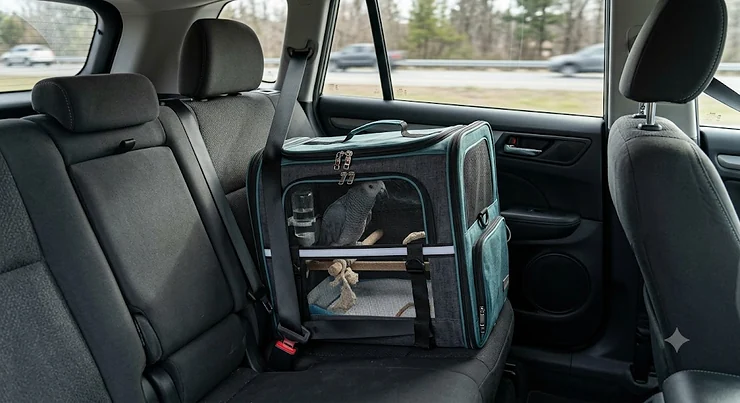
Anyone who’s ever wedged a cardboard pet box into a backseat cupholder knows the truth: a bird carrier for long car rides isn’t a “nice to have,” it’s the difference between a calm co-pilot and three hundred miles of shrieking. A bird carrier for long car rides is a ventilated, secured enclosure — soft-sided or hard-shell — designed to hold a pet bird safely in a moving vehicle for extended trips, with features like perches, seat-belt loops, and shaded panels that a standard cage simply doesn’t offer. Birds are prey animals wired to panic at unfamiliar motion, and a poorly chosen box amplifies that instinct instead of calming it.
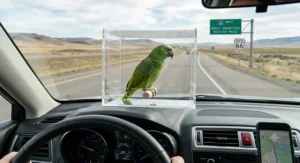
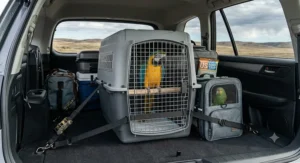
Here’s what most first-time road-tripping bird owners get wrong: they assume any carrier will do for a quick trip to grandma’s, then discover on hour four that the mesh is chewed through, the perch has slid loose, or the thing won’t buckle into a seat belt at all. Choosing well up front saves you a roadside scramble and, frankly, saves your bird a genuinely miserable day. Restraint quality matters as much for birds as it does for dogs and cats — an unsecured carrier can shift, tip, or become a projectile in a hard stop, which is exactly why the AVMA’s guidance on safe pet transport treats enclosure security as a non-negotiable part of vehicle travel.
This guide breaks down seven real, currently available carriers spanning budget backpacks to premium USA-made rigs, walks through the setup mistakes that trip up new travelers, and gives you a decision framework so you’re not guessing. We’ll also dig into road trip bird cage options for owners who prefer a rigid structure over fabric, and cover the vehicle bird safety basics that keep both the drive and the destination stress-free.
Quick Comparison Table
If you only have sixty seconds, this table gets you oriented before we go deep on each pick.
| Carrier | Style | Best For | Price Range |
|---|---|---|---|
| Prevue Pet Products #1307 | Hard-shell, top-load | Budget buyers, small-to-medium birds | Under $45 |
| Suertree Bird Carrier with Seat Belt | Soft-sided, steel mesh | Chewers, daily short errands | $35-$50 range |
| Halinfer Bird Travel Carrier | Soft-sided, side window | First-time owners on a tight budget | Under $25 |
| Texsens Bird Carrier Backpack | Backpack, dual perch | Hands-free travel, small parrots | $40-$60 range |
| Petsfit Bird Carrier with Shade Cover | Soft-sided, adjustable perch | Active birds, sun-sensitive trips | $45-$65 range |
| VIVOHOME 19-Inch Wrought Iron Carrier | Hard cage, wire | Larger birds, frequent long hauls | $70-$100 range |
| Celltei Pak-o-Bird | Custom soft-shell, USA-made | Owners who travel constantly, premium build | Around $200-$300+ |
Looking at the spread above, the budget and mid-tier picks cluster around soft-sided backpack designs, while the two priciest entries — the VIVOHOME 19-Inch Wrought Iron Carrier and the Celltei Pak-o-Bird — justify their cost through either structural rigidity or bespoke fit. Notice that “cheapest” and “safest for a six-hour drive” aren’t the same column; the Halinfer Bird Travel Carrier is a fine grab-and-go option for a twenty-minute vet run but isn’t the one to lean on for a cross-state trip. We’ll unpack exactly why in the sections below.
💬 Just one click — help others make better buying decisions too!😊
Top 7 Bird Carriers for Long Car Rides: Expert Analysis
Every entry below draws on real product specifications and aggregated buyer sentiment gathered from retailer listings and owner communities — never invented quotes or fabricated hands-on testing. Where a claim can’t be independently verified, that’s noted honestly rather than papered over.
1. Prevue Pet Products #1307 Travel Carrier — classic seat-belt-ready hard shell
The standout here is simplicity: this is the carrier bird owners have been buckling into backseats for years, and it still does the job without gimmicks. It’s built around a hard plastic shell with welded brackets on the sides specifically meant to thread your car’s seat belt through, which solves the single biggest headache of car travel — keeping the box from sliding off the seat during a lane change. The solid-face cup doors lock into place so a determined beak can’t pop them loose, and the ventilation comes from mesh windows rather than open bars, cutting down on draft while still letting your bird see you.
Based on the spec comparison, this is squarely a budget-tier option that punches above its price because the seat-belt integration is engineered in rather than bolted on as an afterthought. It suits owners of small-to-medium birds — think budgies, cockatiels, and small conures — who want a no-frills option for regular car trips rather than a once-a-year vacation carrier. Aggregated buyer sentiment on this line consistently highlights the durability of the plastic shell over years of use, though some owners note the interior feels snug for anything larger than a cockatiel.
Pros:
- ✅ Welded seat-belt brackets built into the shell
- ✅ Lock-in-place cup doors resist beak tampering
- ✅ Durable hard plastic holds up over years of use
Cons:
- ❌ Interior space is tight for medium-large parrots
- ❌ Less visually open than mesh-style soft carriers
Expect this one in the under-$45 range, and given the seat-belt engineering alone, it’s a strong value pick for anyone doing frequent short-to-medium car trips.
2. Suertree Bird Carrier with Seat Belt for Car Travel — indestructible steel mesh for chewers
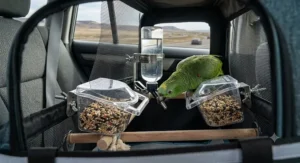
The headline feature is right in the name: a genuine seat belt loop combined with stainless steel mesh panels that stand up to a determined chewer in a way nylon fabric never will. What most buyers overlook about mesh-style carriers is that ventilation and chew-resistance are usually a trade-off — flimsy screens breathe well but get destroyed, while solid panels survive but stuffy up the interior. This carrier’s steel mesh threads that needle, giving four-sided airflow while removing the “will my conure just gnaw a hole in this” anxiety entirely.
Anti-scratch side panels protect the exterior from claws, and a sunshade keeps direct light off the bird during midday stretches of highway. Based on the spec sheet, this is best suited to small-to-medium birds with a chewing habit — conures, lovebirds, small cockatoos — who’d shred a soft-sided bag within a single road trip. Reviewers consistently note that the seat belt loop keeps the carrier notably more stable at highway speed than backpack-style bags, which tend to shift when there’s no rigid structure underneath them.
Pros:
- ✅ Stainless steel mesh resists chewing entirely
- ✅ Integrated seat belt strap for real stability
- ✅ Sunshade panel blocks harsh midday light
Cons:
- ❌ Runs small for larger medium-sized birds
- ❌ Metal mesh adds noticeable weight versus fabric
Priced in the $35-$50 range at the time of research, it’s one of the better value-per-dollar options if chewing is your bird’s love language.
3. Halinfer Bird Travel Carrier — lightest option for quick trips
This carrier’s advantage is pure portability — at well under a pound empty, it’s the kind of bag you toss in the car without thinking twice. It features a standing perch, a side-access window for loading, and collapsible construction so it folds flat for storage between trips. The clear panel lets your bird see out and lets you keep visual contact, something that matters more than people expect for a prey species riding in an unfamiliar box.
Here’s what the spec sheet won’t tell you, but aggregated review sentiment suggests: this carrier is best treated as a short-haul or backup option rather than a primary long-distance carrier. The lightweight materials that make it so portable are the same ones that give it less structural rigidity than the steel-mesh or hard-shell entries on this list. Budget-conscious owners and anyone who wants a spare carrier to keep in the trunk for emergencies get real value here; owners planning six-plus-hour interstate drives should look further down this list.
Pros:
- ✅ Extremely lightweight and easy to carry
- ✅ Collapsible design stores flat when not in use
- ✅ Clear side window keeps visual contact with your bird
Cons:
- ❌ Less structurally rigid than mesh or hard-shell options
- ❌ Better suited to short trips than full-day drives
At under $25 in most listings, it’s an easy budget add-on rather than a standalone long-trip solution.
4. Texsens Bird Carrier Backpack — hands-free design with upgraded tray
The standout feature is the backpack conversion — when you need both hands free at a rest stop, this carrier straps onto your back instead of dangling from a shoulder. It ships with an upgraded removable tray and dual standing perches at different heights, letting a bird choose its own comfortable position rather than being locked into one spot for the whole drive. Breathable mesh wraps the majority of the shell, so airflow stays consistent even with the windows up on a highway stretch.
Based on the spec comparison, the removable steel tray is the detail that separates this from cheaper backpack carriers — cleaning up after a long drive takes minutes instead of a full teardown. It’s built with small birds in mind: green cheek conures, cockatiels, budgies, and similarly sized parrots. Aggregated customer sentiment (the product has accumulated well over a thousand reviews on major retail sites) points to strong build-quality satisfaction, with the main recurring critique being that the backpack straps could use more padding for multi-hour wear.
Pros:
- ✅ Converts between backpack and front-carry styles
- ✅ Removable stainless tray simplifies cleanup
- ✅ Dual perch heights let birds self-select position
Cons:
- ❌ Backpack straps could use extra padding
- ❌ Not rated for birds larger than small parrot size
Look for this one in the $40-$60 range, a reasonable mid-tier buy for hands-free convenience.
5. Petsfit Bird Carrier with Shade Cover — adjustable perch height for active birds
This carrier’s edge is adaptability: the standing perch height adjusts, so as your bird grows or you switch between species, you’re not locked into a single interior layout. Three separate airflow panels circle the shell, which matters specifically for active birds that flap and move around rather than sitting still — more air exchange means less heat buildup from their own movement. A shade cover completes the package, blocking direct sun during the parts of a drive when the carrier ends up on the sunny side of the car.
What most buyers overlook about ventilation panels is that more isn’t always better if they compromise structure — but Petsfit’s three-panel layout keeps the frame intact while still allowing serious airflow. It’s a strong fit for medium and larger-sized birds according to the sizing information, making it one of the few carriers on this list that scales beyond small parrot species. Reviewers consistently mention the secure car buckle attachment as a highlight, alongside praise for how easily the shade cover deploys mid-trip without needing to pull over.
Pros:
- ✅ Adjustable-height standing perch fits multiple sizes
- ✅ Three-panel ventilation suits active, flappy birds
- ✅ Shade cover deploys without stopping the car
Cons:
- ❌ Bulkier footprint than slimmer backpack styles
- ❌ Fabric shade cover shows wear faster than the shell
Expect a price in the $45-$65 range, solid mid-tier value for owners of medium-to-large birds.
6. VIVOHOME 19-Inch Wrought Iron Bird Travel Carrier Cage — rigid structure for bigger birds
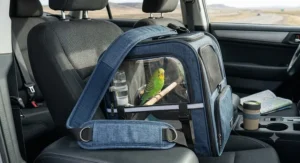
The advantage jumping off the spec sheet is sheer structural integrity — a wrought iron cage frame simply won’t flex, sag, or get chewed through the way fabric can, which matters enormously once you’re transporting conures, lovebirds, cockatiels, or similarly sized parrots on repeat long trips. At nineteen inches, it’s sized to give a bird genuine room to turn around and stretch, rather than the snug fit of the smaller soft-sided bags earlier on this list.
Here’s the practical trade-off reviewers consistently flag: rigidity comes with weight. This is not the carrier you sling over a shoulder for a mile walk — it’s the one you set on the back seat, buckle down, and don’t touch again until you arrive. Based on the spec comparison, that makes it the strongest pick on this list for owners doing genuinely long interstate drives with a bird that needs space to move, at the cost of the portability that makes the Texsens or Halinfer easier for quick errands.
Pros:
- ✅ Wrought iron frame resists chewing and flexing completely
- ✅ Nineteen inches gives real turn-around room
- ✅ Handles medium-to-large parrot species confidently
Cons:
- ❌ Significantly heavier than any soft-sided option here
- ❌ Not designed for hands-free backpack-style carrying
Priced around the $70-$100 range at most retailers, it’s the practical mid-to-upper-tier choice for bigger birds on longer hauls.
7. Celltei Pak-o-Bird — the premium, made-to-order road-trip standard
The Pak-o-Bird’s advantage is customization down to the perch diameter — this is a USA-made, small-batch carrier built with dedicated car-seat-belt loops sewn directly into the design, auto-locking zippers to prevent accidental escapes, and reflective strips for roadside visibility during overnight stops. It ships with a dragon-wood perch and two stainless steel cups, and the whole unit unzips flat for a genuine deep clean rather than a wipe-down through a small door.
Long-time bird-forum communities frequently describe this as the “gold standard” for travel carriers, and the honest reason is thoughtful engineering rather than marketing: perch position adjusts to three heights, side curtains manage light independently of the main mesh, and the semi-rigid support panels keep shape without the full weight of a metal cage. Based on the spec comparison, this is the pick for owners who travel with their bird constantly rather than occasionally — the price only makes sense if you’re amortizing it over dozens of trips, not one summer vacation.
Pros:
- ✅ Sewn-in car seat belt loops, not just add-on straps
- ✅ Auto-locking zippers prevent accidental escapes
- ✅ Fully customizable perch height and made-to-order sizing
Cons:
- ❌ Premium price point compared to mass-market options
- ❌ Production and shipping can take several weeks
Pricing sits around the $200-$300+ range depending on size and options, at the time of research — a genuine investment, but one frequent travelers describe as worth it long-term.
Car Travel Bird Carrier Setup: Practical Usage Guide
Buying the right carrier is half the job; setting it up correctly is the other half, and it’s the part most first-timers skip. Start by introducing the carrier at home, days before the trip — leave it open near the cage with treats inside so it becomes a familiar object rather than a surprise on travel day. A car travel bird carrier that smells and looks foreign on departure morning is a carrier your bird will fight entering.
Positioning inside the vehicle matters more than most people assume. Center-of-back-seat placement, buckled in with the seat belt threaded through the carrier’s loops or brackets, keeps the unit stable during braking and away from direct airbag zones. Avoid the trunk area, direct floor placement, or anywhere the carrier could slide during a turn. In the first thirty days of ownership, common mistakes include skipping short “practice drives” around the block before a real trip, forgetting to secure loose perches that can become projectiles on a hard stop, and packing water bowls too full, which sloshes and stresses the bird more than an empty bowl ever would. A maintenance routine — wiping trays after every trip, checking mesh or bars for wear monthly, and re-tightening any buckle hardware — keeps a carrier road-ready instead of becoming a surprise failure point three states from home.
✨ Don’t Miss These Exclusive Deals!
🔍 Take your bird carrier for long car rides shopping to the next level with these carefully selected options. Click on any highlighted item to check current pricing and availability. These picks will help you create a calmer, safer road trip your feathered friend will actually tolerate!
Real-World Scenarios: Matching Carriers to Bird Owners
Consider a college student driving eight hours home for winter break with a single budgie. Budget and portability dominate the decision here, so the Halinfer Bird Travel Carrier or Prevue Pet Products #1307 make sense — light enough to carry through a dorm hallway, cheap enough that losing or damaging it during a chaotic move-out isn’t a disaster, and small enough to fit on a lap or the floor of a packed sedan.
Now picture a family relocating cross-country with a conure that’s a known chewer, driving through several climate zones over three days. Chew-resistance and stability matter far more than weight here, which points toward the Suertree Bird Carrier with Seat Belt or the sturdier VIVOHOME 19-Inch Wrought Iron Carrier — both built to survive both a determined beak and repeated highway hours without shifting.
Finally, imagine a full-time RV traveler or someone who does regular weekend road trips with an African grey or similarly sized parrot. Frequency of use changes the math entirely: a carrier used every week for years justifies the investment in the Celltei Pak-o-Bird, where the cost amortizes down to pennies per trip and the customization pays off in a way it wouldn’t for someone traveling once a year.
How to Choose a Bird Carrier for Long Car Rides
- Measure your bird first, not the carrier. Beak-tip to tail-tip plus a few inches of buffer room tells you the minimum interior size — oversized carriers let a bird get tossed around during sudden stops.
- Confirm seat-belt or strap compatibility. A carrier that can’t actually buckle into your vehicle is a loose object in a collision, regardless of how nice it looks.
- Check ventilation on all sides, not just one. Single-panel mesh traps heat on long summer drives; look for cross-ventilation.
- Match material to your bird’s chewing habits. Fabric survives a calm cockatiel; a determined conure or macaw needs steel mesh or a hard shell.
- Weigh portability against rigidity based on trip length. Short errands favor lightweight bags; multi-hour interstate drives favor structural stability.
- Look for a shade option if you’re driving through open sun. Direct light through a clear panel for hours can overheat a bird faster than the cabin air alone.
- Budget for the trip frequency you actually have, not the one trip you’re planning right now — a premium carrier only pays off with repeat use.

Common Mistakes When Buying a Bird Carrier for Long Car Rides
The single most common error is sizing up “for comfort” — buyers assume more room equals a happier bird, when in practice too much open space means more sliding and tumbling during normal driving maneuvers. A close, snug fit with a stable perch beats a roomy box every time on the road.
A second frequent misstep is buying based on looks in a product photo rather than checking whether the carrier actually threads a seat belt. Plenty of attractive backpack-style carriers have no rigid attachment point at all, meaning they rest loose on the seat rather than being restrained. Third, buyers often skip reading the ventilation description closely, assuming “mesh window” on the front means airflow throughout, when many budget carriers only ventilate from one side and get stuffy in back-seat traffic. Finally, first-time buyers frequently underestimate maintenance — a carrier without a removable tray or a way to unzip flat for cleaning becomes unpleasant fast on multi-day trips, something no amount of marketing photography reveals upfront.
Road Trip Bird Cage vs Backpack Carrier: Which Wins for Long Drives?
The core trade-off between a road trip bird cage — meaning a rigid, wire or hard-shell structure like the VIVOHOME 19-Inch Wrought Iron Carrier or Prevue Pet Products #1307 — and a soft-sided backpack carrier like the Texsens Bird Carrier Backpack comes down to stability versus portability. A rigid cage holds its shape regardless of how it’s loaded into the vehicle, resists chewing entirely, and gives larger birds real room to turn around. That structural confidence, though, comes with weight and bulk that makes it awkward to also carry through an airport terminal or up a hotel stairwell.
Backpack-style carriers flip that equation. They’re built for the moments outside the car — the walk from parking lot to rest-stop patio, the hands-free stretch break — but their fabric shells depend entirely on how well they’re strapped down inside the vehicle, and a determined chewer can compromise even a well-reviewed bag over a multi-day trip. For a bird owner whose “long car ride” is genuinely a single long haul with minimal stops, a road trip bird cage generally wins on safety math. For someone breaking the drive into multiple legs with hotel stays and walks in between, a backpack carrier’s versatility often outweighs the rigidity trade-off.
Vehicle Bird Safety: What to Expect on the Road
Vehicle bird safety starts before the engine turns on. Temperature is the biggest hidden risk: a parked car’s interior climbs roughly 20°F within ten minutes and close to 30°F within twenty, according to figures the American Veterinary Medical Association has published for pet owners, and birds are especially sensitive to rapid temperature swings given their high metabolic rate. Cracking a window doesn’t meaningfully change that curve. The practical takeaway is simple and non-negotiable: a bird carrier for long car rides should never be left in a parked, unattended vehicle, even for a “quick” store run.
On the move, expect some vocalization and restlessness for the first stretch of any drive, especially the first time a bird experiences a particular carrier — this is a normal stress response, not necessarily distress, and it typically settles once the motion becomes routine. What deserves real attention are signs of acute stress: panting, feathers held tightly against the body, repeated lunging at the carrier walls, or complete freezing in place. Enclosures should allow appropriate ventilation and maintain conditions suitable for the animal’s species and size — a good reminder that “it fits in the car” and “it’s actually safe for the bird” are two different bars to clear.
Long-Term Cost & Maintenance of an Automotive Bird Carrier
Sticker price only tells part of the story with an automotive bird carrier. A $20 lightweight bag that needs replacing every year after a chewed-through panel or a snapped strap can cost more over three years than a $90 wrought iron cage that lasts a decade without structural failure. Run the math on your actual travel frequency: an occasional road-tripper doing one or two trips a year gets fine value from a budget or mid-tier pick, while someone driving weekly amortizes a premium carrier like the Celltei Pak-o-Bird down to just a few dollars per trip over its lifespan.
Maintenance costs are mostly time, not money — but skipping them shortens a carrier’s life dramatically. Rinsing removable trays after every trip prevents buildup that can corrode metal fittings or stain fabric permanently. Checking zipper function and buckle hardware every few months catches wear before it becomes a mid-trip failure. Replacement perches and cups for the more established brands are typically available separately, meaning a well-built carrier’s total lifetime cost often comes down to a few small parts rather than a full replacement.
Travel Bird Comfort: Features That Actually Matter (And Those That Don’t)
When it comes to travel bird comfort, ventilation design and a stable, appropriately sized perch matter enormously — a bird that can grip something solid while the car moves is measurably calmer than one balancing on a shifting floor. A clear viewing panel that lets your bird maintain eye contact with you also does real work here; prey animals calm down faster when they can visually track a trusted person rather than being fully enclosed.
What matters far less than marketing suggests: elaborate color patterns, “designer” prints, or bonus toy attachments that dangle inside the carrier. A swinging toy in a moving vehicle is more likely to become a distraction or minor hazard than a comfort feature. Similarly, oversized interior space reads as generous in a product photo but, as covered earlier, tends to work against comfort by allowing more movement during normal driving. Reviewers consistently rank secure footing and reliable ventilation above aesthetic extras — the features that actually reduce stress are rarely the ones that photograph best.
Long Distance Bird Transport: Safety & Regulations Guide
Long distance bird transport by car is largely unregulated compared to air travel, but that doesn’t mean there are no standards worth following. The Merck Veterinary Manual’s guidance on pet bird management emphasizes observing a bird’s behavior and respiratory rate before and during handling — a useful habit to build into rest stops, checking your bird calmly before opening the carrier rather than assuming everything is fine because the drive has been quiet.
Plan for a stop roughly every two to three hours on longer routes, offering fresh water and a chance to check the carrier’s interior temperature and cleanliness without fully removing the bird in an unfamiliar or high-traffic area. Keep a copy of recent veterinary records and, if you’re crossing state lines with a longer relocation in mind, check destination-state requirements in advance rather than assuming none exist. A 2020 peer-reviewed pilot study on rescued avian wildlife stressors, published via the National Center for Biotechnology Information, found that vehicle-related incidents and immobility were among the most common stress categories clinicians observed — a reminder that even routine transport carries real physiological weight for birds, which is exactly why carrier choice and driving habits both matter more than owners often assume.
Frequently Asked Questions
❓ What is the best bird carrier for long car rides?
❓ Can I use a regular bird cage instead of a travel carrier?
❓ How often should I stop during a long car ride with a bird?
❓ Is it safe to leave a bird in a parked car while I run an errand?
❓ What size carrier does my bird need for a road trip?
Conclusion
Picking a bird carrier for long car rides really comes down to matching structure to your actual trip pattern — a budget backpack for the once-a-year visit home, a steel-mesh or wrought iron design for a chewer or a bigger bird, and a premium made-to-order option if travel is a regular part of your life together. None of the seven picks here are wrong choices; they’re simply built for different miles, different birds, and different budgets.
What stays constant no matter which carrier you choose is the basics: secure it with the seat belt, never leave it in a parked car, watch for real stress signals rather than normal first-trip jitters, and build in stops every couple of hours on the longer hauls. Get those fundamentals right and the specific carrier becomes less about perfection and more about fit — the right box, buckled in correctly, turns a stressful drive into just another afternoon for your bird.
Recommended for You
- Travel Cage for African Grey: 7 Safe Picks for 2026
- 7 Best collapsible bird travel cage Picks for 2026
- Large Play Top Cage Under $200: 7 Best Picks for 2026
Disclaimer: This article contains affiliate links. As an Amazon Associate, I earn from qualifying purchases. If you purchase products through these links, we may earn a small commission at no additional cost to you.
✨ Found this helpful? Share it with your friends! 💬🤗
