
In This Article
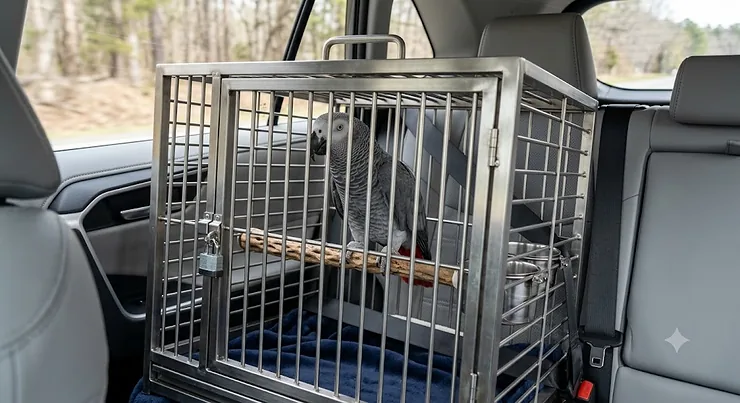
A travel cage for African grey ownership isn’t a luxury — it’s the one piece of gear standing between “smooth vet visit” and “loose parrot in a moving vehicle.” A travel cage for African grey is a compact, portable enclosure — smaller and lighter than a home cage — built to safely contain a mid-sized parrot during car rides, vet trips, or evacuations, typically featuring secure latches, ventilation, and a carry handle. If you’ve ever tried to wrangle a startled, 400-gram bundle of feathers and opinions into a cardboard box because you didn’t own the real thing, you already understand the stakes.
African greys are neither small nor forgiving travelers. They’re intelligent enough to work a latch loose out of sheer curiosity, strong-beaked enough to bend flimsy wire, and sensitive enough that a bad first carrier experience can sour them on travel for years. So the cage matters — a lot more than it does for, say, a budgie who barely notices it’s been relocated.
This guide compares seven real, currently available carriers spanning folding steel cages, wrought iron options, a clear acrylic model, and a backpack-style carrier, with honest analysis of who each one actually suits. We’ll also cover setup, road-trip safety, common mistakes, and the regulations nobody tells you about until you’re standing at an airline counter. Let’s get into it.
Quick Comparison: Travel Cages for African Grey at a Glance
| Carrier | Type | Best For | Price Range |
|---|---|---|---|
| Prevue Hendryx Travel Bird Cage 1305 | Folding steel | Budget short trips | $60–$80 |
| Prevue Pet Products Playtop Travel Carrier 1307 | Powder-coated steel/aluminum | Car safety (seatbelt brackets) | $140–$180 |
| Featherland Paradise Caitec Perch ‘N Go (Large) | Clear polycarbonate | Low-stress, low-visual-barrier travel | $90–$160 |
| ibiyaya TrackPack Medium | Soft-sided backpack | Hands-free walks and hikes | $70–$110 |
A quick look at the spread tells you most of what you need to know: price climbs with materials (steel mesh cheapest, wrought iron and acrylic pricier) and with purpose-built safety features like seatbelt brackets. The Prevue Hendryx Travel Bird Cage 1305 wins on price alone, but it’s genuinely a short-trip tool, not a long-haul solution. The Prevue Pet Products Playtop Travel Carrier 1307 costs more than double because it’s engineered around automotive safety rather than just containment — a meaningful distinction once you’ve white-knuckled a hard brake with a parrot cage sliding across your back seat.
✨ Ready to find the right fit for your bird? Compare all seven picks below before you buy.
Top 7 Travel Cages for African Grey: Expert Analysis
1. Prevue Hendryx Travel Bird Cage 1305 — most budget-friendly folding design
The Prevue Hendryx Travel Bird Cage 1305 has been a staple in bird stores for over a decade, and its simplicity is exactly the point.
At 20″ L x 12.5″ W x 15.5″ H with 3/4-inch wire spacing, it’s sized for short-term containment rather than all-day comfort — the 9-by-9-inch side door lets your grey walk in on its own instead of being manhandled through a top hatch, which matters more than it sounds like for a bird that already associates being grabbed with something bad happening. Powder-coated steel construction resists rust, and the whole thing folds flat in under a minute for storage in a closet or car trunk.
Based on the spec comparison, this cage is built for vet runs, brief car trips, and cage-cleaning days — not multi-hour road trips or air travel, where an African grey needs more room to shift its stance. Reviewers consistently report that it’s sturdy for its price point and easy to assemble, though a Chewy review specifically noted it isn’t intended for finches or lovebirds — reinforcing that Prevue built this around medium-to-large birds like greys and eclectus, not tiny species.
Pros:
- ✅ Folds flat in seconds for easy storage
- ✅ Walk-in side door reduces handling stress
- ✅ Widely available with a long track record of reliability
Cons:
- ❌ Interior height limits comfortable long-duration use
- ❌ Available in white only, which shows dirt fast
At around $60-$80, the Prevue Hendryx Travel Bird Cage 1305 is the easiest entry point into owning a dedicated travel cage, and honestly, there’s little excuse not to own one at this price if you don’t already.

2. Yaheetech 26″ Wrought Iron Travel Bird Cage Carrier — best value step-up in size
The Yaheetech 26″ Wrought Iron Travel Bird Cage Carrier answers the obvious complaint about entry-level cages: not enough room.
Constructed in a hammered-black wrought iron finish with an integrated handle, top perch, and two stainless steel bowls, it stands taller than most budget options, giving an African grey more room to climb and reposition without feeling like it’s wedged into a shoebox. What most buyers overlook about this model is that the extra height does more for behavioral calm than extra floor space would — greys are natural climbers, and a cage that lets them move vertically tends to produce a quieter, less frantic passenger.
Aggregated retailer feedback places it around 4 out of 5 stars from a modest review pool, with owners generally satisfied with the build quality relative to price, though the sample size is small enough that we’d encourage checking current reviews before buying. Here’s what to weigh: wrought iron is heavier than the aluminum used in premium carriers, so this isn’t the pick for anyone prioritizing minimal carry weight.
Pros:
- ✅ Taller profile gives climbing and repositioning room
- ✅ Wrought iron construction resists bending under beak pressure
- ✅ Includes handle, perch, and two stainless bowls
Cons:
- ❌ Heavier to carry than mesh or acrylic alternatives
- ❌ Smaller review pool makes long-term durability less proven
Priced in the $80-$110 range, the Yaheetech 26″ Wrought Iron Travel Bird Cage Carrier is a solid mid-tier jump for owners who’ve outgrown the smallest folding cages.
3. Mcage 24″ Large Bite-Proof Travel Carrier — best for extra bar-spacing security
The Mcage 24″ Large Bite-Proof Travel Carrier leans hard into one specific promise: an African grey is not getting through these bars.
At 24″ L x 16.5″ W x 20″ H with 1-1/8-inch bar spacing, the dimensions land squarely in “actually large enough for a grey to turn around” territory, which a surprising number of travel cages fail to deliver. The epoxy-coated wire frame is designed to resist the kind of determined chewing that turns a cheap wire cage into a science project within a week. Two stainless steel dishes with adjustable holders and a raised grate floor round out the practical features — the raised grate especially, since it keeps feet out of droppings during longer stints in the carrier.
Based on the spec sheet, this model is aimed at owners who need more square footage than a compact carrier offers but don’t want the premium price of a wrought-iron or acrylic model. Reviewers commonly cite the pull-out tray as a genuine time-saver for cleanup, though a few note that the fold-flat mechanism takes a bit of practice the first time.
Pros:
- ✅ Generous interior lets a grey turn and stretch
- ✅ Wider bar spacing tested against beak pressure
- ✅ Pull-out tray simplifies cleanup between trips
Cons:
- ❌ Bulkier footprint than compact carriers
- ❌ Folding mechanism has a learning curve initially
At roughly $70-$100, the Mcage 24″ Large Bite-Proof Travel Carrier offers some of the best square-footage-per-dollar on this list.
4. Mcage Deluxe Wrought Iron Travel Carrier with Cage Cover — best for vet visits with a built-in cover
The Mcage Deluxe Wrought Iron Travel Carrier with Cage Cover solves a problem most travel cages ignore entirely: light and stimulus overload in a waiting room.
Measuring roughly 19″ x 15″ x 25.5″ (including the wooden playtop handle) with 3/4-inch bar spacing, it includes an actual fabric cage cover — a detail that sounds minor until you’ve sat in a crowded vet lobby with a stressed grey trying to process a dog three feet away. The cover blocks direct sightlines and reduces visual triggers, while a side seatbelt safety hook keeps the whole unit anchored during the drive there. A swing-away metal feeder door with two locking stainless bowls prevents spillage without requiring you to open the main door mid-trip.
What most buyers overlook about this model is that the cover functions almost like a portable sound-and-sight buffer — reviewers note it’s genuinely calming for birds that get anxious in unfamiliar environments, which lines up with what avian behaviorists generally recommend for reducing travel stress.
Pros:
- ✅ Included cover reduces visual stress in busy environments
- ✅ Seatbelt hook adds real automotive security
- ✅ Locking feeder doors prevent mid-trip spills
Cons:
- ❌ At 15 lbs, it’s not the lightest option to carry
- ❌ Verified long-term durability reviews are still limited
In the $100-$140 range, the Mcage Deluxe Wrought Iron Travel Carrier with Cage Cover earns its price with genuinely thoughtful stress-reduction design.
5. Prevue Pet Products Playtop Travel Carrier 1307 — best for seatbelt-secured car travel
The Prevue Pet Products Playtop Travel Carrier 1307 is, frankly, the closest thing on this list to purpose-built automotive engineering rather than “a small cage with a handle.”
Measuring 18.75″ L x 14.875″ W x 25″ H (to the top of the playtop perch) with 1/2-inch wire spacing, the carrier includes welded bracket seatbelt collars that let you buckle the entire unit into a car seat — a feature almost no competitor offers in this exact form. Inside, a shapeable rope perch gives a grey’s feet a break from flat metal grating, while a separate wooden playtop perch doubles as the carry handle. Locking cup doors keep food and water in place through hard stops and turns.
Based on the spec comparison, this is the pick for anyone whose primary travel mode is a car rather than a plane — road trips, relocations, weekend cabin trips. Since 1869, Prevue has built a reputation around dependable mid-market pet hardware, and this carrier reflects that: not flashy, but engineered around the actual physics of a moving vehicle. Aggregated retailer commentary consistently highlights the seatbelt system as the standout feature, with occasional notes that the roughly 15-17 lb assembled weight makes it a two-hand carry rather than a sling-it-over-your-shoulder job.
Pros:
- ✅ Welded seatbelt brackets built specifically for car travel
- ✅ Rope perch plus wooden playtop perch for foot health
- ✅ Locking food/water cups resist spills during driving
Cons:
- ❌ Assembled weight makes it awkward for one-handed carrying
- ❌ Overkill (and pricier) if you never travel by car
At $140-$180, the Prevue Pet Products Playtop Travel Carrier 1307 is the road-trip specialist on this list — see the dedicated section below for exactly why that seatbelt system matters.

6. Featherland Paradise Caitec Perch ‘N Go (Large) — best clear-view, low-stress premium pick
The Featherland Paradise Caitec Perch ‘N Go (Large) takes a completely different approach: instead of wire bars, it’s built from clear polycarbonate.
The large size adds extra length specifically to accommodate a long tail — a detail that matters more for African greys than owners often expect, since a tail bent against a wall for hours isn’t just uncomfortable, it can damage feathers over repeated trips. A stainless steel cage door with a parrot-proof latch and a stainless back panel handle ventilation and security, while an adjustable interior perch and mounts for two 10-ounce cups round out the setup. The handle on top doubles as an external perch point.
Here’s what to weigh: the 360-degree clear view is genuinely calming for many birds, since it removes the “boxed in behind bars” visual that can spike anxiety, and it gives you constant visibility into how your bird is doing mid-trip. Petco’s aggregated customer-review summary for this line specifically praises the durable, lightweight build and easy-clean raised bottom, while also noting that assembly can be fiddly with occasionally misaligned panels, and that the included plastic perch is a common target for upgrades to a natural wood one.
Pros:
- ✅ 360-degree clear view reduces visual stress for the bird
- ✅ Extra length protects tail feathers on longer trips
- ✅ Lightweight relative to metal alternatives
Cons:
- ❌ Assembly can be fiddly with panel alignment
- ❌ Included plastic perch is frequently swapped for wood
Priced around $90-$160 depending on configuration, the Featherland Paradise Caitec Perch ‘N Go (Large) is worth the upgrade if reducing visible stress triggers is your priority.
7. ibiyaya TrackPack Medium Backpack Carrier — best for hands-free hikes and walks
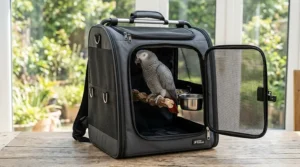
The ibiyaya TrackPack Medium Backpack Carrier trades the “cage” format entirely for a soft-sided backpack, co-developed with the parrot-training brand BirdTricks specifically for medium parrots like African greys, Amazons, and eclectus.
The design centers on a panoramic mesh view panel, lockable zippers to prevent an enterprising beak from working an opening loose, and seatbelt compatibility for car use in addition to backpack straps for hikes, errands, or transit. On paper this means you get portability a wire cage can’t match, at the cost of some of the bite-resistance a metal carrier offers.
As a newer product to the market, independently verified review volume is still thinner than the legacy Prevue and Mcage lines, so we’d encourage checking current buyer feedback before committing, especially around long-term chew resistance for a beak as strong as a grey’s. What most buyers overlook about backpack-style carriers generally is that they suit confident, well-carrier-trained birds far better than nervous or new-to-travel ones — the soft structure moves more than rigid metal, which some birds find unsettling until they’re used to it.
Pros:
- ✅ Hands-free design for walking, hiking, or transit
- ✅ Panoramic mesh view keeps the bird oriented
- ✅ Lockable zippers plus seatbelt compatibility
Cons:
- ❌ Less beak-resistant than metal or acrylic carriers
- ❌ Newer to market, so long-term review data is thinner
At roughly $70-$110, the ibiyaya TrackPack Medium Backpack Carrier is the pick for confident, carrier-trained birds whose owners want mobility over armor.
Practical Usage Guide: Setting Up and Introducing the Cage
Buying the right carrier is half the job; introducing it properly is the other half, and it’s the half most owners skip. Start by leaving the empty cage out in a common room for several days before the first trip, door open, treats occasionally placed inside. African greys are neurotic about novelty in the best and worst ways — they’ll investigate on their own timeline, and forcing the issue tends to backfire.
Once your bird enters voluntarily, start closing the door for short stretches while you’re in the room, then work up to carrying the closed cage around the house before ever loading it into a car. For the first 30 days, the most common mistake is skipping this desensitization step entirely and only pulling the carrier out on travel day — which guarantees the cage itself becomes a stress trigger separate from the trip.
Maintenance is straightforward but easy to neglect: wipe down trays and bars after every use, since dried droppings are far harder to remove than fresh ones, and inspect wire spacing and latches every few months for wear, especially on cages that fold. A loose hinge on a folding model is the most common failure point reported across every metal carrier on this list.
African Grey Car Carrier Safety: Real Road-Trip Scenarios
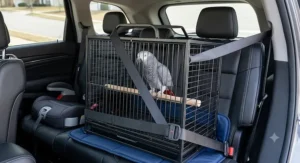
Car travel is where most African grey owners actually use a travel cage, and it’s also where the stakes are highest — an unsecured carrier becomes a projectile in a hard stop. If you’re driving your grey two hours to a new vet after a move, the Prevue Pet Products Playtop Travel Carrier 1307‘s welded seatbelt brackets solve the actual physics problem: the cage buckles in like a car seat, not just sits on a seat and hopes for the best.
If you’re a college student bringing your grey home for a weekend and need something you can also carry on foot from a dorm to a parking garage, the Yaheetech 26″ Wrought Iron Travel Bird Cage Carrier or Mcage 24″ Large Bite-Proof Travel Carrier balance portability with real containment security without the added seatbelt hardware weight.
Positioning matters as much as the cage itself: place it on a back seat, secured upright, never in a trunk or an area with poor airflow, and never in direct sun through a window — cabin temperatures spike fast, and a stressed bird overheats faster than most owners expect. Keep the AC or heat moderate rather than blasting either directly at the carrier.
Problem → Solution: Fixing Common Large Parrot Travel Carrier Headaches
Problem: The bird refuses to enter the carrier. Solution: stop trying on travel day. Leave it out with treats and favorite toys inside for a week beforehand, door propped open, and let curiosity do the work.
Problem: Excessive screaming during transit. Solution: partially cover the sides (not the front) with a light cloth to reduce visual stimulation, and keep car audio low rather than off — total silence can feel more ominous to a bird than ambient road noise.
Problem: Spilled water mid-drive. Solution: use carriers with locking cup brackets, like the Prevue Pet Products Playtop Travel Carrier 1307 or Mcage Deluxe Wrought Iron Travel Carrier with Cage Cover, and fill cups only two-thirds full before departure.
Problem: Bird bites through or bends cheaper wire. Solution: step up to wider-gauge, bite-tested wire like the Mcage 24″ Large Bite-Proof Travel Carrier, rather than replacing the same style repeatedly.
Problem: Carrier feels too small for a multi-hour trip. Solution: prioritize interior height and floor space over price — the Yaheetech 26″ Wrought Iron Travel Bird Cage Carrier or Featherland Paradise Caitec Perch ‘N Go (Large) both give meaningfully more room than entry-level folding cages.
Buyer’s Decision Framework: Matching the Cage to Your Lifestyle
If you only make occasional vet trips a few times a year, choose a budget folding cage like the Prevue Hendryx Travel Bird Cage 1305, because paying for automotive hardware you rarely need doesn’t make financial sense.
If you regularly drive long distances with your bird, choose a seatbelt-compatible model like the Prevue Pet Products Playtop Travel Carrier 1307, because the physics of a sudden stop don’t care how careful a driver you are.
If your bird gets visibly anxious in new environments, choose a covered or clear-acrylic option — the Mcage Deluxe Wrought Iron Travel Carrier with Cage Cover for visual blocking, or the Featherland Paradise Caitec Perch ‘N Go (Large) for a calmer, less bar-heavy view — because reducing sensory overload does more for behavior than cage size alone.
If mobility matters more than armor and your bird is confident and carrier-trained, choose the ibiyaya TrackPack Medium Backpack Carrier, because hands-free portability is worth the trade-off in bite resistance for the right temperament.
How to Choose a Large Parrot Travel Carrier
Picking a large parrot travel carrier comes down to matching real specs to your actual travel pattern, not just grabbing whatever’s cheapest on the page. Here’s the process we’d walk through:
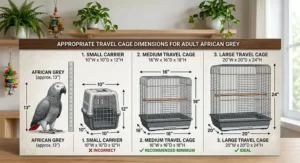
- Measure your bird’s wingspan and tail length first. A cage that’s technically “large parrot” sized on the label can still cramp a long-tailed African grey — check interior dimensions, not just the marketing category.
- Match bar spacing to bite strength. Anything looser than 3/4 inch risks a determined grey working bars apart over time; 1/2 to 3/4 inch is the safer range for this species.
- Decide your primary transport mode. Car-heavy owners should prioritize seatbelt compatibility; frequent walkers should weigh backpack designs; occasional users can stick with basic folding cages.
- Weigh portability against durability. Lighter materials (mesh, acrylic, soft-sided) are easier to carry but generally less bite-resistant than powder-coated steel or wrought iron.
- Check for locking food and water fixtures. Non-locking cups are a near-guaranteed spill during any drive with turns or stops.
- Consider visual stress reduction features. Covers or clear-view acrylic both reduce a common but under-discussed source of travel anxiety.
- Read real owner feedback before buying, since assembly quality and long-term durability vary more between similar-looking budget models than spec sheets suggest.
A large parrot travel carrier that nails these seven points will outperform a more expensive one that only nails two or three.
Large Bird Transport Cage vs Traditional Home Cage
| Factor | Large Bird Transport Cage | Traditional Home Cage | Best For |
|---|---|---|---|
| Portability | Foldable, handle-equipped | Fixed, often on wheels at best | Travel |
| Bar Spacing | Tighter (security-focused) | Wider (enrichment-focused) | Transport cage |
| Daily Use | Short-term only | Long-term housing | Home cage |
| Automotive Safety | Seatbelt options exist | None | Transport cage |
A large bird transport cage and a traditional home cage solve fundamentally different problems, even though both technically “contain” your bird. Home cages prioritize enrichment space — room for toys, foraging, wing-stretching — while a transport cage prioritizes secure, temporary containment during movement, which is exactly why products like the Prevue Hendryx Travel Bird Cage 1305 feel cramped if used as a permanent home. Trying to use a home cage as a transport solution fails for the opposite reason: most aren’t designed to fold, lack seatbelt points, and are simply too bulky to maneuver through doorways and car seats.
💬 Comparing your options? A quick share helps other bird owners find this guide too!
What to Expect: Real-World Performance During Travel
On paper, spec sheets suggest travel cages are simple boxes; in practice, real-world performance varies a lot more than the numbers imply. A cage rated for “medium to large birds” might technically fit an African grey’s body while leaving almost no room to turn around — the difference between a spec sheet and lived comfort. Expect some vocalization during the first few trips regardless of cage quality; this typically decreases as the bird associates the carrier with predictable, non-threatening outcomes rather than only vet visits.
Expect temperature swings inside metal cages to happen faster than in your home, since car interiors heat and cool more dramatically — check on your bird periodically rather than assuming a quiet ride means a comfortable one. Expect droppings and general mess to accumulate faster than expected on longer trips, which is where a pull-out tray, like the one on the Mcage 24″ Large Bite-Proof Travel Carrier, earns its keep.
Long-Term Cost & Maintenance of a Big Bird Carrier
| Carrier Type | Typical Lifespan | Replacement Parts Needed | Approx. Annual Wear Cost |
|---|---|---|---|
| Folding steel | 3-6 years | Tray, occasional bowls | Low |
| Wrought iron/steel | 5-10+ years | Rarely, sturdy build | Low-Moderate |
| Acrylic/polycarbonate | 4-7 years | Perch upgrades common | Moderate |
| Soft-sided backpack | 2-4 years | Zippers, straps | Moderate |
A big bird carrier is a one-time-ish purchase that most owners underestimate the total cost of ownership on, mostly because they forget to budget for wear items. Metal cages like the Prevue Pet Products Playtop Travel Carrier 1307 tend to have the lowest long-term cost per use, since powder-coated steel resists corrosion and rarely needs part replacement beyond the occasional bowl. Soft-sided options wear faster at stress points — zippers and strap seams specifically — which is worth factoring into the sticker-price comparison; a $70 backpack that needs replacing every two years can cost more over a decade than a $150 metal carrier that lasts ten.
Parrot Travel Safety: Regulations & Compliance Guide
Parrot travel safety isn’t just about the cage — it intersects with real regulatory requirements depending on where and how you’re traveling. For car and local travel within the U.S., there’s no federal permit requirement, but airlines vary enormously in whether birds are allowed in-cabin at all, and some carriers have tightened restrictions in recent years, so confirming current policy directly with your airline before booking is essential.
For anyone crossing state lines or traveling internationally with an African grey, official guidance from the USDA Animal and Plant Health Inspection Service outlines quarantine periods, required veterinary exams, and testing that can apply on return to the U.S. — planning months ahead is standard advice, not overcaution. The American Veterinary Medical Association’s guidance on traveling with pet birds is a genuinely useful starting point for understanding health certificate timing and destination-specific requirements before committing to travel dates.
Locally, the practical safety rule that matters most: never let your bird ride loose in a vehicle, and always secure the carrier itself, whether by seatbelt bracket or wedged securely so it can’t slide during braking.
Features That Actually Matter (And Those That Don’t)
Marketing copy loves to lean on words like “premium” and “deluxe” without explaining what they buy you, so here’s an honest filter. Features that actually matter: bar spacing appropriate to bite strength, locking food/water fixtures, a carry handle rated for the bird’s actual weight, and — if you drive regularly — genuine seatbelt integration rather than a strap that just loops over.
Features that matter less than they sound: decorative color options (a Yaheetech cage in “hammered black” performs identically to one in another finish), oversized branding on the box, and “airline approved” claims that, per the VCA Animal Hospitals guide to transporting birds, still depend entirely on the individual airline’s current policy rather than any universal standard. What most buyers overlook is that assembly quality — how tightly panels snap together, how secure a latch actually feels — predicts real-world satisfaction far better than any spec on the box.
FAQ
❓ How big should a travel cage be for an African grey?
❓ Can African greys travel in cars for long distances?
❓ Do airlines allow African grey parrots in the cabin?
❓ What's the safest material for a parrot travel cage?
❓ How often should I clean a bird travel carrier?
Conclusion
Choosing a travel cage for African grey ownership really comes down to being honest about how you actually travel, not how you imagine you might someday travel. If it’s mostly quick vet runs, the budget-friendly Prevue Hendryx Travel Bird Cage 1305 covers you completely. If road trips and car safety are the priority, the Prevue Pet Products Playtop Travel Carrier 1307‘s seatbelt system is worth the extra cost. And if your bird gets visibly stressed by new environments, either the covered Mcage Deluxe Wrought Iron Travel Carrier with Cage Cover or the clear-view Featherland Paradise Caitec Perch ‘N Go (Large) will do more for behavior than any amount of extra floor space.
Whichever you choose, the introduction process matters as much as the hardware — a great cage introduced badly still produces a stressed bird. Give your grey time, keep the setup consistent, and travel days will stop feeling like a battle.
Recommended for You
- 7 Best collapsible bird travel cage Picks for 2026
- Large Play Top Cage Under $200: 7 Best Picks for 2026
- 7 Best Rolling Play Top Cage Picks for 2026
Disclaimer: This article contains affiliate links. As an Amazon Associate, I earn from qualifying purchases. If you purchase products through these links, we may earn a small commission at no additional cost to you.
✨ Found this helpful? Share it with your friends! 💬🤗
