
In This Article
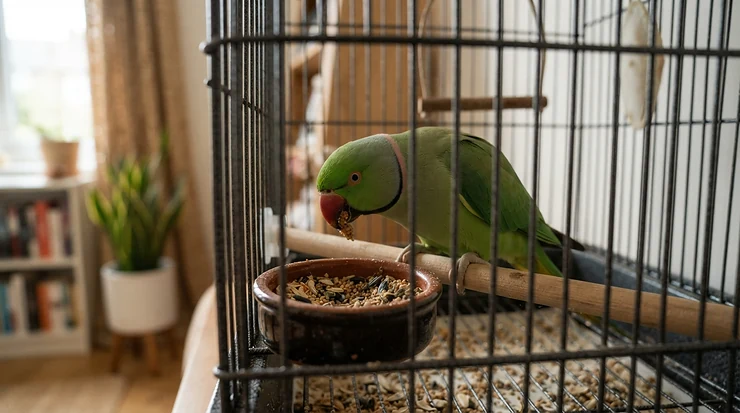
Grain-free pellets for parakeets are formulated bird foods that skip cereal grains like corn, wheat, and rice and lean on legumes, seeds, or vegetables for carbohydrates. Here’s the twist: a truly grain-free pellet sized for a budgie is rare, so most people searching for grain-free pellets for parakeets end up choosing wheat-free, corn-free, or legume-forward formulas instead.

I spent this research round reading ingredient panels instead of marketing copy, and the pattern is blunt. Not one of the seven pellets below is verifiably free of every cereal grain. What you can get is control. That means pellets without corn, pellets without wheat, and formulas where lentils and peas carry some of the load. All of them come in particles small enough for a bird that weighs about as much as five nickels.
Why bother with pellets at all? A seed-heavy bowl lets a budgie play favorites. A PetMD guide to seeds versus pellets lays out the vet-friendly split: about 60-70% pellets, up to 10% seed, and 20-30% fresh food. Pellets are the foundation, so the real question is which pellet.
A quick note on method. I haven’t fed any of these to a bird, so you won’t find invented “my budgie devoured it” stories here. You’ll get ingredient analysis, spec interpretation, and review themes I could actually verify, flagged as thin when they are. Prices appear as ranges because they move constantly, so check current price before you buy. Before any diet change, a conversation with an avian vet is cheap insurance.
Quick Comparison: 7 Grain-Free Pellets for Parakeets at a Glance
Before the deep dives, here’s the whole lineup on one screen. The “Grain-Free?” column is my verified read of ingredient lists and retailer data, not a brand slogan.
| Product | Grain-Free? (Verified) | Corn / Wheat / Soy | Particle Size | Best For |
|---|---|---|---|---|
| TOP’s Mini Pellets | No — rice, millet, barley, quinoa, buckwheat | Corn, wheat, and soy free (maker’s claims) | 3/32 inch | Owners avoiding corn, wheat, and soy |
| Harrison’s Adult Lifetime Super Fine | No — but legume-forward (soybeans, lentils, peas) | Contains corn and soy; no wheat listed | Tiny to small birds | Maintenance after conversion |
| Harrison’s High Potency Super Fine | No — same base, richer formula | Contains corn and soy; no wheat listed | Tiny to small birds | Seed-to-pellet conversion, molting |
| Roudybush Daily Maintenance Mini | No — corn and wheat based | Corn, wheat, soy in retailer lists | Mini (crumble also sold) | Steam-pelleted everyday staple |
| Lafeber Premium Daily Diet for Parakeets | No — corn and soybean meal | Contains corn and soy | Sized to crumble | Picky seed-lovers |
| ZuPreem Natural Small Birds | No — multigrain | Contains corn, wheat, soy | Small pellet | Mainstream baseline |
| Mazuri Mini Bird Diet | No — retailer lists “Grain Free: No” | Contains corn, wheat middlings, soy | 5/64 inch | Smallest particle size |
Read down the second column and a pattern jumps out: nothing earns a clean grain-free stamp. The practical split is between TOP’s Mini Pellets, the only option that dodges corn, wheat, and soy together, and the two Harrison’s formulas, which swap some starch for lentils and peas but keep corn and soy. If you’re chasing a grain allergy in birds, start with the first. If you want legume based pellets, even loosely, start with the second.
💬 Just one click — help others make better buying decisions too!😊
Top 7 Grain-Free Pellets for Parakeets: Expert Analysis
I ranked these by how closely they match what shoppers mean by grain-free pellets for parakeets, then by conversion usefulness, then by how well they work as mainstream baselines.
1. TOP’s Mini Pellets — corn, soy, and wheat free in a mini size
The standout is what’s missing. TOP’s Mini Pellets are cold-pressed, USDA Organic, and made without corn, soy, wheat, or peanuts, according to the maker. That’s why this is the pellet most people mean when they go looking for wheat free pellets for budgies.
Precision matters, though. The ingredient lists I found lean on rice, hulled millet, barley, quinoa, and buckwheat, plus sunflower and sesame seeds, alfalfa, and powdered greens. That’s grain-light, not grain-free. At 3/32 inch across, the pellets suit a budgie beak. Listings report minimum crude protein anywhere from roughly 12% to 13.6%, so check your bag. The maker also lists no added vitamins and openly says no pellet covers every nutritional need, which makes fresh vegetables non-negotiable.
On paper, this is the strongest first stop for corn free pellets for small birds. The short, whole-food ingredient list is a real advantage. The trade-off is that more of the nutritional balancing lands on your daily produce routine.
Reviewers I could verify are mostly owners moving a budgie off seed who like the transparent label. The sample sits largely on retailer pages, so treat it as anecdotal.
Pros:
- ✅ Free of corn, soy, wheat, and peanuts
- ✅ USDA Organic with a short, readable ingredient list
- ✅ 3/32 inch pellets suit budgie-sized beaks
Cons:
- ❌ Still contains rice, millet, barley, and quinoa
- ❌ No added vitamins, so balance depends on you
Expect around $10-$15 for a 1 lb bag, a fair premium if allergens are your priority.
2. Harrison’s Adult Lifetime Super Fine — legume-forward maintenance for tiny beaks
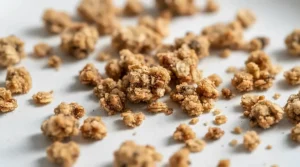
Think of this as the lentil-and-pea route. Harrison’s Adult Lifetime Super Fine is certified organic, non-GMO verified, and sized for tiny, petite, and small birds. Ground soybeans, lentils, and green peas share the ingredient list with corn, hull-less barley, millet, oat groats, rice, and chia.
That makes it legume forward rather than legume based pellets in the strict sense. The legumes add protein and fiber, but corn leads some retailer lists, and peanuts and sunflower are in there too. It won’t suit corn-sensitive or peanut-avoiding households. Ingredient order varies by retailer, so confirm on the bag.
The maker positions it as maintenance food for healthy, non-breeding, non-molting birds that have finished a High Potency program, usually about six months. Here’s the part the spec sheet buries. Opened bags are meant to be used within roughly six to eight weeks, ideally stored in the fridge or freezer, so a 1 lb bag suits one or two budgies better than a bulk sack.
Verified review chatter praises the organic sourcing, but much of it comes from larger-parrot owners. Budgie-specific feedback is thin.
Pros:
- ✅ Lentils, peas, and soybeans add legume weight
- ✅ Organic and non-GMO verified
- ✅ Tiny-bird particle size
Cons:
- ❌ Contains corn, peanuts, and soy
- ❌ Short freshness window once opened
Around $12-$17 for 1 lb, good value for birds that have already converted.
3. Harrison’s High Potency Super Fine — the extra-fat conversion formula
Where the maintenance formula coasts, this one pushes. Harrison’s High Potency Super Fine carries more protein, fiber, and fat than the Adult Lifetime line. Retailers pitch it for diet conversion, molting, underweight birds, and recently weaned youngsters.
The ingredient base mirrors its sibling: yellow corn, hull-less barley, millet, soybeans, peanuts, sunflower, lentils, green peas, rice, and alfalfa, as the retailer lists I checked show. The real difference is energy density. For a budgie flatly refusing pellets, extra fat can keep weight steadier during the switch, which matters when a 25-gram bird can’t afford much loss. For a sedentary cage-bound adult, richer food becomes a long-term liability.
Based on the spec comparison, treat this as a stepping stone, not a forever bowl. The maker’s guidance for birds new to the brand is to start on this formula for at least six months. Some third-party writeups say longer, so budget for several bags.
I couldn’t verify a meaningful pool of budgie-specific reviews for this exact formula, and I’m not going to pretend otherwise. Most public comments concern larger parrots.
Pros:
- ✅ Higher fat and protein support conversion
- ✅ Lentils and peas add legume content
- ✅ Tiny-bird pellet size
Cons:
- ❌ Contains corn, peanuts, and soy
- ❌ Too rich for long-term feeding in inactive birds
Around $14-$19 per 1 lb, good value only as a time-limited conversion tool.
4. Roudybush Daily Maintenance Mini — steam-pelleted staple with crumble options
Steady, boring nutrition can be a compliment. Roudybush Daily Maintenance Mini is a steam-pelleted formula listed as free of added sugars, artificial colors, and animal by-products. Amazon also carries crumble and “Nibles” versions.
Now for the label drama. One retailer tags it wheat free, while another retailer’s ingredient list names ground corn, ground wheat, and soybean meal at the top. A third variation shows peanut meal. Those can’t all describe the same bag. If you need wheat free pellets for budgies, treat this as a contradiction to resolve with the printed panel and the manufacturer, not a safe assumption.
When grains aren’t a concern, the case is reasonable. The mini and crumble versions give you a tiny crumble size that small beaks handle. Retailer reviews mention acceptance by picky birds and a good fit for parrotlet-sized eaters. Owners also describe birds dunking pellets into water bowls, and one buyer’s seed-addicted youngster still hadn’t switched.
Pros:
- ✅ Steam-pelleted with no added sugar or colors
- ✅ Mini, crumble, and Nibles sizes
- ✅ Picky eaters reportedly accept it
Cons:
- ❌ Corn and wheat appear in retailer ingredient lists
- ❌ Conflicting “wheat free” labeling across listings
Pricing swings widely by size, so check current price. It generally sits mid-range here and is good value for grain-tolerant birds.
5. Lafeber Premium Daily Diet for Parakeets — molasses-flavored pellets for seed loyalists
Some budgies treat pellets like a rumor they refuse to believe. Lafeber Premium Daily Diet for Parakeets is built for exactly that bird. The maker flavors it with molasses to improve acceptance among picky seed eaters and sizes the pellets so a parakeet can crumble them up.
The recipe centers on ground non-GMO corn and soybean meal, with whole egg, vitamins, minerals, and amino acids, preserved with mixed tocopherols and citric acid. It’s grain-based by design, so skip it if you truly need corn free pellets for small birds. The whole egg is worth raising with your vet, since an avian veterinary Q&A suggests animal-derived protein is no longer routinely recommended for non-breeding birds.
Why choose it anyway? When conversion is the bottleneck, palatability can beat purity. Think of it as a bridge: a familiar-flavored pellet that gets a bird eating a formulated diet, with ingredient tailoring to follow.
The maker’s own parakeet page showed only about eight reviews at the time of research, including one owner transitioning from Nutri-Berries. That’s too small a pool to summarize with confidence.
Pros:
- ✅ Molasses flavor helps picky seed eaters switch
- ✅ Sized for parakeets to crumble
- ✅ Free from artificial colors, flavors, and preservatives
Cons:
- ❌ Corn and soybean meal lead the formula
- ❌ Contains whole egg and molasses
Around $30-$35 for a 5 lb tub. The tub is generous for one bird, so freshness is the value risk.
6. ZuPreem Natural Small Birds — uniform multigrain pellets that stop the picking
If you want a reference point for what grain-based looks like, start here. ZuPreem Natural Small Birds is a multigrain pellet. Ground corn, soybean meal, millet, oat groats, barley, wheat, and wheat germ meal sit alongside sugar, vegetable oil, flaxseed, and small amounts of celery, carrots, parsley, beets, blueberries, and cranberries.
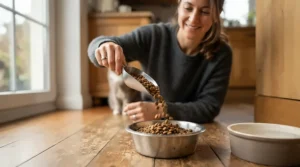
The consistent color and shape are the clever part. They’re meant to keep a bird from cherry-picking favorite pieces. The label suggests 1-3 tablespoons daily of total food for parakeets, a handy sanity check against overfeeding.
Here’s what most buyers overlook: “natural” and “multigrain” here are the opposite of grain free. For anyone whose search for grain-free pellets for parakeets comes from allergy worries, it’s a non-starter. For everyone else, it’s a widely stocked baseline that pricier options need to justify themselves against.
I couldn’t verify written review themes for this listing. What I can say is that the Amazon listing showed a “1K+ bought in past month” badge at the time of research. That signals popularity, not satisfaction.
Pros:
- ✅ Uniform pellets discourage picking
- ✅ Includes flaxseed and vegetable pieces
- ✅ Widely available
Cons:
- ❌ Multigrain formula with corn and wheat
- ❌ Sugar appears on the ingredient list
Around $15-$20 for 2.25 lb. It’s solid value for grain-tolerant birds and the wrong tool for exclusion diets.
7. Mazuri Mini Bird Diet — the smallest particle in the lineup
For the tiniest beaks, size is the story. Mazuri Mini Bird Diet is an extruded feed formed into a 5/64 inch round particle, a true tiny crumble size for budgies, finches, and canaries.
The ingredient list opens with ground corn, wheat middlings, dehulled soybean meal, and corn gluten meal, then ground flaxseed for omega-3s. One retailer flags it “Grain Free: No” in plain terms. It also contains live, naturally occurring microorganisms, and it’s formulated as a primary diet for non-breeding birds. The conversion schedule swaps in about 10% a day over ten days, and it tells you to watch droppings. Dark green, shrinking output means your bird isn’t eating enough.
The particle size solves dish-sorting and waste, but the corn-and-wheat backbone means it’s best for birds without ingredient sensitivities.
Sentiment is mixed rather than glowing as far as I can verify. One retailer page showed a middling 3.4 out of 5 average with no visible review count. A hosted comment from a parrot owner praised low mess and little waste compared with seed.
Pros:
- ✅ Smallest 5/64 inch particle in this lineup
- ✅ Ground flaxseed adds omega-3 fatty acids
- ✅ Contains live naturally occurring microorganisms
Cons:
- ❌ Corn, wheat middlings, and soy lead the formula
- ❌ Mixed retailer ratings
Around $13-$17 for 2 lb, strong budget value for birds who tolerate grains.
Top 7 Comparison: Specs, Price Ranges, and Best Use
| Product | Format | Ingredient Angle | Typical Price Range | Best For |
|---|---|---|---|---|
| TOP’s Mini Pellets | Cold-pressed, organic | Corn, soy, wheat free; rice, millet, quinoa | $10-$15 (1 lb) | Allergen-conscious households |
| Harrison’s Adult Lifetime Super Fine | Organic maintenance | Soy, lentils, peas plus corn | $12-$17 (1 lb) | Post-conversion maintenance |
| Harrison’s High Potency Super Fine | Organic, richer formula | Higher fat and protein | $14-$19 (1 lb) | Converting stubborn seed eaters |
| Roudybush Daily Maintenance Mini | Steam-pelleted | Corn, wheat, soy (verify bag) | Varies by size | Everyday staple feeding |
| Lafeber Premium Daily Diet for Parakeets | Compressed, molasses-flavored | Corn, soybean meal, whole egg | $30-$35 (5 lb) | Picky seed-loyal birds |
| ZuPreem Natural Small Birds | Uniform pellets | Multigrain with vegetables | $15-$20 (2.25 lb) | Budget-conscious baseline |
| Mazuri Mini Bird Diet | Extruded round particle | Corn, wheat middlings, soy | $13-$17 (2 lb) | Smallest-beak feeding |
Looking at the table, Mazuri Mini Bird Diet and ZuPreem Natural Small Birds are the cheapest ways in, while TOP’s Mini Pellets costs more per pound but is the only one that skips corn, wheat, and soy. If legume based pellets appeal to you, the two Harrison’s options are the only real contenders, and Harrison’s High Potency Super Fine is the one to budget as temporary. Cost per pound matters less than whether your bird will actually eat it.
✨ Ready to Find the Right Pellet for Your Budgie?
🔍 Take your bird’s diet to the next level with these carefully compared options. Click any highlighted product name to check current pricing and availability, then match the ingredient panel to your bird’s needs. A better bowl starts with a better label!
How to Switch Your Parakeet to Pellets: A 30-Day Practical Guide
A budgie that has eaten seed for years can be stubborn. A methodical month beats a dramatic overnight swap. Always check with an avian vet first, because conversion carries weight-loss risk.
Before day one: Buy a gram scale and weigh your bird daily, at the same time, since 20-30 grams leaves little margin. A pellet-conversion guide from an avian-health company recommends tracking weight daily and calling your vet if your bird loses more than 10% of starting body weight.
Week one: Mix roughly 75% old food with 25% new pellets, the same starting ratio that guide suggests. Offer fresh food daily and discard leftovers.
Weeks two and three: Shift toward 50/50, then 75% pellets, as long as weight holds and droppings stay normal. One maker’s schedule replaces about 10% of the old food each day over ten days, a faster pace for birds that adapt easily.
Week four: Aim for pellets as the main course with measured seed and fresh produce as supporting acts.
Optimization tricks listings never mention:
- Sprinkle crushed pellets over chopped vegetables so the new flavor arrives with something familiar.
- Scatter a few pellets in foraging spots, not just the dish.
- Watch droppings. Dark green, small-volume output signals your bird isn’t eating enough.
Common first-30-day mistakes: rushing the timeline, skipping weigh-ins, and switching formulas mid-conversion. A pellet change is hard enough without moving the goalposts.
Real-World Scenarios: Matching Pellets to Your Budgie
Abstract advice is easy. Here are three common situations with the logic for each.
Scenario 1: The itchy-looking budgie. You’ve noticed feather chewing and your search history now includes “grain allergy in birds.” The first move is a vet exam, not a pellet. If your vet suggests an elimination trial, TOP’s Mini Pellets is the cleanest way to remove corn, wheat, and soy at once. Budget: around $10-$15 per pound, daily feeding, with fresh vegetables to fill the vitamin gap.
Scenario 2: The four-year-old seed addict. Your budgie treats pellets as a prank. Lafeber Premium Daily Diet for Parakeets offers molasses appeal, while Harrison’s High Potency Super Fine offers a richer formula that keeps weight steadier. Expect a multi-week project, a scale on the cage stand, and mixed meals in the interim.
Scenario 3: An apartment, two budgies, a tight budget. You want a staple without the premium. ZuPreem Natural Small Birds or Mazuri Mini Bird Diet in a 2 lb bag keeps costs in the mid-teens, and smaller bags stay fresher. Add measured vegetables and a little seed, and your bowl already looks like the PetMD split.
Problem → Solution Guide
Problem 1: Your budgie flings pellets or ignores them. Offer smaller, fresher portions and hide a few across the cage. Reviewers of Roudybush Daily Maintenance Mini mention birds turning pellets into soup in water dishes, so keep the water cup well away from the food bowl.
Problem 2: Weight drops during conversion. More than 10% below starting weight means a vet call, per the conversion guide above. Slow down or go back a step.
Problem 3: Droppings turn dark green and shrink. That’s the maker-flagged sign for Mazuri Mini Bird Diet that a bird isn’t eating enough, and it applies to any switch.
Problem 4: The label says one thing and the ingredient list another. The “wheat free” tag on one Roudybush Daily Maintenance Mini listing versus ground wheat on another is the cautionary tale. Trust the printed ingredient panel, and email the manufacturer if it’s unclear.
Problem 5: Pellets go stale before the bag ends. Harrison’s Adult Lifetime Super Fine advises using opened bags within about six to eight weeks and freezing or refrigerating the rest. Buy small.
How to Choose Grain-Free Pellets for Parakeets
Here’s the short version of what separates a good pick from a lucky guess.
- Define what “grain-free” means to you. Allergen avoidance, lower starch, and marketing preference are three different goals, and each points to a different bag.
- Read the ingredient panel top-down. The first three ingredients dominate the formula. Four of the seven pellets above lead with corn.
- Match particle size to the beak. Look for a tiny crumble size, like 5/64 inch or 3/32 inch, that doesn’t force a small bird to wrestle its food.
- Choose by life stage. Conversion or molting may justify richer formulas, while long-term maintenance rarely does.
- Check freshness rules. Opened-bag windows and storage advice matter more for one budgie than for a flock.
- Verify claims twice. Conflicting “wheat free” listings prove one retailer isn’t enough.
- Plan the whole bowl. Pellets at 60-70%, fresh food at 20-30%, and seed up to 10% is the vet-friendly framework referenced earlier.
Grain Allergy in Birds: What the Evidence Actually Says
This is the section most “grain-free” marketing skips, so let’s slow down.
What the research does say
An avian-vet educator writing on allergies in parrots calls proof of food allergies “very scarce,” citing only a few suspected cases tied mostly to ingredients that bother mammals. A veterinary dermatology paper on avian allergic skin disease reports that allergic skin disease does exist but is fairly uncommon. It notes positive skin-test reactions to sunflower and maize in some birds, though it also stresses that many reports are anecdotal.
What it doesn’t say
Nothing I found shows grains as a proven culprit in typical pet budgies. Itchy skin or feather trouble is more often behavioral, such as boredom or too little foraging, or medical. That’s why the workup matters: blood tests, X-rays, and skin biopsies before any food blame. For comparison, veterinary nutrition groups point out that in dogs and cats, meat and dairy cause more confirmed food allergies than grains.
The practical takeaway
Grain allergy in birds is plausible but unproven for the average budgie. If your vet recommends an elimination trial, a pellet like TOP’s Mini Pellets, with no corn, wheat, or soy, makes the experiment simpler. If not, don’t pay a premium based on internet scare stories.
Wheat Free Pellets for Budgies: Reading the Label
Not everyone hunting wheat free pellets for budgies is worried about the bird. Some owners are gluten-intolerant themselves and notice symptoms when handling or scooping food. I found a forum thread and an avian-company Q&A from households with celiac disease asking exactly this.
Here’s the label reality across the seven:
- TOP’s Mini Pellets: the maker describes it as free of wheat, though it contains barley.
- Harrison’s Adult Lifetime Super Fine and Harrison’s High Potency Super Fine: no wheat appears in the retailer ingredient lists I checked, but hull-less barley and oat groats do.
- Roudybush Daily Maintenance Mini: one listing says wheat free, another lists ground wheat. Verify the bag.
- ZuPreem Natural Small Birds and Mazuri Mini Bird Diet: both contain wheat ingredients.
Three terms get confused constantly: wheat free, gluten free, and grain free. They are not interchangeable. Barley is a gluten-containing grain, so a household avoiding gluten needs to read beyond the wheat line. Treat wheat free pellets for budgies as a starting filter, not a finish line.
Corn Free Pellets for Small Birds: Who Needs Them?
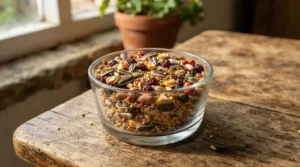
Corn is the quiet default of the pellet aisle. It leads the ingredient list on Lafeber Premium Daily Diet for Parakeets, ZuPreem Natural Small Birds, Mazuri Mini Bird Diet, and Roudybush Daily Maintenance Mini. Some avian educators argue that’s too much sugar and starch for sedentary house birds, which is a reasonable view but not a settled one.
So who actually needs corn free pellets for small birds? Consider the evidence honestly. An avian veterinarian’s Q&A says allergies are hard to test for, likely affect a small minority of birds, and shouldn’t be used to justify stripping ingredients from every bird’s food based on online claims. The suggested approach is to evaluate the individual bird and try eliminating suspected allergens to see whether anything changes.
Among the seven, TOP’s Mini Pellets is the only strictly corn-free option. Harrison’s Adult Lifetime Mash is another to read carefully. The maker says it contains no corn, and a retailer listing shows millet, buckwheat, and soybeans near the top. It’s a ground mash rather than a pellet, and the listing I found was truncated, so confirm on the bag.
Legume Based Pellets: Do Peas and Lentils Earn Their Place?
The appeal is obvious. Peas and lentils are protein-dense. A pet-food industry white paper, written about dog and cat foods, lists peas at roughly 23% protein and lentils around 26%, against about 9% for corn. It also notes a lower glycemic index for pulses.
In this lineup, Harrison’s Adult Lifetime Super Fine and Harrison’s High Potency Super Fine are the closest thing to legume based pellets. Soybeans, lentils, and green peas appear alongside the grains, so “legume forward” is the honest label. Strictly legume based pellets, with no cereal grains at all, didn’t turn up in my research for budgie-sized formulas.
Two honest caveats apply. First, the white paper’s logic comes from dogs and cats, and nobody has proven it carries over to budgies. Second, soy is a legume, so shoppers avoiding soy should skip these. TOP’s Mini Pellets is soy free but not legume based.
Practically, treat legume content as an ingredient-quality signal, not a magic upgrade. A veterinary nutrition page notes that non-breeding birds generally don’t need extra protein, so more protein isn’t automatically better.
Tiny Crumble Size: Why Pellet Dimensions Matter for Budgies
Budgies weigh just 20-30 grams, so everything about their food should be manageable. A pellet that’s too hard or too large turns mealtime into a wrestling match. That’s often when owners conclude “my bird hates pellets” when the real culprit is size.
Here’s how the seven compare on particle:
- Mazuri Mini Bird Diet: a 5/64 inch extruded round particle, the smallest in the lineup.
- TOP’s Mini Pellets: 3/32 inch, cold-pressed, with varying lengths.
- Harrison’s Adult Lifetime Super Fine and Harrison’s High Potency Super Fine: sized for tiny, petite, and small birds.
- Lafeber Premium Daily Diet for Parakeets: sized for a parakeet to crumble.
- Roudybush Daily Maintenance Mini: mini pellets, with crumble and Nibles versions for variety.
A true tiny crumble size does more than ease eating. It reduces waste, and uniform particles discourage the favorite-picking that undermines a balanced diet. If your budgie is refusing pellets, try a smaller crumble before concluding the flavor is the problem. Offer pellets dry, replace them fresh daily, and keep them away from the water dish.
Grain-Free Pellets for Parakeets vs Seed Diets
Veterinary resources describe seed-only budgie diets as high in fat and nutritionally unbalanced. They also warn that budgies tend to pick one or two favorite seeds, with millet a common pick. Pellets fix the sorting problem by putting the same nutrients in every bite.
| Diet Style | Nutrient Consistency | Selective Eating Risk | Allergen Control | Best For |
|---|---|---|---|---|
| Seed-only mix | Low | High | Low | Not recommended as a staple |
| Seed plus pellet blend | Medium | Medium | Low-Medium | Transition meals, e.g. ZuPreem Smart Selects Parakeet & Budgie Food |
| Grain-inclusive pellets | High | Low | Medium | Everyday feeding, e.g. ZuPreem Natural Small Birds, Mazuri Mini Bird Diet |
| Grain-reduced or legume-forward pellets | High | Low | Higher | Ingredient-conscious owners, e.g. TOP’s Mini Pellets, Harrison’s Adult Lifetime Super Fine |
The table shows why the pellet-versus-seed debate is mostly settled while the grain question is still open. Both pellet styles beat a seed-only bowl on consistency and selective eating, and allergen control is where the grain-reduced options pull ahead. For most healthy budgies, the biggest upgrade is moving from seed to any good pellet. The second-biggest decision is whether your bird’s situation justifies a more specialized formula.
Long-Term Cost & Maintenance
Monthly cost depends less on the price per pound than on waste and freshness. A budgie eats small amounts. Lafeber’s guidance for a parakeet fruit pellet, for instance, is an average serving of about 1½ teaspoons.
Here’s the math that matters:
- Small bags beat big tubs. A 5 lb tub of Lafeber Premium Daily Diet for Parakeets is a bargain per pound but can outlast its freshness for a single bird.
- Freshness windows are real. Harrison’s Adult Lifetime Super Fine advises using opened bags within about six to eight weeks, with fridge or freezer storage after opening.
- Premium isn’t automatically pricier overall. TOP’s Mini Pellets costs more per pound than Mazuri Mini Bird Diet, but if it prevents a switch-and-switch-again cycle, the real cost may even out.
- Maintenance is daily. Wash dishes, discard uneaten pellets, and weigh your bird regularly. One maker’s label also says to wash hands after handling.
Total cost of ownership also includes the cost of a poor diet. Veterinary sources describe seed-only feeding as a common contributor to illness in pet budgies, so a sensible pellet is cheaper than a vet bill.
FAQ
❓ Are grain-free pellets for parakeets worth paying extra for?
❓ Can I mix pellets with seed for my budgie?
❓ Where can I find wheat free pellets for budgies on Amazon?
❓ Are legume based pellets safe for small parrots?
❓ How long does a 1 lb bag last for one budgie?
Conclusion
Here’s the bottom line, and it isn’t what the keyword promises: grain-free pellets for parakeets, in the strict sense, didn’t turn up in my research. What does exist is a useful spectrum. TOP’s Mini Pellets is the strongest answer for owners who want corn free pellets for small birds and wheat free pellets for budgies in one bag. The Harrison’s formulas are the nearest thing to legume based pellets. The four mainstream options are honest, widely available, grain-inclusive staples, with Mazuri Mini Bird Diet leading on particle size.
If a grain allergy in birds is your worry, get a vet exam before changing the bowl. If you’re simply tired of seed-only feeding, nearly any of these beats a seed-only mix. Match the pellet to your bird’s tiny crumble size needs, convert slowly with a scale on the cage stand, and keep fresh vegetables in the rotation.
Whichever you choose, read the printed ingredient panel and confirm claims across two sources. Marketing is loud, but labels are quiet and accurate.
Recommended for You
- Pellets For Cockatiels With Sensitive Stomachs: 7 Best Picks 2026
- Pellets For Older Parrots With Kidney Issues: 7 Smart Picks (2026)
- Parrot Pellets For Picky Eaters: 7 Best Picks (Honest 2026 Guide)
Disclaimer: This article contains affiliate links. As an Amazon Associate, I earn from qualifying purchases. If you purchase products through these links, we may earn a small commission at no additional cost to you.
✨ Found this helpful? Share it with your friends! 💬🤗
