
In This Article
Organic pellets for small parrots are formulated bird foods, sized for beaks like those of budgies, parrotlets, lovebirds, and conures. They are made from ingredients grown without synthetic pesticides or genetic engineering and certified under USDA organic rules. They aim to deliver balanced nutrition in every bite, so your bird can’t pick out only the fatty seeds.
Walk down any bird-food aisle and the packaging shouts “natural,” “wholesome,” and “premium.” Most of those words are marketing. “Organic” is different, because it’s regulated. Under the USDA organic labeling rules, a product labeled “organic” must contain at least 95 percent certified organic ingredients (excluding salt and water), while “100 percent organic” means every ingredient qualifies. That makes it one of the few claims on a bag you can actually hold the manufacturer to.
This guide compares seven real options for organic pellets for small parrots, from two brands that dominate the category: Harrison’s and TOP’s. A quick honesty note before we start. This is research-based analysis of manufacturer specs, retailer listings, and the patterns that show up in owner reviews. It is not a lab test, and I haven’t hand-fed any of these to a flock.
What you’ll get instead is the stuff the front of the bag leaves out. That includes what non-GMO ingredients really guarantee, why a preservative free formula needs smarter storage, and how whole food nutrition differs from “complete” nutrition. You’ll also see which pellet size actually fits a parrotlet beak versus a conure beak.
Quick Comparison: 7 Organic Pellets for Small Parrots at a Glance
| Product | Size & Form | Best For | Price Range (check current price) |
|---|---|---|---|
| Harrison’s Adult Lifetime Super Fine | Smallest nugget | Budgies, parrotlets, lovebirds on maintenance | Mid-teens per pound (1-lb bags) |
| Harrison’s High Potency Super Fine | Smallest nugget | Seed-to-pellet conversions, support diets | Mid-teens per pound (1-lb bags) |
| Harrison’s Adult Lifetime Fine | Small nugget | Conures, cockatiels, quakers | Roughly $11-$23 per pound by bag size |
| Harrison’s Organic Premium Pellets | Pellet | Budget-minded daily maintenance | Under $15 per pound |
| TOP’s Organic Mini Pellets | 3/32 in beads | Budgies, lovebirds, parrotlets | Check current price |
| TOP’s Organic Small Pellets | 5/32 in pellets | Conures, quakers, lories | Roughly $6-$8 per pound in larger bags |
| TOP’s Marlene McCohen’s Signature Blend | Seed-and-pellet blend | Picky small parrots, rotation feeding | Premium tier |
Looking at the table above, Harrison’s Adult Lifetime Super Fine and TOP’s Organic Mini Pellets are the most obvious fits for the tiniest beaks. TOP’s Organic Small Pellets wins on cost per pound once you buy larger bags. If you’re weighing budget against size, Harrison’s Organic Premium Pellets sits in the middle, but Harrison’s Adult Lifetime Fine is the safer bet for conure-sized birds.
💬 Just one click — help others make better buying decisions too!😊
Top 7 Organic Pellets for Small Parrots: Expert Analysis
1. Harrison’s Adult Lifetime Super Fine — smallest organic nugget for tiny beaks
The standout here is scale. This is the smallest nugget Harrison’s makes, closer to a millet grain than a typical pellet, and that matters because tiny beaks reject what they can’t manipulate.
Harrison’s positions it as a certified organic maintenance diet built from whole grains and legumes rather than refined flours, with no artificial colors, flavors, or preservatives. That whole food nutrition approach explains why nuggets never look identical from batch to batch: intact ingredients vary. Harrison’s listings also carry a non-GMO verified claim, the kind of non-GMO ingredients statement worth looking for on any bag.
On paper, this is the maintenance step for healthy, non-breeding birds. That makes it a natural fit for certified organic pellets for parrotlets, budgies, and lovebirds once they’re settled on pellets. Because the nuggets resemble seeds, reviewers say they work well for converting a seed-addicted bird.
Aggregated review sentiment leans warm. Parakeet owners describe good acceptance after an introduction period. The recurring complaints are size variation between bags and, from a few buyers, price.
Pros:
- ✅ Seed-like size suits the smallest beaks
- ✅ Whole grains and legumes, not refined flours
- ✅ Certified organic with no artificial preservatives
Cons:
- ❌ Nugget size can vary between bags
- ❌ Priciest per pound at small bag sizes
Expect the mid-teens per pound range for 1-lb bags (check current price). That is a premium, but it buys the best-matched size on this list for very small birds.
2. Harrison’s High Potency Super Fine — transition formula for seed-loving small birds
Where the previous pick maintains, this one supports. Harrison’s High Potency Super Fine is the nutrient-dense version aimed at conversions, weaning, breeding, and birds with special needs.
Retailer descriptions highlight organic, non-GMO whole grains and legumes plus a balanced omega-3 and omega-6 profile. In practice, a food that supports “all life stages” has to cover growth and breeding, which is why the manufacturer treats it as a starting formula rather than a forever one. Harrison’s own guidance for birds weighing 450 grams or less is to begin on High Potency, then move to Adult Lifetime or Harrison’s Organic Premium Pellets once the bird is thriving. Its guidance also notes that a veterinarian may recommend staying on High Potency long-term.
Based on those instructions, this is the right opening move for a budgie or lovebird that has only ever eaten seed. The nuggets are tiny and seed-like, so the visual leap is smaller. It is also a strong candidate for certified organic pellets for parrotlets that need extra support.
Reviewers describe lovebirds being slowly converted by mixing it in, and one finch owner credits Harrison’s pellets for two birds reaching 16 years. Treat that as owner testimony, not proof. One reviewer reports receiving the larger Fine size on a 5-lb listing labeled Super Fine, so double-check what arrives.
Pros:
- ✅ Built for conversions and special-needs diets
- ✅ Tiny seed-like size encourages acceptance
- ✅ Organic whole grains with balanced omega fats
Cons:
- ❌ Not intended as a permanent diet for every bird
- ❌ Size mix-ups reported on some larger listings
Pricing runs in the mid-teens per pound range for 1-lb bags (check current price). It’s good value as a 6-month bridge, not as a lifelong default.
3. Harrison’s Adult Lifetime Fine — the conure-sized everyday maintenance nugget
The hook is versatility. Harrison’s Adult Lifetime Fine is the nugget that covers a wide band of small-to-medium birds, and it’s the most natural USDA-style organic option for conure households in this lineup.
Harrison’s describes it as a certified organic maintenance diet for small to medium birds, ideal after High Potency for cockatiels, budgies, lovebirds, and quakers. Retail listings extend that to lories and eclectus. Whole intact organic ingredients mean the nuggets won’t look uniform, and Harrison’s suggests storing it in original packaging and notes refrigeration or freezing after opening may help freshness.
Here’s what the spec sheet won’t tell you, but owners do. Fine is notably larger than Super Fine. A parrotlet owner on a sister High Potency Fine listing warned it was too big for their bird. That is exactly why USDA organic pellets for conures and certified organic pellets for parrotlets need different sizes.
Conure owners are the happiest reviewers here. They credit it with better energy and steadier weight, and one describes green-cheeks eating it rather than tossing it. The loudest complaint, from a March 2026 cockatiel owner, is that Fine pellets have grown too large to swallow.
Pros:
- ✅ Strong fit for conures, quakers, and lovebirds
- ✅ Certified organic whole grains and legumes
- ✅ Long track record in avian-vet circles
Cons:
- ❌ Too large for parrotlets and some cockatiels
- ❌ Higher per-pound cost in 1-lb bags
Expect roughly $11-$23 per pound depending on bag size (check current price). The 5-lb bag is where the value lives.
4. Harrison’s Organic Premium Pellets — budget-minded organic maintenance
Its hook is cost. Harrison’s Organic Premium Pellets (often shortened to HOPP) positions itself as the budget-friendly organic option from a brand known for premium pricing.
The guaranteed analysis lists crude protein at a minimum of 15 percent, crude fat at a minimum of 4.6 percent, crude fiber at a maximum of 5.5 percent, and moisture at a maximum of 12 percent. The formula is built for maintenance of small to medium pet birds. In plain terms, that fat level is modest, so it’s not an “energy” food for molting or breeding birds. It suits stable adults.
The analysis is straightforward. Harrison’s suggests it for daily feeding or mixed with its extruded nuggets, and its own “where to start” guidance lists it as a maintenance step after High Potency. Retailer notes caution it isn’t for birds with special dietary needs. That makes it a sensible choice for healthy adults, but a poor choice for a bird a vet has put on a therapeutic plan.
Reviews are positive in places and mixed in others. A budgie owner on Harrison’s own site praises the quality and clean ingredient list, and an alexandrine went straight for it. But the review pool is smaller than the nugget lines, and one buyer says their birds rejected it, saved by having also ordered the regular nuggets.
Pros:
- ✅ Lowest cost entry into certified organic pellets
- ✅ Clear guaranteed analysis for maintenance feeding
- ✅ Works as a blend partner with Harrison’s nuggets
Cons:
- ❌ Smaller review pool, more mixed sentiment
- ❌ Not suited to special dietary needs
Pricing sits under $15 per pound (check current price). It’s a smart value pick if your bird accepts it, but buy a small bag first.
5. TOP’s Organic Mini Pellets — USDA organic beads sized for budgies and parrotlets
The hook is the bead. At 3/32 inch in diameter, TOP’s Organic Mini Pellets resemble small jewelry beads, and TOP’s launched them specifically for budgies, lovebirds, cockatiels, and parakeets.
The line is USDA organic certified and cold-pressed, with natural preservation from rosemary, rose hips, lemon, and orange peel. This is a genuine preservative free formula, with no BHA, BHT, or ethoxyquin. Retail listings also report no corn, soy, peanuts, or sugar, and the ingredient list reads like a salad: alfalfa, millet, barley, rice, quinoa, pumpkin, carrot, spinach, kelp, and more. That is whole food nutrition you can read.
A retailer listing for the line shows a guaranteed analysis of 13.6 percent minimum protein, 5 percent minimum fat, 8 percent maximum fiber, and 10.3 percent maximum moisture. One caution: listings describe the food as having no added vitamins or minerals. Because that’s unusual for pellets, ask an avian vet whether it should be your bird’s only staple.
Reviewers like the organic ingredients and say a parakeet finally had a seed alternative. The complaints are practical. Some say the pellets are longer than expected, and others report powder at the bottom of the bag.
Pros:
- ✅ USDA organic, cold-pressed, naturally preserved
- ✅ Bead size built for the smallest parrots
- ✅ Free of corn, soy, peanuts, and sugar
Cons:
- ❌ No added vitamins or minerals per listings
- ❌ Powder and longer pieces reported by some buyers
Check current price, as bag sizes vary. It’s strong value for the certification and ingredient transparency.
6. TOP’s Organic Small Pellets — most affordable USDA organic pellets for conures
Cost-per-pound is the standout. TOP’s Organic Small Pellets measure 5/32 inch and are marketed as ideal for conures, quakers, and parrots who eat directly from the bowl. That makes this one of the clearest USDA organic pellets for conures on the market.
It shares the Mini’s recipe: cold-pressed, USDA organic, no corn, soy, or sugar, and naturally preserved without BHA, BHT, or ethoxyquin. Because the same non-GMO ingredients appear in all three TOP’s sizes, switching size doesn’t change nutrition, only manageability. Larger bags are where it shines, with a 10-lb Chewy listing working out to roughly $6-$7 per pound at research time.
Here’s the catch I’d weigh. Several 2025-2026 reviewers describe dusty, grey-looking pellets in large bags that their conures refused, and one specialty retailer’s page flags the line as discontinued there over manufacturer quality-control issues. That’s a pattern, not proof, but it argues for inspecting each bag and buying modest quantities first.
Positive reviewers describe birds across a mixed flock, from budgies to a Meyers parrot and a blue-crown conure, enjoying them.
Pros:
- ✅ USDA organic at a lower cost per pound
- ✅ Size suits conures and quakers
- ✅ Naturally preserved, no BHA or BHT
Cons:
- ❌ Batch consistency complaints in recent reviews
- ❌ Too large for the tiniest parrots
Expect roughly $6-$8 per pound in larger bags (check current price). Good value if bags arrive fresh and consistent.
7. TOP’s Marlene McCohen’s Signature Blend — organic blend for picky small parrots
The hook is variety. TOP’s Marlene McCohen’s Signature Blend is a USDA organic, non-GMO mix designed for small parrots, free from corn, soy, and peanuts, and named for a well-known avian YouTuber.
It’s the odd one out here, because listings and reviewers describe it as a blend of seeds and pellets rather than a pure pellet. Analytically, that makes it a bridge or rotation food, not a foundation. The MSD Veterinary Manual’s pet-bird feeding guidance is clear that seeds shouldn’t make up most of a bird’s diet, so use this as a foraging add-on rather than the whole bowl.
Reviewers disagree sharply. One calls it pricey and says alfalfa dominates the mix, which their parrot dislikes. A picky cockatiel owner says the bird eats the pellets as eagerly as the seeds, while another found the pieces too tiny for their hookbill. That pattern suggests it suits the smallest or pickiest birds best.
Pros:
- ✅ USDA organic, non-GMO, no corn or soy
- ✅ Can tempt picky birds
- ✅ Adds texture variety to a pellet routine
Cons:
- ❌ Seed content makes it a poor sole diet
- ❌ Divided reviews and premium pricing
It sits in the premium tier (check current price). Buy a small bag and treat it as an enrichment tool.
Top 7 Compared: Specs, Fit, and Review Sentiment
| Product | Certification Claim | Size / Form | Reviewer Pattern | Best For |
|---|---|---|---|---|
| Harrison’s Adult Lifetime Super Fine | Certified organic; non-GMO verified | Smallest nugget | Good conversion; size varies by bag | Budgies, parrotlets |
| Harrison’s High Potency Super Fine | Certified organic | Smallest nugget | Praised for transitions | Seed-to-pellet switching |
| Harrison’s Adult Lifetime Fine | Certified organic; non-GMO verified | Small nugget | Conure owners positive; size concerns | Conures, quakers |
| Harrison’s Organic Premium Pellets | Certified organic | Pellet | Smaller pool, mixed | Budget maintenance |
| TOP’s Organic Mini Pellets | USDA organic | 3/32 in | Positive; some powder | Budgies, lovebirds |
| TOP’s Organic Small Pellets | USDA organic | 5/32 in | Mixed; batch complaints | Conures, quakers |
| TOP’s Marlene McCohen’s Signature Blend | USDA organic | Seed-pellet blend | Divided | Picky eaters |
The pattern is clear. Harrison’s nugget lines earn the steadier review sentiment, while TOP’s Organic Small Pellets and TOP’s Organic Mini Pellets win on certification clarity and price. If your bird is a true beginner at pellets, Harrison’s High Potency Super Fine is the smoothest on-ramp. For adult maintenance, Harrison’s Adult Lifetime Fine or TOP’s Organic Small Pellets are the practical anchors.
How to Choose Organic Pellets for Small Parrots
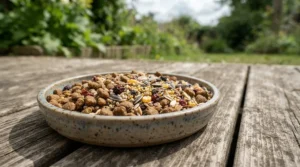
- Match pellet size to beak size. A parrotlet needs a bead or super-fine nugget, while a conure can handle a small pellet. A food that’s too large gets dropped, and one that’s too small can frustrate birds that like to manipulate food.
- Confirm the certification claim. “USDA organic” and “certified organic” should be verifiable on the bag, and the USDA labeling categories explain what each term allows.
- Check the life-stage fit. Maintenance formulas suit healthy, non-breeding adults, while High Potency-style formulas are for transitions and special needs.
- Read the guaranteed analysis. Remember that minimums aren’t averages, so the real fat or protein can run higher.
- Look for a true preservative free formula. Natural preservation (rosemary, citrus peel) beats synthetic additives, but it also shortens shelf life, so buy accordingly.
- Consider supplementation. Some whole-food formulas list no added vitamins, so ask your avian vet whether your bird needs more than the pellets.
- Plan the budget by bag size. Per-pound cost drops in bigger bags, but freshness matters more than savings for a single small bird.
✨ Ready to upgrade the food bowl?
🔍 Click any highlighted product above to check current pricing and availability, then pick the size that matches your bird’s beak. Your small parrot’s next healthy meal starts with the right pellet! 🦜
Non-GMO Ingredients: What the Label Does and Doesn’t Promise
“Non-GMO ingredients” sounds simple, but it’s really two different promises depending on the bag. In the organic system, genetic engineering is prohibited outright. Clemson’s extension summary of the USDA standards notes that organic production excludes synthetic fertilizers, sewage sludge, irradiation, and genetic engineering. So a USDA organic bird food carries non-GMO ingredients by design.
A separate “non-GMO” claim can appear on food that isn’t organic. Lafeber, for example, advertises more than 99 percent non-GMO ingredients on some of its pellets, without organic certification. That is a respectable claim, but a narrower one: it says nothing about pesticide use or fertilizers.
For buyers, the takeaway is practical. Harrison’s Adult Lifetime Fine and Harrison’s Adult Lifetime Super Fine list both certified organic and non-GMO verified language. TOP’s Organic Small Pellets and TOP’s Organic Mini Pellets state USDA organic with non-GMO ingredients. If a bag says only “natural,” treat it as marketing until you see a certification.
One more reality check: “non-GMO ingredients” describes the inputs, not the balance. A bag can be perfectly clean and still be incomplete for your species, which is why the vet conversation never goes away.
USDA Organic Pellets for Conures: Choosing the Right Size and Formula
Conures sit at the upper edge of “small parrot,” and that changes the shopping list. Their beaks handle larger pieces, they’re active, and they’re prone to the weight gain that comes with high-fat seed diets. According to the MSD Veterinary Manual, obesity is common in companion birds, and weekly weigh-ins are recommended.
For USDA organic pellets for conures, two products stand out. TOP’s Organic Small Pellets are explicitly marketed for conures and quakers, and the 5/32-inch size suits bowl-feeders. Harrison’s Adult Lifetime Fine is the nugget alternative, with owners crediting it for energy and weight management in green-cheeks and other conures.
Here’s the nuance. A green-cheek and a sun conure don’t eat identically, so start with one size and watch what ends up on the cage floor. If most of it is being dropped, the pellet may be too big, or the bird may simply need more time.
Whichever you pick, treat pellets as the foundation and fresh vegetables as the supporting cast. For conures especially, USDA organic pellets for conures work best when they replace the fatty seed mix rather than sit beside it.
Certified Organic Pellets for Parrotlets: Solving the Tiny-Beak Problem
Parrotlets are tiny, stubborn, and surprisingly opinionated about food. Shopping for certified organic pellets for parrotlets is mostly a size problem, and the reviews prove it. One parrotlet owner flagged Harrison’s High Potency Fine with a blunt warning that it wasn’t suited to their bird.
The solution is to go one size down. Harrison’s Adult Lifetime Super Fine and Harrison’s High Potency Super Fine are the smallest organic nuggets in the Harrison’s range, and TOP’s Organic Mini Pellets offers a 3/32-inch bead. Both options are plausible foundations for certified organic pellets for parrotlets, depending on whether you want a nugget or a bead.
Introduce them alongside the old food, not instead of it. Parrotlets are known to refuse unfamiliar textures, so a mixed bowl for the first couple of weeks helps. The goal isn’t to win in a day. It’s to have the new food recognized as “food.”
Finally, watch the weight. With a bird this small, a few grams matter, so a kitchen scale designed for small items pays for itself during any diet change. Certified organic pellets for parrotlets only work if the bird actually eats them.
Preservative Free Formula: Keeping Organic Pellets Fresh Without Chemicals
A preservative free formula is a selling point and a responsibility. Remove BHA, BHT, and ethoxyquin and you’ve removed a shelf-life shortcut, so storage becomes your job.
TOP’s Organic Small Pellets and TOP’s Organic Mini Pellets rely on rosemary, rose hips, lemon, and orange peel for natural preservation. One retailer advises that they shouldn’t be refrigerated but can be frozen, with opened bags used within about six months. Harrison’s Adult Lifetime Fine guidance recommends keeping the food in its original packaging and notes that refrigeration or freezing after opening may help maintain freshness.
Put that together and the routine writes itself:
- Buy the smallest bag that matches how fast your bird eats.
- Divide an opened bag into smaller portions and freeze what you won’t use soon.
- Keep it sealed and dry, away from heat and sunlight.
- Replace uneaten food daily, since Harrison’s recommends it.
A preservative free formula also changes how you buy in bulk. A 25-lb bag looks thrifty until the last third goes stale for a single budgie. For one or two small birds, smaller bags beat a bulk discount nearly every time.
Whole Food Nutrition: What’s Actually Inside the Nugget
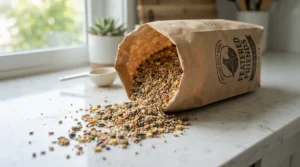
“Whole food nutrition” is more than a slogan on this shortlist. Harrison’s says its nuggets use whole, intact organic grains and legumes rather than refined flours, meals, or by-products. TOP’s ingredient lists name alfalfa, millet, barley, rice, sunflower, sesame, quinoa, pumpkin, buckwheat, dandelion leaf, carrot, spinach, dulse, and kelp. You can read the food like a recipe, which is rare in the pellet world.
But whole food nutrition isn’t automatically complete nutrition. The MSD Veterinary Manual notes that pelleted diets differ in content and quality and must be evaluated individually, and it points to carotenoids and vitamin A precursors as key features of a quality psittacine pellet. That’s the right lens for every product here.
In practice, it’s why TOP’s Organic Mini Pellets deserve a vet question about supplementation, while Harrison’s Organic Premium Pellets and the Harrison’s nuggets are framed as complete maintenance diets. Neither approach is wrong. They simply carry different assumptions.
So read whole food nutrition as a signal of ingredient quality, then confirm completeness with a professional. The ingredient list tells you what’s in the bag, and your vet tells you whether it’s enough.
Organic Pellets vs Seed Mixes vs Conventional Pellets
| Feature | Organic Pellets | Seed Mixes | Conventional Pellets |
|---|---|---|---|
| Nutrient balance | Consistent in every bite | Birds choose favorites | Consistent in every bite |
| Ingredient sourcing | Certified organic, non-GMO | Varies widely | Often non-GMO claims, rarely organic |
| Fat load | Moderate | High | Moderate |
| Typical cost | Premium | Lowest | Mid-range |
| Best for | Foundation diet | Occasional foraging | Budget-conscious maintenance |
The table’s message is simple: pellets win on consistency. The MSD Veterinary Manual states that strictly seed diets are suboptimal for psittacines, and it warns that all-seed diets, and even half-seed, half-pellet mixes that aren’t portion-controlled, run short on vitamin A. Birds simply pick out the tastier seeds and ignore the more nutritious pellets.
Conventional pellets such as ZuPreem True Harvest advertise no artificial colors, flavors, or preservatives, and Lafeber’s lines claim more than 99 percent non-GMO ingredients. They’re legitimate budget alternatives. What organic adds is certification, which matters most to owners who want pesticide-free inputs.
If cost is the barrier, TOP’s Organic Small Pellets narrows the gap, while TOP’s Marlene McCohen’s Signature Blend is more of a treat than a replacement for any of the pure pellets above.
How to Switch Your Small Parrot to Organic Pellets: A 4-Week Plan
Birds can be stubborn, and an abrupt change can lead to a bird that eats too little. The MSD Veterinary Manual recommends gradually switching seed-based diets to a complete formulated diet. Harrison’s also advises consulting an avian vet before converting. Here is a common framework to adapt with your vet:
Week 1: Introduce. Offer the new pellets in a separate dish beside the usual food, and sprinkle a few over a favorite fresh vegetable. Harrison’s suggests planned daily meals rather than “topping off,” which helps hunger do its job.
Week 2: Blend. Mix roughly a quarter new pellets into the old food. Watch the floor of the cage to see what’s being tossed.
Week 3: Shift. Move to about half and half. Weigh your bird every few days.
Week 4: Settle. Make pellets the main offering with fresh foods on the side.
Troubleshooting is simple. If a bird ignores one size, try the next one down. If it eats only the dust, the pieces may be too big. And if weight drops, slow down and call your vet. Never withhold food to force a switch.
Real-World Scenarios: Matching Organic Pellets to Your Flock
Scenario 1: One budgie, small apartment, tight budget. A single budgie eats little, so freshness beats bulk savings. Harrison’s Adult Lifetime Super Fine in a 1-lb bag, or TOP’s Organic Mini Pellets, keeps the size right. Start with Harrison’s High Potency Super Fine if the bird has only eaten seed.
Scenario 2: Two green-cheek conures, daily feeding, moderate budget. Here, USDA organic pellets for conures make sense in larger bags. TOP’s Organic Small Pellets keeps the per-pound cost low, while Harrison’s Adult Lifetime Fine is the alternative if you’d rather have a nugget. Inspect each TOP’s bag on arrival.
Scenario 3: A parrotlet pair, picky eaters, indoor home. The sizing issue dominates. Certified organic pellets for parrotlets means super fine or mini, nothing larger. A mixed bowl of Harrison’s Adult Lifetime Super Fine and TOP’s Organic Mini Pellets also tests which texture they prefer without a wasted full bag.
Scenario 4: A choosy cockatiel that rejects everything. TOP’s Marlene McCohen’s Signature Blend is worth a small trial as an enrichment mix, with Harrison’s Organic Premium Pellets as the maintenance backup once the bird accepts pellets at all.
Long-Term Cost & Maintenance: What Organic Pellets Really Cost
| Product | Bag Sizes Seen | Price Tier (check current price) | Cost Logic |
|---|---|---|---|
| Harrison’s Adult Lifetime Super Fine | 1 lb and larger | Mid-teens per pound | Pay for size accuracy |
| Harrison’s Adult Lifetime Fine | 1 lb, 5 lb | $11-$23 per pound | 5-lb bag cuts cost sharply |
| Harrison’s Organic Premium Pellets | 1 lb, 5 lb | Under $15 per pound | Cheapest Harrison’s route |
| TOP’s Organic Small Pellets | 4 lb, 10 lb, 25 lb | Roughly $6-$8 per pound | Best bulk value if fresh |
| TOP’s Marlene McCohen’s Signature Blend | 2.5 lb | Premium | Treat-level spending |
The cost story isn’t just price per pound, it’s waste per pound. A cheaper bag that your bird rejects, or that goes stale before you finish it, is the most expensive option you can buy. For one small bird, the 1-lb or 4-lb tier usually wins.
Remember that guaranteed analysis lists minimums. The MSD Veterinary Manual says psittacine diets should contain roughly 5 to 12 percent fat depending on species and condition, so a food listing 4.6 or 5 percent minimum fat can’t be judged on that number alone. Ask your vet.
Maintenance is light: buy sized-to-need bags, freeze extras, weigh your bird regularly, and replace uneaten food daily.
Frequently Asked Questions
❓ Which organic pellets for small parrots work best for picky eaters?
❓ Can I mix organic pellets with seeds in the same bowl?
❓ Do organic pellets need to be refrigerated after opening?
❓ Is USDA organic the same as non-GMO for bird food?
❓ Are organic pellets for small parrots worth the higher price?
Conclusion
Picking organic pellets for small parrots comes down to matching three things: bead size, life stage, and your tolerance for risk. For the smallest beaks, Harrison’s Adult Lifetime Super Fine and TOP’s Organic Mini Pellets are the cleanest fits, with Harrison’s High Potency Super Fine as the conversion tool. For conure-sized birds, Harrison’s Adult Lifetime Fine and TOP’s Organic Small Pellets carry the load, and Harrison’s Organic Premium Pellets is the budget-conscious maintenance option. TOP’s Marlene McCohen’s Signature Blend is a trial-size enrichment buy for choosy eaters.
Remember what each claim really covers. Non-GMO ingredients describe the inputs, a preservative free formula puts storage in your hands, and whole food nutrition tells you about ingredient quality, not completeness. Pair any of these with a vet conversation, a gradual switch, and regular weigh-ins.
The best organic pellet is the one your bird actually eats, so start small, watch the cage floor, and adjust.
Recommended for You
- Grain-Free Pellets For Parakeets: 7 Honest Picks For 2026
- Pellets For Cockatiels With Sensitive Stomachs: 7 Best Picks 2026
- Pellets For Older Parrots With Kidney Issues: 7 Smart Picks (2026)
Disclaimer: This article contains affiliate links. As an Amazon Associate, I earn from qualifying purchases. If you purchase products through these links, we may earn a small commission at no additional cost to you.
✨ Found this helpful? Share it with your friends! 💬🤗
