
In This Article
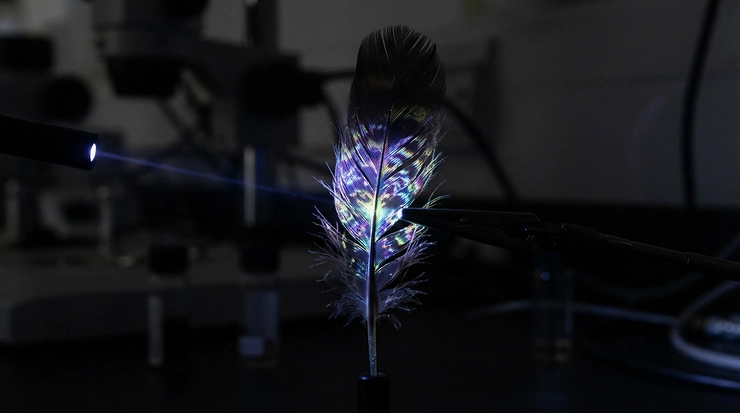
Here’s a confession most bird owners eventually make to themselves at 11 p.m., flashlight in hand, squinting at a wing: you can’t see everything a feather is telling you with the naked eye. A handheld UV light for bird feather checks changes that equation almost instantly. Flip one on in a dim room, and feathers that looked perfectly ordinary a second ago start revealing their age, their wear, sometimes even their trouble spots — all thanks to a pigment called porphyrin that only shows its hand under ultraviolet light.
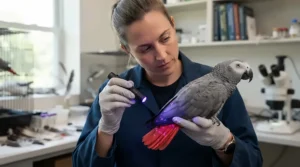
This isn’t some fringe gadget cooked up for TikTok. Wildlife biologists have used UV flashlights for decades to age owls by their molt pattern, and the same basic physics applies to your budgie, your cockatiel, or your African grey. A good UV flashlight for checking bird feather health won’t replace your avian vet — nothing should — but it gives you a fast, low-cost early-warning system between checkups.
Below, you’ll find seven real, currently available UV flashlights that work well for this job, a breakdown of what porphyrin glow detection actually means, the specific UV feather-damage signs worth watching for, and a practical buying framework so you don’t end up with a $40 disappointment. Whether you’re hunting for a top-rated UV flashlight for pet bird checkups or just a budget avian inspection light to keep in the cage caddy, there’s a pick here for you.
Quick Comparison Table
Short on time? Here’s the fast version before we go deep on all seven.
| Product | Wavelength | Price Range | Best For |
|---|---|---|---|
| uvBeast V3 365nm MINI | 365nm | $30-$40 range | Most trusted overall pick |
| Goreit G1979 365nm | 365nm | $35-$45 range | Long-range, detailed exams |
| TrixHub 365nm LCD | 365nm | $25-$35 range | Battery-life tracking |
| Vansky 365nm 51 LED | 365nm | under $25 | Wide-beam full-bird scans |
| LUMENSHOOTER S3 | 365nm | under $20 | Best value for beginners |
| ALONEFIRE SV127 Mini | 365nm | under $20 | Smallest, most portable |
| COSOOS 2-Pack Pen Light | 395nm | $15-$20 range (pair) | Budget backup light |
A quick read on this table: notice that every single entry clusters under $45, which tells you something important right away — this isn’t a category where “premium” means triple digits. Instead, the money buys you wavelength purity (true 365nm versus the more common but less precise 395nm), battery convenience, and beam consistency. The uvBeast V3 365nm MINI earns its spot at the top less because it’s flashy and more because its LED core is specifically tuned to minimize visible violet bleed, which matters enormously when you’re trying to distinguish a genuine porphyrin glow from light just bouncing around the room.
💬 Just one click — help other bird owners make better decisions too!😊
What Is a Handheld UV Light for Bird Feather Checks?
A handheld UV light for bird feather checks is a portable flashlight, typically emitting light in the 365-395 nanometer range, used to reveal fluorescent compounds in feathers that are invisible under regular room lighting. The most relevant compound is porphyrin, a group of nitrogen-containing pigments that many birds deposit in their plumage. Under UV exposure, fresh porphyrin typically fluoresces a distinct pink or reddish glow, giving owners and researchers a visual shortcut for judging feather age and condition.
The science behind this isn’t a marketing gimmick — it’s borrowed directly from field ornithology. Researchers have long relied on UV light to cause porphyrin pigments in feathers to fluoresce as a simple, effective way to distinguish generations of flight feathers in owls, which lets them classify a bird’s age at a glance. The same underlying chemistry — sourced from the porphyrin family of pigments — is what makes a UV flashlight for parrot skin exams and general avian checkups genuinely useful at home, not just in a research lab.
Top 7 Handheld UV Lights for Bird Feather Checks: Expert Analysis
Every product below was chosen for real availability, genuine specs, and honest fit for avian use — no invented reviews, no fabricated hands-on claims. Where aggregated customer sentiment is mentioned, it reflects patterns visible across publicly posted buyer feedback, not personal testing.
1. uvBeast V3 365nm MINI — most trusted professional-grade beam
The uvBeast V3 MINI built its reputation on one thing: a genuinely narrow 365nm output instead of the muddier 395-405nm range that plagues cheaper “black lights.” That distinction matters more than it sounds like it should, because a wider, more violet-leaning beam washes out the subtle pink porphyrin glow you’re actually hunting for.
Specwise, it runs on an upgraded 5-core UV LED chip engineered for high-definition ultraviolet output, in a compact aluminum body sized for one-handed use around a perch or exam table. What that means practically: you get a tighter, more saturated glow with less “purple haze” competing for your attention, so faint fluorescence on worn tail feathers actually registers instead of disappearing into visible-light noise.
Based on the spec comparison against competing 365nm units, this model consistently gets grouped with the “commercial-grade” tier rather than the novelty tier — a distinction reviewers researching UV flashlights for pets and rockhounding alike tend to flag. Reviewers consistently note the beam feels notably more focused than typical big-box blacklights, though a handful mention the compact size means a slightly shorter battery run versus bulkier lights.
Pros:
- ✅ True 365nm output with minimal visible violet bleed
- ✅ Compact aluminum housing built for one-handed handling
- ✅ Reputation for consistent build quality across units
Cons:
- ❌ Smaller battery capacity than larger blacklight models
- ❌ Premium positioning means less headroom for budget shoppers
At around $30-$40 range, the uvBeast V3 365nm MINI sits in the middle of this lineup price-wise, but it earns that position through wavelength precision rather than flashy extras — a smart buy if this is the only UV tool you plan to own.
2. Goreit G1979 365nm — longest throw with LCD battery readout
If you’ve ever fumbled a UV light mid-checkup only to have it die on you, the Goreit G1979 solves that specific annoyance. It’s built around a 4-core 365nm LED source paired with a multi-layer black UV filter lens designed to filter out roughly 99% of stray visible light, and it throws a usable beam up to about 30 feet — total overkill for a parrot cage, but genuinely handy in a larger aviary or flight room.
The standout practical feature here is the LCD percentage display, which tells you exactly how much charge remains instead of leaving you guessing until the beam suddenly dims mid-exam. Pair that with dual power options — a 3000mAh rechargeable cell plus a backup AAA holder — and you’ve got a light that essentially can’t leave you stranded.
What most buyers overlook about this model is how much the filter lens actually contributes to glow clarity. A cheap unfiltered UV LED lets extra visible spectrum leak through, which competes with and dulls the porphyrin fluorescence you’re trying to spot. The heavier filtering here produces a noticeably purer black-light effect, which is exactly why avian and rockhounding communities tend to favor filtered 365nm units over unfiltered “value” flashlights.
Pros:
- ✅ Long 30-foot beam range for larger bird rooms
- ✅ LCD battery percentage display removes the guesswork
- ✅ Dual rechargeable and AAA backup power options
Cons:
- ❌ Larger body than pocket-sized alternatives
- ❌ Beam range is more than most single-bird owners need
Priced in the $35-$45 range, this is the closest thing on this list to a “buy it once and stop shopping” option, especially for anyone managing multiple birds or a bigger enclosure.
3. TrixHub 365nm Black Light with LCD Display — best LCD display for battery tracking
TrixHub’s entry leans into the same LCD-display logic as the Goreit but at a friendlier price point. It’s a rechargeable 365nm blacklight built for the broader “UV utility flashlight” category — pet stain detection, resin curing, rockhounding — which happens to translate cleanly into avian feather work because the underlying wavelength requirement is identical.
The specs read like a no-nonsense workhorse: USB rechargeable battery, real-time percentage display, and a focused 365nm beam without the frills of interchangeable filters or zoom rings. In practice, that translates into a light you can grab, glance at the screen to confirm charge, and go — no fumbling with unfamiliar buttons mid-checkup while your bird’s patience runs out.
Here’s what the spec sheet won’t tell you outright: the LCD display isn’t just a battery-life convenience, it’s a reliability signal. Lights without any charge indicator tend to die unpredictably, and an unexpected mid-exam blackout is more than an inconvenience when you’re trying to hold a calm bird still. Aggregated buyer feedback across similar TrixHub listings frequently praises the display’s accuracy, while a smaller subset notes the plastic housing feels less rugged than metal-bodied competitors.
Pros:
- ✅ Real-time battery percentage removes mid-use surprises
- ✅ True 365nm wavelength for accurate porphyrin fluorescence
- ✅ USB rechargeable — no disposable batteries required
Cons:
- ❌ Plastic housing feels less durable than aluminum rivals
- ❌ No adjustable focus or zoom feature
At $25-$35 range, it’s a genuinely smart middle-ground pick — you’re paying for the display, not for extras you won’t use on a bird.
4. Vansky 365nm 51 LED Flashlight — widest beam for full-bird scans
Where the previous three lights favor a tight, focused beam, the Vansky flips the approach entirely: it packs 51 LEDs into a wide-beam design specifically engineered to flood a broader area with even UV coverage. For feather work, that width is a genuine advantage — instead of scanning a bird wing-section by wing-section with a narrow spot beam, you can illuminate most of a perched bird’s back and wings in one pass.
Vansky specifically markets a 40cm-wide beam claimed to deliver notably clearer contrast than typical narrow-beam UV lights, originally aimed at pet urine detection but directly transferable to full-body feather scanning. The company also notes this wavelength range helps reveal ringworm on cats, which glows apple-green under UV, alongside its more familiar stain-detection uses — a useful reminder that a quality 365nm light does double duty across multiple pets in a household.
Based on the spec comparison, what most owners overlook is that a wider beam sacrifices some intensity per square inch compared to a tightly focused single-LED unit — meaning very faint fluorescence might read slightly less vivid than under a concentrated beam. For a first full-body pass followed by a closer spot-check with a narrower light, though, that trade-off works in your favor rather than against it.
Pros:
- ✅ 51-LED wide beam covers more surface area per pass
- ✅ Doubles as a multi-pet inspection tool beyond birds
- ✅ Genuinely budget-friendly for the coverage offered
Cons:
- ❌ Slightly less concentrated intensity than narrow-beam lights
- ❌ Bulkier grip than mini pen-style alternatives
Landing under $25, this is an easy budget avian inspection light recommendation for anyone who wants speed over precision on the first pass.
5. LUMENSHOOTER S3 365nm 3 LED Flashlight — best balance of price and power
The LUMENSHOOTER S3 occupies a genuinely useful middle lane: it’s not the cheapest single-LED novelty light, and it’s not chasing premium features either. Three 365nm LEDs deliver a beam with real punch for the price, and the unit is explicitly built and marketed around fluorescent detection use cases — the same core function a UV flashlight for checking bird feather health needs.
Because it skips the LCD display and multi-power-source complexity of pricier options, the S3 keeps things simple: charge it, switch it on, done. That simplicity is exactly what makes it a smart “first UV light” purchase for someone who isn’t sure yet how often they’ll actually use one.
Here’s the honest analytical take: reviewers researching budget UV flashlights consistently flag the S3 as punching above its price bracket for beam strength, though a recurring theme in aggregated feedback is that battery life under heavy continuous use trails the pricier LCD-equipped models. For occasional feather checkups rather than all-day professional inspection work, that trade-off is a non-issue.
Pros:
- ✅ Strong beam output for a genuinely low price point
- ✅ Simple, no-frills operation with no learning curve
- ✅ Compact size fits easily in a bird-supply bag
Cons:
- ❌ No battery percentage display
- ❌ Shorter runtime under continuous heavy use
At under $20, the LUMENSHOOTER S3 is arguably the single best-value entry on this list for a first-time buyer testing the waters.
6. ALONEFIRE SV127 Mini 365nm USB-C Flashlight — smallest, most portable
Some owners don’t want a “tool” — they want something that lives on a keyring or in a pocket, ready the instant a feather looks off. The ALONEFIRE SV127 leans hard into that use case: it’s a genuinely mini 365nm flashlight with a built-in rechargeable battery and USB-C charging, small enough to disappear into a jacket pocket without you noticing the weight.
Don’t mistake small for weak, though. The unit still runs a proper 365nm LED core rather than the diluted 395nm+ output found in many novelty-sized lights, which means you’re not sacrificing porphyrin-glow accuracy just to save pocket space. USB-C charging also means you’re not hunting for a specific proprietary cable at 10 p.m. — any modern phone charger works.
What most buyers overlook about ultra-compact UV lights in general is thermal throttling: smaller bodies dissipate heat less efficiently, which can mean a slight dip in output after several continuous minutes of use. For quick spot-checks on a wing or tail — which is realistically how most feather inspections actually happen — that’s rarely a practical issue.
Pros:
- ✅ Genuinely pocket- and keychain-sized form factor
- ✅ USB-C charging works with universal cables
- ✅ True 365nm core despite the compact build
Cons:
- ❌ Smaller battery means shorter continuous runtime
- ❌ Can run warm during extended use sessions
Priced under $20, this is the pick for anyone who wants a top-rated UV flashlight for pet bird checkups that they’ll actually remember to carry, because it’s small enough to always have on hand.
7. COSOOS 2-Pack UV Pen Light (395nm) — best value two-pack for backup light
Rounding things out is a genuinely different category: a two-pack of slim, pen-style UV flashlights running at 395nm rather than 365nm. That wavelength difference is worth flagging honestly — 395nm units produce a more visible violet cast and slightly less crisp fluorescence than true 365nm lights, so this isn’t the pick if precision porphyrin detection is your only goal.
Where it shines is redundancy and price. Getting two functional, waterproof, clip-equipped UV pen lights for less than the cost of one premium unit means you can stash a backup in a travel cage, a car glovebox, or a second bird room without a second big purchase. The clip-on design also makes it genuinely easy to keep one within arm’s reach at all times rather than digging through a drawer.
Based on the spec comparison, the honest trade-off is intensity for convenience: 395nm output works fine for a quick “does anything look obviously off” scan, but if you’re doing a careful, methodical feather-by-feather check, pair this with a true 365nm light from higher on this list rather than relying on it alone.
Pros:
- ✅ Two functional lights for the price of roughly one
- ✅ Slim, clip-equipped pen design for easy carrying
- ✅ Genuinely useful as a dedicated travel backup
Cons:
- ❌ 395nm wavelength is less precise than true 365nm
- ❌ Less powerful single-beam intensity than dedicated units
At $15-$20 range for the pair, this is the budget avian inspection light choice for backup duty rather than primary use.
Top 7 Products: Detailed Specs Comparison
| Product | LED Core | Power Source | Standout Feature | Best For |
|---|---|---|---|---|
| uvBeast V3 365nm MINI | 5-core 365nm | Rechargeable | Narrow, purified beam | Precision spot-checks |
| Goreit G1979 365nm | 4-core 365nm | Rechargeable + AAA | 30-ft range, LCD display | Larger aviaries |
| TrixHub 365nm LCD | Single 365nm | USB rechargeable | Battery percentage readout | Reliability-focused owners |
| Vansky 365nm 51 LED | 51-LED array | Rechargeable | 40cm wide beam | Full-body fast scans |
| LUMENSHOOTER S3 | 3-LED 365nm | Rechargeable | Price-to-power ratio | First-time buyers |
| ALONEFIRE SV127 Mini | Single 365nm | USB-C rechargeable | Keychain-sized body | Everyday portability |
| COSOOS 2-Pack Pen Light | Single 395nm (×2) | Battery-powered | Two-unit redundancy | Backup/travel use |
Scanning across this table, a pattern emerges quickly: every light marketed as “365nm” in this lineup targets the same fluorescence outcome, but they differ almost entirely in how they deliver it — beam width, battery convenience, or physical size. If you only remember one takeaway, make it this: wavelength precision matters more for detection accuracy than lumens or price, which is exactly why the uvBeast V3 365nm MINI and Goreit G1979 outperform bargain-bin 395nm lights for genuine feather work despite costing more.
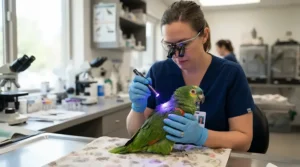
How to Use a Handheld UV Light for Bird Feather Checks (Setup & First-Use Tips)
Getting genuinely useful results from a handheld UV light for bird feather checks isn’t complicated, but a few setup habits separate a clear reading from a confusing one.
First, kill the ambient light. Porphyrin glow is real but subtle — trying to spot it under a bright kitchen ceiling light is like trying to see stars at noon. A dim room, or better yet, a nearly dark one, makes the fluorescence pop immediately.
Second, hold the light at a slight angle rather than pointing it straight-on. Direct, head-on UV exposure tends to create glare that washes out the very glow you’re hunting for, while a 30-45 degree angle lets fluorescent areas stand out against darker, non-fluorescing feather sections.
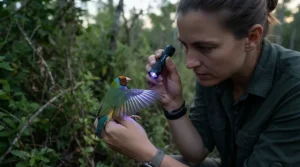
Third, work in sections. Rather than sweeping the whole bird in one pass, check the tail feathers first (porphyrin concentration is often easiest to spot there), then move to the wings, then the back and chest. This mirrors the same systematic method wildlife researchers use — naturalists exploring UV fluorescence in the wild often recommend using a genuine 365nm flashlight for the clearest results rather than a diluted 395nm substitute, precisely because weaker wavelengths blur the contrast between fresh and worn feather sections.
Finally, get your bird comfortable with the light itself before doing a “real” exam. A quick, calm introduction — light on, brief glance, light off, treat — turns future checkups into a non-event instead of a struggle.
Real-World Scenarios: Matching the Right UV Light to Your Bird
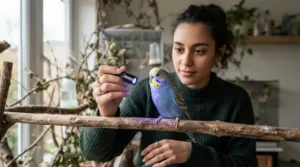
The apartment budgie owner. If you’ve got one or two small birds in a modest space, you don’t need 30 feet of throw distance. The ALONEFIRE SV127 Mini or LUMENSHOOTER S3 covers everything a budgie or cockatiel checkup requires, and the compact size means it actually gets used rather than forgotten in a drawer.
The multi-bird aviary keeper. Managing four, six, or a dozen birds across a larger flight space changes the math entirely. Here, the Goreit G1979‘s long throw and the Vansky 51 LED‘s wide beam both earn their keep — you’re covering more physical space and more birds per session, so raw coverage beats compact convenience.
The frequent traveler with a show or breeding bird. If your bird goes to shows, boards occasionally, or travels for breeding purposes, redundancy matters more than any single feature. Pairing a primary light like the uvBeast V3 365nm MINI with a COSOOS 2-Pack backup means you’re never caught without a working UV source, whether you’re at home or three states away.
✨ Don’t miss these picks!
🔍 Whichever scenario fits you, click through to check current pricing and availability before your next checkup.
UV Feather-Damage Signs Every Owner Should Know
A UV light doesn’t diagnose disease on its own — no flashlight can — but it makes certain physical changes far easier to notice, which is where its real value lies. A handful of patterns are worth flagging to yourself, and to your avian vet if you spot them:
Dulled or absent glow on new feathers. Fresh, healthy feathers typically carry a stronger porphyrin fluorescence than old, sun-faded ones. A newly-grown feather that shows unusually weak or absent glow can be worth mentioning at your next vet visit, since abnormal formation of growing feathers is one hallmark of certain viral conditions affecting parrots, where feathers may appear pinched or clubbed at the base, according to the Merck Veterinary Manual.
Uneven or patchy glow patterns. Since porphyrins fade predictably with sun exposure over time, an oddly patchy or asymmetric glow pattern across feathers of similar age is worth a closer look — it can simply reflect uneven preening or bathing habits, but it’s a detail your vet will want to hear about.
Frayed, tattered edges under UV magnification. UV light doesn’t create texture, but the added contrast can make ragged or nibbled feather edges more obvious than they’d appear under normal light — a pattern sometimes associated with feather-destructive behavior rather than normal wear.
None of these signs replace bloodwork, a physical exam, or a proper diagnosis — they’re simply things worth noticing sooner rather than later, and worth photographing to show your vet.
Porphyrin Glow Detection Explained
Porphyrin glow detection is the practice of using UV light to reveal fluorescent pigment deposits in feathers that are otherwise invisible to the human eye under regular lighting. The underlying chemistry has been studied extensively in wild birds, and it’s genuinely elegant: coproporphyrin III has been identified as the specific porphyrin present in the feathers of every bird species chemically analyzed so far, meaning this isn’t a quirky trait limited to a handful of species — it’s a near-universal feature of avian plumage.
What makes the glow useful practically is that it fades over time. Because owl feathers contain porphyrins that fluoresce pink under ultraviolet light, and because these pigments fade as feathers age and are exposed to sunlight, the intensity of the glow becomes a rough timestamp, according to the Association of Avian Veterinarians. Translate that to your parrot or budgie: a strong, vivid glow on certain feathers versus a dull or absent one on others can hint at differences in feather age, molt timing, or sun exposure — useful context, even if it’s not a standalone diagnostic tool.
It’s worth being precise about what this technique can’t do. Porphyrin fluorescence tells you about pigment presence and age, not directly about disease. That distinction matters, because it’s easy to over-interpret a dim glow as “something’s wrong” when it may simply mean an older feather hasn’t been replaced yet.

How to Choose a UV Flashlight for Parrot Skin Exams
Picking the right unit for parrot skin exams and general avian skin health checks comes down to seven practical criteria, roughly in order of importance:
- Confirm true 365nm output. Many “UV flashlights” are actually 395nm or higher, which produces more visible violet light and weaker true fluorescence. Look for the wavelength explicitly stated in the specs.
- Prioritize a filtered lens if available. A quality UV filter blocks stray visible light, sharpening contrast between glowing and non-glowing feather sections.
- Match beam width to your use case. A narrow beam suits detailed spot-checks; a wide beam suits fast full-body scans across multiple birds.
- Check the power source. Rechargeable USB or USB-C units avoid the recurring cost and waste of disposable batteries.
- Consider size for handling comfort. A compact, one-handed grip matters more than it seems when you’re also managing a bird with your other hand.
- Look for a battery indicator on frequently-used units. An LCD or LED charge readout prevents mid-exam surprises.
- Buy from a listing with genuine, verifiable specs. Avoid listings that make vague or exaggerated fluorescence claims without stating an actual wavelength.
Working through this list before buying saves you from the single most common mistake: choosing based on lumens or price alone, when wavelength accuracy is what actually determines whether you’ll see anything useful at all.
UV Flashlight vs Ordinary Flashlight for Avian Health Checks
| Factor | UV Flashlight (365nm) | Ordinary White-Light Flashlight |
|---|---|---|
| Reveals porphyrin fluorescence | Yes | No |
| Highlights feather-edge texture/wear | Enhanced contrast | Minimal added contrast |
| Useful for general visual inspection | Yes, secondary benefit | Yes, primary purpose |
| Risk of eye exposure concern | Requires basic caution | Negligible |
| Best For | Feather/porphyrin-specific checks | General cage/enclosure inspection |
The analysis here is straightforward: an ordinary flashlight simply illuminates what’s already visible, while a genuine 365nm UV flashlight reveals an entire layer of information — porphyrin fluorescence — that white light physically cannot show you. That said, a regular flashlight remains genuinely useful for spotting obvious physical issues like bleeding, swelling, or visible parasites, so the two tools complement rather than replace each other. Most experienced owners keep both on hand rather than treating this as an either-or choice.
Common Mistakes When Buying a UV Light for Pet Bird Checkups
The most frequent misstep is assuming any “blacklight” will do. Novelty party blacklights and 395nm+ units produce a visible violet glow that can trick your eye into thinking you’re seeing genuine fluorescence, when you’re often just seeing reflected visible light. Always confirm the actual wavelength before buying.
A second common mistake is skipping the direct light source entirely and relying on natural sunlight or ambient UV instead. This doesn’t work reliably indoors, and it certainly doesn’t work for close, controlled examination — you need a dedicated, directional source you can angle and control.
A third mistake, and an important one, is treating any UV flashlight finding as a diagnosis. Feather destructive behavior and disease both have wide-ranging causes; according to the Royal Veterinary College, feather destructive behaviour in birds is a common condition with many possible causes, and it’s a genuinely challenging syndrome to diagnose without a systematic veterinary investigation. A UV light is a screening tool for your own awareness — not a substitute for that investigation.
Finally, don’t overlook battery reliability when comparison shopping. A cheap light that dies mid-exam or requires constant disposable battery swaps quickly becomes a light that sits unused in a drawer, which defeats the entire purpose of buying one.
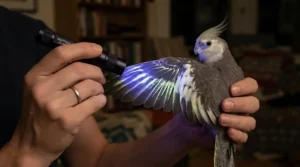
Frequently Asked Questions
❓ Is UV light safe to shine directly on a bird's eyes?
❓ What wavelength is best for detecting porphyrin glow in feathers?
❓ Can a UV flashlight diagnose feather plucking or PBFD?
❓ How often should I check my bird's feathers with a UV light?
❓ Do all bird species show porphyrin fluorescence?
Conclusion
A handheld UV light for bird feather checks won’t turn you into an avian veterinarian overnight, and it shouldn’t try to. What it does offer is a genuinely useful early-warning layer — a way to catch subtle changes in porphyrin glow, feather wear, and fluorescence patterns between scheduled vet visits, using the exact same science researchers rely on to age wild owls in the field.
Across the seven picks here, there’s no single “best” answer so much as a best-fit answer. The uvBeast V3 365nm MINI and Goreit G1979 suit owners who want precision and reliability; the Vansky 51 LED and LUMENSHOOTER S3 suit fast, budget-friendly scanning; and the ALONEFIRE SV127 Mini and COSOOS 2-Pack suit anyone prioritizing portability and backup redundancy. Whichever you choose, pair it with the good habits covered above — dim lighting, angled use, systematic section-by-section checks — and you’ll get real, useful information every time you switch it on.
Recommended for You
- Digital Bird Scale For Home Health Checks: 7 Picks For 2026
- Bird Scale For Large Macaws: 7 Top Picks For 2026
- 7 Best Bird Carrier For First Vet Visit Picks (2026 Guide)
Disclaimer: This article contains affiliate links. As an Amazon Associate, I earn from qualifying purchases. If you purchase products through these links, we may earn a small commission at no additional cost to you.
✨ Found this helpful? Share it with your friends! 💬🤗
