
In This Article
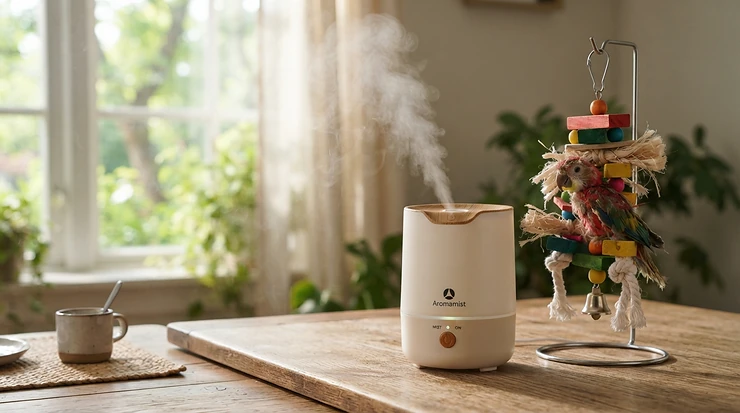
A small humidifier for bird cage room use is a compact, low-noise, cool-mist appliance that raises the ambient humidity in the room where a pet bird lives. It is not aimed at the cage itself. The goal is a steady 40-60% relative humidity, which protects a bird’s nasal passages, skin, and feathers from dry indoor air. 🦜
Here’s the thing about parrots. They evolved in tropical and subtropical air, and then we brought them into centrally heated living rooms that can feel like a desert in January. Heating season can drag indoor humidity into the 20s. Dry air can leave a bird with flaky skin, itchy nostrils, and an irritated respiratory tract. Wildlife-care guidance from Best Friends Animal Society notes that parrots’ respiratory systems, skin, and feathers are built for wet climates. It also describes a humidifier set around 55% as a sensible compromise before mold becomes a problem.
That’s why a small humidifier for bird cage room setups is one of the most practical upgrades you can make. Small keeps it quiet, easy to place, and easy to clean. The catch is that the wrong humidifier can do more harm than good, through bacteria in the tank, mineral dust, or scented mist. This guide covers seven real products, the safety traps, and the setup details that Amazon listings skip.
⚠️ This article is educational, not veterinary advice. If your bird is breathing with an open beak, bobbing its tail with each breath, or sounds wet or wheezy, call an avian vet promptly.
Quick Comparison Table: 7 Picks at a Glance
| Product | Type | Key Spec | Price Range (approx.) | Best For |
|---|---|---|---|---|
| LEVOIT Top Fill 2.5L | Ultrasonic cool mist | 2.5L tank, ~28 dB, up to 25 hrs | ~$30-$45 | Budget single-room use |
| Honeywell HUL520B MistMate | Ultrasonic cool mist | Compact, variable mist dial | ~$30-$50 | Light sleepers, tiny rooms |
| Honeywell HEV320B | Evaporative (wick) | 0.8 gal, antimicrobial filter | ~$50-$90 | Owners avoiding mineral dust |
| Dreo 3L Smart | Ultrasonic + humidity sensor | 3L, ~26 dB, ~30 hrs | ~$40-$65 | Hands-off humidity control |
| Vornado Lucerna 3 Alchema | Filterless ultrasonic | Vortex mist circulation | ~$70-$110 | Even coverage, no filters |
| Oransi Mod Jr. | HEPA air purifier | No ionizer, 363 sq ft at 4.8 ACH | ~$200-$300 | Serious dander control |
| LEVOIT Core 300 | HEPA + carbon purifier | 24-54.5 dB, ~219 sq ft | ~$90-$130 | Budget bird-safe filtration |
Price ranges reflect approximate levels at the time of research and may vary. Check current price before buying.
Looking at the table, the LEVOIT Top Fill 2.5L and Dreo 3L Smart offer the most humidification per dollar, but only the Dreo 3L Smart reads humidity on its own. If you fear mineral dust, the Honeywell HEV320B trades a higher price for a different mist mechanism. The last two products aren’t humidifiers at all. I included them because dry air and airborne dander tend to show up together in bird rooms.
💬 Just one click — help others make better buying decisions too!😊
Top 7 Products: Expert Analysis
I picked these to cover budget, mid-range, and premium tiers. Two are air purifiers, since the secondary needs of a bird room (dander, dust, and fine particles) shape which humidifier makes sense. Review commentary below reflects published editorial testing and clearly labeled aggregated themes, not my own hands-on use.
1. LEVOIT Top Fill 2.5L — best budget pick for tight spaces
The standout feature is the top-fill design. You lift the lid and pour, with no upside-down tank to flip and no slosh near the cage.
Its 2.5L tank is listed at up to 25 hours of runtime and roughly 28 dB of noise. In practice, that’s a hum quieter than most refrigerators, and it won’t startle a light-sleeping cockatiel. Coverage is rated at about 219 square feet, so it suits a bedroom or a dedicated bird room, not an open-plan living area.
The analytical take: this suits owners who want the cheapest sensible entry into a small humidifier for bird cage room duty. Ultrasonic units like this one need distilled or demineralized water to avoid the fine white dust that tap water creates, and you’ll want a separate hygrometer because there’s no built-in humidity sensing. On review sentiment, I could verify strong overall ratings and repeated praise for quiet operation in quiet-humidifier roundups. I couldn’t verify individual customer comments, so treat that as general direction only.
Pros:
- ✅ Top-fill design limits spills near cages
- ✅ Quiet enough for overnight bird rooms
- ✅ Auto shut-off adds a safety net
Cons:
- ❌ No built-in humidity sensor
- ❌ Ultrasonic mist needs distilled water
Price: budget tier, roughly $30-$45 (check current price). Verdict: strong value if you buy a hygrometer too.
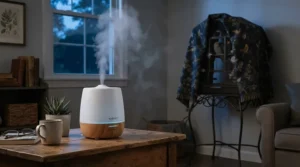
2. Honeywell HUL520B MistMate — whisper-quiet and dead simple
The standout here is a single dial. Turn it up, turn it down, done.
This compact ultrasonic model earned 4.6 out of 5 from Mattress Clarity’s testers, who named it their bedroom pick. They praised quiet operation, variable mist control, and a wide tank opening that makes cleaning easy. That last point matters more for birds than for people. A tank you can reach into with a brush is a tank that actually gets scrubbed, and bacterial film in a water reservoir is exactly what you don’t want aerosolized near a bird.
The tradeoff, flagged by the same testers, is limited capacity and frequent refills. For a small bird room, that’s manageable. You’ll top it up daily and get a natural reminder to clean it. The analytical take: it’s the best fit for a single small room with one or two birds, especially if you value a simple mist dial over app controls. Owners who like automation should look at the Dreo 3L Smart instead. No essential oil tray is a plus for bird households, since scented mist is a hazard, not a feature.
Pros:
- ✅ Wide tank opening simplifies scrubbing
- ✅ Very quiet, suited to light sleepers
- ✅ Variable mist control by dial
Cons:
- ❌ Small tank means frequent refills
- ❌ No humidity sensor or auto mode
Price: roughly $30-$50 (check current price). Verdict: great value for small rooms.
3. Honeywell HEV320B — evaporative alternative for mineral-dust worriers
The standout: it moistens air by pulling it through a wet wick, not by vibrating water into mist.
This 0.8-gallon evaporative unit is sold for small rooms and uses an antimicrobial-treated filter. Evaporative designs release moisture only as fast as the air can absorb it, so they’re less likely to overshoot into damp, mold-friendly territory. Minerals also tend to stay behind in the wick, not floating through your bird’s room as white powder. That’s a real analytical advantage where feather dust and airway sensitivity are already concerns.
The tradeoffs are ongoing wick replacement and slightly more fan noise than ultrasonic models. What most buyers overlook is that wicks still need regular attention. A crusty, damp filter left too long is a poor bet in a bird room. I couldn’t verify a meaningful pool of individual owner reviews for bird-specific use, so I’m not going to imply one. The value case rests on the mechanism, not on anecdotes.
Pros:
- ✅ Self-limiting humidity output
- ✅ Minerals stay in the wick
- ✅ Antimicrobial-treated wick filter
Cons:
- ❌ Wick filters need replacing regularly
- ❌ Slightly noisier than ultrasonic models
Price: roughly $50-$90 (check current price). Verdict: pays off if mineral dust or overshoot is your concern.
4. Dreo 3L Smart — sensor-driven humidity you don’t have to babysit
Its standout is a built-in humidity sensor. That’s the feature I’d pay extra for in a bird room.
Listed specs point to a 3L tank, about 30 hours of runtime, roughly 26 dB of noise, and coverage near 300 square feet. The sensor is the interesting part. Instead of running blindly, the unit can aim for a target humidity, which is exactly how you’d hold a 45-55% band without babysitting a dial. Combined with a separate hygrometer near the cage to verify readings, this is the closest thing to “set it and forget it” in this roundup.
The analytical take: a smart model is most useful when your home’s humidity swings, for instance forced-air heating plus a bathroom door left open. The caveat is that any sensor sits where the unit sits, so the reading at the cage may differ. Roundup editors placed it among the quieter 3L options in their testing tables. As with the others, I can confirm editorial ratings but not individual customer quotes.
Pros:
- ✅ Humidity sensor supports target-based running
- ✅ Around 26 dB, very quiet
- ✅ Roomy 3L tank lasts long
Cons:
- ❌ Sensor reads at the unit, not the cage
- ❌ Ultrasonic mist still needs distilled water
Price: roughly $40-$65 (check current price). Verdict: best all-round pick for most bird owners.
5. Vornado Lucerna 3 Alchema — filterless, with better mist circulation
The standout is vortex circulation. Instead of mist pooling near the unit, air movement spreads it across small to medium rooms.
Mattress Clarity named it their best filterless humidifier and scored it 4.3 out of 5, praising intuitive touch controls and even distribution. It also dodges recurring filter costs. Even mist distribution matters in a bird room because a puddle of humid air around the humidifier and a dry corner near the cage defeats the point. Keep the airflow pointed away from the bird itself, though. Constant drafts are a stressor for a parrot.
The flagged downsides are a higher upfront cost and a tank that doesn’t lock into the base, so spills are possible. The analytical take: this is a “buy once, maintain properly” purchase. If you’re a tidy person who’ll clean it on schedule, the filterless design saves money over years. If you’re clumsy near a caged bird, the spill risk is worth taking seriously.
Pros:
- ✅ Filterless design cuts recurring costs
- ✅ Strong circulation evens out humidity
- ✅ Intuitive touch controls
Cons:
- ❌ Higher upfront price than budget units
- ❌ Tank doesn’t lock into the base
Price: premium tier, roughly $70-$110 (check current price). Verdict: worthwhile long-term, less so for tight budgets.
6. Oransi Mod Jr. — bird-friendly HEPA filtration without gimmicks
The standout is purity of design: filter and motor, no ionizer.
Oransi’s own guidance for bird owners stresses exactly that, a large high-efficiency filter, a strong motor, and no ozone-producing tech. They list the Mod Jr. as covering 878 square feet at 2 air changes per hour or 363 square feet at 4.8. That 4.8 figure is the one that matters for dander-heavy rooms. The Mod Jr. is popular with their bird-owning customers according to the manufacturer. Treat that as company-sourced, not independent, review data.
The analytical take: this is what a top-rated air filter for bird dander allergies looks like when you refuse to compromise on safety. It costs several times more than a humidifier, but filter-only purifiers don’t add ozone risk. A common mistake is running one as an afterthought. Position it a few feet from the cage, not blasting the bird.
Pros:
- ✅ Filter-plus-motor design with no ionizer
- ✅ Covers roughly 363 sq ft at 4.8 ACH
- ✅ Suited to dander and dust removal
Cons:
- ❌ Costs far more than a humidifier
- ❌ Larger than compact competitors
Price: premium, roughly $200-$300 (check current price and Amazon availability). Verdict: worth it if dander is a household-wide problem.
7. LEVOIT Core 300 — budget True HEPA with a lower noise floor
The standout: an H13 True HEPA filter plus activated carbon in a compact tower.
Levoit lists it at 24-54.5 dB, about 143 CFM CADR, and roughly 222 square feet at 4.8 air changes per hour. Its lowest speed is genuinely bedroom-quiet, which suits a quiet air purifier for parrot bedroom use. Tom’s Guide was less enthusiastic. Their review called it noisy for its size at higher speeds and criticized weaker performance and the lack of an auto mode. A small eBay seller-listing sample of buyers praised the low speeds as quiet and the size as right for bedrooms. That’s a tiny sample, so I’d weigh Tom’s Guide more heavily.
The analytical take: run it on the low setting in a small room and it’s a fair deal. Don’t expect it to clear a large dusty living room.
Pros:
- ✅ True HEPA plus carbon prefilter stack
- ✅ Very quiet at lowest speed
- ✅ Compact for bedroom shelves
Cons:
- ❌ Louder on higher speeds
- ❌ No auto mode
Price: roughly $90-$130 (check current price). Verdict: decent starter purifier for small bird rooms.
Ideal Humidity for Parrots: What the Numbers Really Mean
The ideal humidity for parrots isn’t one number. It’s a band, and most guidance clusters in the same neighborhood. Avian Enrichment puts the optimum for home environments at 40-60%. It explains that this gives adequate moisture without encouraging mold and mildew.
Why the ceiling? Molds start growing around 60%, which is why some owners aim for about 55% at the high end. Why the floor? Below about 40%, nasal tissue dries, feathers turn brittle, and skin gets itchy. Signs to watch for, according to Avian Enrichment, include sneezing, continual scratching of nostrils, and frequent head shaking.
Temperature matters too. Warm air holds more moisture than cool air, so 50% at 72°F behaves differently than 50% at 60°F. A cold room with a humidifier cranked up is asking for condensation on windows and walls. Most parrots do well between 65-75°F, per Beak School’s winter care guidance, and drafts near windows are a bigger threat than a mildly cool room.
Practical takeaway: pick a target of about 45-55%, confirm it with a cheap hygrometer at cage height, and adjust seasonally. Species differences and any diagnosed condition may change your avian vet’s advice. If your bird has a heart or lung problem, ask before humidifying.
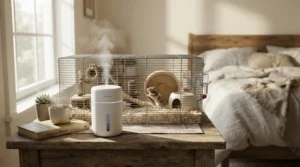
Dry-Air Respiratory Risk: What Happens Inside a Parrot’s Airways
The dry-air respiratory risk is subtle because nothing dramatic happens at first. A parrot’s respiratory system is more efficient than ours, but it’s also more exposed. Air moves through air sacs as well as lungs, so irritants travel deep.
When nasal passages dry out, the body compensates. Mucus production can rise as a defense, and that overcompensation is one reason chronically dry air is associated with upper respiratory trouble. Bird-care educators note that dry air can also leave skin flaky and itchy, which may push some birds toward over-preening or plucking. That doesn’t mean humidity causes plucking, since medical, dietary, and behavioral causes matter. It does mean dry air is an easy variable to fix.
The other half of the risk is what floats around in that dry air. Powder from cockatiels, cockatoos, and African greys, cage debris, and household dust all hang in the room longer when humidity is low. Moisture helps particles settle, which is one reason bathing and humidity are often discussed together.
Watch for these early signals: frequent sneezing, nostril scratching, head shaking, crusty nares, or a voice that sounds different. None of these is a diagnosis. If they persist, an avian vet visit beats any gadget. 🩺
How to Choose a Small Humidifier for Bird Cage Room Spaces
Featured-snippet answer first: choose a cool-mist, easy-to-clean humidifier with a tank you can scrub by hand, a noise level around 30 dB or lower, and a way to verify humidity. Then work through these steps:
- Pick cool mist only. Hot surfaces and steam introduce burn and tip-over risks around cages.
- Match capacity to room size. A 2.5-4L tank is enough for a bedroom-sized bird room. Bigger isn’t better; it just overshoots humidity faster.
- Prioritize a wide, hand-reachable tank. If you can’t scrub it, you won’t. Biofilm is the enemy.
- Check noise specs (aim under ~30 dB). Birds sleep 10-12 hours, and a droning motor can disrupt rest.
- Add a separate digital hygrometer. Built-in sensors read at the unit; you care about cage height.
- Skip scent trays and diffusers. Essential oils and fragrance oils are respiratory hazards for birds.
- Plan for water type. Ultrasonic units generally need distilled or demineralized water to limit mineral dust.
Humidifier Placement Near Birds: A Practical Setup Guide
Humidifier placement near birds is where good products go wrong. Use this routine for the first 30 days:
Distance and height. Keep the unit roughly 4-6 feet from the cage, on a stable surface at least a couple of feet off the floor. Mist should dissipate before it reaches feathers. A bird misted continuously by a nearby humidifier can get damp, chilled, and stressed.
Airflow direction. Point the nozzle across the room, not at the cage. Avoid placing it where a fan will blow mist directly at the bird.
Stability and cords. Place it on a low table or shelf where the bird can’t reach cords or tip it. Wipe up any water pooling around the base.
Hygrometer test. Put a hygrometer at cage height for three days. If readings hover in the 45-55% range, leave things alone. If they pass 60%, drop the mist setting.
Cleaning schedule. Empty and dry the tank daily. Scrub with a soft brush a couple of times a week. Rinse thoroughly, and don’t leave cleaning-product residue behind.
First-30-day mistakes. Filling with tap water, forgetting the hygrometer, and setting mist to maximum “to catch up” are the classics. Increase humidity gradually over several days.
✨ Ready to Make the Air Safer?
🔍 Take your bird room to the next level with these carefully selected products. Click on any highlighted item to check current pricing and availability. These tools will help you create the healthy, comfortable air your feathered family deserves!
Real-World Scenarios: Three Bird Households
Scenario 1: The apartment cockatiel owner. A single cockatiel lives in a 10 x 11 foot bedroom. Heating drops winter humidity below 30%. Budget is under $100 total. The Dreo 3L Smart plus a $10-$15 hygrometer handles the humidity, and the sensor keeps overshoot in check. Add a LEVOIT Core 300 on low if powder dander bothers the owner.
Scenario 2: The multi-bird household with allergies. Two African greys and a human with asthma share a dedicated room. Powder is the main problem. Start with the Oransi Mod Jr. as the anchor, then pair a Honeywell HUL520B MistMate for gentle humidity. Budget moves toward $250-$400 combined.
Scenario 3: The minimalist keeper in a dry climate. One conure, low-maintenance mindset. The Vornado Lucerna 3 Alchema avoids filters, and distilled water plus weekly deep cleaning keeps upkeep simple. The higher upfront cost pays back in fewer parts to replace.
The pattern across all three: identify your dominant problem first (dry air, dander, or both), then buy for that problem rather than for the longest feature list.
Problem → Solution Guide for Bird-Room Humidity
Problem: white dust on cage and furniture. Cause: minerals from tap water in an ultrasonic unit. Solution: switch to distilled water, or choose an evaporative model such as the Honeywell HEV320B.
Problem: window condensation or musty smell. Cause: humidity too high. Solution: lower the mist setting, verify with a hygrometer, and improve ventilation.
Problem: humidity won’t rise. Cause: undersized unit or leaky room. Solution: close doors, check the unit’s rated coverage, and consider a sensor model like the Dreo 3L Smart.
Problem: bird seems chilled or damp. Cause: mist reaching the cage. Solution: move the unit farther away and redirect the nozzle.
Problem: slimy tank film. Cause: water sitting for days. Solution: empty daily, scrub regularly, and pick a wide-mouth tank like the Honeywell HUL520B MistMate.
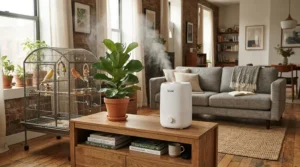
Humidifier for Cockatiel Respiratory Support and Parrot Respiratory Health
A humidifier for cockatiel respiratory support looks different from one for a Amazon parrot. Cockatiels are dust producers, which changes what “helpful” means. Their powder is a normal part of feather care, and it combines with dry air to irritate both bird and owner. A gentle 45-55% humidity band, a weekly bath or misting routine, and a HEPA purifier nearby is a sensible triad. Beak School and other avian educators highlight dander from cockatiels, cockatoos, and African greys as a common household irritant.
For a humidifier for parrot respiratory health more broadly, remember what a humidifier can and can’t do. It reduces dryness-driven irritation. It doesn’t treat infection, and it won’t fix a bird with underlying disease. If a vet has diagnosed something like pneumonia or aspergillosis, follow their instructions. Some conditions call for less moisture, not more.
The smart approach is simple: humidify the room, not the bird; keep the water clean; and use your vet as the decision-maker when symptoms appear.
Top-Rated Air Filter for Bird Dander Allergies
If dander is what sends you sneezing, a top-rated air filter for bird dander allergies should be a True HEPA unit, which captures 99.97% of particles at 0.3 microns. Oransi notes that bird powder is fine, stays suspended for a long time, and that ionic, UV-C, and ozone technologies don’t remove it. Carbon helps with odors, not particulates.
Beak School’s bird-room purifier guide recommends True HEPA, an activated carbon stage, and a pre-filter. It also warns against ionizers and “plasmawave” technology, since many produce ozone. For a bird owner, that’s the entire checklist.
In this roundup, the Oransi Mod Jr. is the stronger dander machine, while the LEVOIT Core 300 is the lighter-duty budget option. The gap shows up in coverage: 363 square feet at 4.8 ACH for the Oransi Mod Jr. versus about 222 for the LEVOIT Core 300. Match the machine to the room, not to the marketing.
Quiet Air Purifier for Parrot Bedroom: Safety and Noise
A quiet air purifier for parrot bedroom use has to clear two hurdles: noise and chemistry. On noise, run it on its lowest setting overnight. The LEVOIT Core 300 lists 24 dB at its lowest, which is close to silent. Birds need long, undisturbed sleep, and a loud fan can undermine it.
On chemistry, the EPA’s ozone generator guidance is worth reading. Ozone is a lung irritant for humans, and birds’ sensitive respiratory systems make it an even bigger concern. Ozone generators are deliberate producers, and ionizers can produce it as a byproduct. Avian-safety guides consistently steer bird owners toward filter-only units.
While you’re at it, remember other invisible hazards: non-stick cookware fumes (PTFE), scented candles, aerosol sprays, and air fresheners. A purifier can help, but source removal is safer than filtration after the fact.
Ultrasonic vs Evaporative: Which Suits a Bird Room?
| Factor | Ultrasonic Cool Mist | Evaporative (Wick) |
|---|---|---|
| Noise | Typically quietest | Fan noise, a bit louder |
| Mineral dust | Yes, with tap water | Minimal |
| Overshoot risk | Higher | Lower (self-limiting) |
| Upkeep | Tank cleaning | Tank + wick replacement |
| Best For | LEVOIT Top Fill 2.5L, Dreo 3L Smart | Honeywell HEV320B |
The table shows a clear tradeoff. Ultrasonic models are quieter and cheaper to run, but they demand distilled water and an attentive owner. Evaporative models are steadier and gentler on air quality but ask for wick maintenance. If you’re forgetful about cleaning, I’d lean evaporative. If you’re diligent and want silence, ultrasonic is fine.
Long-Term Cost & Maintenance
| Item | Recurring Cost | Cleaning Frequency | Best For |
|---|---|---|---|
| Distilled water for ultrasonic tanks | Ongoing, low-moderate | Daily rinse, weekly scrub | Honeywell HUL520B MistMate |
| Wick filters | Periodic replacement | Weekly check | Honeywell HEV320B |
| HEPA filter replacement | Roughly every 6-8 months per Levoit | Vacuum pre-filter monthly | LEVOIT Core 300 |
| Filterless upkeep | Minimal parts | Weekly descale | Vornado Lucerna 3 Alchema |
Total cost of ownership is where cheap units can sneak up on you. A $35 humidifier that needs a $10 wick every couple of months and constant distilled water isn’t cheaper than a filterless model. Total up parts and water for a year before deciding. Purifiers deserve the same math, since HEPA replacements are a recurring cost too.
FAQ
❓ Can I use tap water in a small humidifier for bird cage room setups?
❓ Are essential oil humidifiers safe around parrots?
❓ Can a humidifier and air purifier run in the same bird room?
❓ Do I really need a hygrometer for my bird's room?
❓ How often should I clean a humidifier near a bird?
Conclusion
Dry air doesn’t announce itself. It shows up as a sneeze here, a scratchy nostril there, and feathers that look a little duller than they should. The fix isn’t complicated, but it does need care. Choose a small humidifier for bird cage room use that runs quietly, stays clean, and holds 45-55% humidity without soaking the space.
For most people, the Dreo 3L Smart is the smartest all-round pick thanks to its humidity sensor. Budget buyers will do well with the LEVOIT Top Fill 2.5L or the Honeywell HUL520B MistMate. The Honeywell HEV320B suits owners nervous about mineral dust, and the Vornado Lucerna 3 Alchema rewards tidy long-term keepers. If dander is the bigger issue, the Oransi Mod Jr. and LEVOIT Core 300 give you filter-only, ozone-free options at very different price points.
Above all, pair whatever you buy with a hygrometer, clean water, and regular scrubbing. And if your bird shows real breathing trouble, skip the shopping and call your avian vet.
Recommended for You
- HEPA Air Purifier For Bird Rooms: 7 Best Picks For 2026
- Sample Collection Kit For Bird Vet: 7 Best Picks For 2026
- Handheld UV Light For Bird Feather Checks: 7 Top Picks (2026)
Disclaimer: This article contains affiliate links. As an Amazon Associate, I earn from qualifying purchases. If you purchase products through these links, we may earn a small commission at no additional cost to you.
✨ Found this helpful? Share it with your friends! 💬🤗
