
In This Article
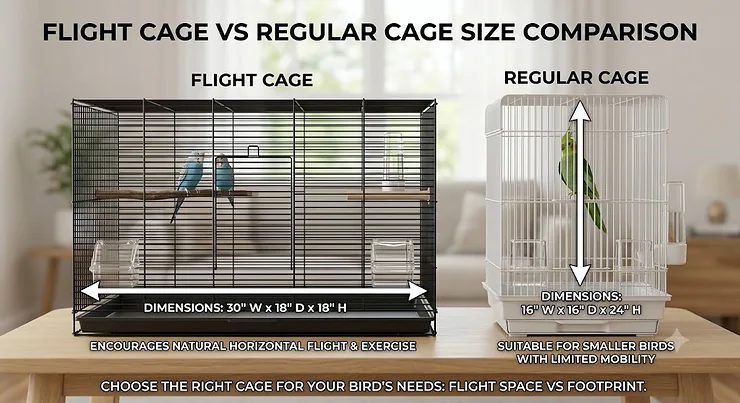
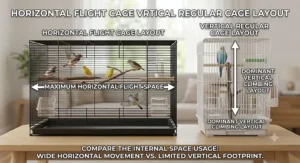
Somewhere between the pet store aisle and your bird’s first nervous flutter around your living room, you’re going to hit the same wall every bird owner hits eventually: flight cage vs regular cage, and nobody tells you the honest answer until you’ve already bought the wrong one. A flight cage is a wide, horizontally-oriented enclosure built to give a bird room to actually fly — not hop, not climb, fly — while a regular cage is typically smaller and taller, designed more for perching, sleeping, and short bursts of movement. That’s the textbook difference. The lived difference is bigger, and weirder, and it has everything to do with how your particular bird spends its day.
I’ve spent the last few weeks buried in spec sheets, bar-spacing charts, and more Amazon review threads than I’d like to admit, cross-referencing what avian veterinarians actually recommend against what real owners report after month three (not week one, when everything still smells new and exciting). The MSPCA-Angell’s housing guidelines for pet birds make a point that keeps surfacing in this research: cage size isn’t a nice-to-have, it’s one of the leading predictors of whether a bird develops behavioral problems at all.
So here’s what this guide actually does. It walks through seven real cages — three flight cages, four regular/standard cages — spanning budget to premium, with honest analysis of who each one is actually for. Then it digs into the flight cage vs regular cage question from every angle that matters: cost, space, species, and the mistakes that quietly wreck a bird’s quality of life. No fluff, no invented reviews, just the research laid out straight.
Flight Cage vs Regular Cage: Quick Comparison Table
Before diving into all seven products, here’s the fast version — the one you’d want if you were standing in a warehouse aisle with fifteen minutes to decide.
| Cage Type | Best For | Typical Footprint | Price Range | Assembly |
|---|---|---|---|---|
| Flight Cage | Multiple small birds, active flyers | Wide & horizontal | $90–$400 | 45–90 min |
| Regular Cage | Single bird, limited floor space | Tall & vertical | $60–$250 | 20–45 min |
| Hybrid/Play-Top | Single active bird, out-of-cage time | Moderate footprint, vertical play area | $150–$350 | 45–75 min |
The pattern here isn’t subtle once you see it laid out: flight cages trade floor-space efficiency for wingspan, which means they cost more and eat more square footage in your home, but they solve a problem regular cages structurally can’t — actual flight. Regular cages aren’t a downgrade so much as a different bet, one that assumes your bird gets meaningful out-of-cage time to compensate for the tighter quarters. If your bird spends 20+ hours a day caged, that bet gets a lot riskier.
💬 Already leaning toward one style? Scroll down to see exactly which model fits your setup — and why.
Top 7 Flight Cages & Regular Cages: Expert Analysis
Here’s where the theory meets actual hardware. These seven cages cover budget, mid-range, and premium tiers, plus a real mix of flight-oriented and traditional builds, so whichever side of the flight cage vs regular cage debate you’re leaning toward, there’s something here worth a real look.
1. Yaheetech 64-Inch Open Top Bird Cage — best budget entry into flight-style space
The open-top design is the sneaky feature here — it turns the cage into a supervised jungle gym the second you flip the top back, which most budget cages simply don’t offer. Specs-wise, you’re looking at roughly 64 inches of height with a 20 x 20-inch footprint, powder-coated steel bars, and a pull-out tray with a grate to keep your bird out of its own mess. That height matters more than it sounds — it gives cockatiels and smaller conures vertical climbing room even though the floor plan stays compact, which is a reasonable compromise if you’re short on horizontal space but still want more than a cramped starter cage.
Based on the spec comparison against other budget cages in this range, the Yaheetech 64-Inch Open Top Bird Cage punches above its price point mainly because of that open-top feature and the inclusion of a rolling stand, which a lot of competitors charge extra for. Reviewers consistently report solid assembly instructions and praise the caster wheels for easy cleaning access, though a recurring theme in aggregated feedback is that the door latches feel a little flimsy for larger, more determined birds like conures who like to test locks.
Pros:
- ✅ Open top doubles as a supervised play area
- ✅ Rolling stand included at no extra cost
- ✅ Pull-out tray simplifies daily cleaning
Cons:
- ❌ Door latches feel light-duty for strong beaks
- ❌ Footprint stays narrow despite the height
Priced in the $100–$140 range at the time of research, this is a smart pick if your household has vertical space to spare but not much horizontal room — check current price and availability before buying, since Yaheetech rotates configurations fairly often.
2. Prevue Hendryx Flight-Fit Large — best true flight cage for small flocks
This is where “flight cage” stops being a marketing word and starts meaning something literal. The Prevue Hendryx Flight-Fit Large runs about 36 inches long, 18 inches wide, and 24 inches tall — genuinely enough horizontal runway for a budgie or small conure to get a few real wingbeats in before it needs to bank a turn. Prevue’s been building bird enclosures since 1869, and it shows in the welded joints and the flat-top design, which resists the wobble you sometimes get with snap-together budget frames.
What most buyers overlook about this model is that it’s genuinely built for multiple small birds rather than a single large one — the horizontal bar spacing and dual feeding stations suggest Prevue designed it with flocks of budgies, canaries, or finches in mind, not a solo cockatiel. Aggregated reviewer sentiment leans heavily positive on the powder-coat finish holding up against daily wear, and several reviewers specifically mention it as a step up from cheaper flight cages that rust within a year.
Pros:
- ✅ Genuine horizontal flight room for small flocks
- ✅ Durable powder-coat finish, no early rust reports
- ✅ Established brand with replacement parts available
Cons:
- ❌ Not tall enough for larger parrot species
- ❌ Heavier to relocate than open-top alternatives
Expect a price in the $120–$160 range. If you’re housing more than one small bird, this is arguably the single best value move on this entire list — the cost-per-bird math improves fast once you split it across a pair or trio.
3. Prevue Hendryx F050 X-Large Flight Cage — premium pick for serious enthusiasts
If the Flight-Fit Large is the smart mid-tier choice, the Prevue Hendryx F050 X-Large Flight Cage is what you buy when you’ve decided you’re not doing this halfway. At roughly 37 inches wide with locking casters and a noticeably heavier gauge wire, it’s built less like a cage and more like furniture that happens to hold a bird. The locking casters alone solve a problem that plagues cheaper rolling stands — cage drift every time your bird flaps hard enough to rock the frame.
Here’s what the spec sheet won’t tell you, but reviewers note repeatedly: the crescent-style door locks genuinely stop escape attempts from clever, food-motivated birds in a way that simple slide-latches don’t. On paper this means paying a premium for hardware most owners never think about until the day it matters. Aggregated review sentiment is close to unanimous that assembly, while longer than average, produces a noticeably sturdier result than anything else in this price tier — this is a cage bought once and used for a decade, not replaced in eighteen months.
Pros:
- ✅ Locking casters eliminate cage drift
- ✅ Crescent locks resist determined escape artists
- ✅ Heavy-gauge wire built for long-term durability
Cons:
- ❌ Highest price point on this list
- ❌ Assembly takes noticeably longer than average
At a price in the $300–$400 range, this isn’t a budget-conscious buyer’s cage — it’s for someone who’s already decided their bird deserves the best available flight cage and wants it to be the last one they ever buy.
4. Vision Premier Aviary Mini — best vertical flight cage for finches and canaries
Not every flight need is horizontal, and that’s exactly the gap the Vision Premier Aviary Mini fills. Finches and canaries are vertical fliers by nature — they dart up and down more than they cruise laterally — so this cage’s 20 x 12 x 30-inch footprint emphasizes height over width, which is a smarter match for these species than a wide flight cage would be. The stainless-steel wire and clear acrylic front panel combo also solves a real practical problem: finch cages traditionally scatter seed everywhere, and the acrylic base catches most of it before it hits your floor.
Based on the spec comparison, what stands out here is that Vision designed the sliding door specifically to reduce stress during daily care — small songbirds startle easily, and a swinging door that flaps open can trigger a panicked flight response that a smooth slider avoids. Reviewers consistently mention the reduced mess as the standout benefit, with a common theme in feedback being that the acrylic panel occasionally shows scratches over time from repeated wipe-downs, which is a fair tradeoff for the mess containment it provides.
Pros:
- ✅ Vertical orientation matches finch/canary flight patterns
- ✅ Acrylic base dramatically reduces seed scatter
- ✅ Sliding door minimizes daily-care stress
Cons:
- ❌ Acrylic panel can scratch with heavy cleaning
- ❌ Too small for cockatiels or larger birds
Priced around $150–$200 depending on the retailer, this is a specialist’s cage — not the right call for a cockatiel, but close to ideal for the songbird crowd it was actually built for.
5. Yaheetech 52-Inch Wrought Steel Bird Cage with Stand — best mid-size flight-style option
Sitting right between “starter cage” and “dedicated flight cage,” the Yaheetech 52-Inch Wrought Steel Bird Cage with Stand gives parakeets, lovebirds, and small cockatiels enough combined height and width to stretch wings without committing to a full-blown flight-cage footprint. The wrought steel construction and included stand keep the whole unit stable, and Yaheetech’s slide-out tray design shows up again here, which by now feels like the brand’s signature convenience feature.
What most buyers overlook about this model is how well it splits the difference — it’s roomier than a typical “regular cage” but doesn’t demand the floor space a true flight cage does, making it a realistic pick for apartment dwellers who still want more than the bare minimum. Aggregated customer sentiment frequently praises the stability of the stand under active birds, though a recurring complaint involves the door hinge loosening slightly after a year or more of daily opening and closing.
Pros:
- ✅ Genuinely roomy without a huge footprint
- ✅ Stable stand handles active, energetic birds
- ✅ Slide-out tray simplifies cleanup routine
Cons:
- ❌ Door hinge can loosen with heavy daily use
- ❌ Not spacious enough for full flight behavior
At a price in the $90–$130 range, this is the pragmatic middle-ground pick — not a true flight cage, but a meaningful upgrade over anything labeled strictly “regular.”
6. AVAWING 70-Inch Bird Cage with Play Top & Storage Cabinet — premium all-in-one for larger flocks
The AVAWING 70-Inch Bird Cage with Play Top & Storage Cabinet solves a problem nobody talks about enough: where does all the bird gear actually go? The built-in storage cabinet underneath holds seed, toys, and cleaning supplies, while the 70-inch height with an open play top gives larger cockatiels, conures, or small parrot species real vertical range plus a supervised perching zone above the bars.
Here’s what the spec sheet won’t tell you, but reviewers note repeatedly: that storage cabinet is the actual differentiator that justifies the premium price, not the cage bars themselves — it turns a corner of a room into a genuinely functional bird station instead of just an enclosure with clutter piled around it. Reviewers consistently highlight the pull-out tray and multiple access doors as major time-savers, though a fair number mention that the overall unit is heavy enough that repositioning it solo isn’t realistic once assembled.
Pros:
- ✅ Built-in storage cabinet keeps supplies organized
- ✅ Play top adds supervised out-of-cage perching
- ✅ Multiple access doors speed up daily care
Cons:
- ❌ Too heavy to reposition without help
- ❌ Requires meaningful floor space to fit comfortably
Expect a price in the $250–$350 range. If floor space isn’t your constraint and you want a genuine bird “station” rather than just a cage, this is the strongest all-in-one on this list.
7. FinerFurnis 60-Inch Wrought Iron Bird Cage — best traditional cage with rolling stand
Rounding out the list, the FinerFurnis 60-Inch Wrought Iron Bird Cage leans hard into the classic parrot-cage aesthetic — black wrought iron, a rolling stand, a play top, and four stainless steel bowls included out of the box. It’s built for African Greys, conures, and similarly sized parrots that need a sturdier bar gauge than what smaller-bird cages typically use.
Based on the spec comparison against other mid-premium cages, the standout here is the bowl count and stainless-steel build — cheap plastic bowls degrade and stain over time, and swapping four of them out is a hidden cost that this cage avoids entirely from day one. Aggregated review sentiment consistently praises the hammertone-style finish for looking noticeably more substantial than budget alternatives, while a recurring note in feedback is that the rolling casters perform better on hard flooring than on thick carpet, where they can catch and stall.
Pros:
- ✅ Stainless steel bowls included, no early replacement needed
- ✅ Bar gauge suited to medium-large parrot species
- ✅ Rolling stand and play top add real functionality
Cons:
- ❌ Casters underperform on thick carpet
- ❌ Vertical design limits true flight behavior
Priced around $180–$250 at the time of research, this is the traditional-cage pick on the list — proof that “regular cage” doesn’t have to mean bare-bones when the build quality is actually there.
Practical Usage Guide: Setting Up Your Cage for Success
Buying the right cage is half the job — setup determines whether your bird actually thrives in it. Start by placing the cage against a wall, not in the middle of a room; birds feel exposed with open space on all sides, and a solid backdrop cuts down on stress-related feather plucking within the first week. Position it near household activity but away from kitchens, since nonstick cookware fumes and cooking smoke are genuinely dangerous to birds’ sensitive respiratory systems, a point echoed in PetMD’s guide to setting up a bird cage.
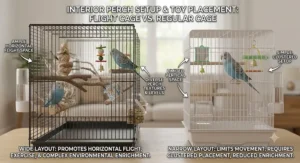
During the first 30 days, resist the urge to rearrange perches and toys constantly — birds build spatial confidence through consistency, and a cage that changes layout weekly can actually slow the adjustment period. A common first-timer mistake is overcrowding the cage with toys immediately; start with two or three items and add gradually so the bird has room to move and isn’t overwhelmed. For flight cages specifically, orient any horizontal perches to encourage lateral movement across the longer axis, since that’s the whole point of the extra width. Clean the tray every one to two days regardless of cage type, and do a full disinfection pass weekly — a task the slide-out trays on most of the cages above make considerably less painful than it sounds.
Real-World Scenarios: Matching the Cage to Your Bird and Your Life
If you’re a first-time budgie owner in a one-bedroom apartment with limited floor space, the Yaheetech 64-Inch Open Top Bird Cage or the Yaheetech 52-Inch Wrought Steel Bird Cage with Stand make the most sense — both prioritize vertical space over footprint, which respects apartment square footage while still beating a bare-minimum starter cage.
If you’re housing a small flock — say, three budgies or a pair of canaries — the math shifts hard toward the Prevue Hendryx Flight-Fit Large, since flight cages become dramatically more cost-effective per bird when multiple animals share the same horizontal space rather than each needing their own cramped enclosure.
If you’ve got a single, high-energy conure or African Grey and genuinely want to invest in long-term quality of life, the Prevue Hendryx F050 X-Large Flight Cage or the AVAWING 70-Inch Bird Cage with Play Top & Storage Cabinet are the realistic premium picks — both solve for a bird that’s going to be in that enclosure for a decade or more.
How to Choose Between a Flight Cage and a Regular Cage
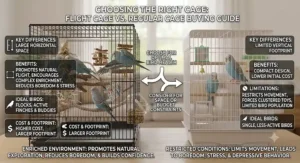
- Count your birds first. A single bird in a regular cage with generous out-of-cage time can thrive; multiple birds almost always need flight-cage horizontal space to avoid territorial stress.
- Measure your actual floor space, not your ideal floor space. A flight cage that doesn’t fit is worse than a well-chosen regular cage that does.
- Match bar spacing to species, not just cage size — a technically large cage with wrong bar spacing is still a safety hazard.
- Factor in daily out-of-cage time honestly. If your schedule realistically allows 3+ hours of supervised free-flight time, a regular cage becomes a much more viable option.
- Check assembly and mobility needs. Renters and frequent movers benefit from lighter regular cages; permanent setups can absorb a heavier flight cage’s tradeoffs.
- Budget for the whole ecosystem, not just the cage — perches, bowls, toys, and stands add real cost on top of the sticker price.
- Think ten years ahead, not ten months — birds like cockatiels and African Greys can live decades, and cage needs rarely shrink over that timeline.
Flight Cage vs Regular Cage: The Real Difference Explained
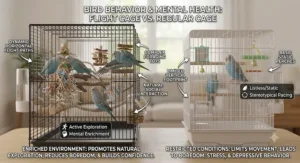
The textbook difference between a flight cage and a regular cage comes down to orientation and intent: flight cages are built wide and horizontal specifically to enable sustained flying, while regular cages are built taller and narrower, optimized for perching, climbing, and shorter bursts of movement rather than actual flight. But the practical difference goes deeper than dimensions.
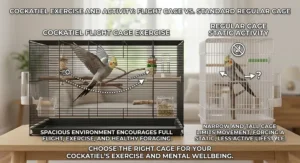
A flight cage assumes your bird will spend meaningful time inside it flying — which means it’s typically the primary exercise space, not just a resting spot. A regular cage assumes the opposite: that exercise happens mostly outside the cage, during supervised free time, and the cage itself is more of a secure home base. Neither assumption is universally right or wrong; it depends entirely on your household’s realistic routine. According to guidance summarized in the MSD Veterinary Manual’s overview of pet bird care, cage size sits alongside diet and sanitation as one of the core pillars of preventing disease and behavioral problems in captive birds — which is a strong signal that this isn’t a purely cosmetic choice.
Where things get genuinely tricky is with medium-sized birds like cockatiels and small conures, who fall in a gray zone — active enough to benefit meaningfully from flight space, but small enough that a well-designed regular cage with strong daily out-of-cage time can still work. That’s really the crux of the flight cage vs regular cage decision: it’s less about which cage type is objectively better, and more about which one honestly matches how much supervised time you can realistically give your bird outside the bars.
When to Use a Flight Cage (And When a Regular Cage Still Works)
A flight cage earns its keep when you’ve got multiple small birds sharing a space, when your bird species is a strong flier by nature (budgies, canaries, cockatiels), or when out-of-cage supervised time is realistically limited on weekdays. In these situations, the cage itself becomes the primary source of daily exercise, and skimping on horizontal space directly translates to muscle atrophy and weight gain over time.
A regular cage still makes complete sense when you have a single bird, strong daily free-flight routines already in place, or genuinely limited floor space that simply can’t accommodate flight-cage dimensions. It also tends to fit better for species that are climbers rather than flyers — cockatoos and larger parrots, for instance, often use vertical bars and play tops more than they use open floor space anyway. The honest takeaway: don’t buy a flight cage as a guilt purchase if your actual routine doesn’t support the extra footprint, and don’t stick with a cramped regular cage if your bird is clearly food-motivated, restless, or displaying feather-plucking behavior that space alone might resolve.
Flight Cage Benefits: What Research and Real Owners Report
The core flight cage benefit isn’t just “more room” in an abstract sense — it’s the specific physical and behavioral upside of a bird actually being able to fly indoors. Flight is a bird’s primary natural behavior, and suppressing it entirely tends to show up as obesity, weakened muscle tone, and in some documented cases, increased feather-destructive behavior driven by boredom and pent-up energy.
Reviewers across the flight-oriented cages on this list consistently mention calmer, less anxious birds within the first few weeks of upgrading from a cramped enclosure — a pattern that lines up with what avian behavior specialists generally observe, even though individual results obviously vary by bird and species. There’s also a social benefit worth naming: flight cages housing multiple birds tend to reduce cage-boredom-driven aggression, since birds have room to physically separate from each other rather than being forced into constant close contact. None of this means a regular cage is automatically harmful — it just means the benefits of flight-specific space are real, measurable in behavior, and worth weighing seriously against the extra cost and footprint.
Cage Type Comparison: Bird Cage Styles at a Glance
| Style | Orientation | Best Species Match | Best For |
|---|---|---|---|
| Flight Cage | Horizontal | Budgies, canaries, small conures, flocks | Prevue Hendryx Flight-Fit Large, Prevue Hendryx F050 X-Large Flight Cage |
| Play-Top Cage | Vertical + open top | Cockatiels, medium conures | Yaheetech 64-Inch Open Top Bird Cage, AVAWING 70-Inch Bird Cage with Play Top & Storage Cabinet |
| Traditional/Wrought Iron | Vertical | African Greys, larger conures | FinerFurnis 60-Inch Wrought Iron Bird Cage |
| Vertical Aviary | Tall, narrow | Finches, canaries | Vision Premier Aviary Mini |
Looking at this table, the pattern is pretty clear: horizontal footprint tracks directly with flight-forward species like budgies and canaries, while vertical designs suit climbers and perchers like African Greys and cockatoos. The Yaheetech 52-Inch Wrought Steel Bird Cage with Stand sits deliberately between categories, which is exactly why it works so well as a compromise pick for owners who can’t commit to a full flight-cage footprint but still want more than a bare vertical enclosure.
💬 Just one click — help others make better buying decisions too! 😊
Common Mistakes When Buying a Bird Cage
The single most common mistake is buying based on the bird’s current size rather than its adult size — a baby cockatiel and an adult cockatiel need very different cages, and undersizing early means a second purchase down the line anyway. A close second is ignoring bar spacing in favor of overall dimensions; a technically huge cage with bars spaced wrong for the species is a genuine escape and injury risk, not just an inconvenience.
Owners also frequently underestimate assembly time and end up rushing the build, which leads to unstable joints and doors that don’t latch securely months later. Another recurring pitfall: choosing based on aesthetics (a striking wrought-iron design, for instance) over practical features like tray accessibility, which turns daily cleaning into a genuine chore rather than a two-minute routine. Finally, plenty of buyers skip reading aggregated review sentiment around long-term durability, focusing only on unboxing impressions — which is exactly why cages that look great on day one sometimes develop hinge or latch issues by month six.
Long-Term Cost & Maintenance: Flight Cages vs Regular Cages
The sticker price is only the opening bid. Flight cages generally cost more upfront — often $100 to $200 more than a comparable regular cage — but the cost-per-bird math improves significantly if you’re housing multiple animals, since one flight cage replaces what would otherwise be two or three separate regular cages. Maintenance-wise, larger flight cages take longer to clean per session simply due to surface area, but many, including the AVAWING 70-Inch Bird Cage with Play Top & Storage Cabinet and Yaheetech models on this list, offset that with slide-out trays that meaningfully cut cleaning time compared to lift-out designs.
Replacement parts are the other hidden cost worth factoring in. Established brands like Prevue tend to keep replacement trays, doors, and stands available for years, which extends a cage’s usable life well past the point where a no-name budget cage would need full replacement. Over a five-year ownership window, a higher-quality flight cage with available replacement parts frequently ends up cheaper per year than cycling through two or three budget regular cages that degrade and get tossed.
Safety, Regulations & Compliance for Bird Cages
Bar spacing safety isn’t optional — the wrong spacing lets small birds squeeze through and get injured, or lets larger birds get a head or wing stuck between bars. As a practical baseline, most small-bird cages should use spacing under half an inch, while larger parrot cages can safely use spacing closer to three-quarters to one inch depending on the species.
Material matters just as much: zinc-plated and galvanized wire can pose toxicity risks if a bird chews on it repeatedly, which is why the powder-coated and wrought-iron finishes on the cages featured here are generally the safer long-term choice over bare galvanized metal. In the U.S., commercial breeding and exhibition facilities fall under Animal Welfare Act oversight, though individual pet ownership isn’t federally regulated the same way — which puts more responsibility on the owner to self-enforce good practice rather than relying on any external mandate. For a broader look at how captive bird housing is defined and studied more generally, Wikipedia’s overview of animal enclosures offers useful background on the design principles that carry across species.
Frequently Asked Questions
❓ Is a flight cage better than a regular cage?
❓ What size flight cage do I need for two budgies?
❓ Can cockatiels live in a regular cage?
❓ How often should I clean a flight cage vs a regular cage?
❓ Are wrought iron cages safe for birds?
Conclusion
If there’s one honest takeaway from all this research, it’s that “flight cage vs regular cage” was never really a fair fight to begin with — they’re built for different situations, not competing for the same crown. A flight cage like the Prevue Hendryx F050 X-Large Flight Cage earns its premium price when you’ve got the floor space and a flock that genuinely benefits from horizontal room to fly. A well-built regular cage like the FinerFurnis 60-Inch Wrought Iron Bird Cage holds its own just fine when paired with real daily out-of-cage time and a species that leans more toward climbing than cruising.
The seven cages covered here span a wide enough range — from the budget-friendly Yaheetech 64-Inch Open Top Bird Cage up through the all-in-one AVAWING 70-Inch Bird Cage with Play Top & Storage Cabinet — that almost any household situation has a genuinely sensible option on this list. The real work now is being honest with yourself about floor space, flock size, and how much free-flight time you can realistically commit to, because that answer decides the category long before any specific model does.
Recommended for You
- Indoor Flight Cage for Finches: 7 Top Picks for 2026
- Flight Cages for Birds: 7 Top Rated Picks Ranked (2026)
- Walk In Bird Cage for Macaw: 7 Best Options Reviewed (2026)
Disclaimer: This article contains affiliate links. As an Amazon Associate, I earn from qualifying purchases. If you purchase products through these links, we may earn a small commission at no additional cost to you.
✨ Found this helpful? Share it with your friends! 💬🤗
