
In This Article
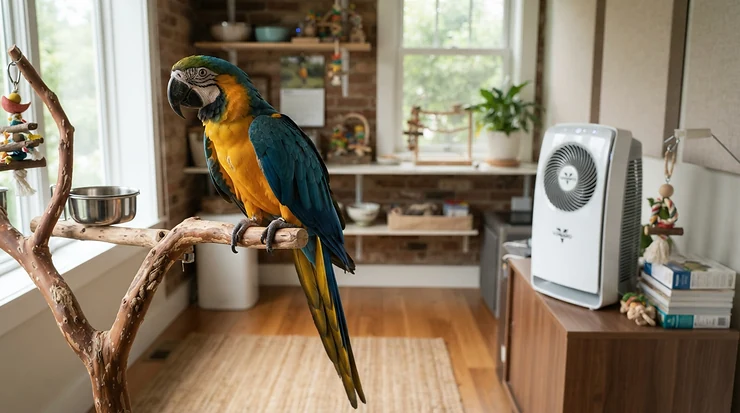
If you live with a parrot, cockatiel, or cockatoo, you already know the fine white film that shows up on your TV screen, your coffee table, and — worst of all — in your lungs. A HEPA air purifier for bird rooms isn’t a luxury gadget in a house like that. It’s closer to a second respiratory system for the whole room, quietly grabbing keratin dust, feather particles, and dander before they settle into your carpet or your sinuses. Powder-down species like African greys, cockatoos, and cockatiels shed constantly, and that dust doesn’t politely stay near the cage. It rides air currents into vents, onto bookshelves, and straight into anyone’s airway who happens to be breathing that day.

So what is a HEPA air purifier, exactly? It’s an appliance built around a pleated mechanical filter engineered to capture at least 99.97% of particles as small as 0.3 microns — the size class that includes bird dander, pollen, and mold spores. That number isn’t marketing fluff; it comes from a federal filtration standard that a filter either meets or doesn’t.
This guide walks through seven real, currently available units spanning budget to premium, explains what actually matters when shopping for one, and answers the questions bird owners search for most — from ionizer safety to how often you really need to swap that filter.
Quick Comparison: Top Picks at a Glance
Short on time? Here’s the fast version before we go deep on all seven.
| Category | Product | Best For | Price Range |
|---|---|---|---|
| Best Overall | Levoit Core 400S | Auto-sensing dust response | $180–$220 |
| Best Budget | MOOKA B-D02L | Large rooms on a tight budget | $90–$130 |
| Best Premium | Austin Air HealthMate Plus | Severe allergies, multi-bird rooms | $750–$900 |
Notice the spread here: you can spend under $100 or well over $700 and still land on a true HEPA unit — the difference is coverage area, filter longevity, and how aggressively the machine reacts to sudden dust events like a wing-flap or a bath session. Budget units clean effectively but need more frequent filter swaps and cover less square footage, while the premium tier trades a steep upfront cost for filters that last years instead of months. If your bird room is small and your main goal is basic dust control, don’t overspend — but if you’re managing a dedicated aviary or a bird with diagnosed respiratory sensitivity, the extra investment upfront often works out cheaper per year of clean air.
💬 Found the pick that fits your space? Scroll down for the full breakdown — including which one to skip if you’ve got a sensitive macaw nearby.
Top 7 HEPA Air Purifiers for Bird Rooms: Expert Analysis
We picked these seven to cover every realistic bird-room scenario: studio apartments with a single cockatiel, dedicated bird rooms with three or four parrots, and full aviary setups. Budget, mid-range, and premium tiers are all represented, along with a couple of lesser-known options that don’t get enough credit.
1. MOOKA B-D02L — best budget pick for large bird rooms
The MOOKA B-D02L proves you don’t need a three-figure-plus price tag to cover a genuinely large space. This one’s rated for rooms up to 1,076 square feet, which is unusually generous for its price class. The H13 True HEPA filter is the same efficiency grade used in far pricier units, meaning it’s technically capturing particles at the same 99.97% threshold — the price difference mostly comes down to build materials, smart features, and filter lifespan rather than raw filtration power.
Based on the spec sheet, this makes it a smart pick for a single-parrot household or a spare room converted into an aviary corner where you don’t want to sink hundreds of dollars into infrastructure. What most buyers overlook about entry-tier units like this is that the fan motor tends to be less refined at top speed, so don’t expect library-quiet operation if you crank it up during a molting week.
Reviewers consistently note that the odor-elimination layer handles ammonia from droppings better than expected for the price, though the included night light is a take-it-or-leave-it extra depending on whether your birds are light-sensitive.
Pros:
- ✅ Covers unusually large rooms for its price tier
- ✅ True H13 HEPA filtration, not “HEPA-type”
- ✅ Handles ammonia odor better than typical budget units
Cons:
- ❌ Noticeably louder at max fan speed
- ❌ Fewer smart features than pricier competitors
Prices typically run in the $90–$130 range at the time of research — check current price, as availability shifts. For the coverage-per-dollar ratio alone, this is hard to beat if your budget is the primary constraint.
2. Levoit Core300-P — quietest option for small-to-medium bird rooms
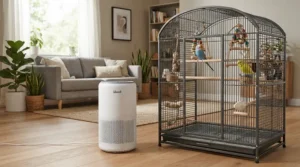
The Levoit Core300-P has become something of a default recommendation among pet owners, and the reasoning holds up under scrutiny. It’s rated for coverage up to 1,073 square feet and uses a 3-in-1 filter combining a pre-filter, true HEPA layer, and activated carbon — meaning it’s tackling dust, dander, and cage odor in a single pass rather than requiring separate stages.
In practice, what that layered design means is you’re not choosing between odor control and dust removal; you get both from one filter cartridge. The sleep mode is genuinely quiet, which matters more than people expect in a bird room — sudden loud appliance noise can stress skittish species like conures or cockatiels.
AHAM-verified CADR ratings back up the coverage claims rather than leaving you to trust marketing copy alone. Where this model shines for parrot dust and dander specifically is the compact footprint; it fits on a shelf near the cage without dominating the room.
Pros:
- ✅ AHAM-verified performance, not just marketing claims
- ✅ Genuinely quiet on sleep mode
- ✅ Combines dust, dander, and odor filtration in one filter
Cons:
- ❌ No washable pre-filter, so full replacements come sooner
- ❌ Coverage claims assume ideal air-change conditions
Expect to pay somewhere in the $100–$130 range. For a single mid-size parrot or a pair of smaller birds, this is one of the safest first purchases in the whole category.
3. Coway Airmega AP-1512HH(W) — best value with built-in air quality monitoring
The Coway Airmega AP-1512HH(W) has earned its reputation the unglamorous way: through years of consistently strong third-party testing rather than flashy marketing. Independent lab testing found it removed 96.9% of 2.5-micron particles and 99.9% of 10-micron particles at maximum fan speed — numbers that matter directly for bird dander, which tends to fall in that particle-size window.
What that means in practice is you’re getting near-total removal of the visible dust that settles on furniture, not just the microscopic fraction. The built-in air quality sensor and auto mode are the real differentiator here: the unit ramps up automatically when it detects a dust spike, like your cockatoo shaking out after a bath, then quietly steps back down.
Reviewers consistently highlight the washable pre-filter as a cost-saver, since it extends the life of the pricier HEPA cartridge underneath. At 77 watts on high, it’s not the most efficient in this lineup, but the eco mode claws some of that back.
Pros:
- ✅ Auto mode reacts to real-time dust spikes
- ✅ Washable pre-filter extends HEPA filter life
- ✅ Independently tested filtration performance
Cons:
- ❌ Higher power draw at top speed than competitors
- ❌ App connectivity is less polished than newer rivals
Price typically falls in the $150–$230 range depending on retailer promotions. Prices may vary, so check current price before buying — this one’s frequently discounted.
4. Levoit Vital 200S-P — best for high-output large aviaries
Step up in output and you land on the Levoit Vital 200S-P, which posts some of the strongest CADR numbers in this lineup: 250 CFM for smoke, 254 CFM for dust, and 289 CFM for pollen. Here’s what to weigh: those are laboratory clean-air delivery rates, and higher numbers translate directly into faster particle turnover in a room full of active, dust-shedding birds.
Rated for spaces up to 1,875 square feet, this is the unit to reach for if you’re running a genuine multi-bird aviary room rather than a single cage in the corner of a bedroom. App control and customizable fan modes add convenience, letting you schedule higher output during the hours your birds are most active and winding down overnight.
What the spec sheet won’t tell you, but reviewers note, is that at full blast this unit pushes noticeably more airflow than you’d feel from smaller units — which some owners like for faster dust clearance and others find creates a slight draft near the cage, something to test and adjust for.
Pros:
- ✅ Highest CADR ratings in this roundup for its class
- ✅ Rated for genuinely large aviary-sized rooms
- ✅ App-based scheduling around bird activity patterns
Cons:
- ❌ Airflow at max speed may create a draft near cages
- ❌ Larger physical footprint than compact units
Typical pricing sits in the $150–$200 range — check current price for seasonal deals. For dedicated bird rooms, this is one of the strongest CADR-to-price ratios available.
5. Levoit Core 400S — smartest auto-sensing pick
The Levoit Core 400S takes the Core300-P’s foundation and adds a laser particle sensor that continuously reads real-time air quality, then adjusts fan speed without you touching a dial. This matters more for bird owners than for the average allergy sufferer, because bird dust release isn’t steady — it spikes during preening, flapping, and bathing, then settles. Based on the spec comparison, an auto-sensing unit like this responds to those spikes within seconds rather than running at one fixed speed all day, which is both more effective and quieter on average since it’s not blasting max fan speed when nothing’s happening. Crucially for bird safety, it carries no ionizer or ozone-generating function at all — it’s a pure mechanical HEPA design, no gas byproducts to worry about. Sleep mode drops as low as 27 decibels, which genuinely helps keep nervous birds calm overnight.
Pros:
- ✅ Real-time laser sensor adjusts speed automatically
- ✅ Completely ozone-free, ionizer-free design
- ✅ Whisper-quiet sleep mode around 27 decibels
Cons:
- ❌ Mid-tier price point compared to basic models
- ❌ Replacement filters cost more than entry-level units
Prices generally land in the $180–$220 range at the time of research. This is the pick for owners who want a “set it and mostly forget it” unit that reacts to their birds automatically.
6. PuroAir 130i — best Wi-Fi remote monitoring for premium buyers
The PuroAir 130i targets owners who want to check air quality from their phone without walking into the bird room. Rated for spaces up to 600 square feet, it uses a 3-layer system combining HEPA filtration with a carbon-technology layer, and it’s independently rated to filter out 99.9% of airborne pollutants including pet dander, dust, and smoke. What most buyers overlook about Wi-Fi-enabled purifiers is that the connectivity itself doesn’t clean air any better — the real value is monitoring trends over time, so you can see whether dust levels spike predictably around molting season or feeding time. Reviewers consistently flag the higher initial cost and ongoing filter expense as the main tradeoff versus simpler mechanical models, but for anyone managing air quality remotely — say, checking in during a workday — that convenience carries real weight.
Pros:
- ✅ Remote monitoring and control via smartphone app
- ✅ Multi-layer HEPA plus carbon filtration
- ✅ Independently rated for 99.9% pollutant capture
Cons:
- ❌ Higher upfront and ongoing filter costs
- ❌ Coverage area smaller than some cheaper large-room units
Expect a price in the $300–$400 range depending on bundle and promotions — always check current price since premium units see frequent seasonal discounting.
7. Austin Air HealthMate Plus — best medical-grade option for severe allergies
At the top of this lineup sits the Austin Air HealthMate Plus, a genuinely different category of machine from everything else on this list. Rated for spaces up to 1,500 square feet, it runs air through a 4-stage system: a cotton pre-filter for large particles, a medium-particle filter for mold and pollen, a 15-pound activated carbon bed infused with potassium iodide and zeolite for gases and odors, and finally a medical-grade HEPA layer removing 99.97% of particles at 0.3 microns.
Here’s what to weigh: that carbon bed is what separates this from every other unit here — it’s built to handle heavy chemical odors and VOCs, not just particulate dust, which matters if your bird room also deals with cleaning-product fumes or heavy ammonia buildup from multiple cages.
The standout feature bird owners specifically care about is the 5-year filter life under normal use, backed by a pro-rated filter warranty, meaning the eye-watering upfront cost amortizes to a genuinely competitive per-year figure. Aggregated buyer feedback across retail platforms consistently praises the build quality and long-term reliability, though it’s worth noting this is a heavier, more industrial-looking appliance than the sleek consumer units above it.
Pros:
- ✅ 5-year filter life dramatically lowers long-term cost
- ✅ Medical-grade HEPA plus heavy-duty carbon for odors and VOCs
- ✅ Rated for large rooms up to 1,500 square feet
Cons:
- ❌ Steep upfront cost compared to every other pick here
- ❌ Bulkier, more utilitarian design than consumer-style units
Pricing typically runs in the $750–$900 range at the time of research. For owners managing multiple powder-down species or a bird with a diagnosed respiratory hypersensitivity, this is often the unit vets and dedicated breeders reach for.
| Product | Coverage | Filtration | Price Range | Best For |
|---|---|---|---|---|
| MOOKA B-D02L | Up to 1,076 sq ft | H13 True HEPA | $90–$130 | Tight budgets, large rooms |
| Levoit Core300-P | Up to 1,073 sq ft | 3-in-1 True HEPA | $100–$130 | Quiet, compact bird rooms |
| Coway Airmega AP-1512HH(W) | ~361 sq ft rated | True HEPA + sensor | $150–$230 | Auto-reacting dust control |
| Levoit Vital 200S-P | Up to 1,875 sq ft | High-CADR True HEPA | $150–$200 | Large multi-bird aviaries |
| Levoit Core 400S | ~403 sq ft rated | Laser-sensor True HEPA | $180–$220 | Smart, ozone-free auto mode |
| PuroAir 130i | Up to 600 sq ft | 3-layer HEPA + carbon | $300–$400 | Remote app monitoring |
| Austin Air HealthMate Plus | Up to 1,500 sq ft | Medical-grade HEPA + carbon | $750–$900 | Severe allergies, long filter life |
Looking at the table, the pattern that jumps out is coverage area doesn’t track linearly with price — the budget MOOKA B-D02L actually outcovers several pricier units on square footage alone. What you’re really paying for as prices climb is sensor sophistication, filter longevity, and odor-specific carbon capacity rather than raw HEPA performance, since all seven meet the same 99.97% particle-capture bar. If your bird room runs under 400 square feet, don’t feel pressured into an oversized unit; match the coverage rating to your actual room size plus a margin, not to the biggest number on the shelf.
Setting Up Your Bird Room Air Purifier: A Practical Guide
Buying the right unit is half the job. Placement and habits do the rest. Position the purifier three to six feet from the cage — close enough to catch dust as it’s released, far enough that the airflow doesn’t blow directly onto your bird, which can cause stress or chilling in smaller species. Run it continuously on low or auto rather than cycling it on only when you notice dust, since particulate levels build steadily between preening sessions and never fully “start fresh.” If electricity use worries you, most HEPA units at low speed draw 15 to 40 watts — comparable to a couple of LED bulbs — so 24/7 operation is genuinely affordable.
During the first 30 days, the most common mistake is undersizing the unit to the visible cage area rather than the whole room; dust travels well past where you can see it settle. A second common misstep is placing the purifier in a corner behind furniture, which restricts intake airflow and cuts effective performance noticeably. Finally, resist the urge to add scented plug-ins or essential oil diffusers near the unit — some fragrance compounds are genuinely unsafe for birds, and running them near your purifier’s intake just recirculates the problem faster.
Real Bird Rooms, Real Solutions: Matching Purifiers to Your Setup
Consider a college student with a single cockatiel in a 300-square-foot studio apartment. Budget is tight, noise matters because of shared walls, and the room is small. A compact, quiet pick like the Levoit Core300-P fits this scenario precisely — enough coverage with room to spare, low operating cost, and a sleep mode that won’t announce itself through the wall at 2 a.m.
Now picture a hobbyist running a genuine home aviary: four to six birds, including a couple of dusty cockatoos, in a converted spare room or three-season porch. Here, a budget air purifier for an aviary setup needs to prioritize coverage and continuous-duty reliability over smart features. The MOOKA B-D02L‘s large coverage rating at a low price point makes sense here, possibly paired with a second unit if the space exceeds 1,000 square feet, since doubling up on mid-tier units often beats stretching a single unit past its rated capacity.
Finally, imagine someone with a diagnosed dust sensitivity themselves, managing a blue-and-gold macaw alongside a powder-producing African grey — a known trigger combination for pulmonary hypersensitivity in macaws. Here, the case for the Austin Air HealthMate Plus becomes about more than dust: its carbon-heavy filtration and sustained 5-year performance make it the pick when both human and avian respiratory health are genuinely on the line, and cutting corners isn’t worth the risk.
How to Choose a HEPA Air Purifier for Bird Rooms
- Confirm it’s True HEPA, not “HEPA-type.” Only true HEPA carries the 99.97%-at-0.3-microns certification; “HEPA-type” or “HEPA-like” filters aren’t held to that standard and may perform noticeably worse.
- Size up, not down. Match — or exceed — the manufacturer’s square footage rating for your actual room, since bird rooms generate dust faster than typical living spaces.
- Verify it’s ozone-free. Ionizing or ozone-generating features can seriously endanger birds; the unit should state clearly that it produces no ozone.
- Check the noise profile. Sudden loud noise stresses birds; look for published decibel ratings on sleep or low mode specifically.
- Factor in filter replacement cost. A cheaper unit with pricier, frequent filter swaps can cost more over two years than a pricier unit with a long-life filter.
- Look for a washable pre-filter. This single feature meaningfully extends the life of the more expensive HEPA cartridge underneath it.
- Consider carbon capacity if odor is a factor. Multi-bird rooms with heavy droppings need a real activated carbon layer, not just a thin odor-masking pad.
Air Purifier vs Ionizer for Bird Dust: Which Is Actually Safer?
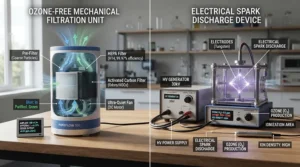
This comparison isn’t close, and it’s worth being direct about why. Ionizers work by releasing charged ions that cause airborne particles to clump and fall out of the air — but many ionizing devices, particularly older or cheaper ones, generate ozone as a byproduct, sometimes marketed under euphemisms like “activated oxygen.” Ozone is a genuinely toxic gas, and federal indoor air quality guidance is unambiguous that ozone-generating devices sold as air cleaners can produce concentrations high enough to cause respiratory irritation and lung inflammation in humans — and birds, with their far more sensitive and efficient respiratory systems, are considerably more vulnerable to the same exposure.
A true HEPA purifier, by contrast, is a purely mechanical filter with no gas byproduct at all — it physically traps particles in a fiber mesh rather than chemically altering the air. For bird rooms specifically, this isn’t a matter of personal preference; it’s a bright safety line. If a unit advertises an “ionizer mode,” confirm you can switch it off entirely, and when in doubt, choose a purely mechanical HEPA design like the Levoit Core 400S, which ships ozone-free by design rather than as an optional toggle.
Best Air Purifier Choices for Bird Owners With Respiratory Concerns
If you’re the one dealing with allergy symptoms, watery eyes, or a cough that flares up whenever you’re in the bird room, the calculus shifts slightly toward filtration strength and continuous operation over convenience features. Powder-down species — cockatoos, cockatiels, African greys, and Amazons among them — produce dust that’s specifically documented to irritate human respiratory tracts, not just bird lungs. Avian veterinary guidance on managing dusty species consistently recommends placing a quality air filter directly near the cage of the dustiest bird in the household as a first-line management step, alongside — not instead of — good room ventilation.
For someone managing personal respiratory sensitivity, prioritize a unit like the Coway Airmega AP-1512HH(W) or Levoit Vital 200S-P, both of which post independently verified high-efficiency numbers rather than relying on marketing language alone. Running the unit continuously, rather than only when symptoms flare, matters more here than almost any other single factor — reactive use lets dust concentrations rebuild between sessions.

Bird Dust Allergy Relief: What Actually Works
Full allergy relief rarely comes from a single fix — it’s a layered approach. Continuous HEPA filtration is the foundation, but pairing it with habit changes compounds the benefit considerably. Bathing or misting your bird two to three times weekly reduces the dust released during preening at the source, rather than only capturing it after it’s airborne. Wiping down cage surfaces daily with a damp cloth, rather than dry-dusting, prevents re-suspending settled particles back into the air.
If symptoms persist despite these steps — particularly recurring cough, chest tightness, or breathlessness that improves when you’re away from the birds — that pattern is worth mentioning to a doctor, since chronic exposure to avian proteins in feather and dropping dust is a recognized cause of a lung condition called hypersensitivity pneumonitis. This is a sensitive health topic, and while a strong air purifier meaningfully reduces exposure, it isn’t a substitute for medical evaluation if respiratory symptoms are ongoing or worsening.
Common Mistakes When Buying an Air Purifier for Parrot Dust and Dander
The single most frequent mistake is buying based on price alone and landing a unit with a “HEPA-type” filter that doesn’t actually meet the certified standard — always confirm “True HEPA” language specifically. A close second is undersizing: buying a purifier rated for a 200-square-foot room to cover an open-plan 500-square-foot space, which leaves the unit working far harder than its design intends and shortens its effective lifespan. Some buyers also get pulled in by ionizer features marketed as a “bonus,” without realizing that’s a bird-safety liability rather than an upgrade. Finally, skipping the ongoing filter-cost math is a quiet budget-killer — a $90 unit with $40 filters needed every two months costs more over two years than a $200 unit with $30 filters needed twice a year.
HEPA Filter Replacement Schedule: Long-Term Cost and Maintenance
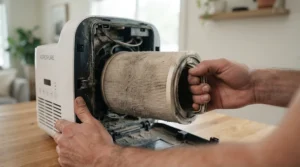
Most consumer HEPA filters in bird rooms need replacement every 3 to 6 months rather than the 6-12 months typical in dust-free homes, simply because the particulate load is heavier. Watch for two signals rather than relying purely on the calendar: a visible grey buildup on the filter surface, or a noticeable drop in airflow at the same fan speed you normally run. Budget units like the MOOKA B-D02L and Levoit Core300-P typically fall on the shorter end of that window in a busy bird room, while carbon-heavy premium units like the Austin Air HealthMate Plus are the outlier — its 5-year filter life fundamentally changes the total-cost-of-ownership math, since you’re not repeatedly buying replacement cartridges even though the upfront cost is far higher.
Aviary Air Quality: What to Expect From Day One
The first week after installing a proper HEPA unit is usually the most noticeable. Surfaces that needed daily wiping often go two or three days between visible dust buildup instead. What’s less obvious, but arguably more important, is the reduction in airborne particulate you can’t see — the fraction actually reaching deep into lungs, avian and human alike. Don’t expect zero dust; a HEPA purifier reduces airborne particulate load dramatically, but active preening and flapping still generate fresh dust continuously, so the unit is managing an ongoing process rather than eliminating the source. In larger aviary rooms with multiple powder-down birds, expect the unit to run at a noticeably higher average fan speed than in a single-bird bedroom setup — that’s the system working as intended, not a sign something’s wrong.
🔋 Ready to breathe easier?
Compare today’s top-rated bird-safe purifiers and pick the one that matches your room size — your lungs (and your birds’) will thank you.
Frequently Asked Questions
❓ Do air purifiers actually help with bird dander?
❓ Is an ionizer safe to use around birds?
❓ How often should I replace a HEPA filter in a bird room?
❓ Can an air purifier help with bird-related allergies in humans?
❓ What size air purifier do I need for a bird room?
Conclusion
A HEPA air purifier for bird rooms isn’t about chasing the flashiest features — it’s about matching real coverage, true filtration certification, and ozone-free safety to your specific setup. Budget units like the MOOKA B-D02L and Levoit Core300-P handle single-bird households and modest rooms without breaking the bank, while high-CADR options like the Levoit Vital 200S-P and smart auto-sensing picks like the Levoit Core 400S suit busier, multi-bird spaces. For anyone managing genuine respiratory sensitivity — human or avian — the Coway Airmega AP-1512HH(W), PuroAir 130i, or the medical-grade Austin Air HealthMate Plus offer real headroom for tougher conditions. Whichever tier fits your room and budget, the throughline is the same: true HEPA certification, no ozone, and continuous operation matched to your actual square footage. Get those three things right, and everything else is a bonus feature.
Recommended for You
- Sample Collection Kit For Bird Vet: 7 Best Picks For 2026
- Handheld UV Light For Bird Feather Checks: 7 Top Picks (2026)
- Digital Bird Scale For Home Health Checks: 7 Picks For 2026
Disclaimer: This article contains affiliate links. As an Amazon Associate, I earn from qualifying purchases. If you purchase products through these links, we may earn a small commission at no additional cost to you.
✨ Found this helpful? Share it with your friends! 💬🤗
