
In This Article
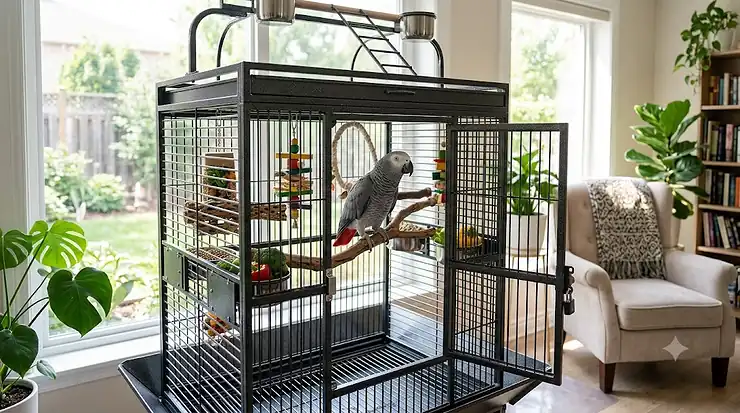
An african grey cage buying guide should start with one blunt fact: most cages sold as “large parrot cages” are still too small for a Congo or Timneh African grey. These birds are roughly the size of a small chicken with the wingspan of a hawk, and they spend more waking hours in their cage than almost any other common pet. Get the cage wrong, and you’re not just buying the wrong box — you’re setting up months of feather-plucking, screaming, or a bird who refuses to climb down and bond with you.
What most first-time grey owners overlook is that “African grey size” isn’t really about the bird’s body — it’s about wingspan, tail clearance, and how much horizontal room there is to walk and forage. A cage that looks enormous in a showroom photo can still cramp a grey that needs to flap, climb, and destroy a toy or two before lunch.
This guide walks through seven real, currently listed cages on Amazon — from budget aviary-style builds under $200 to a premium stainless-steel option built to outlast the bird itself (and greys can live 50+ years). Along the way, you’ll get the buying criteria, the mistakes that send people back to the return window, and a setup routine that actually matters more than which brand name is printed on the box.
Quick Comparison Table
| Pick | Best For | Bar Spacing | Approx. Price Range |
|---|---|---|---|
| Yaheetech 63″ Open Play Top | Best Overall / First Real Grey Cage | 1″ | $200–$280 |
| Mcage Castle PlayTop X-Large | Best Premium Statement Cage | 3/4″ | $300–$450 |
| Prevue Stainless Steel Play Top | Best Long-Term / Heavy Chewers | 1″ | $450–$650 |
| HSM 62″ Wrought Iron Flight Cage | Best Budget Pick | 3/4″–1″ | $150–$220 |
Looking at this snapshot, the Yaheetech earns the “best overall” slot because it hits the African grey size minimums without forcing a premium-tier budget. If you’ve already decided your grey will spend serious daily time outside the cage on a stand, the HSM is a defensible way to save money on the enclosure itself. Owners going stainless steel should treat it as a once-per-bird-lifetime purchase rather than a yearly upgrade.
💬 Just one click — help others make better buying decisions too!😊
✨ Don’t Miss These Exclusive Deals!
🔍 Take your African grey’s setup to the next level with these carefully selected cages. Click on any highlighted item to check current pricing and availability — these picks will help your bird settle into a space it can actually thrive in!😊
Top 7 African Grey Cages: Expert Analysis
1. Yaheetech Extra Large Bird Cage 63″ Open Play Top
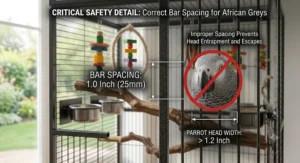
The Yaheetech Extra Large Bird Cage is built around a 24″L x 22″W x 44.5″H interior with 1-inch bar spacing — dimensions Yaheetech specifically markets for African grey, Amazon parrot, and small macaw owners. The 1-inch spacing matters more than the marketing copy lets on: it’s wide enough that a grey’s thick beak and legs won’t catch, but narrow enough to block head entrapment, which remains one of the more common cage-related injuries vets see.
What most buyers overlook about this model is the individual lock on every door, including the top opening — cheaper cages often skip locking the play-top hatch, and that’s exactly where a bored grey will spend an afternoon figuring out the latch. The Victorian arch-top play area gives the bird an above-cage perch to climb onto without leaving home entirely, which helps with the all-important “out of cage but still secure” routine.
Customer feedback on this model consistently highlights smooth-rolling caster wheels and a manageable assembly time, though a few buyers note the seed guard catches less mess than expected on the open play-top side.
✅ Solid 1″ bar spacing built for grey-sized birds
✅ Locking play-top hatch, not just the main door
✅ Rolling casters make repositioning easy
❌ Seed guard underperforms on the open play-top
❌ Interior floor space is adequate, not generous, for a second bird
In the $200–$280 range, this is the cage I’d point a first-time grey owner toward — it’s sized correctly without asking for premium-cage money.
2. Mcage Castle PlayTop X-Large Parrot Bird Cage
The Mcage Castle PlayTop is the ornate option — a wrought-iron “castle” design with seed skirts on all four sides and an X-Large interior around 32″W x 23″D x 44″H before the play top is added. In my experience, this is the cage people buy when the bird is also living in the main living room and needs to look intentional, not improvised.
The four-stainless-cup setup inside plus two more cups on the play top means you can separate water from food-prone-to-fouling without juggling bowls daily. The double dome walking ladders are a genuine upgrade over a single straight ladder — greys use the extra rungs to descend at an angle instead of doing an awkward vertical drop, which matters for older or heavier birds.
Reviewers flag two consistent points: the seed skirts genuinely cut down on floor mess, and assembly takes longer than the box implies, with the four-caster base being the fiddliest part to attach.
✅ Largest accessory set of any cage on this list (8 total cups, 2 ladders)
✅ Seed skirts measurably reduce floor cleanup
✅ Side breeding door adds flexibility if you ever house a pair
❌ Assembly runs long — budget 60–90 minutes
❌ Ornate scrollwork is harder to disinfect in corners
At $300–$450, this is squarely a mid-to-premium buy — pick it when aesthetics and accessory count matter as much as raw interior square footage.
3. Prevue Pet Products Wrought Iron Select Bird Cage (36″ x 24″ x 66″)
Prevue has built bird-specific products since 1869, and the Prevue Wrought Iron Select in its largest 36″L x 24″W x 66″H configuration is the brand’s answer to “give me something I trust without the flair.” The 3/4-inch wire spacing sits at the lower edge of what’s appropriate for a grey — fine for most adults, but worth double-checking against your specific bird’s head width before buying.
What the spec sheet won’t tell you is that Prevue’s bird-proof bolt lock paired with a separate windbell lock at the top of the door is genuinely harder for a grey to defeat than a single push-button latch. Greys are escape artists who treat a single lock as a puzzle to be solved within a week; a second, independent lock buys you real peace of mind.
Long-time Prevue owners on forums report that replacement trays and grilles are still available years after purchase, which isn’t something you can say about every off-brand cage — a real factor in long-term cost of ownership.
✅ Dual independent lock system slows down escape attempts
✅ Replacement parts remain available long-term
✅ Removable seed guards let you choose between contained and open styles
❌ 3/4″ spacing is on the narrow side for larger Congo greys
❌ Rolling casters are plastic, not the heavier-duty metal seen on premium models
Around $200–$270, this is the pick for buyers who’d rather have brand reliability than a showpiece cage.
4. Prevue Pet Products Large Stainless Steel Play Top Bird Cage
The Prevue Stainless Steel Play Top is the splurge option, and it’s explicitly marketed for African greys alongside Amazons and cockatiels. At roughly 31.5″L x 23.6″W x 61.25″H with 1-inch spacing, it’s not the biggest cage on this list — but stainless steel changes the long-term math entirely. Wrought iron, even powder-coated, eventually chips and rusts at chew points; stainless steel doesn’t, which matters enormously for a bird that may outlive the cage’s expected category lifespan twice over.
The textured stainless perches — both inside the cage and on the play top — give better grip than smooth dowels, reducing the kind of foot strain that contributes to bumblefoot over the decades a grey is likely to use this cage. Two independent lock styles on the front door echo the same “slow the escape artist down” logic seen on the Prevue wrought-iron model above.
Buyers consistently cite easier cleaning and zero rust after extended use as the standout benefit, which is exactly what you’re paying the premium for.
✅ Rust-proof for the bird’s entire (very long) lifespan
✅ Textured stainless perches reduce foot strain over time
✅ Dual front-door lock styles
❌ Highest price point on this list by a wide margin
❌ Slightly smaller footprint than some wrought-iron competitors
At $450–$650+, treat this as a buy-once purchase rather than a starter cage — it’s the option that makes sense once you know you’re committed long-term.
5. Belnest 69″ Extra Large Bird Cage
The Belnest 69″ Extra Large Bird Cage is built as a heavy-duty metal aviary on a rolling stand, explicitly sized for African greys, cockatoos, conures, and macaws, and rated for indoor or outdoor placement. The extra height over many competitors in this price bracket gives a grey more vertical climbing room, which these birds use constantly even when floor space is unremarkable.
What stands out in practice is the slide-out tray design — two separate trays rather than one combined unit, which cuts cleaning time noticeably versus pulling, dumping, and reseating a single oversized tray.
Owners report it holds up well outdoors during mild weather, though a few mention the powder coat shows wear faster than premium stainless options when left outside year-round in humid climates.
✅ Genuine outdoor-rated build at a non-premium price
✅ Dual slide-out trays speed up cleaning
✅ Extra-tall design supports vertical climbing
❌ Powder coat wears faster than stainless in humid outdoor use
❌ Fewer included accessories than the Mcage or Prevue options
In the $180–$250 range, this is a strong pick for anyone splitting time between an indoor room and a covered patio setup.
6. HSM 62-Inch Wrought Iron Large Bird Flight Cage
The HSM 62-Inch Wrought Iron Flight Cage is marketed directly at African grey owners alongside cockatiel, conure, and lovebird households, with a rolling stand included as standard. This is the true budget pick on the list, and it earns that spot by not cutting corners on the parts that matter most — bar spacing and lock security — while trimming the parts that don’t, like decorative skirting.
The flight-cage framing (wider than tall, relative to some competitors) actually suits greys reasonably well, since these birds are stronger fliers in short bursts than many owners expect and benefit from lateral space to glide a few feet rather than only climbing vertically.
Reviewers note the included stand wobbles slightly on uneven flooring until the caster brakes are engaged — a five-second fix, but worth knowing before assembly day.
✅ Lowest price point that still meets grey-appropriate bar spacing
✅ Wider flight-style layout suits short lateral glides
✅ Rolling stand included, no separate purchase needed
❌ Stand wobbles on uneven floors until casters are locked
❌ No play-top hatch — birds exit through the main door only
At $150–$220, this is the cage for a second unit, a travel-adjacent setup, or a tight first-time budget — just plan to supplement with an external play stand.
7. Sinopet 68″ Large Parrot Cage
The Sinopet 68″ Large Parrot Cage is the lesser-known name on this list, but it’s marketed specifically for cockatoo, African grey, and lovebird households and includes a play top, multiple feeders, a slide-out tray, and a seed catcher — essentially matching the feature list of pricier competitors at a lower price point.
The trade-off with a smaller brand is name recognition, not necessarily build quality — several owners report the welds and bar finish hold up comparably to Yaheetech at a similar size, while undercutting it on price during regular listings.
The seed catcher skirt is a genuine plus for apartment dwellers trying to keep mess contained without a dedicated cage mat underneath.
✅ Feature parity with bigger brand names at a lower price
✅ Seed catcher skirt helps apartment cleanup
✅ Play top included standard, not as an upsell
❌ Smaller brand means fewer long-term reviews to lean on
❌ Customer support and replacement parts are less established
In the $160–$230 range, this is worth cross-shopping against the HSM and Yaheetech before you decide — it’s a legitimate “lesser-known but high-quality” alternative.
Top 7 Cages — Full Comparison
| Cage | Approx. Interior Size | Bar Spacing | Material | Price Range | Best For |
|---|---|---|---|---|---|
| Yaheetech 63″ Open Play Top | 24″x22″x44.5″ | 1″ | Wrought iron | $200–$280 | First full-size grey cage |
| Mcage Castle PlayTop X-Large | 32″x23″x44″ | 3/4″ | Wrought iron | $300–$450 | Statement piece + accessories |
| Prevue Wrought Iron Select (36″) | 36″x24″x66″ | 3/4″ | Wrought iron | $200–$270 | Brand reliability, parts availability |
| Prevue Stainless Steel Play Top | 31.5″x23.6″x61.25″ | 1″ | Stainless steel | $450–$650 | Long-term, heavy chewers |
| Belnest 69″ Extra Large | ~69″ tall | 3/4″–1″ | Wrought iron | $180–$250 | Indoor/outdoor flexibility |
| HSM 62″ Flight Cage | ~62″ tall | 3/4″–1″ | Wrought iron | $150–$220 | Tightest budgets |
| Sinopet 68″ Large Cage | ~68″ tall | 3/4″–1″ | Wrought iron | $160–$230 | Budget feature parity |
Reading across this table, the clearest pattern is that 1-inch bar spacing concentrates in the higher price brackets, while several budget-to-mid cages sit at 3/4 inch — workable for most greys, but worth measuring against your specific bird if it’s a larger Congo grey rather than a Timneh. Stainless steel only appears once on this list, which tells you something about why it costs what it costs: there’s simply less competition at that durability tier.
Setting Up Your African Grey’s Cage: A First-30-Days Guide
Don’t place the cage the day it arrives and call it done. Position it against a wall, not in a walkway, so the bird has a sense of a defended back rather than 360 degrees of exposure — greys are prey-driven enough that an exposed cage location alone can trigger chronic stress.
For the first week, leave the cage door open during supervised time rather than forcing the bird in and out. Greys investigate new objects slowly; rushing the introduction is the single most common reason a brand-new cage gets associated with fear instead of safety.
Common 30-day mistakes: overloading the cage with toys before the bird has explored the empty space, placing food and water cups directly under a perch where droppings will contaminate them within a day, and skipping a weekly tray-and-grille deep clean because the daily wipe-down looked sufficient. It usually wasn’t — ammonia buildup from droppings happens faster in a cage this size than owners expect.
Real-World Scenarios: Which Cage Fits Your Situation?
The apartment-dwelling first-time owner with a single grey and limited floor space does well with the Yaheetech or Sinopet — both deliver correct bar spacing and a play top without demanding a dedicated room.
The owner planning a decade-plus commitment who’s already kept smaller parrots and knows the long-term cost of cage replacement should look hard at the Prevue Stainless Steel model. The upfront price stings less once you divide it across 20+ years of expected use.
The family with an outdoor patio or sunroom gets more value from the Belnest, which is explicitly rated for that kind of mixed indoor/outdoor placement, provided it’s brought inside during temperature extremes.
✨ Don’t Miss These Exclusive Deals!
🔍 Whichever scenario matches your home, these seven cages are all currently available and sized correctly for African greys — check current pricing before they shift.
Problem → Solution: Fixing Common African Grey Cage Headaches
Problem: The bird keeps defeating the door lock. Solution: prioritize cages with two independent lock mechanisms, like the Prevue models above — a single push-button latch is genuinely beatable by a determined grey within days.
Problem: Constant floor mess despite a seed guard. Solution: look specifically at seed-skirt designs (Mcage) or dedicated seed-catcher skirts (Sinopet) rather than relying on a shallow guard alone.
Problem: The cage looks empty and the bird seems anxious in it. Solution: this is rarely a cage-size issue and usually a perch-placement issue — add varied-diameter perches at different heights rather than more toys, since perch variety addresses foot health and confidence simultaneously.
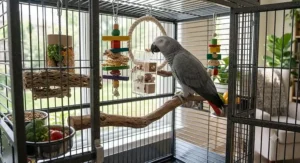
How to Choose an African Grey Cage: 7 Criteria That Actually Matter
- Bar spacing — 3/4″ to 1″ is the safe band for adult greys; anything wider risks head entrapment.
- Interior footprint, not advertised height — a tall, narrow cage looks impressive but a grey needs horizontal room to walk and flap nearly as much as vertical climbing space.
- Lock redundancy — single push-button latches get solved fast by this species specifically.
- Material lifespan vs. your bird’s expected lifespan — greys regularly live 40–60 years; budget wrought iron may need replacing more than once across that span.
- Tray and grille accessibility — daily cleaning compliance drops fast if the tray is hard to pull.
- Mobility — locking caster wheels matter more than they sound; you will move this cage for cleaning and room changes constantly.
- Number of access doors — multiple feeder doors reduce the need to open the main door (and risk an escape) just to refill water.
Common Mistakes When Buying an African Grey Cage
The single biggest mistake is buying based on a cage marketed broadly as a “large bird cage” without confirming African grey is explicitly listed among the suitable species — generic large-bird marketing sometimes means cockatiel-scale dimensions stretched taller, not wider.
A close second: assuming a higher price automatically means better bar spacing or lock security. Several mid-priced cages on this list outperform pricier decorative options on the safety fundamentals that matter most.
Finally, owners frequently underestimate assembly time and end up rushing the build, which is exactly when caster legs get attached wrong or a door hinge ends up misaligned.
Wrought Iron vs. Stainless Steel: Which Material Wins for African Greys?
Wrought iron with a powder-coat finish dominates this market for good reason — it’s strong, widely available, and far cheaper to manufacture at large sizes. The catch is that any chip in the coating, which a grey’s beak will eventually find, exposes the metal underneath to rust over years of use.
Stainless steel sidesteps that problem entirely. It costs roughly double to triple the price for a comparable size, but there’s nothing to chip through to expose corrodible metal. For a bird with a 40+ year lifespan, that’s a genuinely different ownership calculation than it would be for a shorter-lived pet.
The practical verdict: wrought iron is the right call for most first cages and even most second cages. Stainless steel earns its premium specifically for owners who’ve already committed long-term and want to stop thinking about cage replacement entirely.
What to Expect: Real-World Performance Once the Cage Arrives
On unboxing day, expect assembly to run 45–90 minutes depending on the model, with ornate designs like the Mcage running longer. Expect the bird to ignore the cage entirely for the first hour or two — that’s normal investigative caution, not rejection.
Within the first week, expect to discover your actual cleaning rhythm doesn’t match the manual’s suggested schedule; most owners settle into daily spot-cleaning with a deeper weekly tray scrub, regardless of what the included instructions recommend.
By week three or four, expect to be adding or repositioning perches as you learn your specific bird’s climbing habits — the stock perch placement is a starting point, not a final layout.
Long-Term Cost & Maintenance: The True Price of Cage Ownership
The sticker price is the smallest piece of total ownership cost. Replacement perches, occasional tray or grille swaps, and a cage cover for sleep hygiene all add up over years. Wrought-iron cages typically need a replacement perch or two within the first year as a grey’s beak works through the stock wooden ones; budgeting an extra $20–$40 annually for perch and toy replacement is realistic regardless of which cage you buy.
Stainless steel reduces one specific cost — corrosion-driven full replacement — but doesn’t eliminate routine maintenance spend. Across a full grey lifespan, the gap between a $200 wrought-iron cage replaced twice and a $550 stainless cage bought once narrows considerably.
Safety, CITES & Regulations: What African Grey Owners Need to Know
African greys (Psittacus erithacus) carry import and ownership considerations that most parrot species don’t. Since 2017, the species has been listed under CITES Appendix I, the convention’s highest level of protection for internationally traded species, a status driven by steep wild-population declines tied to the pet trade and habitat loss. That listing doesn’t typically affect a domestic cage purchase, but it does mean responsible breeders and sellers should be able to document a bird’s legal origin if you’re acquiring one alongside the cage.
On the housing side itself, the MSD Veterinary Manual publishes minimum cage size and bar spacing recommendations by species that are worth checking against any cage you’re considering, since marketing copy doesn’t always reflect veterinary minimums precisely. Conservation groups tracking the species, including IFAW, note that grey parrots remain primarily threatened by illegal trade and habitat loss in the wild — a reminder that ethical sourcing matters as much as cage selection for this particular bird.
❓ Frequently Asked Questions
❓ What size cage does an African grey actually need?
❓ Can African grey cages be used outdoors?
❓ How often should an African grey cage be deep cleaned?
❓ Is stainless steel worth the extra cost for a grey cage?
❓ Do I need paperwork to buy an African grey, separate from the cage?
✨ Don’t Miss These Exclusive Deals!
🔍 Ready to set your African grey up right? These seven cages cover every budget tier — click through to check today’s availability before making your final pick!
Conclusion
Choosing among these seven cages comes down to matching your timeline, not just your budget. If this is a first grey and a first large-bird cage, the Yaheetech or Sinopet get the fundamentals right without overspending. If you’re already years into bird ownership and thinking in decades, the Prevue stainless steel model is the purchase that stops the cage-replacement conversation entirely. Whatever you choose, prioritize bar spacing and lock security over decorative extras — those two factors affect your bird’s safety every single day it spends in the cage.
Recommended for You
- 7 Best African Grey Parrot Cages in 2026
- Cockatiel Cage vs Conure Cage: 7 Proven Picks for 2026
- Medium Parrot Cage Buying Guide: 7 Best Picks for 2026
Disclaimer: This article contains affiliate links. As an Amazon Associate, I earn from qualifying purchases. If you purchase products through these links, we may earn a small commission at no additional cost to you.
✨ Found this helpful? Share it with your friends! 💬🤗
