
In This Article
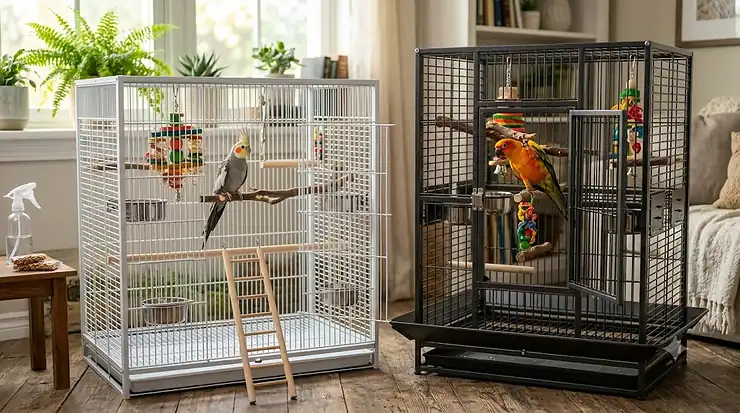
Here’s the thing nobody tells you at the pet store: a cockatiel cage and a conure cage are, on paper, almost the same box. Same general footprint. Same wire grid. Same rolling stand with the squeaky wheel that’ll wake your neighbors at 6 a.m. feeding time. So why do bird forums light up every week with someone asking whether their “cockatiel cage” is secretly a death trap for their new green cheek?
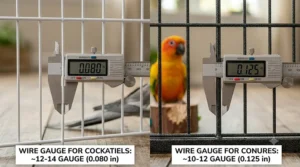
The short answer: a cockatiel cage vs conure cage decision isn’t really about size at all — it’s about how each bird uses the space, and how hard one of them is trying to destroy it. A cockatiel is a glider with a long tail and a love of horizontal runways. A conure is a gymnast with a beak built like a bolt cutter. Same square footage, completely different lifestyle demands.
I’ve spent the last few weeks pulling apart real listings, real specs, and real owner complaints to figure out which cages actually hold up — not just which ones photograph well. Below you’ll find a quick comparison, seven cages worth your money in 2026, and the unglamorous details (bar gauge, finish chemistry, chew resistance) that actually decide whether your bird is happy or escaping through a bent bar by Tuesday.
What’s the Real Difference Between a Cockatiel Cage and a Conure Cage?
A cockatiel cage and a conure cage share similar minimum dimensions, but a true cockatiel cage prioritizes width for gliding flight and slightly wider bar spacing, while a conure-rated cage prioritizes bar gauge thickness and chew-resistant, non-toxic materials, since conures bite far harder relative to their size.
Quick Comparison: Cockatiel Needs vs Conure Needs
| Factor | Cockatiel | Conure (Green Cheek–size) |
|---|---|---|
| Minimum footprint | 24″L x 18″D x 24″H for one bird A cage should measure at least 24 inches wide, 18 inches deep, and 24 inches tall for a single bird | 24″L x 24″D x 30″H, more square than rectangular aim for a cage at least 24 x 24 x 30 inches in size |
| Bar spacing | 1/2″–5/8″ | 1/2″–5/8″, tighter end preferred for smaller species |
| Biggest risk factor | Wing/tail injury in cramped cages | Chewed-through powder coat, bent bars |
| Flight style | Long horizontal glides | Vertical climbing, swinging, “dancing” |
| Best material | Powder-coated steel is fine | Stainless steel or thick-gauge wrought iron preferred |
That table looks tidy, but here’s the part it can’t show you: a cage that’s “technically” the right size can still fail a conure in six months if the bar gauge is thin, because conures, despite being lightly built, have small but strong beaks that go to work on weak spots immediately. Cockatiels are comparatively gentle on hardware — their stress test is space and flight room, not structural integrity.
💬 Just one click — help others make better buying decisions too!😊
✨ Don’t Miss These Picks!
💬 Whichever side of the cockatiel-cage-vs-conure-cage debate your bird falls on, scroll down — the right match is in the list below, and it might cost less than you think.
Top 7 Cockatiel and Conure Cages — Expert Analysis
I sorted these by what they’re actually good at, not by price. A few show up on “best cockatiel cage” lists; a couple are built specifically to bridge both species.
1. Yaheetech 52-inch Wrought Steel Standing Flight Cage
Yaheetech 52-inch Wrought Steel Standing Large Flight King Bird Cage is the generalist of this list — it’s marketed for cockatiels, conures, quakers, and small Amazons all at once, and the dimensions back that up: this large birdcage measures 31″ L × 20.5″ W × 52″ H and features a 5/8″ bar spacing. That width matters more than the spec sheet lets on — 20.5 inches of depth gives a cockatiel actual room to flap rather than just hop between two perches three inches apart.
What most buyers overlook here is that 5/8″ spacing sits right at the edge of “safe” for both species — fine for an adult cockatiel’s skull, fine for most conures, but worth a second look if you’ve got a particularly slim-headed cockatiel hen. The Yaheetech is built from sturdy powder-coated metal for enhanced strength and durability, which holds up to normal cockatiel activity but will show chew marks faster under a determined conure than the stainless options further down this list.
✅ Wide enough for real lateral flight
✅ Rolling stand included, easy to reposition
✅ Budget-friendly entry point into flight-cage territory
❌ Powder coat can chip under heavy chewing over years of use
❌ 5/8″ spacing needs supervision with very small-headed birds
Best for: First-time cockatiel owners, or conure owners who aren’t dealing with a hardcore chewer. Typically lands in the $110–$150 range — solid value for the footprint you’re getting.
2.Prevue Pet Products Wrought Iron Flight Cage (F040)
This is the cage that keeps showing up on “best all-around” lists for a reason, and it’s currently sold direct on Amazon under multiple finish options. Prevue Pet Products Wrought Iron Flight Cage, model F040, measures 31″L x 20-1/2″W x 53″H with 1/2″ wire spacing — a quarter-inch tighter than the Yaheetech above, which sounds small until you realize it closes the gap that lets a curious cockatiel get its head stuck.
What actually makes the Prevue worth the higher price isn’t the dimensions — it’s the company behind it. Prevue Hendryx has been building cages since the 1800s, and the F040 reflects that with two large front doors, an integrated stand with storage shelf, and four plastic cups plus three wood perches included. On Amazon, the listing explicitly covers parakeets, cockatiels, conures, lovebirds, canaries, finches, parrotlets, and caiques — about as direct a “yes, this works for both” answer as you’ll get from a manufacturer.
In my experience, the one real complaint that surfaces in owner reviews is door placement — both access doors sit center-front, which makes rearranging perches and feeders more awkward than cages with side doors. It’s a minor annoyance, not a dealbreaker.
✅ Tighter, safer 1/2″ bar spacing
✅ Multi-generation brand reputation
✅ Confirmed dual-species fit straight from the listing
❌ Pricier than budget flight cages
❌ Center-only doors make rearranging fiddly
Best for: Owners who want one cage to do double duty for a cockatiel-and-conure household. Generally runs $210–$260, with the price fluctuating around sales — it’s been tracked as low as roughly $211 against a $260 list price.
3. A&E Cage Company 18″x18″ Play Top Cage (5/8″ Bar Spacing)
This one’s the sleeper pick. A&E Cage Company 18″x18″ Play Top Cage is one of the few cages on the market explicitly engineered for both target birds — the manufacturer specs list it as best suited for cockatiels, parakeets, conures, quakers, mini macaws, small cockatoos, African greys, and Amazons, and the build matches the claim: exterior dimensions of 18″x18″x54″, a 24-inch interior height, 5/8″ bar spacing, and 2.5mm bar gauge.
That bar gauge number is the detail spec sheets bury and owners pay for later. A 2.5mm gauge is noticeably thicker than what you’ll find on most sub-$150 imports, which means a conure can gnaw on it daily for years without bending it into an escape hatch. The playtop adds real value too — two ladders, a perch, and a toy hook turn the top of the cage into supervised out-of-cage time without needing a separate stand.
The footprint is the tradeoff: 18×18 inches is compact, which is great for apartments but tight for a bird that doesn’t get much daily out-of-cage time. Think of it as a “great home base, not a permanent flight enclosure” cage.
✅ Purpose-built spec sheet names both species directly
✅ Thicker 2.5mm bar gauge resists conure chewing
✅ Compact footprint fits small apartments
❌ 18×18 floor space is snug without daily playtime
❌ Assembly required, no pre-built option
Best for: Apartment dwellers and anyone tired of buying a “universal” cage that turns out to be neither bird’s actual best fit. Typically priced in the $170–$220 range.
4. A&E Cage Company Play Top Cage, Stainless Steel
Same footprint, completely different material story. The A&E Cage Company Stainless Steel Play Top Cage shares the 18″x18″x54″ shape of the powder-coated version above, but trades the coating for solid stainless — and the manufacturer markets it as best suited for cockatiels, conures, and lovebirds specifically.
Here’s what the spec sheet won’t tell you: powder coating is a finish applied over metal, and finishes chip. Stainless steel doesn’t have a coating to lose — there’s nothing for a conure’s beak to flake off, which removes the long-term chip-and-rust cycle that eventually turns a powder-coated cage into a safety question. One owner’s experience captured this well — a pineapple green cheek conure settled into the cage comfortably, with the bar spacing and double-lock door mechanism standing out as genuinely useful for a smaller chewing bird, and the reviewer noted it suits a small conure, cockatiel, or similarly sized bird just as well.
This is the cage I’d point a conure-specific household toward if budget allows, because it sidesteps the one failure mode powder-coated cages eventually run into.
✅ Zero chip/corrosion risk — nothing for a beak to peel
✅ Easiest material to deep-clean and disinfect
✅ Owner-verified fit for green cheek conures specifically
❌ Priciest pick on this list
❌ Same compact 18×18 footprint as the powder-coat version
Best for: Owners of heavy chewers who want a cage that will genuinely outlast the bird. Stainless construction commands a real premium over the powder-coated sibling — expect somewhere in the $350–$450 range depending on retailer and season.
5. Topeakmart 63-Inch Wrought Iron Large Parrot Cage
If the A&E cages above are the precision tools, Topeakmart 63-Inch Wrought Iron Large Parrot Cage is the brute-force option. The listing title alone tells you what it’s for — it’s marketed directly as a Cockatiel Conure Mid-Sized Parrot Cage, and at 63 inches tall with a full flight-cage body, it gives both species serious vertical and horizontal room to work with.
What I’d flag here: Topeakmart doesn’t always publish bar spacing as prominently as Prevue or A&E do on this particular model, so before you buy, pull up the current listing and confirm the spacing matches your bird — that single five-minute check prevents the most common “wrong cage” mistake in this whole category. The wrought iron build itself is solid and holds up well to general use; it’s the kind of cage that wins on raw size-per-dollar rather than refined engineering.
✅ Genuinely large footprint for the price tier
✅ Explicitly dual-branded for cockatiel and conure
✅ Wrought iron frame, not thin sheet metal
❌ Spec transparency varies — verify bar spacing before ordering
❌ Finish quality is a step below premium brands
Best for: Budget-conscious owners who want maximum interior volume without paying boutique prices. Generally falls in the $140–$190 range.
6. VIVOHOME 54 Inch Wrought Iron Large Bird Flight Cage
VIVOHOME 54 Inch Wrought Iron Large Bird Flight Cage is the value play that keeps earning repeat mentions across review sites, and the spec sheet explains why — it’s built from a high-quality metal frame with nontoxic hammer-pattern paint that resists corrosion, paired with four universal casters and a latch design meant to stop birds from opening the door themselves.
The flat-top design (versus a domed or play-top design) is the detail that splits opinion. It means less built-in enrichment than the A&E cages, but more room to set up your own toy rotation or even a potted plant for visual enrichment — a small thing that matters more than it sounds for a bored cockatiel.
✅ Strong value at this price point
✅ Flat top maximizes hanging-toy real estate
✅ Decent track record across thousands of buyer reviews
❌ Budget build quality — assembly can be fiddly
❌ Less out-of-the-box enrichment than play-top designs
Best for: Owners who want a large flight cage and plan to customize the inside themselves. Typically sits around $130–$160.
7. YITAHOME 53.9-inch Metal Bird Cage with Stand and Cover
Rounding out the list, the YITAHOME 53.9-inch Metal Bird Cage earns its spot for one reason most competitors skip entirely: it actually ships with a cage cover. The full listing covers a seed catcher and bird cage cover along with a rolling stand and brakes, marketed for lovebirds, cockatiels, pigeons, and finches — and by direct size comparison, it suits smaller conure species just as well.
The cover is the sleeper feature here. Most owners buy one separately within the first month of cage ownership anyway, so getting it bundled in is a real cost saver, not a marketing throwaway. The brake-equipped casters are the other nice touch — locking wheels matter more than people expect once a bird starts leaning into the cage during play.
✅ Cage cover included — a cost most owners pay separately
✅ Brakes on casters add real stability
✅ Seed catcher cuts down floor mess
❌ Heavier to relocate without help
❌Smaller footprint than the flight-cage options above
Best for: Owners who want a complete starter kit without assembling it from five different product pages. Generally priced around $110–$150.
Quick Comparison Table — All 7 Picks
| Cage | Best For | Bar Spacing | Price Range |
|---|---|---|---|
| Yaheetech 52″ Flight Cage | Budget all-rounder | 5/8″ | $110–$150 |
| Prevue F040 Flight Cage | Multi-bird households | 1/2″ | $210–$260 |
| A&E 18×18 Play Top (powder) | Apartments, dual-species fit | 5/8″ | $170–$220 |
| A&E 18×18 Play Top (stainless) | Heavy chewers | 5/8″ | $350–$450 |
| Topeakmart 63″ Large Cage | Max volume per dollar | Verify before buying | $140–$190 |
| VIVOHOME 54″ Flight Cage | DIY enrichment setups | Not always listed | $130–$160 |
| YITAHOME 53.9″ with Cover | Complete starter kit | Not always listed | $110–$150 |
Looking at the spread above, the two A&E cages bracket the real decision in this niche: pay less and accept the chip-and-rust clock on powder coating, or pay roughly double for stainless and stop thinking about it for the next decade. The Prevue earns its premium through brand longevity rather than raw specs, while the Topeakmart and VIVOHOME options compete purely on volume-per-dollar — fine choices, as long as you personally verify bar spacing before checkout rather than trusting the headline title alone.
🔍 Take Your Setup to the Next Level
Click through on any cage above to check current availability and pricing — listings shift fast, and the model you want can sell out of a finish color overnight.
Setting Up a New Cage: The First 30 Days
Getting the cage right is half the job. The other half is the setup, and most new owners overload it on day one.
Start with perches before toys. Use at least two different diameters and textures — natural wood, not just the dowels included in the box — because foot health depends on varying grip surfaces, not a flat repeated shape. Place food and water on opposite sides of the cage, not stacked next to each other, so your bird has to move to use both. That single change does more for activity levels than almost any toy you can buy.
Resist the urge to fill every inch with toys in week one. A half-empty cage that a nervous bird can navigate beats a fully decorated one that overwhelms it. Add one new item every few days instead, and watch how your bird responds before adding the next. If you’re transitioning from a smaller cage, expect a short adjustment window — birds occasionally avoid a new, larger space initially simply because it changes their sense of where “safe” is. Patience here outperforms forcing the issue.
By week three, do a full hardware check — tighten any bolts that loosened during the breakerin period, and inspect bar spacing points near doors and feeder openings, since those are the spots most likely to widen first under regular use.
Real-World Scenarios: Matching Bird to Cage
The apartment-dwelling cockatiel owner. Limited floor space, one bird, daily out-of-cage supervised time available. The A&E 18×18 Play Top (powder-coated) fits this profile well — compact enough for a small living room, with the playtop covering the enrichment gap that the footprint alone can’t.
The two-conure household with a serious chewer. Multiple birds, heavy beak activity, budget that allows for a long-term investment. This is exactly the case the A&E stainless steel version was built for — the upfront cost stops being a question once you calculate what a powder-coated cage costs to replace every two to three years under that kind of pressure.
The first-time bird owner on a tight budget. One bird, first cage ever, uncertain how committed they’ll be to the hobby long-term. The YITAHOME with included cover or the Yaheetech 52-inch both make sense here — low enough cost to test the waters, solid enough build to not regret the purchase if the hobby sticks.
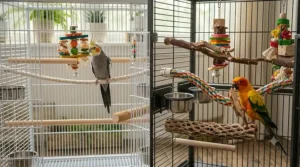
How to Choose Between a Cockatiel Cage and a Conure Cage
- Measure your bird’s wingspan first, not the cage. The cage should be at least one and a half times the size of the bird’s wingspan in all directions — work backward from that number rather than picking a cage size that just “looks big enough.”
- Check bar spacing against your specific species. Cockatiels tolerate up to 5/8″; smaller conure species like green cheeks do best at 1/2″–5/8 “.
- Prioritize material over paint job for conures. A heavy chewer will out-beak a thin powder coat within a year or two — gauge thickness and material (stainless vs. coated steel) matter more than color options.
- Count the doors, not just the size. Multiple access points make daily feeding and cleaning dramatically easier — a detail that only becomes obvious after the first week of ownership.
- Add multi-bird math before buying. If you want to keep more than one bird in the same cage, make sure the cage is even bigger — don’t assume two birds simply split one bird’s recommended space in half.
- Buy the rolling stand if it’s optional. Cleaning frequency goes up dramatically once you can actually move the cage to a sink or hose-down spot.
- Leave room to grow. A cage that’s perfect on delivery day often feels small within a year, once your bird’s confidence and activity level increase.
Common Mistakes When Buying a Medium Bird Cage
The single most common mistake is buying for the bird you have today, not the bird in six months. Cockatiels and conures both get bolder with confidence, and a cage that felt spacious for a nervous, newly-acquired bird often feels cramped once that same bird is flying laps and demanding floor time.
The second mistake is trusting “for cockatiels AND conures” marketing language without checking the actual bar spacing number. As we covered above, that single spec is doing more safety work than the species list in the title. The third mistake — and this one’s sneaky — is underestimating cleaning frequency. A cage without a rolling stand or wide enough door access turns a five-minute daily clean into a fifteen-minute wrestling match, and that gap is exactly how cleaning corners start getting cut.
Features That Actually Matter (And Those That Don’t)
Bar gauge thickness matters enormously and gets almost no marketing attention — it’s the single best predictor of how a cage holds up to a conure’s beak over years, not months. Pull-out trays matter too; the difference between a tray that slides smoothly and one that catches on every removal is the difference between cleaning daily and cleaning every third day out of frustration.
What doesn’t matter nearly as much as the marketing implies: decorative paint colors, “designer” shapes like arched or domed tops, and bundled toy counts. A cage with five mediocre included toys isn’t better than a cage with two — your bird will ignore most of them within a week regardless. Spend the marginal dollar on build quality, not accessory count.
Long-Term Cost & Maintenance
| Cost Factor | Budget Cage (Powder Coat) | Premium Cage (Stainless) |
|---|---|---|
| Upfront price | $110–$190 | $350–$450 |
| Replacement cycle (heavy chewer) | 2–4 years | 10+ years |
| Cleaning effort | Higher — coating traps grime in chips | Lower — smooth surface, no chip points |
| Long-term cost | Repeated purchases add up | Pays for itself over a decade |
Run the math over a decade of ownership and the stainless option usually wins for households with a determined chewer, even though the sticker price looks rough up front. For a gentler cockatiel that isn’t gnawing on hardware daily, the budget powder-coated cages hold up fine and the math tips the other way.
Safety & Bar Spacing Compliance Guide
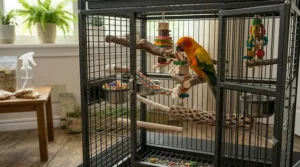
There’s no government-mandated bar spacing standard for pet birds in the U.S., which is exactly why this falls on the buyer to verify. The widely repeated rule of thumb across avian-care resources puts cockatiels safely under 5/8″ and most pet conure species at 1/2″–5/8″, with smaller-headed individuals needing the tighter end of that range regardless of species label on the box. If a listing doesn’t state bar spacing explicitly, treat that as a reason to keep looking rather than assume it’s “probably fine.”
FAQ
❓ What size cage does a cockatiel need?
❓ Can a conure live in a cockatiel cage?
❓ What bar spacing is safe for a green cheek conure?
❓ Is stainless steel worth it for a conure cage?
❓ How often should I deep clean a cockatiel or conure cage?
Conclusion
If you’ve made it this far, you already know the cockatiel cage vs conure cage debate isn’t really a debate — it’s a checklist. Get the wingspan-based sizing right, match bar spacing to your specific bird rather than the species label on the box, and weight material quality higher than paint color or bundled accessories. Do that, and almost any cage on this list will serve your bird well for years.
My honest pick for most households: the Prevue F040 if you want one trusted, do-it-all flight cage, or the A&E stainless steel play top if a conure’s beak has already proven it can out-chew a cheaper finish. Either way, the right cage is the one that fits the bird you’ll have in a year, not just the one you have today.
✨ Don’t Miss These Picks!
🔍 Take your bird’s setup to the next level with the cages covered above — check current availability before the finish color you want sells out.
Recommended for You
- Medium Parrot Cage Buying Guide: 7 Best Picks for 2026
- Conure Cage Buying Guide 2026: 7 Real Picks (Don’t Skip This)
- Top Rated Conure Cages: 7 Best Picks for 2026
Disclaimer: This article contains affiliate links. As an Amazon Associate, I earn from qualifying purchases. If you purchase products through these links, we may earn a small commission at no additional cost to you.
✨ Found this helpful? Share it with your friends! 💬🤗
