
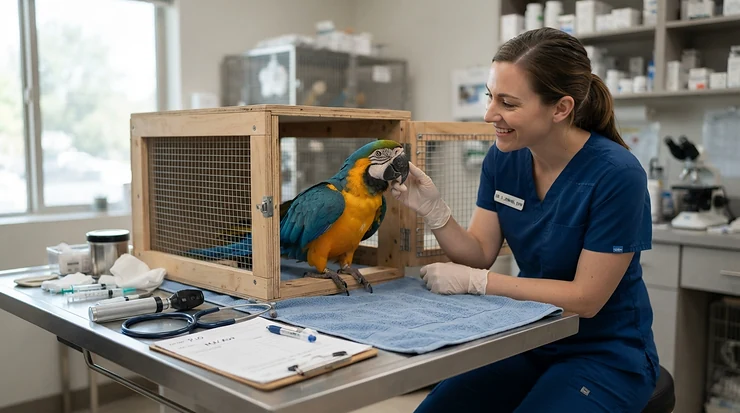
A bird carrier for large parrot vet transport is a reinforced, well-ventilated container built to hold a macaw, cockatoo, Amazon, or African grey securely between your front door and the exam table — nothing more glamorous than that, but everything hinges on it. If you’ve ever wrestled a forty-mile-an-hour blur of feathers into a cardboard box because the “good” carrier got chewed through last spring, you already know why this matters. The right carrier isn’t a luxury item; it’s the difference between a parrot who steps calmly onto a scale and one whose heart rate spikes before the vet even opens the door.
Large parrots are smart, strong-beaked, and easily rattled by anything unfamiliar, so a flimsy or ill-fitting box turns a routine checkup into a genuine ordeal. U.S. federal live-animal transport standards, adapted from IATA container rules, even spell out minimum size and ventilation requirements for a reason: cramped, poorly aired containers create real physiological stress. Below, you’ll find seven real carriers — from budget fabric zip-ups to a purpose-built macaw backpack — plus the sizing logic, hard-shell-versus-soft breakdown, and pre-appointment prep that actually make a difference.
In This Article
Quick Comparison Table
Before diving into individual products, here’s how the four broad carrier styles stack up against each other for a bird carrier for large parrot vet transport buyer.
| Carrier Type | Typical Weight | Price Range | Best For |
|---|---|---|---|
| Hard-shell wire cage | 6–9 lbs | $35–$140 | Powerful beaks, cage-style comfort |
| Hard-shell acrylic/clear | 7–9 lbs | $90–$160 | Visibility, easy disinfecting |
| Soft-sided backpack | 2–5 lbs | $55–$400 | Hands-free carrying, active owners |
| Fabric zip-top carrier | 1–3 lbs | $20–$50 | Cockatiels, small conures |
Weight and material trade off almost perfectly against chew-resistance: the lighter the shell, the more a determined beak can eventually work through it. If your household includes a cockatoo or macaw with a habit of testing every seam, budget more toward the hard-shell end of this table. If you’re mostly transporting a cockatiel or small conure who’s never so much as nibbled a zipper, the fabric options save weight, money, and closet space.
💬 Just one click — help other bird owners make better carrier decisions too! 😊
Top 7 Bird Carriers for Large Parrot Vet Transport: Expert Analysis
We researched real, currently-manufactured carriers spanning budget, mid-range, and premium tiers, with an eye toward what actually holds up against a determined macaw or cockatoo. Every pick below includes honest analysis grounded in published specs and aggregated owner feedback — never invented reviews.
1. Prevue Pet Products Playtop Bird Travel Carrier — seatbelt-secured hard cage built for chewers
The standout here is simple: this is one of the few travel cages with built-in seatbelt collar brackets, so it buckles into a car seat instead of sliding around the floorboard during braking.
Measuring roughly 18.75″ long by 14.875″ wide by 18″ high with half-inch wire spacing, the Prevue Pet Products Playtop Bird Travel Carrier gives an Amazon or small cockatoo enough headroom to stand upright without crouching, and the powder-coated steel bars simply don’t yield to a determined beak the way fabric or acrylic eventually might. Lock-in stainless cups mean spilled water isn’t part of the ride, and a wind-bell grille tray lock keeps the pull-out cleaning tray from rattling loose over speed bumps.
Based on the spec sheet, this is the pick for owners whose bird has already destroyed a soft carrier — the rigid steel frame simply removes that failure mode entirely. Reviewers consistently note strong build quality and easy assembly, with the product holding a 4.6-star average across more than 1,200 ratings on major retail sites, though a few owners mention the powder coating can chip if the carrier is dropped repeatedly.
Pros:
- ✅ Seatbelt brackets for genuine automotive security
- ✅ Steel bars resist even strong-beaked chewers
- ✅ Lockable cups prevent mid-drive spills
Cons:
- ❌ Heavier than soft carriers at nearly 9 lbs
- ❌ No shoulder strap — you carry it by handle only
At around $115–$140, the Prevue Pet Products Playtop Bird Travel Carrier is a strong value if you want one carrier that will simply outlast your bird’s curiosity.
2. Celltei Pak-O-Bird Backpack Carrier (Macaw/Wide sizing) — hands-free backpack built specifically for macaw-sized bodies
What immediately sets this apart is that Celltei actually manufactures a size class scaled for macaws, rather than stretching a cockatiel design and hoping it fits.
Built from 1680-denier nylon with stainless-steel mesh windows, the Celltei Pak-O-Bird Backpack Carrier is designed to be worn — front or back — with padded straps that turn a vet trip into something closer to hiking with a very opinionated passenger. What most buyers overlook about backpack-style carriers is the balance benefit: a bird can grip its perch with one foot and brace against a second point of contact as you walk, which meaningfully reduces the swaying that triggers panic in a rigid box swinging from a handle.
Long-running owner discussions on bird-specific forums describe the Pak-O-Bird as expensive but “worth every penny” over years of daily use, with multiple long-term owners reporting six-plus years of service from a single unit. The main complaint that surfaces repeatedly is the price tag and a multi-week manufacturing lead time, since each unit ships from the manufacturer rather than off a retail shelf.
Pros:
- ✅ Purpose-built sizing for large parrot species
- ✅ Hands-free backpack design frees both arms
- ✅ Reported to last many years of repeated use
Cons:
- ❌ Among the most expensive options on this list
- ❌ Custom-order lead time can run several weeks
Expect to pay in the $250–$400 range depending on size and customization, making this a premium buy that earns its keep if vet trips (or outings in general) are a regular part of your bird’s life.
3. A&E Cage Company Voyager Travel Carrier (Large) — budget-friendly shell that still includes a real perch
The advantage that jumps out immediately is value: a reinforced plastic shell, a wooden perch with two mounting positions, and cross-ventilation mesh, all for less than the cost of a vet office copay.
The A&E Cage Company Voyager Travel Carrier combines a durable plastic shell with cotton canvas overlays, giving it more structure than a pure fabric bag while staying dramatically lighter than a full wire cage. The adjustable perch placement matters more than it sounds — being able to move the perch height means the same carrier can reasonably fit a mid-size Amazon or a smaller conure without the bird’s head brushing the roof, which is exactly the kind of cramped-fit stress that federal container standards are written to prevent.
Aggregated customer sentiment on this line skews positive for the price point, with owners frequently citing the padded shoulder strap and easy-clean floor liner as practical wins; the recurring criticism is that the plastic shell isn’t rated for a serious cockatoo or macaw who wants out.
Pros:
- ✅ Genuinely low price for a structured carrier
- ✅ Adjustable perch fits multiple bird sizes
- ✅ Removable floor liner simplifies cleanup
Cons:
- ❌ Plastic shell can be chewed through by large beaks
- ❌ Less ventilation than dedicated wire cages
At roughly $35–$50, the A&E Cage Company Voyager Travel Carrier is the sensible starter pick for Amazons, conures, and other mid-size parrots who aren’t serial escape artists.
4. PENNZONI Macaw & Parrot Acrylic Carrier — clear acrylic walls so the vet tech sees everything before opening the door
The headline feature is visibility: quarter-inch acrylic panels let staff assess posture, breathing, and droppings before ever touching the latch, which speeds up triage on a busy clinic day.
Measuring about 27″ long by 12″ wide by 17″ high and weighing around 8 lbs, the PENNZONI Macaw & Parrot Acrylic Carrier is sized specifically with macaws and large parrots in mind. Here’s what to weigh: acrylic is roughly a quarter-inch thick and manufacturer testing claims it’s far less prone to cracking than glass, plus the closed panels reportedly cut ambient noise by 30–50% compared with open wire — genuinely useful if your bird is the type that screams the second it senses stress building in the car.
Because this is a newer entrant compared with legacy brands like A&E or Prevue, the verifiable review pool is thinner; what’s out there leans positive on the noise-reduction claim and the fold-flat storage design, so treat the acrylic durability claims as manufacturer-stated until a longer track record of independent reviews accumulates.
Pros:
- ✅ Full visibility for faster clinic triage
- ✅ Notable noise dampening versus wire cages
- ✅ Folds flat for storage between trips
Cons:
- ❌ Thinner independent review history than legacy brands
- ❌ Acrylic can scratch and cloud with heavy use
Priced in the $90–$150 range, this is a smart mid-tier pick if visibility and noise reduction matter more to you than sheer chew-proofing.
5. Prevue Pet Products Backpack Bird Travel Carrier (Model 1311) — the lightest true backpack that still fits a small macaw
The standout advantage is weight: at under three pounds empty, it’s dramatically lighter than most hard-shell alternatives while still carrying a wooden perch and full wire-mesh viewing window.
The manufacturer explicitly rates the Prevue Pet Products Backpack Bird Travel Carrier for anything from a parrotlet up to a severe macaw, and the durable canvas with stiffened side panels gives it more shape retention than a pure duffel-style bag. On paper, this means you get backpack-style hands-free carrying — a real advantage for balance-sensitive birds, as noted earlier — at roughly a quarter of the price of a custom Pak-O-Bird.
Reviewers commonly describe it as a solid “starter backpack,” praising the adjustable perch and machine-washable interior pad, while also noting that a persistent chewer can eventually work through the double-zipper closure, so this suits calmer temperaments better than known escape artists.
Pros:
- ✅ Very lightweight for a full backpack design
- ✅ Rated up to severe macaw size
- ✅ Removable, washable interior floor pad
Cons:
- ❌ Zippers vulnerable to persistent chewers
- ❌ Less rigid protection than a hard-shell cage
At about $55–$70, this carrier fills the gap between the cheapest fabric options and a full premium backpack nicely.
6. Kaytee Come Along Carrier (Large) — a wallet-friendly pick built for cockatiels, not chewers
This carrier’s advantage is pure accessibility: it’s one of the cheapest carriers on this list, widely stocked, and specifically sized for a travel cage for cockatiel vet appointment use rather than for macaw-scale birds.
At roughly 17″ long by 11.5″ wide by 12.5″ high, the fabric-covered Kaytee Come Along Carrier includes nylon mesh windows for airflow and a vinyl interior that wipes clean after an accident on the way to the office — genuinely useful given how often stress loosens a bird’s droppings mid-transport. What most buyers overlook is that manufacturers and specialty retailers explicitly flag this style as unsuitable for African greys, Amazons, or small cockatoos, since those species can chew through the fabric with relative ease; it’s built and marketed for cockatiels, small conures, lovebirds, and similarly modest beak strength.
Owner sentiment across retail listings is generally favorable for its intended audience, citing the double-zipper access and lightweight carry handle, with the recurring caution being exactly the size limitation above — don’t buy this expecting it to hold a macaw.
Pros:
- ✅ Among the most affordable carriers available
- ✅ Well ventilated with easy-clean vinyl lining
- ✅ Sized appropriately for cockatiels and small conures
Cons:
- ❌ Not chew-resistant enough for large parrots
- ❌ No dedicated perch mounting hardware
At around $20–$30, the Kaytee Come Along Carrier is the honest budget answer for smaller companion birds heading to routine appointments.
7. Mcage Two Size Travel Collapsible Parrot Bird Carrier Cage — folds flat in seconds, the one that lives in your trunk
The stand-out feature is portability: a collapsible wire frame that folds down to a fraction of its assembled size, so it doesn’t permanently colonize your car’s cargo area between vet visits.
At approximately 20″ long by 12″ wide by 16″ high, the Mcage Two Size Travel Collapsible Parrot Bird Carrier Cage offers real wire-cage ventilation and structure while staying noticeably lighter than fully welded steel carriers — a genuine advantage if you’re the one lugging it up an apartment stairwell. Based on the spec comparison with rigid cages like the Prevue Playtop, the trade-off is a slightly less bombproof frame in exchange for a design that assembles and breaks down without tools, which matters if you’re storing it in a closet rather than a garage.
Bird-owner forum threads mention this exact style repeatedly as an “inexpensive, lightweight” go-to, with multiple owners noting their birds walk in willingly once it’s set up flat on the floor first; the main drawback flagged is that the folding hardware can loosen over years of repeated setup and breakdown.
Pros:
- ✅ Genuinely lightweight bird carrier for car travel
- ✅ Collapses flat for easy storage
- ✅ Wire construction gives strong ventilation
Cons:
- ❌ Folding hinges can loosen with heavy long-term use
- ❌ Less chew-resistant than solid welded cages
Typically priced in the $35–$55 range, it’s a smart middle-ground pick between disposable fabric bags and a permanent hard-shell cage.
| Product | Style | Approx. Price | Best For |
|---|---|---|---|
| Prevue Pet Products Playtop Bird Travel Carrier | Hard wire | $115–$140 | Chewers, car seatbelt use |
| Celltei Pak-O-Bird Backpack Carrier | Soft backpack | $250–$400 | Macaws, frequent outings |
| A&E Cage Company Voyager Travel Carrier | Soft/plastic shell | $35–$50 | Budget, mid-size parrots |
| PENNZONI Macaw & Parrot Acrylic Carrier | Hard acrylic | $90–$150 | Visibility, noise reduction |
| Prevue Pet Products Backpack Bird Travel Carrier | Soft backpack | $55–$70 | Lightweight, up to small macaw |
| Kaytee Come Along Carrier | Fabric | $20–$30 | Cockatiels, small conures |
| Mcage Two Size Travel Collapsible Parrot Bird Carrier Cage | Foldable wire | $35–$55 | Car storage, occasional trips |
Looking at the table above, the Prevue Pet Products Playtop Bird Travel Carrier delivers the best all-around durability for the price, but if your household includes a full-size macaw who travels often, the Celltei Pak-O-Bird Backpack Carrier justifies its higher cost through purpose-built sizing and reported longevity. Budget-conscious owners of smaller species should note that the Kaytee Come Along Carrier is explicitly not built for large, strong-beaked parrots — matching carrier to species matters more than matching carrier to price.
First Vet Appointment Prep: A Practical Usage Guide
Getting a new carrier is only step one; first vet appointment prep is really about teaching your bird that the carrier itself isn’t a threat, ideally weeks before you actually need it. Start by leaving the carrier open in a room your parrot already frequents, door propped, with a favorite treat placed just inside — no pressure, no closing the door, just familiarity. Behavior specialists who work with veterinary clinics note that training birds for transport in advance meaningfully increases the odds owners actually bring their bird in for regular checkups rather than avoiding the stress altogether.
Common first-30-days mistakes include introducing the carrier for the very first time on the morning of the appointment (guaranteed to spike stress), over-cleaning a brand-new carrier so it smells sterile and unfamiliar, and leaving food and water bowls rattling loose during the drive rather than securing them. A simple maintenance habit that pays off: wipe down perches and trays after every use, but don’t scrub away every trace of your bird’s own scent between sessions — some familiar smell inside the carrier is doing you a favor.
On the day itself, skip breakfast in the carrier (droppings on an empty crop are easier for your vet to interpret) and bring a lightly soiled cage liner from home if you can, since veterinarians often want to see recent droppings as part of the exam. Keep the ride itself as boring as possible — steady temperature, minimal sudden stops, and a light cover over part of the carrier if your bird calms down in dim light rather than bright visibility.

Real-World Scenarios: Which Carrier Fits Your Bird?
The Cockatiel Owner Heading to a Routine Checkup
If you’re managing a travel cage for cockatiel vet appointment logistics and your bird has never damaged so much as a toy, a fabric option like the Kaytee Come Along Carrier is genuinely sufficient — light, cheap, and appropriately scaled. Save the premium hard-shell spending for species that actually need it.
The Macaw Owner Facing an Unplanned Visit
A sudden illness or injury visit is exactly when a backpack carrier earns its cost: the Celltei Pak-O-Bird Backpack Carrier lets you move quickly with both hands free for doors, keys, and a stressed bird’s favorite blanket, without wrestling an awkward handle-carried box down a hallway.
The Renter Who Drives Everywhere and Has No Storage Space
If your priority is genuinely a lightweight bird carrier for car travel that doesn’t eat up closet space between visits, the Mcage Two Size Travel Collapsible Parrot Bird Carrier Cage folds flat enough to slide behind a couch, while the A&E Cage Company Voyager Travel Carrier offers a similarly compact, budget-friendly footprint if you’d rather have fixed structure over a fold-down frame.
How to Choose a Bird Carrier for Large Parrot Vet Transport
Picking the right bird carrier for large parrot vet transport comes down to seven concrete criteria, roughly in order of importance:
- Interior size — your bird should stand fully upright and turn around without wingtips brushing the sides.
- Chew-resistance — match shell material (steel, acrylic, reinforced plastic, or fabric) to your bird’s actual beak strength and history.
- Ventilation — look for mesh or bar coverage on at least two, ideally three, sides.
- Secure automotive fit — seatbelt loops or a flat, non-sliding base matter more than most buyers assume.
- A stable perch or non-slip floor — a bird bracing against motion is calmer than one sliding across a smooth floor.
- Visibility versus darkness — some birds calm down when they can see out; others do better semi-covered, so consider a carrier that allows both.
- Weight you can actually carry — the sturdiest carrier in the world doesn’t help if it’s too heavy to get from car to clinic quickly.
Standard avian physical exam protocol involves observing the bird’s respiratory rate and posture inside the carrier before handling begins, which is one more reason a carrier your vet can partially see into — rather than a fully opaque box — genuinely speeds up the appointment.
Avian Carrier Size Guide: Matching Dimensions to Species
An avian carrier size guide only works if it accounts for wingspan and tail length, not just body size — a long-tailed conure needs more interior length than its body weight suggests, while a stocky Amazon needs more shoulder-to-shoulder width.
| Species Group | Recommended Interior Size | Best For |
|---|---|---|
| Cockatiel, small conure | ~14″ L x 10″ W x 12″ H | Kaytee Come Along Carrier |
| Amazon, Quaker, mid conure | ~18″ L x 13″ W x 16″ H | A&E Cage Company Voyager Travel Carrier |
| African grey, small cockatoo | ~19″ L x 15″ W x 18″ H | Prevue Pet Products Playtop Bird Travel Carrier |
| Macaw, large cockatoo | 20″+ L x 15″+ W x 18″+ H | Celltei Pak-O-Bird Backpack Carrier |
Reading across this table, undersizing is the far more common mistake than oversizing — a carrier that’s slightly roomier than strictly necessary rarely causes problems, while one that forces a hunched posture actively adds physical stress on top of the emotional kind. If your bird’s species sits right on a size boundary, size up rather than down, especially for a bird with a long tail like a macaw or Alexandrine parakeet.
Hard Shell vs Soft Bird Carrier for Vet Trips: Which Wins?
The hard shell vs soft bird carrier for vet trips debate really comes down to your specific bird’s behavior rather than a universal winner. A hard-shell option — wire, acrylic, or reinforced plastic — wins decisively on pure containment: a determined cockatoo or macaw simply cannot chew, claw, or pry its way through welded steel bars or quarter-inch acrylic the way it eventually can through canvas or nylon mesh.
Soft-sided carriers win on two fronts hard shells can’t match: weight and wearability. A backpack-style soft carrier lets you keep both hands free, which matters enormously if you’re also managing a leash, a diaper bag, or simply a heavy clinic door, and the reduced weight makes a real difference on stairs or a long parking-lot walk. What most buyers overlook is that soft carriers also flex slightly on impact, which can actually be gentler during a sudden stop than a rigid box banging against a hard interior.
The honest verdict: if your bird has ever damaged a carrier, cage, or toy through sheer beak strength, spend the extra weight budget on hard-shell. If your bird is calm, well-socialized to the carrier, and you value portability, a quality soft-sided option like the Prevue Pet Products Backpack Bird Travel Carrier covers the vast majority of routine trips without the bulk.
Features That Actually Matter (And Those That Don’t)
Marketing copy on bird carriers loves to list features, but not all of them earn their keep once you’re actually loading a stressed parrot into the car.
Bird Carrier with Perch for Vet Visits: Why It’s Non-Negotiable
A bird carrier with perch for vet visits gives your parrot something to grip with its feet, and that grip does real work: birds balance instinctively through their feet, and a smooth, perch-free floor forces them to brace with their whole body against every turn and stop. Every carrier on this list except the pure fabric zip-tops includes some form of adjustable perch, and it’s genuinely one of the least skippable features on the entire list — reviewers across multiple products specifically call out perch stability as a comfort factor.
Lightweight Bird Carrier for Car Travel: What Actually Matters
For a lightweight bird carrier for car travel, the meaningful spec isn’t just total weight — it’s how securely the carrier sits once loaded. A three-pound carrier that slides off the seat under braking is more dangerous than a slightly heavier one that seatbelts in place. Prioritize a flat, wide base or built-in strap loops over shaving off another half-pound of shell weight.
Features That Don’t Matter Much
Decorative color options, branded carrying cases, and “designer” fabric prints add cost without adding safety — skip paying a premium purely for aesthetics unless it happens to bundle in a feature you’d want anyway.
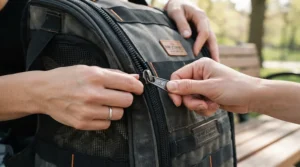
Macaw Vet Visit Stress: What to Expect and How to Reduce It
Macaw vet visit stress tends to look different from stress in smaller species — instead of the quiet freezing you might see in a cockatiel, macaws more often vocalize loudly, lunge at the carrier door, or pin their eyes rapidly as a warning sign. Clinical guidance on avian fear, anxiety, and stress notes that even calm birds commonly display these signals immediately upon arriving at the hospital, which means seeing it in your own bird doesn’t mean something has gone wrong — it means the process is doing exactly what it’s designed to minimize, not eliminate entirely.
What actually helps: keeping the same carrier for every trip so the smell and shape stay familiar, covering roughly half the carrier with a light cloth so your macaw can choose between visibility and a dark, secure-feeling corner, and avoiding car rides that are only ever associated with the vet — an occasional short, pleasant drive can decouple “carrier” from “something bad is about to happen.” Bringing a second person to hold the carrier steady while you drive also reduces the sliding and jostling that amplifies a macaw’s fight-or-flight response.
Common Mistakes When Buying a Bird Carrier for Vet Transport
The single most frequent mistake is buying based on price alone rather than beak strength — a $25 fabric carrier is a false economy if your macaw chews through it on the first trip. A close second is guessing at size instead of measuring wingspan and tail length against the size guide above, which routinely leads to owners returning an undersized carrier within weeks.
Owners also commonly overlook automotive security, treating the carrier as something to simply set on a seat rather than securing it with a belt or non-slip base — exactly the failure mode the Prevue Pet Products Playtop Bird Travel Carrier‘s seatbelt brackets solve directly. Finally, plenty of buyers skip the acclimation period entirely, introducing the carrier for the very first time on appointment morning, which stacks unnecessary stress on top of whatever brought the bird to the vet in the first place.
Bird Carriers vs. Traditional Transport Methods
Before dedicated carriers were common, owners improvised with pillowcases, towel-wraps, or a borrowed cat carrier — methods that still surface in casual advice today.
| Method | Safety | Vet-Visit Ease | Typical Stress Level |
|---|---|---|---|
| Dedicated bird carrier | High | High | Lower |
| Towel-wrap / pillowcase | Low | Low | Higher |
| Borrowed cat/dog carrier | Medium | Medium | Medium–high |
A dedicated carrier wins on every axis that matters for a repeat, ongoing relationship with a vet, mainly because it gives your bird a consistent, controllable environment trip after trip. A borrowed cat carrier is a reasonable one-time emergency stopgap, but it usually lacks a bird-appropriate perch and often has door gaps wide enough for a determined head or foot to squeeze through — something plain to see once you compare it side-by-side with a purpose-built option like the A&E Cage Company Voyager Travel Carrier.
Long-Term Cost & Maintenance: Is a Premium Carrier Worth It?
Run the actual math and a premium carrier often wins on cost-per-use rather than losing to a cheaper option. A $30 fabric carrier that gets chewed through in eight months and needs replacing three times over five years costs roughly $90 plus the hassle of last-minute reordering before an appointment; a $300 Celltei Pak-O-Bird Backpack Carrier that reasonably lasts six-plus years, based on long-term owner reports, works out to roughly $50 per year of actual use.
Maintenance itself is minor either way: wipe down trays and perches after each trip, air-dry fabric carriers fully before storage to avoid mildew, and periodically check wire cages for loosened hinges or rust spots, particularly on foldable models like the Mcage Two Size Travel Collapsible Parrot Bird Carrier Cage where hardware sees repeated stress from folding and unfolding. The real long-term cost driver isn’t the sticker price — it’s how well the carrier’s material matches your bird’s actual chew strength, since replacement cycles are what quietly erode the “budget” option’s advantage over time.
FAQ
❓ What is the best bird carrier for large parrot vet transport?
❓ Is a hard shell or soft bird carrier better for vet trips?
❓ What size carrier does a cockatiel need for a vet appointment?
❓ How do I reduce macaw vet visit stress before an appointment?
❓ Can I use a regular cat carrier for my parrot?
Conclusion
Choosing the right bird carrier for large parrot vet transport really comes down to being honest about your specific bird — its size, its beak strength, and how it’s handled travel so far. Budget-conscious owners of calm, smaller species can lean on options like the A&E Cage Company Voyager Travel Carrier or the Kaytee Come Along Carrier, while owners of powerful-beaked macaws and cockatoos are better served spending more upfront on the Prevue Pet Products Playtop Bird Travel Carrier or the Celltei Pak-O-Bird Backpack Carrier.
None of this replaces the groundwork of acclimating your bird to the carrier long before an appointment is on the calendar, and none of it substitutes for your avian vet’s specific guidance about your bird’s individual needs. What a good carrier does is remove one entire category of preventable stress from a day that’s already asking a lot of your bird — and that’s worth getting right.
Recommended for You
- Play Gym For Cockatiel: 7 Best Picks (2026)
- Play Gym for African Grey: 7 Best Picks Ranked for 2026
- Bird Play Gyms: 7 Best Picks to Transform Playtime in 2026
Disclaimer: This article contains affiliate links. As an Amazon Associate, I earn from qualifying purchases. If you purchase products through these links, we may earn a small commission at no additional cost to you.
✨ Found this helpful? Share it with your friends! 💬🤗
