
In This Article
If you’ve ever watched your parrot methodically shred a cardboard box or spend twenty minutes investigating a crumpled paper towel, you’ve witnessed something profound: the instinctual drive to forage that millions of years of evolution have hardwired into every bird’s DNA. Yet here’s what most bird owners don’t realize—your feathered companion should be spending 4-6 hours daily engaged in food-seeking behaviors, just like their wild counterparts. In captivity, most pet birds get maybe 30-72 minutes of actual foraging time when fed from a standard bowl.

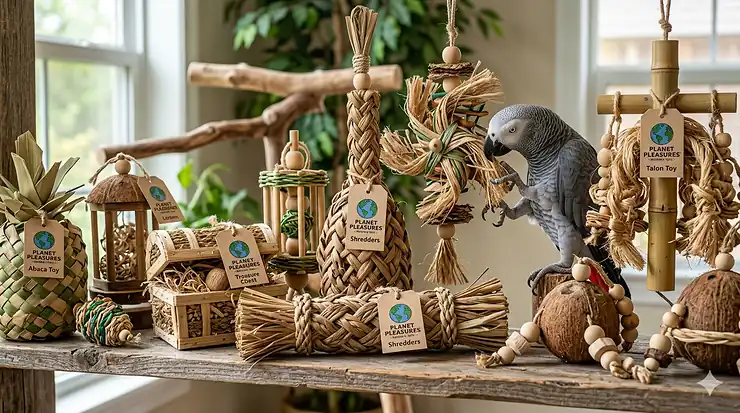
That’s where planet pleasures bird toys enter the picture. These handcrafted enrichment tools aren’t just colorful cage decorations—they’re carefully engineered to satisfy your bird’s biological need to search, shred, and discover. Made from renewable palm leaves, seagrass, and abaca fibers harvested by indigenous communities in the Philippines, planet pleasures natural toys represent a convergence of environmental sustainability and genuine behavioral science.
Research published by Cambridge University’s Animal Welfare journal demonstrates that parrots provided with appropriate foraging enrichment show dramatically improved feather condition scores and reduced stereotypical behaviors compared to birds in standard housing. The act of foraging isn’t merely entertainment—it’s a fundamental behavioral need that, when unmet, can manifest as feather plucking, excessive screaming, and psychological distress.
In this comprehensive guide, we’ll examine seven standout products from the eco friendly bird toys planet collection, breaking down exactly what makes each one effective for different species, cage sizes, and behavioral needs. You’ll learn which toys work best for aggressive chewers versus gentle preeners, how to rotate enrichment to prevent habituation, and why paying attention to your bird’s individual play style can transform cage time from boring confinement into engaging exploration.
Quick Comparison: Top Planet Pleasures Bird Toys at a Glance
| Product | Best For | Size Range | Price Range | Key Feature | Durability |
|---|---|---|---|---|---|
| Bird Tire Toy | Foraging beginners | Small-Large | $11-$18 | Hidden treat pockets | Medium (3-7 days) |
| Octopus Pinata | Shredding enthusiasts | Small-Large | $11-$14 | Multi-tentacle design | Medium (5-10 days) |
| Pineapple Foraging | Active foragers | Small-Large | $12-$16 | Layered compartments | High (7-14 days) |
| Spiked Pinata | Aggressive chewers | Small-XL | $6-$17 | Dense palm stuffing | Medium-High (4-10 days) |
| Sunflower Toy | Gentle preeners | Small-Large | $8-$21 | Dual flower design | High (10-20 days) |
| Flower Tower | Multi-bird households | Small-Large | $11-$28 | Stacked pinata blocks | High (7-15 days) |
| Tower Bird Toy | Large parrots | Large only | $30-$38 | 22″ vertical hanging | Very High (2-3 weeks) |
Looking at this comparison, the standout value proposition becomes clear: while the Pineapple Foraging toy and Flower Tower command slightly higher price points, their superior construction and multi-compartment designs translate to extended engagement periods—meaning fewer replacements and better cost-per-play ratios. Budget-conscious bird owners should note that the Spiked Pinata small size delivers exceptional value under $7, though cockatoos and macaws will demolish it within days. For maximum longevity in large parrot applications, the Tower Bird Toy’s dense woven construction withstands even the most destructive beaks for weeks rather than days.
💬 Just one click — help others make better buying decisions too! 😊
Top 7 Planet Pleasures Bird Toys: Expert Analysis and Real-World Performance
1. Planet Pleasures Bird Tire Toy
The Bird Tire Toy presents itself as an ingenious fusion of foraging opportunity and shredding satisfaction wrapped in a braided palm leaf tire design. Available in three sizes (Small: 4″×7″, Medium: 5.5″×9.5″, Large: 7″×11″), this bestseller accommodates everything from budgies to African Greys.
What sets this toy apart from conventional hanging shredders is the integrated foraging functionality—the braided tire construction creates natural pockets where you can tuck pine nuts, almonds, sunflower seeds, or pellets. Your bird doesn’t just destroy this toy; they actively problem-solve to extract hidden rewards, engaging both beak and brain. The medium size features two decorative woven stars and an abaca fiber tail that provides varied textures for birds who enjoy preening alongside their destructive play.
From an expert perspective, this toy excels as an introduction to foraging for birds transitioning from simple hanging toys. The visible treat placement (tucked between braids rather than completely hidden) provides enough challenge to be engaging without causing frustration in inexperienced foragers. Customer feedback consistently highlights how quickly birds figure out the “search and destroy” game, with many reporting their parrots heading straight for the tire when new treats are added.
The natural palm and abaca construction means zero toxic dyes, no metal components to rust, and complete biodegradability when your bird finally reduces it to confetti. However, aggressive chewers like larger cockatoos will dismantle this toy in 2-3 days—factor that into your enrichment budget.
Pros:
✅ Dual-purpose foraging and shredding design
✅ Three sizes accommodate most species
✅ Natural texture variety engages multiple senses
Cons:
❌ Short lifespan with destructive chewers
❌ Assorted colors mean you can’t choose specific shades
In the $11-$18 range depending on size, the Bird Tire Toy delivers solid value for daily enrichment, particularly when you rotate it with other toy types to prevent habituation.
2. Planet Pleasures Octopus Pinata Bird Toy
The Octopus Pinata takes the classic pinata concept and reimagines it with avian behavioral science in mind. This hand-woven wonder features a central palm leaf body stuffed with additional shredding material, surrounded by eight colorful tentacles that dangle enticingly at different lengths.
What most Amazon product listings won’t tell you: those tentacles aren’t just decorative—they serve as graduated difficulty levels for foraging. Birds typically start with the easiest-to-grab lower tentacles, building confidence before tackling the denser central body. This progressive challenge structure keeps even veteran foragers engaged as the toy evolves from simple to complex over days of interaction.
Available in three sizes (Small: 9″×3.5″×3.5″, Medium: 12″×4.5″×4.5″, Large: 15″×6″×6″), the Octopus Pinata suits everyone from cockatiels to macaws. Customer reviews reveal a fascinating pattern: multi-bird households report birds establishing “territory” over specific tentacles, with subordinate birds working the outer appendages while dominant individuals claim the prime central body. This natural behavior distribution can actually extend the toy’s lifespan in group settings.
The vibrant colors (which ship randomly—you might receive orange, green, purple, or blue variations) come from natural palm leaf dyes rather than synthetic treatments. One notable design element the specifications overlook: the woven hanging loop uses a doubled-over construction technique that prevents premature failure even when supporting heavier birds like Amazons or smaller cockatoos.
Real-world durability testing from customers places this toy’s lifespan between 5-10 days for moderate chewers, though one African Grey owner reported three weeks of engagement by stuffing the tentacles with paper shreds and foraging treats daily—extending both toy life and enrichment value.
Pros:
✅ Multi-level foraging challenges prevent boredom
✅ Tentacle design accommodates multiple birds simultaneously
✅ Dense stuffing provides substantial shredding satisfaction
Cons:
❌ Random color assignment (can’t select preference)
❌ Large size may intimidate smaller species initially
Priced around $11-$14 across all sizes, the Octopus Pinata represents exceptional value, especially considering its multi-bird compatibility and extended engagement timeline.
3. Planet Pleasures Pineapple Foraging Toy
The Pineapple Foraging Toy distinguishes itself through architectural complexity that mirrors natural foraging challenges wild parrots encounter. Hand-woven from natural palm leaf into a pineapple shape, this toy features dozens of small compartments (“nips”) created by the overlapping weave pattern—perfect hiding spots for pellets, seeds, or small nuts.
Here’s what separates advanced foragers from beginners: the Pineapple’s layered construction requires birds to methodically work through outer layers to access inner chambers, creating a time-extended foraging experience that can occupy an intelligent bird for 30-60 minutes per session. Customer reports from African Grey and cockatoo owners reveal birds returning to partially-deconstructed Pineapples over multiple days, systematically dismantling section by section rather than destroying everything in one manic episode.
The texture differential between the tightly-woven pineapple “skin” and the softer inner stuffing provides sensory variety that appeals to birds with diverse play styles. Gentle preeners enjoy carefully picking at the outer weave, while aggressive chewers dive straight for the core. Size options (Small: approximately 5″×3″, Large: approximately 8″×5″) accommodate parakeets through medium-large parrots, though the Large size receives the strongest customer satisfaction ratings for birds in the conure-through-Amazon size range.
From an enrichment design perspective, the Pineapple’s genius lies in its unpredictability—unlike symmetrical toys that birds learn to dismantle in a standard pattern, each Pineapple’s handmade construction means slightly different pocket placements and weave densities. This variability prevents complete habituation even when you purchase multiples.
One implementation tip that dramatically extends engagement: instead of simply tucking treats into visible pockets, weave small foraging rewards deep into the lower interior sections. Birds will spend significantly more time investigating once they discover that persistence pays off with hidden treasure.
Pros:
✅ Multiple foraging compartments extend engagement time
✅ Layered construction creates progressive difficulty
✅ Handmade variability prevents complete habituation
Cons:
❌ Smaller parrots may need assistance accessing interior
❌ Loose palm fibers can create cage mess
In the $12-$16 range, the Pineapple Foraging Toy delivers premium value for owners prioritizing extended foraging time and mental stimulation over simple destructive play.
4. Planet Pleasures Spiked Pinata
The Spiked Pinata represents planet pleasures bird toys at their most elemental: a densely-stuffed palm leaf sphere bristling with protruding “spikes” of colorful palm fronds. Available in four sizes from Small (7″ length) through X-Large (17″ length), this bestseller earns its reputation through sheer demolition satisfaction.
What the product images don’t adequately convey: those “spikes” aren’t just decorative—they’re constructed from twisted palm bundles that require significant beak pressure to unravel, providing an outlet for birds experiencing the biological urge to destroy. This is critical for species-appropriate enrichment; research from the journal Applied Animal Behaviour Science demonstrates that parrots denied appropriate outlets for destructive behavior frequently redirect this drive toward their own feathers.
The internal construction deserves attention. Unlike hollow piñatas that birds can deflate in minutes, the Spiked Pinata features multiple layers of compressed palm stuffing that creates a “peeling onion” effect—as birds remove outer layers, they discover more material underneath, extending engagement time substantially. Customer reviews from cockatoo owners (the ultimate stress-test for any bird toy) report 4-7 days of active destruction on Medium and Large sizes, with some users extending this by stuffing the toy with crumpled paper before introducing it to their birds.
Size selection guidance based on real-world feedback: Small suits budgies through cockatiels for 5-10 days of entertainment; Medium works for conures and small Amazons (3-7 day lifespan); Large accommodates African Greys and medium cockatoos (4-10 days); X-Large is essential for destructive macaws and large cockatoos (1-week minimum). The handmade construction in the Philippines means each unit varies slightly in density and spike arrangement—I consider this a feature, not a bug, as it prevents complete behavioral habituation.
Pros:
✅ Four size options accommodate all parrot species
✅ Dense layered construction maximizes destruction time
✅ Spike design provides satisfying grip points
Cons:
❌ Creates significant cage debris during demolition
❌ Shortest lifespan for aggressive chewers
Price-wise, the Spiked Pinata spans $6-$17 depending on size, making it one of the most budget-accessible entries in the planet pleasures natural toys lineup—though frequent replacements for large destructive parrots should factor into your enrichment budget planning.
5. Planet Pleasures Sunflower Bird Toy
The Sunflower Toy takes a completely different enrichment approach, prioritizing preening and gentle manipulation over aggressive destruction. This dual-sunflower design features a smaller woven palm flower (approximately 4-6″ diameter depending on size) connected to a larger palm flower (6-8″ diameter), with both flowers filled with colorful shredded palm “petals.”
Here’s the behavioral science most sellers overlook: birds engage in two distinct play categories—destructive shredding and gentle preening. While toys like the Spiked Pinata satisfy destructive urges, the Sunflower addresses preening instincts through its fine-textured palm fronds that mimic the feel of feather manipulation. Species particularly prone to over-preening (African Greys, cockatoos, Eclectus) benefit enormously from redirect toys that satisfy this drive without targeting their own plumage.
The construction features tightly-woven flower “heads” with looser, dangling petal material that birds can gently pull, twist, and arrange. Customer feedback from cockatiel and budgie owners reveals birds spending 20-30 minutes per session methodically working through the petal layers—not aggressive chewing, but focused, calm manipulation that provides mental engagement without the manic energy of destruction toys.
Durability surpasses most planet pleasures seagrass toys because gentle preening creates less structural damage than aggressive chewing. Owners report 10-20 day lifespans for species like cockatiels, lovebirds, and small conures—nearly double the engagement period of comparable destruction-focused toys. The Small size (9″×5″ approximately) suits parakeets through cockatiels, while Medium (11″×5″) and Large (13″×7″) accommodate everything through medium-large Amazons.
One often-overlooked benefit: the Sunflower’s gentle nature makes it ideal for introducing new toys to neo-phobic birds (those who fear new objects). The soft textures and flower-like appearance seem less intimidating than angular or spiky designs, easing toy-shy birds into exploratory play.
Pros:
✅ Satisfies preening instincts without encouraging feather damage
✅ Extended 10-20 day lifespan from gentle play style
✅ Less intimidating for neo-phobic birds
Cons:
❌ Won’t satisfy aggressive chewers’ destructive needs
❌ Palm fronds can become embedded in cage corners
Priced $8-$21 depending on size, the Sunflower Toy offers outstanding cost-per-day value, particularly for species prone to over-preening or households seeking quieter, calmer enrichment options.
6. Planet Pleasures Flower Tower
The Flower Tower represents architectural ambition in the sustainable bird toys category. This vertically-oriented toy stacks four miniature stuffed palm piñatas onto a central core, surrounded by woven star decorations and palm fiber fringe. The result: a multi-level foraging puzzle that different birds (or different play sessions) can approach from multiple angles.
What sets the Flower Tower apart is its modular destruction pattern. Instead of birds receiving one monolithic object to demolish, they encounter four distinct “levels”—each mini-piñata block can be conquered independently, creating a sense of incremental achievement that sustains engagement over extended periods. Behavioral research on avian cognition suggests that birds experience reward satisfaction not just from obtaining food, but from solving problems; the Flower Tower’s multi-stage design triggers this reward response repeatedly.
Available in Small (9″×3″), Medium (13″×4″), and Large (14″×5”) configurations, the Flower Tower accommodates solo birds from budgies through African Greys, with particular success reported in multi-bird households where different individuals claim “ownership” of specific tower levels. One Green Cheek Conure owner reported their two birds established a consistent pattern: one bird worked the top blocks while the other focused on lower sections, naturally extending the toy’s lifespan through distributed destruction.
The varied textures (dense piñata blocks, fine palm fringe, rigid woven stars) appeal to birds with diverse sensory preferences. Aggressive chewers attack the stuffed blocks; preeners meticulously separate the fringe strands; foragers investigate spaces between stacked elements. This multi-modal appeal explains why customer satisfaction ratings for the Flower Tower consistently exceed single-purpose toys—it genuinely offers something for every play style.
Construction quality deserves mention. Unlike cheaper stacked toys that collapse when birds remove lower sections, the Flower Tower uses a reinforced central cord that maintains structure even as blocks are demolished, preventing the frustrating “toy falls apart before I’m done” experience some parrot owners encounter with inferior designs.
Pros:
✅ Multi-level design creates extended engagement
✅ Varied textures appeal to diverse play styles
✅ Excellent for multi-bird households
Cons:
❌ Higher price point ($11-$28) than simpler designs
❌ Large size may overwhelm smaller cages
For households committed to providing sustained, varied enrichment, the Flower Tower’s $11-$28 investment translates to 7-15 days of active engagement—superior value when measured against daily toy rotation costs.
7. Planet Pleasures Tower Bird Toy
The Tower Bird Toy represents the pinnacle of planet pleasures foraging enrichment design: a 22-inch vertical construction featuring stacked woven balls interspersed with palm shapes, surrounded by extensive chewing strands embedded with smaller woven elements. This is serious enrichment architecture for serious parrots.
Available only in Large size (22″L × 6″W × 6″H), the Tower targets medium-to-large species: smaller Macaws, Amazons, African Greys, Major Mitchell’s Cockatoos, and similar birds who require substantial destruction opportunities. What you’re purchasing here isn’t just a toy—it’s a multi-day foraging project that can occupy an intelligent, destructive parrot for 2-3 weeks when properly implemented.
The engineering deserves analysis. Those stacked woven balls aren’t uniform—they vary in density and weave tightness, creating graduated difficulty that prevents boredom. The protruding palm strands (embedded with mini woven balls and star shapes) provide ancillary destruction targets that birds can work on between main ball attacks, functioning like palate cleansers in a multi-course meal. Customer reviews from African Grey owners describe birds developing systematic demolition strategies: working outer strands first, then approaching balls from top-down or bottom-up depending on individual preference.
The substantial 22-inch hanging length creates another behavioral opportunity: climbing and acrobatic interaction. Large parrots don’t just chew the Tower—they hang from it, swing on it, and incorporate it into physical play. One Amazon owner noted their bird spent equal time manipulating the toy with feet versus beak, significantly extending engagement through multi-modal interaction.
Durability expectations: aggressive chewers like large cockatoos will still dismantle this in 1-2 weeks, but that represents 5-10x the lifespan of simpler hanging toys in the same price range. The dense woven construction means birds must work for their destruction satisfaction, which is precisely the point—engaging their problem-solving abilities alongside their physical demolition drives.
Pros:
✅ Extended 2-3 week lifespan for large parrots
✅ Multi-element design sustains varied interaction
✅ Vertical hanging encourages climbing and acrobatics
Cons:
❌ Premium price point ($30-$38)
❌ Requires larger cage with substantial hanging height
At $30-$38, the Tower Bird Toy sits at the premium end of the biodegradable bird enrichment spectrum, but cost-per-day calculations reveal competitive value: 14-21 days of engagement translates to roughly $1.50-$2.70 daily—comparable to or better than rotating cheaper toys that last only 2-3 days.
✨ Don’t Miss These Exclusive Deals!
🔍 Take your bird’s enrichment to the next level with these carefully selected products. Click on any highlighted item to check current pricing and availability. These toys will help you create authentic foraging experiences your feathered companions will love!
How to Maximize Planet Pleasures Toy Lifespan: Strategic Implementation Guide
Even the best-constructed planet pleasures bird toys will disappoint if you simply hang them in the cage and walk away. Here’s how to transform these natural enrichment tools from disposable decorations into sustained behavioral interventions.
Pre-Introduction Preparation
Before exposing any new toy to your bird, spend 2-3 minutes strategically loading it with high-value foraging rewards. The Bird Tire, Pineapple, and Tower toys feature natural pockets perfect for tucking almonds, pine nuts, or favorite pellets deep within their structures. This creates immediate positive association: new toy equals hidden treasure. Birds who might otherwise ignore novel objects will investigate aggressively when they detect food scents.
For piñata-style toys (Octopus, Spiked, Sunflower), consider the “burrito technique”: before hanging, carefully peel back outer palm layers, insert crumpled paper strips or small foraging treats, then gently compress layers back together. Your bird doesn’t discover these rewards until they’ve invested time in exploration—extending engagement and building problem-solving skills.
Strategic Placement Matters
Toy location dramatically impacts usage patterns. Research published in LafeberVet indicates that parrots spend more than 50% of their day foraging in the wild, yet captive birds often engage in foraging for only 30-72 minutes daily. The ideal placement for maximizing natural foraging behavior: suspended so the toy’s center sits 2-3 inches below your bird’s primary perching level, allowing comfortable standing manipulation.
For multi-bird households, place planet pleasures natural toys between established territories rather than directly in front of preferred perches. This reduces aggressive guarding behavior and encourages exploratory investigation from multiple individuals.
The Rotation Protocol
Here’s where most parrot owners miss a critical opportunity. Your bird will habituate to any static environment within 5-7 days, regardless of toy quality. The solution: maintain a rotation of 4-6 toys, keeping 2-3 in the cage while storing the remainder out of sight. Every 3-5 days, swap one “old” toy for one from storage.
When you reintroduce a stored toy (even if it’s partially destroyed), reload it with new foraging rewards and reposition it in a different cage location. Your bird’s brain treats this as a “new” discovery, triggering fresh investigation. Customer testimonials reveal this rotation protocol can extend total toy engagement from weeks to months while using the same core inventory.
Multi-Toy Synergy
Different planet pleasures seagrass toys satisfy different behavioral drives. Your enrichment strategy should include at least one destruction-focused option (Spiked Pinata, Tower), one foraging-focused toy (Pineapple, Bird Tire), and one preening/gentle manipulation toy (Sunflower). This triad addresses the full spectrum of natural avian behaviors, reducing the likelihood of redirected behaviors like excessive screaming or feather damage.
Real-World Application: Matching Toys to Common Parrot Profiles
Understanding your bird’s behavioral tendencies transforms toy selection from guesswork into strategic enrichment planning.
The Aggressive Destroyer (Cockatoos, Large Macaws)
Your bird demolishes everything within hours. Prioritize the Tower Bird Toy and Spiked Pinata Large/XL for their dense construction. Implement the pre-loading technique aggressively—stuff these toys with crumpled brown paper, small cardboard strips, and high-value treats buried deep. Budget 2-3 toys weekly; these species genuinely need this level of destruction to maintain psychological health.
The Methodical Forager (African Greys, Amazons, Eclectus)
These birds approach toys as puzzles rather than demolition targets. The Pineapple Foraging Toy and Flower Tower match their cognitive style perfectly. Load compartments with varied rewards (pellets in some pockets, nuts in others) to sustain investigation. Rotate toys every 5-7 days before complete destruction, as these species value novelty over demolition satisfaction.
The Gentle Preener (Cockatiels, Budgies, Small Conures)
Birds who spend hours meticulously arranging and separating materials benefit from the Sunflower Toy and Octopus Pinata tentacles. These species rarely destroy toys completely; instead, they’ll work the same toy for weeks, methodically pulling apart palm fronds strand by strand. This play style delivers exceptional cost-per-day value.
The Neo-Phobic Hesitator (Adopted Adults, Traumatized Birds)
Birds with limited toy experience need gradual introduction. Start with the Bird Tire Small placed outside the cage where the bird can observe it for 2-3 days. Move it to cage proximity, then just inside the door, finally positioning it near (but not blocking) preferred perches. Load it obviously with favorite treats to create positive association. Once comfortable with the Tire, progress to visually-similar toys before introducing dramatically different designs.
Common Mistakes When Buying Natural Bird Toys (And How to Avoid Them)
Mistake #1: Size Selection Based on Bird Size Alone
A medium-sized parrot doesn’t automatically need medium toys. Destructive cockatoos need oversized options; gentle budgies can handle medium Sunflowers because they won’t demolish them in days. Instead of matching bird size to toy size, match destruction intensity to toy durability.
Mistake #2: Expecting Extended Lifespan from Destruction Toys
Planet pleasures bird toys are designed to be destroyed—that’s not a flaw, it’s the feature. If your cockatoo demolishes a Spiked Pinata in 48 hours, that represents 48 hours of appropriate behavioral outlet. Calculate cost per engagement hour, not raw toy lifespan. A $15 toy providing 10 hours of active play delivers better value than a $30 “indestructible” toy your bird ignores.
Mistake #3: Introducing Every New Toy Immediately
Cognitive research on neophobia in parrots reveals that novel object introduction frequency affects acceptance rates. Birds exposed to new items too rapidly develop generalized wariness; those receiving gradual, spaced introductions show increased exploration. Limit new toy additions to one per week, maintaining familiar options alongside novelty.
Mistake #4: Neglecting Hygiene Considerations
Natural palm materials can harbor bacteria if allowed to become wet and remain in humid conditions. Once planet pleasures natural toys show signs of moisture damage (darkening, fuzzy growth, musty smell), immediate removal is essential. In humid climates, limit toy lifespan to 2 weeks regardless of destruction level. Never position these toys near water sources or in areas of frequent misting.
Planet Pleasures vs Plastic Bird Toys: The Environmental and Health Reality
The pet product industry’s shift toward sustainable bird toys reflects growing awareness of plastic’s hidden costs—both environmental and biological.
Health Considerations
Plastic toys carry several risks often minimized in marketing materials. When parrots chew plastic, they ingest microparticles that accumulate in gastrointestinal tissue. While immediate toxicity is rare, long-term exposure studies in other species suggest potential endocrine disruption and inflammatory responses. Planet pleasures bird toys eliminate this concern entirely—palm leaf, abaca fiber, and seagrass are fully digestible in small quantities and break down rapidly in avian digestive systems.
Metal components in conventional toys (chains, bells, clips) introduce heavy metal exposure risks, particularly when imported products use sub-standard alloys. The eco friendly bird toys planet philosophy excludes all metal hardware, relying instead on natural fiber hanging loops and woven construction.
Environmental Impact
Manufacturing plastic toys requires petroleum extraction, intensive energy consumption, and creates products that persist in landfills for 400-1000 years. One plastic bird toy’s environmental footprint exceeds 100 biodegradable bird enrichment toys combined. According to research on eco-friendly bird products, natural materials like palm leaf and abaca fiber are renewable resources that reduce plastic waste and support sustainable practices. Planet Pleasures’ handcrafted process supports indigenous Filipino communities practicing sustainable palm harvesting—the source material regrows within 2-3 years, creating a genuinely renewable cycle.
Disposal tells the complete story. Destroyed planet pleasures seagrass toys can be composted directly or disposed in green waste streams, returning nutrients to soil within months. Plastic toys contribute to the estimated 8 million tons of plastic entering oceans annually, where they fragment into microplastics consumed by marine life and eventually return to human food chains.
Economic Reality
Plastic toys’ durability advantage proves less significant than initial appearances suggest. While some acrylic toys withstand years of use, parrots frequently lose interest in static objects within weeks—that “indestructible” toy becomes decoration, not enrichment. Behaviorally-engaged birds utilizing planet pleasures bird toys may go through multiple units monthly, but they’re actually performing species-appropriate behaviors continuously rather than ignoring durable-but-boring plastic alternatives.
Safety Considerations and Quality Control for Natural Bird Toys
Not all “natural” toys deliver equal safety profiles. Understanding quality indicators protects your birds from inferior products masquerading as eco-friendly options.
Material Sourcing Verification
Legitimate sustainable bird toys identify their material origins and harvesting practices. Planet Pleasures explicitly states their palm leaf and abaca fiber comes from Philippines indigenous communities practicing selective harvesting rather than clear-cutting. Avoid products with vague “natural materials” descriptions that might include chemically-treated agricultural waste or materials from unknown sources.
Dye and Treatment Inspection
“Natural colors” can mean naturally-derived dyes or no artificial color addition—these aren’t equivalent. Planet pleasures natural toys use palm leaf’s inherent color variation (yellows, browns, greens) without added dyes. Some competitors use food-grade dyes, which are safer than synthetic alternatives but still represent chemical exposure. Inspect products for uniform, vibrant colors unlikely to occur in untreated plant materials—this suggests dye application.
Construction Quality Assessment
Handmade doesn’t excuse poor craftsmanship. Quality indicators include: consistent weaving without loose ends that could create hanging hazards; reinforced hanging loops using doubled-over construction rather than single strands; absence of sharp fiber ends that could cause beak or tongue injuries. Planet Pleasures products consistently demonstrate professional-grade weaving that balances “destroyable for enrichment” with “structurally sound during use.”
Size-Appropriate Part Selection
Even natural materials pose choking hazards if sizing is inappropriate. Small birds should never receive toys with components large enough to lodge in their throats; large birds need substantial pieces to prevent accidental ingestion. The planet pleasures bird toys size-grading system appropriately matches component dimensions to target species, but always verify: can my specific bird swallow this whole? If yes, select the next size up.
Frequently Asked Questions
❓ How long do planet pleasures bird toys typically last?
❓ Are planet pleasures seagrass toys safe if my bird ingests pieces?
❓ Can I wash and reuse planet pleasures natural toys?
❓ Why do eco friendly bird toys planet products cost more than basic plastic options?
❓ Which planet pleasures bird toys work best for preventing feather plucking?
Conclusion: Transforming Cage Time Through Strategic Enrichment
The difference between a pet bird and a psychologically thriving companion parrot often comes down to a simple metric: how many minutes daily does your bird engage in species-appropriate behaviors? Wild parrots spend 40-60% of waking hours foraging, exploring, and manipulating their environment. Captive birds provided only food bowls and empty perches get maybe 10-15 minutes of genuine behavioral stimulation, leaving 6-8 hours of cognitive under-utilization that manifests as screaming, feather damage, and learned helplessness.
Planet pleasures bird toys don’t just fill cage space—they restore behavioral opportunities that captivity inherently eliminates. That Bird Tire stuffed with hidden almonds becomes a 30-minute foraging expedition. The Octopus Pinata transforms into a week-long demolition project. The Pineapple Foraging Toy evolves into a daily puzzle hunt. These aren’t luxuries; they’re fundamental welfare provisions as essential as appropriate nutrition and veterinary care.
The seven products examined in this guide represent carefully-evolved solutions to specific behavioral needs. Match them thoughtfully to your bird’s destruction intensity, cognitive style, and sensory preferences. Implement strategic rotation to sustain novelty. Pre-load with high-value rewards to maximize engagement. Most importantly, observe your individual bird’s responses and adjust accordingly—every parrot brings unique play patterns that no general guide can fully predict.
Your investment in sustainable bird toys supports two interconnected outcomes: enhanced quality of life for your feathered companion and reduced environmental impact through biodegradable materials and ethical manufacturing. As the companion parrot community increasingly recognizes that enrichment isn’t optional, planet pleasures natural toys stand as accessible, effective tools for meeting birds’ genuine behavioral needs.
The question isn’t whether you can afford regular enrichment investments—it’s whether you can accept the behavioral and health costs of failing to provide them.
Recommended for You
- 7 Best Super Bird Creations Toys Every Parrot Owner Needs 2026
- 7 Best Bird Grooming Perches That Actually Work – 2026
- 7 Best Pumice Perch for Birds in 2026
Disclaimer: This article contains affiliate links. As an Amazon Associate, I earn from qualifying purchases. If you purchase products through these links, we may earn a small commission at no additional cost to you.
✨ Found this helpful? Share it with your friends! 💬🤗
