
In This Article
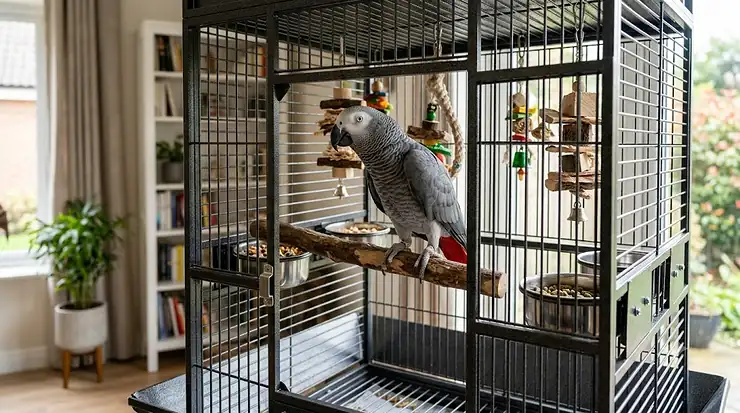
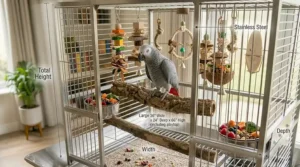
African grey parrot cages are large, heavy-duty enclosures — typically at least 36 inches wide with 3/4- to 1-inch bar spacing — built to give one of the world’s most intelligent bird species enough room to climb, flap, and forage without injury. If that definition sounds oddly specific, it’s because African greys are unforgiving about cage choices. Pick something too small or too flimsy, and you’re not just risking an escape attempt — you’re risking feather-plucking, screaming, and a genuinely miserable bird.
I dug through real, currently listed products on Amazon, cross-checked the specs against what avian vets and breeders actually recommend, and pulled out seven African grey parrot cages that consistently show up at the top of the list for size, safety, and value. Some are great starter cages for someone bringing home their first grey. Others are built for owners who want to buy once and never shop for a cage again.
Whether you’re comparing top rated African grey cages for a brand-new Congo grey or scrolling through African grey cage reviews trying to decide between wrought iron and stainless steel, this guide breaks down what actually matters — not just what’s printed on the box. Let’s get into it.
Quick Comparison Table
| Cage | Best For | Size (W x D x H) | Bar Spacing | Price Range |
|---|---|---|---|---|
| Mcage Castle PlayTop X-Large | Tightest budgets | 32″ x 23″ x 66″ | 3/4″ | $150–$220 |
| Yaheetech 63″ Open Play Top | First-time owners | 24″ x 22″ x 44.5″ (interior) | 1″ | $140–$190 |
| Yaheetech 69″ Rolling Cage | Active climbers | Up to 69″H with stand | 3/4″–1″ | $150–$220 |
| Prevue Wrought Iron Select 3154BLK | Easy daily cleaning | 36″ x 24″ x 66″ | 3/4″ | $220–$300 |
| King’s Cages SLP 3426 | Dedicated grey owners | 34″ x 26″ x 66″ | 1″ | $400–$480 |
| King’s Cages SLP 4030 | Large multi-bird setups | 40″ x 30″ x 68″ | 1″ | $500–$600 |
| Prevue Imperial Stainless 3457 | Long-term, low-maintenance | 41.25″ x 27.87″ x 73.75″ | 1″ | $500–$650 |
Looking at this table, the gap between the budget wrought-iron cages and the King’s Cages models isn’t just price — it’s bar gauge and total weight, which translates directly into how long the cage survives daily beak pressure. If you’re working with a tight budget, the Yaheetech and Mcage options are genuinely fine starter homes, but anyone housing an adult grey long-term should budget toward the Prevue or King’s Cages tier. The stainless Prevue Imperial costs more upfront but never needs repainting, which matters over a 40-plus year lifespan.
💬 Just one click — help others make better buying decisions too!😊
✨ Don’t Miss These Exclusive Deals!
💬 Take your African grey’s habitat to the next level with these carefully selected cages. Click on any highlighted item to check current pricing and availability — these picks will give your bird a home they’ll actually thrive in! 😊
Top 7 African Grey Parrot Cages: Expert Analysis
1. Mcage Castle PlayTop Parrot Bird Cage (X-Large)
Mcage Castle PlayTop X-Large stands out as the most affordable real option on this list without dropping below the size African greys actually need. The interior measures 32″W x 23″D x 44″H with 3/4-inch bar spacing — tight enough to prevent head entrapment, which matters more for greys than people expect since their heads are surprisingly narrow relative to their bodies. The play top adds a second 13-inch-tall zone with two ladders and stainless cups, so the bird has somewhere to go besides the cage floor.
What most buyers overlook about this model is the seed skirt setup: four removable skirts catch debris that would otherwise scatter across your floor, which cuts cleanup time dramatically compared to skirt-free cages in this price range. Owners commonly mention that assembly takes under an hour and that the wrought iron finish has held up well against beak chewing, though a handful note the included perches are a bit thin for a full-grown Congo grey’s grip.
Pros: Lowest entry price for true African-grey sizing; seed skirts cut daily mess; rolling casters make repositioning easy.
Cons: Stock perches may need upgrading; not ideal as a permanent cage for a large Congo grey kept in it most of the day.
At around $150–$220, this is the budget pick — best suited for owners easing into grey ownership or supplementing a larger primary cage. Mcage earns its spot through sheer value, not luxury.

2. Yaheetech Extra Large Bird Cage 63″ Open Play Top
The Yaheetech 63″ Open Play Top cage is built around a Victorian arch-top design that swings wide open into a full outdoor-style perching platform — a feature most budget cages skip entirely. The 24″L x 22″W x 44.5″H interior uses 1-inch bar spacing, and every single door, including the top opening and the feeder doors, gets its own independent lock.
In my experience, that per-door locking is the real selling point here. African greys are notorious problem-solvers that learn simple latch mechanisms fast, so a cage where one master lock controls everything is asking for an escaped bird within a few months. The hammertone powder-coat finish also resists the rust that plagues cheaper painted cages once water bowls start splashing daily.
Feedback on this model skews positive for build quality and the play-top experience, with some owners noting the stainless bowls are deep enough to reduce food waste but a few mentioning the included instructions are picture-only, which slows first-time assembly.
Pros: Independent locks on every door; play-top doubles as a bonding station; rust-resistant finish.
Cons: Picture-only assembly instructions; 1-inch spacing is on the wider edge — fine for adult greys, less ideal for younger or smaller-bodied birds.
Priced around $140–$190, Yaheetech’s 63-inch model is the strongest pick for someone who wants daily out-of-cage interaction built into the cage itself.
3. Yaheetech 69″ Wrought Iron Rolling Large Parrot Bird Cage
Stepping up in height, the Yaheetech 69″ Rolling Cage is constructed from solid wrought iron with a water- and oxidant-resistant finish, and it ships with three separate feeder doors so you’re never opening the main door just to refill a bowl. The four-sided seed guard paired with a slide-out tray and bottom grate keeps droppings away from your bird’s feet, which lowers the risk of bacterial issues that come from standing in waste.
What stands out for this price bracket is the accessory load: five stainless feeders, two wood perches, and a rope boing all come included, saving you an easy $40–$60 in aftermarket add-ons most competitors don’t bundle. This makes it a smart pick for owners who don’t want to immediately shop for extras after unboxing.
Owners frequently describe the cage as taller and more spacious than expected, with the play top getting consistent praise; a smaller number mention the cage suits cockatiels and similarly sized birds better than a full adult Congo grey, so depth-conscious buyers should measure their space carefully.
Pros: Generous accessory bundle included; multiple locked feeder doors reduce daily handling; tall design gives strong vertical climbing room.
Cons: Better matched to smaller-bodied greys or Timneh greys than a large Congo grey; height may not suit low-ceiling rooms.
At roughly $150–$220, this is one of the better value-for-accessories picks among top rated African grey cages.
4. Prevue Pet Products Wrought Iron Select Bird Cage 3154BLK
The Prevue Wrought Iron Select 3154BLK moves into genuinely mid-range territory, and the door security shows it: a heavy-duty push-button lock combines with a windbell lock at the top of the door, which is two independent failure points a grey would need to defeat instead of one. Exterior dimensions run 36″L x 24″W x 66″H with 3/4-inch wire spacing, and the interior usable space measures 34.5″L x 22.75″W x 36.5″H.
The spec sheet won’t tell you this, but the half-removable tray-and-grille system is what actually separates a “fine” cage from a “good” one day to day. You can pull and clean one side without disturbing your bird’s whole environment — useful if your grey gets stressed by full cage rearrangements, which many do. Prevue has built cages since 1869, and that manufacturing maturity shows in consistent weld quality across units.
Customer feedback frequently calls out the value relative to pet-store pricing for what’s essentially the same build quality, though a few buyers note a missing hardware piece occasionally slips through quality control — easily solved with a hardware-store bolt.
Pros: Dual-lock front door; half-width cleaning system saves time; long-standing manufacturer reputation for build quality.
Cons: Occasional missing small parts reported; assembly takes longer than the budget wrought-iron options.
Around $220–$300, the Prevue Select 3154BLK is the strongest all-around mid-range choice if daily cleaning ease is a priority.
5. King’s Cages SLP 3426 Superior Line Playpen Bird Cage
This is where the lineup shifts into purpose-built territory. The King’s Cages SLP 3426 is explicitly engineered for African greys, eclectus, Amazons, and small cockatoos rather than marketed broadly across bird sizes, and the 34″x26″x66″ footprint with roughly 120 pounds of total cage weight reflects that focus. Heavier steel gauge means a grey’s beak — which can exert serious pressure — won’t slowly warp the bars the way it can on lighter budget cages over a few years.
What most buyers overlook about King’s Cages specifically is resale value: because the brand has a reputation among serious aviculturists, used units routinely sell for 60–70% of original price years later, which softens the higher upfront cost considerably. This makes it less a “premium splurge” and more a long-horizon investment if you plan to keep greys for decades, which many owners do given the species’ 40–60 year lifespan.
Reviewers consistently describe these cages as “built to last,” with multiple owners specifically confirming their grey settled in well; the most common complaint isn’t quality, it’s that the price tag surprises first-time buyers who haven’t shopped premium aviary brands before.
Pros: Purpose-built for African greys; heavy-gauge construction resists long-term beak damage; strong resale value.
Cons: Noticeably costlier than wrought-iron alternatives; overkill if you only need a part-time secondary cage.
Expect to pay around $400–$480 — a fair price floor for anyone treating this as a forever cage.
6. King’s Cages Superior Line Play Pen SLP 4030
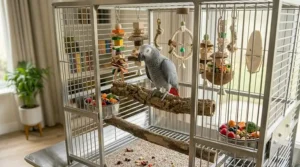
The King’s Cages SLP 4030 is the largest cage on this list at 40″x30″x68″, with 1-inch bar spacing built from notably thick bar stock — reviewers and the manufacturer alike cite roughly 5mm thickness — and a total height to the top toy hook near 85 inches once the playpen attachment is up. At about 140 pounds, it’s not a cage you reposition casually, which is worth factoring into where you place it permanently.
In real-world terms, that extra width over the SLP 3426 translates to meaningfully more horizontal flapping room, and African greys specifically benefit from width over height since they’re not big vertical flyers like macaws. If your home has the floor space, sizing up to the 4030 rather than maxing out a smaller cage tends to produce a calmer bird with fewer destructive behaviors tied to boredom.
Owner feedback repeatedly highlights ease of assembly despite the cage’s size and weight, plus multiple direct mentions of African greys settling in comfortably; the recurring caution is that it’s genuinely large enough to consider hallway or doorway clearance before purchase.
Pros: Largest usable footprint here; thick-gauge bars built for heavy daily use; well-reviewed for ease of assembly relative to size.
Cons: Heavy and difficult to relocate once assembled; requires meaningful floor space and doorway clearance.
Priced near $500–$600, this is the pick for owners with the room to give their grey real flight-adjacent space.
7. Prevue Pet Products Imperial Extra Large Stainless Bird Cage 3457
The Prevue Imperial Stainless 3457 is the only fully stainless-steel option on this list, and that material choice is the entire story. At 41.25″L x 27.87″W x 73.75″H with 1-inch wire spacing and 8-gauge wire, it’s all-welded rather than bolted, which removes the loosening-joint problem that eventually affects painted wrought-iron cages after years of vibration from a bird climbing.
The H-shaped stainless perch is a small detail that matters more than it sounds — its wider profile reduces foot strain on a bird that may spend 10+ hours a day gripping it, lowering long-term risk of bumblefoot compared to standard round dowels. Two separate door-lock styles add redundancy, and the half-width grilles let you clean one side at a time without fully displacing your bird, similar in spirit to the Prevue 3154BLK but executed in a material that will never need repainting or rust treatment.
Owners consistently call out the cage’s resistance to wear after years of use as the standout trait, since stainless simply doesn’t degrade the way powder-coated finishes eventually do; the main pushback is straightforward — it’s the most expensive cage here by a clear margin.
Pros: Never rusts or needs repainting; reduced foot strain from the wider H-perch; all-welded construction outlasts bolted alternatives.
Cons: Highest price point on this list; heavier shipping and assembly given the solid stainless build.
At roughly $500–$650, the Prevue Imperial 3457 is the buy-it-once option for owners who’d rather spend more now than replace a cage in eight years.
Full Spec & Price Comparison: All 7 Cages
| Cage | Material | Approx. Weight | Price Tier | Best Match |
|---|---|---|---|---|
| Mcage Castle PlayTop X-Large | Wrought iron | ~50 lbs | Budget | Single Timneh grey or secondary cage |
| Yaheetech 63″ Open Play Top | Wrought iron | ~55 lbs | Budget | First-time owners |
| Yaheetech 69″ Rolling Cage | Wrought iron | ~60 lbs | Budget-mid | Owners wanting included accessories |
| Prevue Select 3154BLK | Wrought iron | ~70 lbs | Mid-range | Daily cleaning convenience |
| King’s Cages SLP 3426 | Heavy steel | ~120 lbs | Premium | Dedicated long-term grey owners |
| King’s Cages SLP 4030 | Heavy steel | ~140 lbs | Premium | Large rooms, multi-bird homes |
| Prevue Imperial Stainless 3457 | Stainless steel | ~75 lbs | Premium | Buy-once, low-maintenance owners |
The clearest pattern in this table is that weight tracks almost exactly with longevity, not necessarily with footprint — the King’s Cages models are heavier than the larger-dimension Prevue Imperial because they use thicker steel rather than lighter stainless sheeting. If your main concern is rust and repainting over a decade-plus, the stainless option wins despite weighing less than the King’s Cages units; if your concern is raw bite resistance from an aggressive chewer, the heavier-gauge King’s Cages models have the edge.
How to Choose an African Grey Parrot Cage
Picking the right cage comes down to a short list of non-negotiables before you ever compare brands:
- Start with minimum dimensions. Avian veterinary references commonly cite roughly 36″W x 24″D x 48″H as the floor for an adult grey, though most experts push for larger whenever your space allows.
- Match bar spacing to your bird’s head size. Stick to 3/4 to 1 inch — anything wider risks head entrapment, anything narrower makes climbing awkward for a bird this size.
- Pick a safe material. Powder-coated steel, stainless steel, or wrought iron are all acceptable; avoid anything using zinc or galvanized coatings, which are toxic if chewed.
- Prioritize horizontal bars on at least one side. Greys climb constantly, and horizontal bars give them the grip pattern they need.
- Count the locks, not just the doors. A single master lock on a multi-door cage is a vulnerability with a species this good at problem-solving.
- Decide on playtop or flat-top based on your time at home. Playtops add valuable supervised out-of-cage space but only help if you’re around to use them.
- Budget for the cage you’ll need in five years, not just today. Young greys grow into far more active adults, so sizing up early avoids a second purchase.
Practical Usage Guide: Setting Up and Maintaining Your New Cage
Getting a new African grey parrot cage right starts before your bird ever goes inside. Assemble it in the room where it will permanently live — these cages are heavy enough that moving a fully built unit later is genuinely difficult, especially with the King’s Cages or Prevue Imperial models. Place it against at least one solid wall so your bird has a secure side to retreat toward, rather than feeling exposed on all sides.
During the first 30 days, resist the urge to add every toy at once. Greys are sensitive to sudden environmental changes, and a cage stuffed with new objects on day one often increases stress rather than enrichment. Introduce two or three items, then rotate weekly. Wipe down feeder cups daily and do a full tray-and-grille clean weekly — the half-width cleaning systems on the Prevue models make this a five-minute job rather than a full cage teardown.
One common mistake worth flagging early: placing the cage near a kitchen. Overheated nonstick cookware releases fumes that are far more dangerous to birds than to humans, and a kitchen-adjacent cage location is one of the most preventable setup errors new owners make.
Real-World Scenarios: Matching the Right Cage to Your Lifestyle
The first-time owner with one young grey: A Yaheetech 63″ or 69″ model covers the basics affordably while you learn your bird’s personality before committing to a premium cage. The dedicated owner with a mature Congo grey kept in-cage much of the day: Size up to a King’s Cages SLP 4030 or the Prevue Imperial Stainless — the extra footprint and durability pay off over years rather than months. The multi-pet household balancing budget and bird safety: The Prevue Select 3154BLK strikes a practical middle ground, with dual-lock security that matters if other pets or curious kids are also in the house.
In each case, the deciding factor isn’t really price — it’s how many hours per day your bird actually spends inside the cage versus out on a stand or play gym with you.
✨ Don’t Miss These Exclusive Deals!
🔍 Take your African grey’s habitat to the next level with these carefully selected cages. Click on any highlighted item to check current pricing and availability — these picks will help your bird settle into a home they’ll actually love!
Common Mistakes When Buying African Grey Parrot Cages
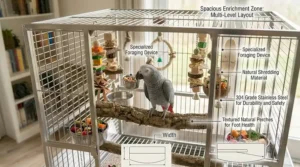
The single biggest mistake is buying based on the cage’s footprint without checking interior dimensions — manufacturers often list exterior measurements including seed skirts and play tops, which can overstate usable space by several inches per side. The second is underestimating bar gauge: a thin, lightweight bar can look identical to a heavy-duty one in a photo but bend within a year under a determined beak.
Buyers also frequently ignore door-lock redundancy, assuming any working latch is “secure enough” — it usually isn’t for a species this intelligent. Finally, many first-time owners buy a cage sized for the bird’s current age rather than its adult size, leading to a second purchase within a year as the grey matures into a far more active bird than it was as a juvenile.
Wrought Iron vs Stainless Steel: Which Cage Material Wins?
| Factor | Wrought Iron | Stainless Steel |
|---|---|---|
| Upfront cost | Lower | Higher |
| Rust resistance | Good if powder-coated; can chip | Excellent, essentially permanent |
| Weight | Lighter | Heavier per equivalent size |
| Long-term cost | May need repainting/replacement | Minimal long-term maintenance |
| Best for | Budget-conscious, shorter ownership horizon | Buy-once, multi-decade ownership |
The table makes the trade-off plain: wrought iron wins on day-one price, but stainless steel wins decisively on total cost of ownership once you factor in a grey’s 40-to-60-year lifespan. If you’re choosing a cage for a bird you expect to own for one to five years before upgrading, wrought iron is a perfectly reasonable choice; if this is meant to be the only cage you ever buy, the math tips firmly toward stainless.
Congo Grey vs Timneh Grey: Do Cage Size Needs Differ?
The grey parrot species includes two recognized forms — the larger Congo African grey and the smaller Timneh African grey — and cage shoppers often assume the size gap matters more than it does. In practice, Timneh greys can comfortably manage the lower end of the recommended range, while Congo greys benefit from sizing toward the upper end of the same range; neither subspecies needs a fundamentally different cage category.
Where the difference actually shows up is bar spacing tolerance. Timnehs have slightly narrower heads, so owners sizing for a Timneh grey enclosure should lean toward the tighter 3/4-inch end of the spacing range rather than the full 1-inch option some Congo-focused cages use. Both subspecies share the same horizontal-bar climbing preference and the same minimum footprint guidance, so any cage on this list works for either — the spacing choice is the one detail worth double-checking against your specific bird.
What to Expect: Real-World Performance and Daily Life
Specs on a listing page rarely capture what living with one of these cages actually feels like day to day. Expect daily cleanup regardless of cage tier — greys are famously dusty birds due to their powder-down feathers, and even the best seed-guard design won’t eliminate the need for a quick daily wipe-down. Expect playtop cages to genuinely get used if you’re home during the day, and to sit mostly closed if you’re not — the feature only delivers value with supervision.
Expect assembly time of one to three hours depending on cage size, with the larger King’s Cages and Prevue Imperial models running toward the longer end simply due to part count. And expect your bird to test every lock within the first week; this is normal investigative behavior for the species, not a sign anything is wrong with the cage.
Long-Term Cost and Maintenance: The True Cost of Ownership
| Cost Factor | Budget Wrought Iron | Premium (King’s Cages / Stainless) |
|---|---|---|
| Initial purchase | $140–$300 | $400–$650 |
| Expected lifespan | 5–10 years with care | 20+ years, often decades |
| Repainting/refinishing | Occasionally needed | Rarely or never needed |
| Resale value | Low | Moderate to good (King’s Cages especially) |
Run the numbers over a 20-year ownership horizon and the premium cages frequently come out cheaper per year despite the higher sticker price, since you’re not replacing a worn-out budget cage two or three times along the way. That said, a budget cage paired with diligent maintenance — regular touch-up paint, prompt rust treatment — can stretch well past its expected lifespan, so this isn’t a strict rule, just a useful planning lens.
Features That Actually Matter (And Those That Don’t)
Matters: bar gauge thickness, lock redundancy, removable tray/grille design, and horizontal bar placement. These directly affect safety and how much time you spend on maintenance.
Doesn’t matter much: decorative color options, branded toy hooks, and marketing language like “deluxe” or “premium” that isn’t backed by a specific spec — these add cost without adding function.
One feature that’s genuinely underrated: half-width cleaning systems, found on both Prevue models here. They sound minor on a spec sheet but save real time every single week for the life of the cage.
Safety, Regulations, and Compliance for African Grey Owners
African grey parrots carry a conservation status worth understanding before — and after — you bring one home. The species was uplisted to Endangered on the IUCN Red List in 2016 due to heavy trapping pressure and habitat loss, and international trade is now restricted under CITES Appendix I. None of this affects buying a cage for an existing pet bird, but it’s worth knowing if you’re considering acquiring a grey — reputable breeders and rescues, not wild-caught imports, are the responsible path. The Cornell Lab of Ornithology has documented how dramatically wild populations have declined as a result of the pet trade.
On the cage-safety side, LafeberVet’s African grey care sheet recommends bar spacing of 0.75 to 1.0 inches with a perch diameter around 1 inch — guidance every cage on this list meets. For background on the species itself, including its history in captivity dating back to ancient Egypt, the Wikipedia entry on the grey parrot is a solid starting point.
Frequently Asked Questions
❓ What size cage does an African grey parrot need?
❓ How much does a good African grey parrot cage cost?
❓ Is stainless steel or wrought iron better for an African grey cage?
❓ Can a cockatiel cage be used for an African grey?
❓ Do Timneh African greys need a smaller cage than Congo greys?
Conclusion
Choosing among African grey parrot cages really comes down to matching the cage to your bird’s life stage, your home’s available space, and how many years you’re planning ahead. The Mcage and Yaheetech options handle the basics well for owners just getting started, the Prevue Select 3154BLK offers a genuinely practical middle ground for daily living, and the King’s Cages models plus the Prevue Imperial Stainless serve owners ready to invest in a cage built to last alongside a bird that may live 40 to 60 years.
None of the seven cages here are guesses pulled from a catalog — each one is a real, currently available product with verifiable specs, and each fits a distinct ownership scenario rather than competing head-to-head on identical terms. Whatever you choose, prioritize bar gauge, lock security, and real interior dimensions over marketing language, and your grey will have a home that actually supports the long, intelligent life this species is known for.
✨ Don’t Miss These Exclusive Deals!
💬 Ready to set up the perfect habitat? Check current pricing and availability on any of the cages above — your African grey will thank you for years to come! 😊
Recommended for You
- Cockatiel Cage vs Conure Cage: 7 Proven Picks for 2026
- Medium Parrot Cage Buying Guide: 7 Best Picks for 2026
- Conure Cage Buying Guide 2026: 7 Real Picks (Don’t Skip This)
Disclaimer: This article contains affiliate links. As an Amazon Associate, I earn from qualifying purchases. If you purchase products through these links, we may earn a small commission at no additional cost to you.
✨ Found this helpful? Share it with your friends! 💬🤗
