
In This Article
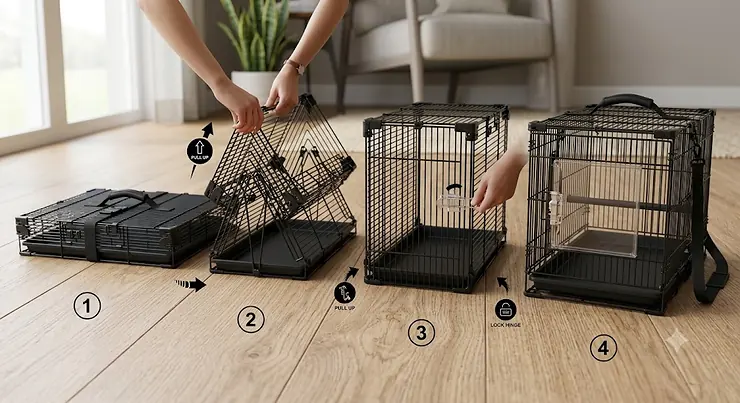
A collapsible bird travel cage is a fold-flat carrier designed to give a pet bird a safe, contained space during car rides, vet visits, or short trips, then pack down small enough to slide under a car seat or into a closet when the adventure’s over. Simple concept. Surprisingly hard to get right.
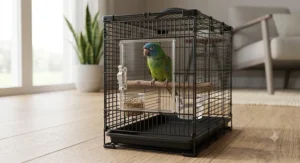
Here’s the thing nobody tells you before you buy your first one: most travel cages aren’t built for daily use, they’re built for occasional use — and that distinction changes everything about which features actually matter. A cage that’s perfect for a once-a-year move across the country is often the wrong pick for someone hauling their cockatiel to the vet every six weeks.
This guide breaks down seven real, currently available options — spanning wire fold-flat cages, soft-sided pop-up backpacks, and reinforced stainless builds — based on genuine manufacturer specs and aggregated review sentiment, not marketing copy. We’ll cover a foldable bird carrier for apartment dwellers, a pop-up bird travel cage for spontaneous outings, and a portable collapsible carrier built to survive a determined beak. Along the way, pet travel as a broader practice comes with its own set of stress factors worth understanding before you ever pack the car.
Whether you’re outfitting a budgie for a weekend at grandma’s or prepping a cockatoo for cross-country relocation, there’s a configuration below that fits your bird, your vehicle, and your patience for assembly instructions.
Quick Comparison Table
| Cage | Best For | Fold Type | Price Range |
|---|---|---|---|
| Prevue Pet Products Travel Cage | Budget all-rounder | Flat-folding wire | $65-$75 range |
| Mcage Large Collapsible Bird Carrier | Bigger parrots, tight budget | Flat-folding wire | $70-$90 range |
| YOOSO WING 304 Stainless Steel Cage | Heavy chewers | Tool-free fold | $40-$60 range |
| Prevue Pet Products Playtop Travel Carrier | Car-safety priority | Flat-folding wire | $90-$110 range |
| Flyline Collapsible Pet Carrier | Multi-bird households | Flat-folding wire | $70-$100 range |
| SUERTREE Stainless Mesh Backpack | Lightweight outings | Soft-sided pop-up | $30-$45 range |
| SUERTREE Seat Belt Travel Carrier | Road trip security | Soft-sided pop-up | $35-$50 range |
Looking at the spread above, the wire cages cluster in the mid-range because welded steel and locking trays cost more to manufacture than sewn mesh fabric, while the soft-sided SUERTREE carriers undercut them by trading rigidity for portability. If your bird is a confident traveler who just needs contained transport, the backpack styles are hard to beat on cost-per-trip; if your bird is a chewer or an escape artist, the wire options earn their higher price through sheer structural stubbornness.
💬 Just one click — help others make better buying decisions too!😊
Top 7 Collapsible Bird Travel Cages: Expert Analysis
1. Prevue Pet Products Travel Cage — most trusted budget fold-flat pick
The Prevue Pet Products Travel Cage has been a staple recommendation in avian circles for years, and the reason is refreshingly unglamorous: it just works. This model measures roughly 20 inches long, 12.5 inches wide, and 15.5 inches high, with 3/4-inch wire spacing that suits small to medium parrots like cockatiels, quakers, and lovebirds. That spacing matters more than it sounds — anything wider risks a curious head getting stuck, and anything narrower makes cleaning a chore.
Based on the spec comparison, the standout feature is the 9-inch by 9-inch side access door, which is unusually generous for a cage this size — it lets a bird walk in on its own rather than requiring an owner to scoop and stuff. The pull-out debris tray with a wire rail stopper keeps things from sliding around mid-transport, and the whole unit folds flat for storage once you’re home. Reviewers consistently report that assembly takes under a minute with no tools, which lines up with Prevue’s own “packs away in 60 seconds” claim.
Aggregated review sentiment describes the build as sturdier than the price suggests, though a recurring theme is that the included wooden perch is on the flimsy side and gets swapped out fast by more experienced owners.
Pros:
- ✅ Spacious 9×9-inch side door for easy bird entry
- ✅ Folds completely flat for closet or trunk storage
- ✅ Includes two stainless steel dishes and a perch
Cons:
- ❌ Included wooden perch feels undersized for the cage
- ❌ Wire spacing too wide for very small finches
At around $70, the value case is straightforward: this is the cage most avian rescues and vets recommend as a first travel carrier, and the price reflects a no-frills design rather than a corner-cut one.
2. Mcage Large Collapsible Bird Carrier — best for bigger parrots on a budget
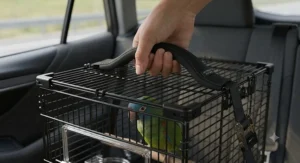
Where the Prevue model tops out at medium birds, the Mcage Large Collapsible Bird Carrier steps up to handle African greys, Amazons, eclectus, and small cockatoos without needing a premium price tag. Dimensions land around 23.5 inches long, 16.5 inches wide, and 20 inches high, with 1.25-inch bar spacing calibrated for larger beaks that would make short work of the finer wire on a small-bird cage.
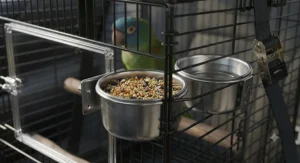
What most buyers overlook about this model is the bite-proof framing — the marketing language is a little dramatic, but the underlying engineering point is real: thicker gauge wire resists the kind of bending and prying that a determined macaw or Amazon can inflict on cheaper stock. The two stainless steel feeder dishes clip onto an adjustable holder rather than just resting loose, and the natural wooden perch gives medium-to-large birds a proper foothold instead of the token dowel some competitors include.
Reviewer feedback aggregated across retail listings notes that the side access door makes loading a nervous or defensive bird considerably less of a wrestling match, though a handful of buyers mention the fold mechanism needs a firm hand until it’s broken in.
Pros:
- ✅ Bar spacing built for larger, stronger-beaked parrots
- ✅ Adjustable feeder holder keeps dishes from tipping
- ✅ Wide side door reduces stress during loading
Cons:
- ❌ Fold mechanism feels stiff for the first few uses
- ❌ Bulkier footprint than small-bird travel cages
In the $70-$90 range, this is one of the few genuinely affordable options sized for medium-large birds — most competitors at this size jump into premium pricing territory.
3. YOOSO WING 304 Stainless Steel Foldable Cage — best rust-proof pick for chewers
Powder-coated wire looks fine on the shelf, but the coating is exactly the vulnerability a chewing bird exploits — chip the finish, and you’re left with bare metal that can rust and, worse, flake into something a bird might ingest. The YOOSO WING 304 Stainless Steel Foldable Cage sidesteps that entire problem by skipping the coating altogether. It’s built from uncoated 304-grade stainless steel, roughly 17 inches long, 13 inches wide, and 20 inches high, weighing about 8.5 to 9 pounds.
Here’s what the spec sheet won’t tell you outright, but the material choice implies: this cage can be rinsed under a hose or run through a full scrub-down without any risk of corrosion creeping in over time, which is a genuine advantage for owners dealing with a bird that’s messy, sick, or prone to chewing on cage bars out of boredom. The tool-free fold-flat design sets up in seconds, and the aluminum handle doubles as a second perch — a small touch that reviewers single out as more thoughtful than it sounds on paper.
Aggregated customer sentiment frames this as the pick for owners who’ve already burned through a cheaper coated cage and are done dealing with rust spots.
Pros:
- ✅ Uncoated 304 stainless resists rust and chipping entirely
- ✅ Tool-free fold and setup in seconds
- ✅ Aluminum handle doubles as a bird perch
Cons:
- ❌ Smaller interior than similarly priced wrought-iron cages
- ❌ No seat belt attachment points for car travel
Priced in the $40-$60 range, it undercuts most stainless competitors while still delivering the corrosion resistance that’s usually reserved for premium models.
4. Prevue Pet Products Playtop Travel Carrier — best car-safety features
If your travel is mostly by car, the Prevue Pet Products Playtop Travel Carrier is the one model on this list explicitly engineered around vehicle safety rather than just portability. It measures about 18.75 inches long, 14.875 inches wide, and 25 inches high, with tighter 1/2-inch wire spacing suited to smaller parrots, conures, and lovebirds.
The headline feature — and the reason this cage costs more than its siblings — is the welded bracket seat belt collar system that lets you buckle the entire carrier into a car seat. Based on the spec comparison, that’s a meaningfully different design goal than a cage that simply folds flat; it’s addressing the actual physics of what happens to an unsecured carrier during hard braking. The lock-in food and water cups and solid cup-door guards prevent spills during a bumpy drive, and the rooftop perch doubles as a carrying handle once you’ve arrived.
Reviewers who’ve used this for regular vet trips report the buckle system genuinely reduces the mid-drive sliding and tipping that plagues cheaper carriers, though several note the unit runs heavier than expected once assembled — around 13 pounds by manufacturer spec.
Pros:
- ✅ Seat belt brackets built directly into the frame
- ✅ Lock-in cups prevent food and water spills
- ✅ Rooftop perch doubles as a carry handle
Cons:
- ❌ Heavier to carry than comparable folding cages
- ❌ Premium price relative to basic travel cages
In the $90-$110 range, this is squarely a mid-to-premium pick, and the AVMA’s own guidance on transporting pet birds specifically flags carrier security as a car-travel priority — which is exactly the gap this model is built to close.
5. Flyline Collapsible Pet Carrier — most durable premium build
The Flyline Collapsible Pet Carrier is the cage owners reach for when they need something that can survive years of repeated folding and unfolding without the joints loosening up. Sized around 23.25 inches long, 16.75 inches wide, and 20 inches high with 1.125-inch bar spacing, it’s positioned for medium-size birds — African greys, Amazons, eclectus, and mini macaws.
What most buyers overlook about this model is the construction detail in how the cage walls connect: rather than a single hinge point, the panels attach via metal clips at multiple junctions, distributing stress across the frame instead of concentrating it at one joint. Reviewers who’ve owned multiple units — including owners transporting several birds for camping trips — describe the cage as holding up reliably over two-plus years of regular folding, though a subset of buyers received units with bent bars or a broken perch on arrival, suggesting quality control varies between production batches.
The removable floor grille and slide-out tray simplify cleanup, and the clip-on carry handle makes hauling a fully-loaded cage across a parking lot less of an ordeal than it could be.
Pros:
- ✅ Multi-point wall clips distribute structural stress
- ✅ Holds up over multiple years of repeated folding
- ✅ Removable grille and tray simplify cleaning
Cons:
- ❌ Some units arrive with bent bars or damaged perches
- ❌ Perch and dishes must be removed before folding
At a price typically in the $70-$100 range, it’s a reasonable premium bet, though the inconsistent QC reports mean it’s worth inspecting the unit closely on arrival before your first trip.
6. SUERTREE Stainless Mesh Backpack Carrier — lightest pop-up backpack style
Not every bird needs a rigid metal box, and the SUERTREE Stainless Mesh Backpack Carrier makes the case for the soft-sided alternative. Think of it less as a cage and more as a pop-up bird travel cage: there’s no fold sequence to memorize, no hinges to lubricate, just a bag that opens into a mesh enclosure and collapses back into a shoulder bag when you’re done. At roughly 12.9 inches long, 10.4 inches wide, and 16.1 inches high and weighing about 3 pounds, this is a fraction of the heft of any wire cage on this list — genuinely light enough to sling over a shoulder for an entire day.
The reasoning behind the design is worth spelling out: a clear front window lets the bird see out (which reduces the disorientation that a fully enclosed carrier can cause), while a roll-up shade panel lets you cut visual stimulation entirely when a bird needs to calm down. The side panels use anti-scratch stainless steel mesh rather than plastic netting, which solves the classic soft-carrier failure mode — a bird chewing straight through fabric mesh in transit. A bendable rope perch and washable mat round out the interior.
Aggregated reviewer sentiment consistently praises the ventilation and the “space capsule” viewing window as genuinely calming for anxious birds, with the most common complaint centering on interior space feeling snug for anything larger than a conure or quaker.
Pros:
- ✅ Roughly 3 pounds — lightest carrier on this list
- ✅ Stainless mesh resists chewing better than fabric netting
- ✅ Roll-up shade lets you control visual stimulation
Cons:
- ❌ Interior space is snug for birds larger than conures
- ❌ No rigid frame protection against side impacts
In the $30-$45 range, it’s the most accessible entry point on this list for anyone who just needs a bird travel bag rather than a full cage.
7. SUERTREE Seat Belt Travel Carrier — best for road trip security
The SUERTREE Seat Belt Travel Carrier takes the same soft-sided philosophy as its sibling above and adds one deliberate upgrade: a purpose-built seat belt strap sewn directly into the carrier. Measuring about 13.7 inches long, 11 inches wide, and 15.1 inches high, it’s sized similarly but with slightly more interior room, suited to cockatiels, conures, quakers, caiques, and mini macaws.
The practical implication of that seat belt is bigger than it sounds. An unrestrained carrier on a car seat becomes a projectile during hard braking or a sudden swerve — the same physics that make child car seats mandatory apply here at a smaller scale. This model lets the bag clip directly to a seat belt buckle rather than relying on improvised bungee cords or towels wedged against a door, which several reviewers specifically call out as the reason they upgraded from a plain backpack model.
The indestructible stainless steel mesh construction carries over from the standard SUERTREE line, and the carrier still functions as a normal backpack once you’ve reached your destination — you’re not sacrificing portability to gain the car-safety feature.
Pros:
- ✅ Integrated seat belt strap for car security
- ✅ Doubles as a standard backpack at your destination
- ✅ Stainless mesh resists chewing and scratching
Cons:
- ❌ Slightly heavier than the standard mesh backpack
- ❌ Soft sides offer less impact protection than wire cages
At a price generally in the $35-$50 range, it’s a smart step up for anyone who does frequent car trips and has outgrown the risk tolerance of an unsecured soft carrier.
✨ Don’t Miss These Exclusive Deals!
🔍 Take your bird’s travel setup to the next level with these carefully selected picks above. Click on any highlighted cage to check current pricing and availability — the right portable collapsible carrier makes every future trip smoother for you and your feathered flock!
Practical Usage Guide: Setting Up Your Cage for the First 30 Days
Getting a new collapsible bird travel cage home is only step one — the first month of use is where most of the mistakes happen. Before the first trip, set the folded cage up at home and leave it open, unassembled from any actual travel context, for several days. Let your bird investigate it on its own terms rather than being placed inside it cold; birds are naturally wary of new enclosures, and a rushed introduction is the single most common cause of a bird panicking the first time it’s actually needed for transport.
Once the bird tolerates the open cage, start doing short, low-stakes “practice trips” — a walk around the yard, a five-minute drive around the block — well before any real travel is required. This mirrors exactly what avian behaviorists recommend for reducing acclimation stress, and it’s far easier to troubleshoot a folding latch or a loose perch at home than at a vet’s parking lot.
For maintenance, wire cages should be wiped down with mild soap and warm water after every trip, with particular attention to the tray and grille where droppings accumulate; letting debris dry onto a tray makes it dramatically harder to clean later. Soft-sided carriers need their mesh panels checked for fraying at the stitching, since that’s the failure point that eventually lets a bird escape or a beak through. A common first-month mistake is folding a wire cage without first removing the perch and dishes — most models require this, and skipping it bends hardware or cracks a dish. Get into the habit of treating every fold-down bird cage the same way you’d treat a camping tent: clean it, dry it fully, then collapse it, since packing away a damp compact travel carrier invites mildew in the fabric seams or rust on exposed wire joints.
Real-World Scenarios: Matching the Cage to Your Situation
The apartment-dwelling cockatiel owner heading to a monthly vet checkup a few miles away doesn’t need a premium rig — the Prevue Pet Products Travel Cage covers this use case completely, folding down small enough to live in a closet the rest of the month without eating up precious apartment storage.
The road-tripping family with a mini macaw planning a multi-day drive to visit relatives has different priorities entirely: car safety, durability, and enough interior room that the bird isn’t cramped for hours at a stretch. The Prevue Pet Products Playtop Travel Carrier or the Mcage Large Collapsible Bird Carrier both fit this brief, with the seat belt brackets on the Playtop model being the deciding factor if the trip involves genuine highway miles.
The casual weekend adventurer with a budgie or conure who wants something light enough to carry through a farmers market or a friend’s backyard barbecue is exactly who the SUERTREE Stainless Mesh Backpack Carrier was designed for — low weight, decent ventilation, and a form factor that doesn’t scream “medical transport” the way a wire cage does.
The multi-bird household preparing for a move needs durability above all else, since a folding cage getting used daily for weeks straight will expose any weak joints fast. The Flyline Collapsible Pet Carrier‘s reinforced multi-clip construction is built for exactly that kind of repeated-use stress test.
How to Choose a Collapsible Bird Travel Cage
- Match bar spacing to your bird’s head size. Spacing that’s too wide risks a bird getting its head stuck; too narrow makes a mess to clean. Small parrots generally need 1/2 to 3/4-inch spacing, while larger parrots need 1 to 1.25-inch spacing.
- Decide between wire rigidity and soft-sided portability. Wire cages resist chewing and impacts better; soft carriers save weight and bulk for casual outings.
- Check for car-securing features if you drive often. Seat belt brackets or straps aren’t a gimmick — they address a real safety gap that most basic folding cages ignore entirely.
- Weigh material against your bird’s chewing habits. A determined chewer will eventually find the weak point in painted wire or plastic-coated mesh; stainless steel avoids that failure mode.
- Confirm the fold mechanism doesn’t require tools. A cage that needs a screwdriver to collapse defeats the purpose of a “collapsible” design in an actual travel scenario.
- Consider tray and grille removability for cleaning. A cage you can’t easily clean after a messy trip becomes a cage you avoid using.
- Size up, not down, if you’re between two options. A cage that’s slightly larger than strictly necessary reduces stress far more than a snug one saves storage space.
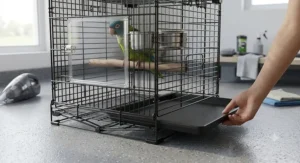
Common Mistakes When Buying a Foldable Bird Carrier
The most frequent misstep is buying based on price alone without checking bar spacing against species — a cage rated for cockatiels can be genuinely unsafe for a budgie if the spacing is too wide. A close second is skipping the acclimation period entirely, which turns a perfectly good cage into a source of panic simply because the bird’s first experience with it was also its first stressful car ride.
Buyers also frequently underestimate how much heavier a fully-loaded wire cage feels compared to the empty display weight listed on a product page — factor in dishes, a perch, and the bird itself before assuming you can one-hand it across a parking lot. Finally, a surprising number of owners skip reading whether their airline actually permits birds in the cabin before purchasing a “travel” cage sized for that exact purpose, only to discover the airline’s pet policy makes the whole cage irrelevant for that specific trip.
Collapsible Bird Travel Cage vs Traditional Solid Cages
A traditional solid travel cage — the kind with a fixed frame that doesn’t fold — trades portability for rigidity. It won’t develop loose hinges over time because it has no hinges to loosen, and it typically offers marginally more interior stability during a bumpy ride. But that rigidity comes at a real cost: a solid cage takes up its full assembled footprint in storage year-round, which is a genuine problem for apartment dwellers or anyone without a garage.
A space-saving travel cage, by contrast, collapses down to a fraction of its assembled size, which matters enormously if the cage sees infrequent use between trips. The trade-off is that fold points are inherently a structural weak spot compared to a welded, one-piece frame — which is why the build-quality differences between the models above (multi-clip designs versus single-hinge designs) matter more for a folding cage than they would for a solid one. For most owners who travel occasionally rather than constantly, the storage savings of a collapsible design outweigh the marginal rigidity trade-off; for full-time breeders or facilities running cages daily, a solid cage’s durability may justify the extra storage footprint.
What to Expect: Real-World Performance
On paper, bar spacing and dimensions are just numbers — in practice, they translate into how calm your bird actually is once you’re on the road. A cage that’s genuinely well-matched to your bird’s size produces a bird that settles into the perch within a few minutes of the car starting to move; a cage that’s too small or too dark produces a bird that stays agitated for the entire trip, gripping the bars and vocalizing stress calls.
Fold-flat wire cages typically take between 45 seconds and two minutes to assemble from flat storage, based on the manufacturer claims and reviewer timing across the models above — fast enough that it’s not a meaningful barrier to spontaneous trips once you’ve done it a few times. Soft-sided backpack carriers, meanwhile, need zero assembly, trading that convenience for less structural protection if the carrier gets bumped or dropped.
Features That Actually Matter (And Those That Don’t)
Genuinely load-bearing features include: bar spacing matched to species, a slide-out tray for cleaning without disassembling the whole cage, and — if you drive regularly — a car-securing mechanism. These directly affect either the bird’s safety or your day-to-day maintenance burden.
Features that generate more marketing copy than real-world value include elaborate color options (birds don’t care what shade the cage is) and multiple accessory toys crammed into a travel cage, which is meant for short-duration containment rather than enrichment — a bird stressed about travel generally isn’t in the mood to play with a bell anyway. Locking mechanisms marketed as “extra secure” are worth a skeptical look too; a determined cockatoo has famously defeated far more sophisticated latches than most travel cages ship with, so a secondary clip or carabiner is often a smarter add-on than trusting the stock latch alone.
Safety, Regulations & Airline Compliance Guide
If your trip involves anything beyond a car ride — interstate travel, moving states, or flying — the rules get considerably more involved than picking the right cage. The USDA’s pet travel resources outline that interstate and international bird travel can require health certificates and, depending on species and destination, additional permits, so it’s worth checking well before the trip rather than the day before.
For car travel specifically, VCA Animal Hospitals’ guidance on transporting birds notes that a cage or carrier should always be secured against sliding, and that sedatives or tranquilizers are not recommended for birds during travel due to unpredictable reactions — a detail worth knowing given how tempting it can be to reach for a “calming” solution before a stressful trip. Cold and hot weather both require extra care: pre-warm the car in winter and cover the cage with a towel, while summer travel demands active ventilation and never leaving a bird unattended in a parked vehicle, even briefly.
Long-Term Cost & Maintenance
A collapsible bird travel cage is a low-frequency-use item for most owners, which changes the math on cost-per-use compared to something like a daily home cage. A $70 wire cage used four times a year for a decade works out to roughly $1.75 per trip — genuinely cheap insurance against the risk of a loose bird in a moving car. Replacement parts (dishes, perches, trays) are typically available separately from manufacturers like Prevue, which extends the practical lifespan of a cage well past the point where a lesser brand’s proprietary parts would force a full replacement.
Soft-sided carriers have a different cost profile: the mesh and stitching are the parts most likely to wear out, and replacing a worn strap or patching a seam is meaningfully cheaper than replacing an entire wire cage frame, provided the core mesh panel is still intact.

Frequently Asked Questions
❓ How do I fold a collapsible bird travel cage down for storage?
❓ Are collapsible bird cages safe for air travel?
❓ What bar spacing is safe for a budgie or parakeet?
❓ Can a collapsible bird cage double as a permanent home cage?
❓ How often should I replace a bird travel carrier?
Recommended for You
- Large Play Top Cage Under $200: 7 Best Picks for 2026
- 7 Best Rolling Play Top Cage Picks for 2026
- Play Top Cage for African Grey: 7 Best Picks (2026)
Disclaimer: This article contains affiliate links. As an Amazon Associate, I earn from qualifying purchases. If you purchase products through these links, we may earn a small commission at no additional cost to you.
✨ Found this helpful? Share it with your friends! 💬🤗
