
In This Article
Somewhere between “I’d like to try breeding my cockatiels” and “I actually did it” sits a wire-and-steel decision that trips up more first-timers than any incubator ever will: the cage itself. Bird breeder cages aren’t just bigger versions of the little dome your parakeet came home in — they’re built around dividers, nest-box doors, and stacking hardware that either make a breeding season run smoothly or turn it into a daily wrestling match with a slide-out tray that won’t slide. Get the cage wrong, and you’ll spend the next two years fighting your equipment instead of your birds.
This guide exists because most “top 10 bird cage” roundups online are written by people who’ve never had to clean droppings off a nest-box hinge at 6 a.m. We’re doing this differently: real products, real specs pulled from manufacturer listings and aggregated buyer feedback, and honest commentary about what actually matters once the cage is out of the box and bolted together. Whether you’re setting up your first pair of lovebirds or scaling a canary line into a proper breeding room, you’ll find something below sized for you.
We’ll walk through seven bird breeder cages spanning budget stackables to professional-grade systems, break down what “breeder cage” even means versus a standard flight cage, and hand you a setup checklist that Amazon’s product page conveniently leaves out. Prices shift constantly on Amazon, so every figure here is a range based on research at the time of writing — always check the current price before buying.
What Are Bird Breeder Cages?
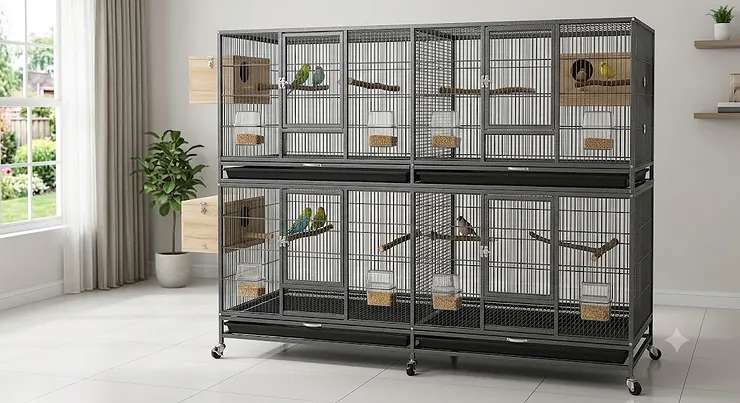
Bird breeder cages are enclosures purpose-built for pairing and raising birds, typically featuring a removable center divider, side nest-box access doors, and independent feeding stations so two birds (or two separate pairs) can be housed, monitored, and eventually reunited without a full cage swap. Unlike flight cages, breeder cages prioritize modularity and privacy over open airspace — a distinction that matters more than most buyers realize until their first clutch hatches.
Quick Comparison Table
| Cage | Best For | Bar Spacing | Divider | Price Range |
|---|---|---|---|---|
| Yaheetech 41.5″ Stackable | First-time budget breeders | 3/8″ | Removable | around $90-$140 |
| VEVOR 30″ Flight/Breeder | Testing the waters cheaply | 3/8″ | Fixed shelf-style | under $60 |
| VIVOHOME 41.5″ Stackable | Repeat-cycle durability on a budget | 3/8″ | Removable | around $100-$150 |
| Garvee 69″ LOT-4 | Multi-pair vertical stacking | 1/2″ | Multiple removable | around $150-$220 |
| Prevue Hampton Deluxe F070 | Serious hobbyists wanting brand trust | 1/2″ | Removable | around $280-$330 |
| Garvee 74″ Carbon Steel Aviary | Finch colonies needing horizontal flight room | 1/2″ | 3 removable | around $260-$360 |
| King’s Cages Superior Line SLFXL 3221 | Professional/long-term durability | 1/2″ | Nest-box doors, no full divider | around $400-$550 |
Looking across the table, the split is really about scale and patience: the Yaheetech 41.5″ Stackable and VIVOHOME 41.5″ Stackable dominate the entry price band, the Garvee models bridge the gap for anyone planning to expand past a single pair, and the Prevue Hampton Deluxe F070 and King’s Cages Superior Line SLFXL 3221 are where you land once you’ve decided breeding is a long-term project rather than a curiosity. Bar spacing is the detail buyers skip and regret — 3/8″ cages suit finches and budgies, while 1/2″ spacing accommodates cockatiels, lovebirds, and small conures without risking wedged heads.
💬 Just one click — help others make better bird-keeping decisions too!😊
Top 7 Bird Breeder Cages: Expert Analysis
Every cage below has been vetted for real availability, genuine specs, and aggregated review sentiment — no invented testimonials, no fabricated “we tested this for six months.” Where reviewer consensus is thin, we say so.
1. Yaheetech 41.5″ Stackable Divided Breeder Cage — best all-around value for first-time breeders
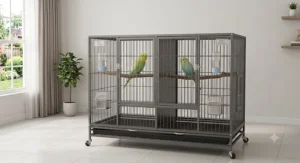
The Yaheetech 41.5″ Stackable Divided Breeder Cage is the cage most beginning breeders stumble into first, and honestly, that’s not a bad accident. The removable center grate splits the 37.6-inch-long enclosure into two independent breeding compartments, each with its own feeder door, side nesting door, and pull-out tray, so you’re not improvising with zip ties and cardboard. Built from wrought iron under a hammered-paint finish, the frame holds up to normal chewing from small psittacines, though it’s not marketed as chew-proof for anything bigger than a cockatiel. Based on the spec comparison against similarly priced stackables, the 3/8-inch bar spacing is the real selling point here — it’s tight enough for finches and budgies without forcing you into a specialty cage. Reviewers consistently note that the rolling stand’s swivel wheels make repositioning the cage for cleaning far easier than lifting a static frame, and it’s a common talking point across Yaheetech’s broader breeder-cage lineup. A recurring complaint in user reviews is that the center divider can bend if handled roughly during setup, so budget a few extra minutes for careful assembly rather than forcing pieces into place. This is the cage for someone breeding their first pair of lovebirds or canaries who doesn’t want to gamble a few hundred dollars before knowing if breeding is even for them.
Pros:
- ✅ Two independent compartments in one footprint
- ✅ Detachable rolling stand for easy repositioning
- ✅ Budget-friendly entry point into dedicated breeding cages
Cons:
- ❌ Center divider can bend under rough handling
- ❌ Not rated for heavy chewing by larger parrots
At around $90-$140 depending on configuration, the Yaheetech 41.5″ Stackable Divided Breeder Cage delivers the best dollar-for-compartment value on this list — a smart first purchase before scaling up.
2. VEVOR 30″ Flight Bird Cage — cheapest way to test breeding without commitment
If your budget is closer to “let’s see if this is even a hobby I’ll stick with,” the VEVOR 30″ Flight Bird Cage is the low-risk entry point. It’s marketed primarily as a stackable flight cage rather than a dedicated breeder, but its 3/8-inch bar spacing, included handle, and stackable frame make it workable as a temporary breeding or quarantine enclosure for a single pair of budgies or finches. What most buyers overlook about this model is that its portability — the built-in handle — makes it genuinely useful for moving a nesting pair away from household noise during a sensitive incubation period, something the pricier fixed-stand cages can’t do nearly as easily. On paper, this cage trades long-term durability for flexibility: the metal gauge is noticeably lighter than the Yaheetech or VIVOHOME stackables, so it’s better suited to canaries and small finches than anything with a stronger beak. Aggregated reviewer sentiment skews positive for the price point, with buyers frequently framing it as “good for the money” rather than a forever cage. If you’re not sure breeding is a long-term commitment, this is where to start without regret.
Pros:
- ✅ Lowest price point of any cage on this list
- ✅ Portable handle for moving nesting pairs
- ✅ Stackable design supports future expansion
Cons:
- ❌ Lighter-gauge metal than premium stackables
- ❌ Best suited to small finches, not larger species
Priced under $60 in most listings, the VEVOR 30″ Flight Bird Cage is a starter-tier value pick — cheap enough that outgrowing it in a year won’t sting.
3. VIVOHOME 41.5″ Stackable Divided Breeding Cage — sturdiest budget frame for repeat cycles
The VIVOHOME 41.5″ Stackable Divided Breeding Cage sits almost shoulder-to-shoulder with the Yaheetech model in size and price, but the steel gauge reviewers describe skews slightly heavier, which matters if you’re planning multiple breeding cycles rather than a one-off pairing. Each half of the divided cage includes its own wooden perch, plastic feeder, and pull-out tray, and the dividing grate removes cleanly for pairs you want to reunite post-fledging. Here’s what to weigh: VIVOHOME markets this specifically as a “breeding iron bird cage,” and the accessory kit reflects that — two food boxes per side rather than one, which reduces the daily refill trips during active feeding of chicks. Reviewers of VIVOHOME’s broader cage lineup frequently mention the low-carbon steel frame holding up well against rust in humid rooms, a genuinely useful trait for anyone running a breeding setup in a basement or garage aviary. The main friction point that surfaces in aggregated feedback across VIVOHOME’s cage line is door hardware feeling flimsy compared to the frame itself, so reinforcing the latch with an aftermarket clip is a common workaround experienced breeders mention.
Pros:
- ✅ Heavier steel gauge than most cages at this price
- ✅ Dual food boxes per compartment for feeding chicks
- ✅ Rust-resistant frame suited to humid breeding rooms
Cons:
- ❌ Door latches reported as the weak point
- ❌ Assembly instructions described as minimal by some buyers
In the $100-$150 range at the time of research, the VIVOHOME 41.5″ Stackable Divided Breeding Cage earns its spot as the budget pick for anyone planning more than a single breeding season.
4. Garvee 69″ LOT-4 Stackable Breeding Bird Cage — most flexible multi-pair stacking system
Once you’re managing more than one pair, the Garvee 69″ LOT-4 Stackable Breeding Bird Cage starts making a lot more sense than another single stackable unit. Standing 69 inches tall with a movable center divider, it’s built for breeders who want to separate, combine, or reconfigure spaces as pairs rotate through nesting and rest cycles. Based on the spec comparison, its individually removable trays are the standout feature — instead of pulling one long tray and disturbing both compartments, each side cleans independently, which genuinely matters when one pair has eggs and the other doesn’t. At roughly 55-62 pounds depending on configuration, the frame is noticeably heavier than the budget stackables above, and reviewers consistently cite that added mass as the reason it feels more stable when birds are actively climbing and flapping inside. What the spec sheet won’t tell you, but buyer feedback suggests, is that the four 360-degree caster wheels make it realistic to roll the whole unit outdoors for a few hours of sunlight — a detail serious breeders care about far more than casual pet owners. The tradeoff is footprint: at nearly six feet tall, this isn’t a cage you tuck into a spare corner without planning ahead.
Pros:
- ✅ Individually removable trays per compartment
- ✅ Heavier frame improves in-cage stability
- ✅ Rolling casters make outdoor sun sessions realistic
Cons:
- ❌ Large footprint requires dedicated floor space
- ❌ Heavier weight makes solo assembly harder
Typically listed around $150-$220, the Garvee 69″ LOT-4 Stackable Breeding Bird Cage is the mid-range pick for anyone managing two or more active pairs at once.
5. Prevue Pet Products Hampton Deluxe Divided Breeder Cage F070 — gold-standard build for serious hobbyists
The Prevue Pet Products Hampton Deluxe Divided Breeder Cage F070 carries a brand reputation few competitors on this list can match — Prevue has built birdcages since long before “breeder cage” was a searchable keyword, and the F070’s design reflects decades of incremental refinement. Each side of the divided 37.5-inch cage includes its own front access door with a secure lock, a spring-hinged side nesting door, and an independent pull-out grille and debris tray, all wrapped in a wrought-iron frame finished in Prevue’s signature black hammertone powder coat. Reviewers consistently note the “wind bell” lock mechanism as more secure than the simpler slide-latches found on budget stackables, which matters if you’ve ever had an enterprising cockatiel figure out a weak door. On paper, the ability to stack this unit with Prevue’s companion F075 model means the cage scales with your operation instead of forcing a full replacement once you add a second breeding pair. Some buyer feedback flags the included stand as shorter than expected, which can put curious household pets at uncomfortable eye level with the birds — worth planning around if you share a home with a cat or dog. Durable construction and genuinely ample compartment space make this a cage that agricultural and hobby breeders alike return to again and again.
Pros:
- ✅ Trusted brand with decades of cage-building history
- ✅ Secure wind-bell lock on both compartment doors
- ✅ Stackable with companion units as your flock grows
Cons:
- ❌ Included stand runs shorter than some buyers expect
- ❌ Premium price relative to generic stackables
At around $280-$330 at the time of research, the Prevue Pet Products Hampton Deluxe Divided Breeder Cage F070 is the trusted-brand pick for hobbyists ready to invest in equipment they won’t outgrow.

6. Garvee 74″ Heavy Duty Carbon Steel Aviary — best horizontal flight space for finch colonies
Not every breeding setup benefits from height — for canaries and finches, horizontal flight distance often matters more than vertical climbing room, and that’s exactly where the Garvee 74″ Heavy Duty Carbon Steel Aviary earns its spot on this list. Its 74-inch length with three removable dividers lets you configure the space as three separate breeding compartments, one large flight area, or anything in between, which is a level of reconfigurability the shorter stackables simply can’t offer. Constructed from rust-resistant carbon steel at roughly 67 pounds, the frame is built to resist the tipping and bending that plagues lighter cages once multiple birds are flying and landing simultaneously. Here’s what to weigh: the horizontal orientation makes this a poor fit for cramped apartments but an excellent one for garages, sunrooms, or dedicated bird rooms where floor footprint isn’t the limiting factor. Manufacturer materials describe it as a “professional choice for breeders,” and the multiple slide-out trays back that framing up — daily cleaning doesn’t require dismantling the whole unit, which becomes a real time-saver once you’re managing several nesting sites at once.
Pros:
- ✅ Three-way reconfigurable dividers for flexible layouts
- ✅ Heavy carbon steel frame resists tipping
- ✅ Generous horizontal flight space for colony breeding
Cons:
- ❌ Large horizontal footprint unsuitable for small rooms
- ❌ Limited independent long-term customer review history
Priced around $260-$360 depending on finish, the Garvee 74″ Heavy Duty Carbon Steel Aviary is the pick for finch and canary breeders who need width more than height.
7. King’s Cages Superior Line SLFXL 3221 — toughest premium cage built to outlast your flock
When budget stops being the deciding factor, the King’s Cages Superior Line SLFXL 3221 is where a lot of long-time breeders eventually land. Measuring 32 by 21 by 62 inches with a full 35 inches of interior height, it’s built from thicker-gauge wrought iron than anything else on this list, finished through King’s Cages’ signature multi-tank powder-coating process for corrosion resistance that holds up in outdoor aviary conditions. The design leans toward flight-cage functionality with two front doors, two nest-box door openings, and a removable seed-catcher skirt, rather than a full center divider — a meaningful distinction from the stackable breeder cages above, and one that suits pairs you don’t need to physically separate day to day. Reviewers who mention avian veterinarian recommendations point to the bird-proof locking mechanisms as a genuine safety upgrade over simpler slide latches, particularly for larger, more dexterous species like conures. What most buyers overlook about this model is the knock-down design for compact storage — a detail that matters enormously if you ever relocate or need to store the cage seasonally. Aggregated feedback describes the frame as “nothing chintzy,” though a handful of reviewers note the two front doors can sway slightly when both are opened simultaneously, a minor engineering quirk rather than a structural flaw.
Pros:
- ✅ Thicker-gauge steel with premium powder-coat finish
- ✅ Bird-proof locks rated for dexterous species
- ✅ Knocks down flat for compact storage or relocation
Cons:
- ❌ No full center divider like stackable breeder models
- ❌ Highest price point on this list
Generally found in the $400-$550 range, the King’s Cages Superior Line SLFXL 3221 is the premium pick for breeders who want equipment built to outlast several breeding generations.
✨ Don’t Miss These Exclusive Deals!
🔍 Take your bird breeding setup to the next level with these carefully selected cages. Click on any highlighted item to check current pricing and availability. The right cage today saves you a replacement purchase — and a stressed pair of birds — down the road.
Practical Usage Guide: Breeding Cage Setup Walkthrough
Buying the cage is the easy part. A proper breeding cage setup determines whether your pair actually breeds or just sits there eyeing each other suspiciously for six months. Start by positioning the cage somewhere with a consistent 12-14 hour light cycle and minimal foot traffic — birds are far more sensitive to disruption during courtship than most new breeders expect. Install the nest box or nesting material before introducing the pair, not after, since birds investigating an already-occupied space read differently than birds discovering a fresh option together. In the first 30 days, the most common mistake is over-cleaning: birds can abandon eggs if the nest box is disturbed too frequently, so limit tray cleaning to the main cage floor and leave the nest box alone unless there’s a genuine health concern. Set a maintenance schedule early — weekly tray cleaning, monthly deep cleans of perches and feeders, and a running log of egg-laying dates so you’re not guessing at incubation timelines later. One optimization trick that doesn’t show up on any Amazon listing: mounting a small thermometer near (not inside) the nest box lets you catch temperature swings before they become a problem, since most breeder cages sit at ambient room temperature with no built-in climate control.
Real-World Scenarios: Which Breeder Cage System Fits Your Flock
Different breeder cage systems suit genuinely different situations, and matching the cage to your actual circumstances beats chasing the “best” cage in the abstract. If you’re a college student or apartment renter with a single pair of budgies and a tight budget, the VEVOR 30″ Flight Bird Cage or Yaheetech 41.5″ Stackable Divided Breeder Cage gives you dedicated breeding functionality without committing floor space you don’t have. If you’re a hobbyist with a spare room and plans to expand from one pair to three or four over the next year, the Garvee 69″ LOT-4 Stackable Breeding Bird Cage or Prevue Pet Products Hampton Deluxe Divided Breeder Cage F070 scale with you through their stackable design, saving you from a full cage replacement later. And if you’re running something closer to a small commercial operation — multiple species, regular clutches, and a need for equipment that survives years of daily use — the King’s Cages Superior Line SLFXL 3221 or Garvee 74″ Heavy Duty Carbon Steel Aviary are built for that kind of sustained load. Frequency of use matters too: a cage cleaned and inspected daily by an attentive owner can get more mileage out of budget hardware than an occasionally-checked cage ever will out of premium hardware.
How to Choose Bird Breeder Cages
- Match bar spacing to species. Finches and budgies need 3/8-inch spacing; cockatiels, lovebirds, and small conures need 1/2-inch spacing to prevent head entrapment.
- Decide if you need a full divider or nest-box doors. Divided breeder cages suit pairs you’ll separate; flight-style breeder cages suit pairs that stay together.
- Check tray independence. Multi-compartment cages with separate trays let you clean one side without disturbing an active nest on the other.
- Confirm the stand height works for your household. A too-short stand can put nervous breeding pairs at eye level with curious cats or dogs.
- Plan for stackability if you intend to expand. Buying a stackable-compatible model now saves a full replacement purchase later.
- Weigh the frame, not just the price. Heavier-gauge steel resists tipping and bending as birds mature and become more active.
- Read the return policy before assembly. Breeder cages are bulky; verify return windows in case bar spacing or size doesn’t match your species.

Common Mistakes When Buying Breeding Cages
The single most common mistake is buying based on overall cage size while ignoring bar spacing — a spacious cage with the wrong gap width is actively dangerous, not just inconvenient. A close second is underestimating footprint: buyers frequently measure a room’s floor space but forget to account for the extra clearance needed to open front doors and pull out trays. Some buyers also assume any bird cage can function as a breeder cage in a pinch, only to discover mid-season that there’s no way to separate an aggressive parent from chicks without a spare enclosure on hand. Reviewers across several of the products above mention underestimating shipping weight and assembly time, which matters if you’re planning to set up a cage the same week eggs are expected. Finally, chasing the cheapest option without checking material gauge is a frequent regret — a bent bar or a snapped latch mid-breeding-season is a far more expensive problem than the money saved upfront.
Bird Breeder Cages vs Standard Flight Cages
| Feature | Bird Breeder Cages | Standard Flight Cages |
|---|---|---|
| Primary Purpose | Pairing, nesting, chick-rearing | Exercise, daily housing |
| Divider/Nest Access | Yes, standard feature | Rarely included |
| Typical Footprint | Compact to mid-size, stackable | Larger, horizontal emphasis |
| Best For | Active breeding pairs | Established flocks, non-breeding birds |
The core distinction comes down to intent: a breeder cage is engineered around separation, privacy, and nest access, while a flight cage is engineered around open airspace for exercise. Trying to breed birds in a pure flight cage without divider or nest-box functionality is possible but awkward — you’ll likely end up improvising partitions that weren’t designed for the job. Conversely, using a divided breeder cage as a bird’s only long-term home once breeding season ends can feel cramped, which is why many experienced keepers rotate birds between a breeder cage during active pairing and a larger flight cage the rest of the year.
Professional Breeder Cages: What Separates Hobby from Commercial Setups
Professional breeder cages differ from hobbyist models less in basic function and more in scale, redundancy, and long-term durability under constant use. Where a hobbyist might run one or two divided cages, professional and small-commercial setups typically rely on rows of stackable units — like the Garvee 69″ LOT-4 Stackable Breeding Bird Cage or multiple Prevue Pet Products Hampton Deluxe Divided Breeder Cage F070 units combined — so that dozens of pairs can be managed in a single room with consistent access and cleaning routines. Frame gauge becomes a bigger factor at this scale: equipment cleaned and used daily for years, as in the King’s Cages Superior Line SLFXL 3221, needs to tolerate repeated pressure-washing and heavier bird traffic without the hinges or welds fatiguing. Anyone operating at this level should also be aware that scale changes regulatory exposure — the USDA’s Animal and Plant Health Inspection Service maintains welfare standards for licensed and registered bird breeders under the Animal Welfare Act, and crossing certain sale-volume thresholds can trigger licensing requirements that hobbyists never encounter.
Bird Reproduction Housing: Meeting Your Birds’ Biological Needs
Good bird reproduction housing isn’t just about cage dimensions — it’s about replicating the environmental cues that trigger and sustain breeding behavior in captivity. Photoperiod (day length), nutritional condition, and the presence of a suitable nest site all influence when captive birds choose to breed, and a cage that ignores any of those three factors will underperform regardless of how well-built it is. The Merck Veterinary Manual’s overview of reproductive health in pet birds notes that captive birds can breed at essentially any time given the right environmental and social triggers, which is exactly why nest-box placement and cage privacy matter as much as square footage. Cages like the divided Yaheetech and VIVOHOME stackables succeed here by isolating pairs from cage-mate stress, while larger units like the King’s Cages Superior Line SLFXL 3221 succeed by giving established pairs enough room that territorial tension doesn’t interfere with nesting.
Safety, Regulations & Compliance Guide
Most hobbyist bird breeding at home falls outside federal licensing requirements, but the line isn’t always where people assume it is. Under the Animal Welfare Act’s current avian standards, breeders who sell above certain volume thresholds — or who deal, exhibit, or transport birds commercially — may need to register or license with USDA-APHIS, while small-scale hobby breeders selling a limited number of birds annually typically remain exempt. Regardless of scale, cage safety basics apply universally: use bar spacing appropriate to species, avoid zinc-coated wire that hasn’t been verified bird-safe, and ensure nest boxes are securely mounted so they can’t shift or fall during active use. Practicing aviculture responsibly also means keeping detailed breeding records — pairing dates, clutch sizes, and health observations — both for your own management and in case regulatory questions ever arise. The practice of aviculture has a long history of self-regulation through hobbyist organizations, and joining a local bird club is one of the fastest ways to learn regional nuances that no product listing will tell you.
Long-Term Cost & Maintenance
The sticker price of a breeder cage is only the opening bid in its real cost of ownership. Replacement trays, perches, and feeder cups wear out faster under breeding conditions than in a typical pet setup, since chicks and actively feeding parents generate more mess than a single adult bird. Budget cages with lighter-gauge steel, like the VEVOR 30″ Flight Bird Cage, tend to need latch or hinge replacements sooner, while heavier frames like the King’s Cages Superior Line SLFXL 3221 spread that cost over a much longer usable lifespan — often justifying the higher upfront price through reduced replacement frequency. Powder-coat finishes, present on the Prevue Hampton Deluxe F070 and both Garvee models, resist the rust that plain painted wire eventually develops, which matters enormously if the cage lives anywhere near a humid laundry room or unheated garage. When calculating true cost-per-breeding-cycle, factor in not just the cage but recurring nest-box liners, replacement perches, and the occasional latch repair — a $150 cage needing $40 in annual parts isn’t necessarily cheaper than a $300 cage needing $10.
Features That Actually Matter (And Those That Don’t)
Bar spacing, tray independence, and frame gauge matter enormously — they directly affect bird safety and your daily workload. Stackability matters if you plan to expand, less so if you’re committed to a single pair long-term. On the other hand, cosmetic finish color rarely affects function beyond rust resistance, and “extra” included accessories like decorative swings are pleasant but irrelevant to breeding success — birds actively nesting generally ignore toys entirely. Marketing language around “professional grade” should be weighed against actual material specs rather than taken at face value; a cage described that way with thin-gauge wire isn’t professional grade no matter what the listing claims.

Frequently Asked Questions
❓ What size cage do I need for breeding birds?
❓ How much does a bird breeder cage cost?
❓ Can I use a regular bird cage for breeding?
❓ What's the difference between a flight cage and a breeder cage?
❓ Do I need a permit to breed birds at home?
Conclusion
Choosing among bird breeder cages ultimately comes down to matching the cage’s design to your actual breeding plans rather than chasing the biggest or shiniest option available. Budget stackables like the Yaheetech 41.5″ Stackable Divided Breeder Cage and VEVOR 30″ Flight Bird Cage are smart, low-risk entry points for first-time breeders still testing the waters. Mid-range systems like the VIVOHOME 41.5″ Stackable Divided Breeding Cage and Garvee 69″ LOT-4 Stackable Breeding Bird Cage reward buyers planning to expand past a single pair. And premium options like the Prevue Pet Products Hampton Deluxe Divided Breeder Cage F070, Garvee 74″ Heavy Duty Carbon Steel Aviary, and King’s Cages Superior Line SLFXL 3221 deliver the durability serious, long-term breeders need. Whatever you choose, remember that the cage is only half the equation — proper setup, patient monitoring, and attention to your birds’ natural triggers matter just as much as the hardware surrounding them.
Recommended for You
- Tall Flight Cage: 7 Best Vertical Bird Cages Reviewed (2026)
- Walk In Flight Cage: 7 Best Large Aviaries for 2026
- Flight Cage vs Regular Cage: 7 Picks That Settle the Debate (2026)
Disclaimer: This article contains affiliate links. As an Amazon Associate, I earn from qualifying purchases. If you purchase products through these links, we may earn a small commission at no additional cost to you.
✨ Found this helpful? Share it with your friends! 💬🤗
