
In This Article
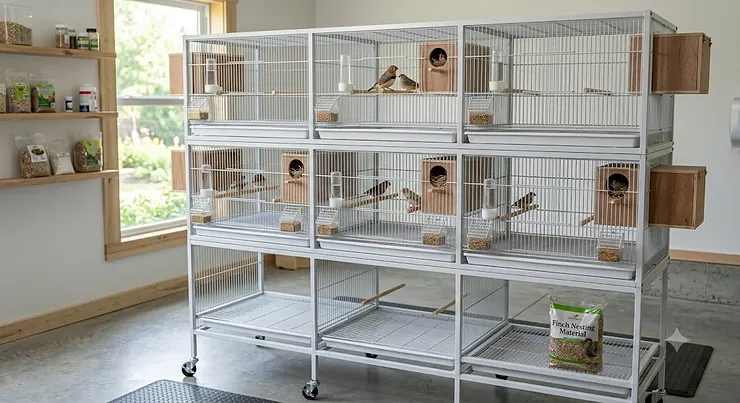
Somewhere between “I’ll just get one finch” and “I now own four breeding cages and a spreadsheet of clutch dates,” most finch keepers hit the same wall: the cage they started with was never built for babies. A finch breeding cage system is a purpose-built enclosure — usually rectangular, wide rather than tall, with tight bar spacing and dedicated nest-box access — designed to give a pair or small colony the privacy, space, and structural cues they need to actually raise chicks instead of just perching around looking pretty. It’s a different animal from a decorative pet-store cage, and treating the two as interchangeable is where a lot of first breeding seasons quietly fail.
This guide walks through seven real, currently available cage systems spanning budget stackers to premium rolling colony setups, with honest notes on what the spec sheets don’t tell you. According to the Society finch’s classification as a domesticated subspecies of estrildid finch that entered the pet trade through Europe in the 1860s, we’ve had well over a century to figure out what actually works — and yet plenty of new breeders still buy a cage sized for a single pet parakeet and wonder why nothing hatches. We’ll cover pair cages, colony setups, nesting enclosures, and the maintenance realities nobody puts in the product description, so you can pick a system that matches your actual goals — not just your budget.
Quick Comparison Table
| Cage System | Best For | Bar Spacing | Approx. Price Range |
|---|---|---|---|
| Prevue Hendryx Breeder Cage | First-time single-pair breeders | 1/2″ | Budget ($40s-$60s) |
| YML Small Breeding Cage with Divider | Flexible pair-to-colony conversion | 1/2″ | Budget ($50s-$70s) |
| VEVOR 30-Inch Stackable Divided Flight Cage | Multi-pair setups on a shelf | 3/8″-1/2″ | Mid-range ($40s-$90s) |
| Yaheetech Stackable Divided Breeder Cage | Space-saving vertical stacking | 1/2″ | Mid-range ($60s-$100s) |
| 2GR Canary and Finch Breeding Cage 326/B | Boutique single-pair, small footprint | 1/2″ | Mid-range ($60s-$100s) |
| FASCK 47-Inch Rolling Breeding Flight Cage | Serious colony breeders, mobile setups | 3/8″-1/2″ | Premium ($200s-$400s) |
| Wrought Iron Stacker Center-Divided Breeder Cage | Modular multi-pair breeding banks | 1/2″ | Premium ($200s-$300s) |
Looking at the spread here, the pattern is pretty clear: cheaper systems win on simplicity and get you breeding fast with a single committed pair, while the pricier rolling and stacker systems earn their keep when you’re running multiple pairs at once and need side-by-side nest box access without dragging cages around your bird room. The 2GR and Prevue sit in an interesting middle ground — small footprint, but genuinely built for breeding rather than just “finch-compatible” the way a lot of general aviary cages are marketed. If you’re not sure which tier fits, the honest answer is: start with what matches how many pairs you’re committing to this season, not how many you hope to have by next year.
💬 Already narrowing it down? Bookmark this table — you’ll want to compare it against the deep dives below before you decide.
Top 7 Finch Breeding Cage Systems: Expert Analysis
1. Prevue Hendryx Breeder Cage — the stackable budget classic
The Prevue Hendryx Breeder Cage has been the default recommendation in beginner finch forums for years, and the reason is structural, not sentimental: it’s designed to stack up to four units high, which means your first cage doesn’t box you in if you expand later. At roughly 23.5″L x 12″W x 15.5″H with 1/2-inch bar spacing, it’s tight enough to keep even small finch chicks contained once they fledge — a detail that matters more than people expect, since a slightly-too-wide bar spacing is a common way fledglings escape or get a head stuck. It ships with a solid-panel divider and a separate wire-panel divider, so you can run it as two isolated breeding compartments or open it into one larger flight, plus side nest-box doors on each half. This is the cage for someone breeding one or two pairs seriously rather than running a colony — the compact interior isn’t trying to be a flight aviary. Reviewers consistently note it’s straightforward to assemble and holds up well over multiple seasons, though a handful mention the wire gauge feels a bit light compared to older Prevue stock. At around $40-60, the value case is strong if you only need one or two compartments; the price climbs quickly once you’re stacking four.
Pros:
- ✅ Stacks up to four units for easy future expansion
- ✅ 1/2″ spacing safely contains fledglings and small breeds
- ✅ Dual divider system offers pair or open-flight flexibility
Cons:
- ❌ Interior footprint is snug for anything beyond two birds per side
- ❌ Some reviewers report thinner wire gauge than earlier production runs
Price range: budget tier, roughly $40-$60 at the time of research — check current listing, since Prevue pricing shifts with material costs.
2. YML Small Breeding Cage with Divider — best for pair-to-colony flexibility
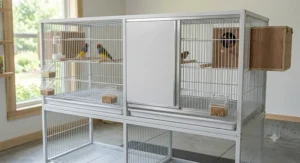
The YML Small Breeding Cage with Divider is built at 24″L x 16″D x 16″H with 1/2-inch bar spacing, and the extra depth compared to the Prevue is what sells it — finches are horizontal flyers, not climbers, so that additional four inches of depth translates into real usable flight space rather than just floor clutter. It comes with a single wire divider, four perches, four feeder cups, and a pull-out tray for cleaning, and you can run it divided for two separate pairs or pull the divider entirely for a small colony of four to six birds. What most buyers overlook about this model is that it does not include side nest-box doors on the end panels — you’re mounting external nest boxes through the front doors instead, which works fine but changes your daily maintenance routine compared to cages with dedicated side access. Aggregated reviewer sentiment is mixed but informative: several owners praise the interior space for the price, while others describe the wire fit as slightly imprecise on assembly, with perches sitting at odd angles. For a breeder who wants one cage that can flex between “two isolated pairs” and “one small colony” depending on the season, this is a genuinely practical pick.
Pros:
- ✅ Extra depth gives finches real horizontal flight room
- ✅ Divider removable — converts pair cage to small colony
- ✅ Pull-out tray simplifies daily cleaning
Cons:
- ❌ No dedicated side nest-box doors on end panels
- ❌ Reviewers note wire fit can feel imprecise during assembly
Price range: budget-to-mid tier, roughly $50-$70 — prices vary by color and current stock.
3. VEVOR 30-Inch Stackable Divided Flight Cage — best mid-range multi-pair option
The VEVOR 30-Inch Stackable Divided Flight Cage widens the field with tighter 3/8-inch bar spacing on some divider sections, which matters if you’re breeding smaller estrildid finches whose chicks can slip through standard 1/2-inch gaps during the wobbly first week out of the nest. Built with a slide-out tray and a top carrying handle, it’s engineered as much for a breeder who’s moving cages between a breeding room and a quarantine space as for someone who sets it and forgets it. Here’s what the spec sheet won’t tell you, but the design implies: the stackability plus handle combo is a strong signal this cage is meant to be part of a bank of several, not a standalone display piece — buy two or three from the start if that’s your plan, since matching units stack far more cleanly than mismatched brands. Aggregated review sentiment sits high, around 4.5 out of 5 across roughly 100 ratings, with reviewers frequently mentioning smooth delivery and functional slide-out cleaning trays, alongside a few comments wishing for sturdier packaging. For a mid-range multi-pair breeder, this hits a sweet spot most $40-90 cages miss.
Pros:
- ✅ Tighter 3/8″ spacing option protects newly fledged chicks
- ✅ Slide-out tray speeds up daily cleaning routines
- ✅ Stacks cleanly for multi-cage breeding banks
Cons:
- ❌ Packaging quality reported as inconsistent by some buyers
- ❌ Handle and stacking hardware add bulk versus simpler models
Price range: mid tier, roughly $40-$90 depending on configuration — verify current pricing before purchase.
4. Yaheetech Stackable Divided Breeder Cage — lightest footprint for apartment breeders
The Yaheetech Stackable Divided Breeder Cage targets a very specific buyer: someone breeding in a spare room or apartment corner who needs vertical square footage, not horizontal. Built with 1/2-inch bar spacing and a center divider, it stacks efficiently without eating floor space, which honestly matters more than most first-time breeders realize until they’re three cages deep into a hobby their landlord didn’t sign up for. Based on the spec comparison against the Prevue and YML units, the Yaheetech leans slightly lighter in overall build weight — a genuine advantage if you’re regularly repositioning cages for cleaning or seasonal light adjustment, and a minor downside if you’re prioritizing long-haul structural rigidity over five-plus years of daily use. What most buyers overlook is that a lighter frame also means it’s more prone to minor flex when fully loaded with birds, food, and a nest box on one side, so wall-mounting or a stable shelf setup is worth the extra ten minutes. Customer sentiment trends positive on ease of assembly and stacking precision, with occasional notes about thinner base trays than expected.
Pros:
- ✅ Compact stacking profile ideal for small breeding rooms
- ✅ Lighter frame simplifies repositioning during cleaning
- ✅ Center divider supports pair or colony configurations
Cons:
- ❌ Lighter build flexes slightly under full nest-box load
- ❌ Base tray reported thinner than competing mid-range models
Price range: mid tier, roughly $60-$100 — availability and color options affect final cost.
5. 2GR Canary and Finch Breeding Cage Art. 326/B — boutique pick for small-footprint pairs
The 2GR Canary and Finch Breeding Cage Art. 326/B is a genuinely different animal from the mass-market stackers above — it’s a compact, foldable unit measuring roughly 22.8″ x 11.8″ x 15.3″, built with white plastic side panels, 1/2-inch metal grid, two drinking tubes, four feeder cups, and four perches included standard. What most buyers overlook about this model is the fold-flat design, which is a real practical win for anyone who needs to store cages between breeding seasons or transport birds to shows — try folding a welded wrought-iron stacker into a car trunk and you’ll appreciate this feature fast. On paper, this means slightly less structural mass than an all-metal cage, which is a fair trade for the portability, and reviewers in the specialty canary-and-finch community tend to treat these European-style breeding cages as a known quantity rather than a gamble, since the design has been in circulation for years. The included drinking tubes are a nice touch that several competitors skip, saving you a separate accessory purchase. This isn’t the cage for a six-bird colony — it’s the cage for someone breeding a single committed pair who values footprint efficiency and easy storage over sheer interior volume.
Pros:
- ✅ Folds flat for compact off-season storage
- ✅ Includes drinking tubes, saving a separate accessory buy
- ✅ Established European breeding-cage design with a track record
Cons:
- ❌ Smaller interior limits use to a single pair
- ❌ Plastic side panels less durable long-term than solid metal
Price range: mid tier, roughly $60-$100 depending on seller — check current listing for the specific variant.
6. FASCK 47-Inch Rolling Breeding Flight Cage — best for serious colony breeders
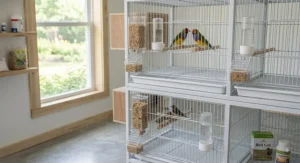
The FASCK 47-Inch Rolling Breeding Flight Cage is where the category shifts from “cage” to “system” in the fullest sense — a 47-inch flight cage with a detachable rolling stand, built to house parakeets, canaries, and finches alike, which means the interior volume is genuinely generous for a finch colony rather than merely adequate. Reviewers and product listings describe compatibility across multiple small-to-mid bird species, and the detachable stand is the standout feature: you get mobility for cleaning, seasonal repositioning near natural light, or moving birds away from drafts, without needing to physically lift a fully assembled cage. Based on the spec comparison with the stacking units above, the trade-off is footprint and price — this is not a cage you tuck into a closet corner, and at a few hundred dollars it’s a genuine investment rather than an impulse buy. What the spec sheet won’t tell you is that a cage this size needs more than one nest box if you’re running true colony breeding, since finches can crowd into a single favored box and interfere with each other’s incubation — plan your nest box count for at least one per established pair. For someone past the “one pair, see if I like this” stage and committed to colony production, the extra interior volume and mobility genuinely change your day-to-day workflow.
Pros:
- ✅ Large flight volume suited to true multi-pair colonies
- ✅ Detachable rolling stand simplifies cleaning and repositioning
- ✅ Cross-species compatible if you keep a mixed collection
Cons:
- ❌ Significant footprint requires dedicated floor space
- ❌ Premium price puts it out of reach for casual breeders
Price range: premium tier, roughly $200-$400 depending on configuration — prices fluctuate, so check current availability.
7. Wrought Iron Stacker Center-Divided Breeder Cage — best modular breeding bank
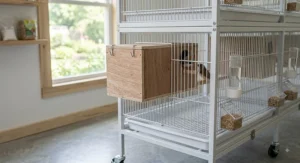
The Wrought Iron Stacker Center-Divided Breeder Cage closes out this list as the pick for breeders thinking in terms of infrastructure rather than a single enclosure — it’s a sturdy, welded-construction stacking unit built specifically to combine into a “breeding bank” of multiple cages, with side nest-box doors on both halves and dedicated feeder doors that keep daily maintenance fast even across a dozen compartments. The welded wrought-iron build is a meaningful upgrade over the folded-wire construction on cheaper stackers — it holds its shape better under repeated stacking and unstacking, which matters if you’re rotating pairs seasonally rather than leaving cages permanently assembled. Here’s what most buyers overlook: the side nest-box doors on both panels mean you can service nest boxes without opening the main front door and risking a startled hen abandoning eggs, a small design choice that has an outsized effect on hatch consistency during the first sensitive week of incubation. Aggregated sentiment across similar wrought-iron stacker listings runs positive on durability, with the most common critique being assembly time — these units simply have more hardware than a single-piece plastic-sided cage. For anyone building out a genuine breeding operation of five or more pairs, this is the infrastructure piece worth budgeting for.
Pros:
- ✅ Welded iron construction outlasts folded-wire stackers
- ✅ Dual side nest-box doors reduce incubation disturbance
- ✅ Modular design scales cleanly into a full breeding bank
Cons:
- ❌ Longer assembly time than single-piece plastic cages
- ❌ Higher per-unit cost adds up fast across multiple cages
Price range: premium tier, roughly $200-$300 per unit — multi-unit “lot” listings can shift pricing significantly.
Top 7 Products: Feature Comparison
| Product | Bar Spacing | Nest Box Access | Best For |
|---|---|---|---|
| Prevue Hendryx Breeder Cage | 1/2″ | Side doors | Beginner single-pair breeders |
| YML Small Breeding Cage | 1/2″ | Front-mounted | Flexible pair/colony use |
| VEVOR 30-Inch Flight Cage | 3/8″-1/2″ | Side doors | Chick-safety-focused multi-pair |
| Yaheetech Stackable Cage | 1/2″ | Side doors | Space-limited breeders |
| 2GR Art. 326/B | 1/2″ | Side doors | Boutique single-pair, storage-friendly |
| FASCK 47-Inch Rolling Cage | 3/8″-1/2″ | Multiple, side | Serious colony breeders |
| Wrought Iron Stacker Bank | 1/2″ | Dual side doors | Multi-pair breeding operations |
Reading across this table, nest-box access type ends up mattering more than most buyers expect going in — a cage with side doors lets you check eggs and refresh bedding without cracking open the main compartment and startling an incubating hen, while front-mounted access on cages like the YML works fine but adds a small disturbance risk during the first nervous week. If your priority is minimizing clutch abandonment in flighty species, weight your decision toward the side-door models even if it costs a bit more.
✨ Ready to narrow it down? Scroll back to whichever system matched your breeding goals and check today’s availability before it’s gone.
Finch Breeder Cage Setup: From Unboxing to First Clutch
Getting a finch breeder cage setup right in the first 30 days determines a lot about whether your first breeding attempt actually produces chicks or just produces eggs that go nowhere. Start by placing the cage somewhere with consistent temperature — avoid direct HVAC vents and drafty windows, since temperature swings are a quiet but common reason eggs fail to develop even when the pair seems otherwise healthy and attentive. Mount the nest box at least a few days before introducing a committed pair, giving birds time to investigate it as part of their territory rather than as a sudden intrusion; rushing this step is one of the most common first-time mistakes, since finches that don’t trust their nest site will often refuse to lay or will scatter eggs across the cage floor instead. Line the box lightly with coconut fiber or dried grass rather than packing it tight — birds do most of the actual nest architecture themselves, and over-filling the box removes their ability to shape it to their liking. Once eggs appear, resist the urge to check the box daily; brief, infrequent checks (every two to three days) are enough to monitor progress without risking abandonment, particularly in first-time breeding pairs that startle easily. Keep a simple log of pairing date, first egg date, and expected hatch date (typically around 12-16 days post-incubation start for most estrildid finches) — it sounds excessive for a first attempt, but it’s the fastest way to spot a problem early, like a clutch that’s overdue with no activity.
Real-World Scenarios: Which System Actually Fits You
Picture three finch keepers, each with a different starting point. The first is a college student in a studio apartment with two zebra finches she’s had for a year and wants to try breeding once, casually — for her, the Prevue Hendryx Breeder Cage makes sense: small footprint, low cost of entry, and if it doesn’t work out this season, she hasn’t sunk money into infrastructure she doesn’t need. The second is a retired teacher setting up a spare bedroom as a dedicated breeding room, planning to keep three to four pairs of society finches long-term — for her, either the YML Small Breeding Cage as a starter pair of units or, if budget allows, moving straight to a Wrought Iron Stacker Center-Divided Breeder Cage bank saves a costly mid-season upgrade later, since she already knows she’s not stopping at one pair. The third is an experienced aviculturist expanding from a handful of pairs into genuine colony production for local bird club sales — for him, the FASCK 47-Inch Rolling Breeding Flight Cage or a multi-unit wrought-iron bank reflects where his hobby actually is: production-scale, mobile, and built to be serviced quickly across many birds at once. The lesson across all three: buy for your actual, current commitment level, not the aspirational version of your hobby three years from now — you can always add a second cage, but you can’t easily un-spend money on capacity you never used.
How to Choose a Finch Breeding Cage System
- Match cage width to flight behavior. Finches fly horizontally, not vertically, so prioritize length and depth over height — a tall, narrow cage wastes usable space regardless of total square footage.
- Check bar spacing against your species and chicks. 1/2-inch spacing suits most adult finches, but freshly fledged chicks of smaller species can slip through — 3/8-inch spacing adds a real safety margin during the first fledgling week.
- Decide on nest-box access style upfront. Side-door access lets you service the nest without disturbing the main compartment, which measurably reduces incubation disturbance in skittish pairs.
- Plan for one nest box per established pair. Colony setups with too few boxes relative to pairs create crowding and interference, even in normally cooperative species.
- Weigh stackability against your growth plans. If you expect to add pairs, a stackable system saves money over buying a single oversized cage you’ll outgrow anyway.
- Prioritize cleaning access. A pull-out tray and removable grille turn a five-minute daily chore into a genuine time sink if missing — factor this into long-term usability, not just initial price.
- Budget for accessories separately. Nest boxes, extra perches, and nesting material rarely come fully included even on “complete” listings — build that into your real total cost.
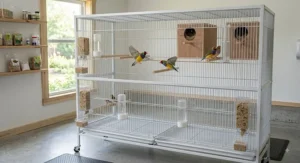
Colony Finch Breeding Cage vs Finch Breeding Pair Cage
The colony-versus-pair decision is less about which setup is “better” and more about which matches your actual breeding goals, and it’s worth thinking through before you buy rather than after. A finch breeding pair cage — like the Prevue Hendryx Breeder Cage or a single divided compartment of the YML Small Breeding Cage — isolates one male and one female, giving you full control over parentage, which matters enormously if you’re breeding for specific color mutations or maintaining a known lineage. The trade-off is labor: more pairs means more individual cages, more nest boxes, and more daily checks multiplied across every compartment. A colony finch breeding cage, by contrast — think the FASCK 47-Inch Rolling Breeding Flight Cage or an open (non-divided) Wrought Iron Stacker unit — houses multiple pairs together, letting birds self-select mates and often producing more natural, lower-stress breeding behavior, particularly in highly social species like society finches. The catch is you lose precise parentage tracking unless you’re leg-banding chicks as they fledge, and dominant pairs can occasionally monopolize the best nest sites, leaving subordinate pairs unproductive. Reviewers and experienced breeders consistently note that colony setups work best with species known for cooperative temperaments and enough nest boxes to go around — cramming six pairs into a cage with two boxes is a recipe for stress, not efficiency. If genetic tracking matters to your program, pair cages win outright; if you’re breeding for volume and general vigor in a naturally social species, a colony setup often produces better results with less daily intervention per bird.
Finch Nesting Enclosure Essentials
A finch nesting enclosure is only as good as what’s inside it, and this is the category where cheap shortcuts cost you the most in hatch rates. The nest box itself should have an indented or slightly cupped bottom to prevent eggs from rolling to the edges and going cold — a flat-bottomed box is a surprisingly common cause of unexplained egg loss in first-time setups. Depth matters too: too shallow and chicks tumble out before fledging age; too deep and parents struggle to reach chicks in the back corners during feeding. Nesting material should be fibrous but not stringy — loose coconut fiber, dried grass, or jute strands work well, while long threads or yarn genuinely pose an entanglement risk to chick legs and toes, something worth taking seriously rather than treating as internet paranoia. Position the enclosure in the quietest, most sheltered corner of the cage, away from the door and away from direct foot traffic in the room, since finches choose nest sites instinctively for concealment and will underuse a box that feels exposed. If you’re running side-door access cages like the VEVOR 30-Inch Flight Cage or the Wrought Iron Stacker, check the box briefly every few days rather than leaving it entirely alone — you want to catch problems like a dead-in-shell egg or a chick that’s stopped developing before it affects the rest of the clutch, without disturbing the pair so often that they abandon the effort altogether.
Society Finch Breeder Cage Considerations
Society finches deserve their own section here because they’re genuinely different to house than most other finch species, and a lot of general breeding-cage advice doesn’t fully apply to them. Society finches are known for serving as foster parents to other finches’ young, a tendency that makes them popular in aviary settings where breeders lean on that cooperative instinct, which is exactly why a well-chosen society finch breeder cage often leans toward the colony end of the spectrum rather than strict pair isolation — these birds are unusually tolerant of close quarters and will frequently share nesting duties without the aggression you’d see in less social species. That said, their sociability cuts both ways in a breeding context: society finches tend to crowd into a single favored nest if kept in a group, interfering with incubation or damaging eggs, which is why they typically breed more reliably when housed as individual pairs in dedicated breeding boxes despite their social nature. Practically, this means the Prevue Hendryx or 2GR pair-style cages often outperform a fully open colony setup for breeders prioritizing hatch consistency, even though society finches would happily live together outside of active breeding season. For general species background and everyday care context beyond breeding logistics, Lafeber’s society finch care guide is a solid reference point worth reading alongside your cage decision.
Finch Reproduction Housing: What Actually Affects Hatch Rates
Finch reproduction housing is where cage choice stops being about convenience and starts directly affecting outcomes, because breeding success is genuinely sensitive to environmental variables that a casual pet-only setup doesn’t need to worry about. Egg formation in birds is a real physiological process with a defined timeline — the entire period of egg formation takes roughly 24 hours, with calcium drawn from bone stores later used in shell production, and ovulation triggered by rising estrogen and luteinizing hormone in response to environmental and nutritional cues — which is a clinical way of saying that lighting consistency, diet, and stress levels in your housing setup aren’t background details, they’re inputs to a biological process happening in real time. This is exactly why cages with poor humidity retention, drafty placement, or startling access points measurably reduce success even when the pair itself is healthy and willing. Chronic egg-laying issues and calcium deficiency are common causes of complications like egg binding, and an inappropriate environment or lack of a proper nest box is a recognized contributing factor — reinforcing that the housing itself, not just the birds’ genetics or health, is a direct lever on reproductive outcomes. Practically, this means investing in stable temperature, a properly shaped nest box, and calcium-rich diet supplementation (cuttlebone or mineral block, available at all times during breeding season) pays off far more than any other single change you can make to your setup.
Common Mistakes When Buying a Finch Breeding Cage System
The single most common mistake is buying based on exterior dimensions without checking interior clearance once perches, feeders, and a nest box are installed — a cage that looks spacious on the listing photo can feel cramped once fully furnished. A close second is underestimating bar spacing risk: buying a 1-inch-spacing cage marketed generically for “small birds” without confirming it’s genuinely finch-safe, since standard parakeet spacing is too wide for finch chicks and even some adult species. Buyers also frequently skip planning for nest-box count relative to pair count, assuming one box will suffice for a colony of four or five pairs — it rarely does, and overcrowding a favored box causes exactly the kind of egg damage and incubation interference that tanks hatch rates. Another overlooked issue is ignoring cleaning access entirely at purchase time, then discovering months later that a cage without a pull-out tray turns every cleaning session into a 20-minute ordeal instead of a five-minute routine. Finally, plenty of first-time buyers purchase a single cage sized exactly for their current pair count, with zero room to stack or expand — a decision that looks fine on day one and becomes an expensive mid-season upgrade the moment breeding actually succeeds and they want to keep offspring or add a second pair.
Long-Term Cost & Maintenance
The sticker price on any finch breeding cage system is genuinely just the entry fee — the real cost of ownership includes nesting material replaced every clutch cycle, occasional perch and feeder-cup replacement as they wear or crack, and the calcium and protein supplementation birds need specifically during active breeding season. Budget cages like the Prevue Hendryx or YML Small Breeding Cage win clearly on upfront cost, but their thinner wire and lighter frames may need replacement or reinforcement sooner under years of repeated stacking and disassembly, while the welded construction on something like the Wrought Iron Stacker or the FASCK 47-Inch Rolling Cage spreads a higher purchase price across a genuinely longer usable lifespan. Cage cleaning products, replacement trays, and occasional wire-grid replacement are worth budgeting for annually rather than treating as a surprise expense — a well-maintained cage bank can run five-plus years without structural issues, while a neglected one starts showing rust or wire fatigue within two. If you’re running multiple pairs, the time cost matters as much as the dollar cost: side-door nest-box access and pull-out trays aren’t luxury features, they’re the difference between daily maintenance taking ten minutes or forty across a full breeding bank.
Safety, Regulations & Compliance Guide
Breeding finches at home in the United States is largely unregulated for hobbyist-scale operations, but the line between “hobbyist” and “regulated breeder” has shifted in recent years and is worth understanding before you scale up. A 2023 USDA/APHIS rule established the first bird-specific standards under the Animal Welfare Act, covering animal health, husbandry, and transportation requirements for birds not bred solely for research purposes, and while most small hobbyist setups fall outside licensing thresholds, anyone considering selling birds commercially or operating at meaningful scale should check the USDA APHIS pet bird species guidance directly rather than relying on secondhand summaries, since thresholds and exemptions can change. On the material-safety side, avoid galvanized wire cages where birds have direct chewing access — zinc toxicosis from ingested galvanized coating flakes is a real and documented risk in captive passerines, which is one reason powder-coated or stainless steel construction is worth the modest price premium over raw galvanized wire. If you’re introducing new birds to an existing breeding setup, a quarantine period of several weeks in a separate cage before integration is standard responsible practice, reducing the risk of introducing mites, respiratory infections, or other transmissible issues into an established colony.
Features That Actually Matter (And Those That Don’t)
Marketing copy on breeding cages loves to lean on features that sound impressive but rarely change breeding outcomes — decorative color options, oversized branded logos, and “premium” perch materials with no functional difference from a basic wooden dowel. What actually matters, based on the spec comparison across all seven systems here, comes down to a short list: correct bar spacing for your species and chick size, side or easily accessible nest-box doors, a genuinely removable cleaning tray, and enough interior depth for finches to fly rather than just hop. Stackability matters if you plan to grow, but it’s irrelevant if you’re committed to a single permanent pair setup — don’t pay a premium for scalability you won’t use. Wheels and mobile stands, as seen on the FASCK 47-Inch Rolling Cage, are genuinely useful for large colony setups that need repositioning for cleaning or seasonal light, but they’re an unnecessary cost add for a single compact pair cage that rarely moves once placed. The honest takeaway: spend your budget on structural and access features, not cosmetic ones — a plain white cage with the right bar spacing and a side nest door will outperform a stylish one without them, every single breeding season.
Problem → Solution: Fixing Common Breeding Cage Issues
Problem: Eggs keep rolling out of the nest and going cold. This is almost always a flat-bottomed or overfilled nest box — switch to a box with an indented base, like those paired well with the Prevue Hendryx or 2GR cages, and reduce nesting material so the pair can properly cup the center themselves.
Problem: Pair abandons the nest after you check on eggs. You’re checking too frequently or too invasively. Limit checks to once every two to three days, and use side-door access cages such as the VEVOR 30-Inch Flight Cage or Wrought Iron Stacker so you’re not opening the main compartment every time.
Problem: Colony setup has one overcrowded nest box and idle pairs elsewhere. Add additional boxes — aim for at least one per established pair, and space them at opposite ends of the enclosure so dominant pairs can’t easily monopolize every option in setups like the FASCK 47-Inch Rolling Cage.
Problem: Chicks are escaping through cage bars after fledging. Your bar spacing is too wide for the species. Move future clutches to a tighter-spacing system, such as the 3/8-inch sections on the VEVOR 30-Inch Flight Cage, rather than trying to retrofit an existing wide-spaced cage.
Problem: Cleaning has become an unmanageable daily chore. You likely bought a cage without a pull-out tray or side access. Going forward, prioritize that feature explicitly — it’s a small line item on a spec sheet that has an outsized effect on how sustainable daily care actually feels.
👉 Solving a specific setup problem right now? The right cage swap above often fixes it faster than troubleshooting the one you already have.
Buyer’s Decision Framework
If you’re breeding one committed pair for the first time and want to keep costs low, choose a compact pair cage like the Prevue Hendryx or 2GR Art. 326/B, because low commitment and easy storage matter more than colony scale at this stage. If you’re planning three or more pairs long-term and want room to grow without a mid-season upgrade, choose a stackable system like the YML, VEVOR, or Yaheetech cages, because expandability now saves a second purchase later. If you’re running true colony production for volume or club sales, choose the FASCK 47-Inch Rolling Cage or a Wrought Iron Stacker bank, because interior volume and multiple nest-box capacity directly support that scale. And if genetic tracking or specific color-mutation breeding is your priority, always default to individual pair cages over open colony setups, because parentage control simply isn’t possible once multiple pairs share unrestricted access to each other.
FAQ
❓ What size cage do I need for a breeding pair of finches?
❓ Can I breed finches in a colony instead of separate pair cages?
❓ How often should I check the nest box during incubation?
❓ What bar spacing is safe for finch chicks?
❓ Do I need a license to breed finches at home in the US?
Conclusion
Choosing the right finch breeding cage system really comes down to being honest with yourself about scale — a single committed pair in a spare bedroom corner has completely different needs than a five-pair breeding bank aimed at club sales, and the cages built for each look genuinely different for good structural reasons, not just marketing. The Prevue Hendryx and 2GR Art. 326/B earn their spot for anyone starting small and valuing low cost or storage flexibility, while the YML, VEVOR, and Yaheetech stackers hit a practical middle ground for breeders who expect to grow but aren’t ready to commit to premium infrastructure yet. At the top end, the FASCK 47-Inch Rolling Cage and the Wrought Iron Stacker Center-Divided Breeder Cage exist for exactly one kind of buyer: someone who already knows this is more than a passing hobby. Whichever tier you land in, the details that actually move the needle on hatch rates — correct bar spacing, accessible nest-box doors, adequate nest count per pair, and a stable, low-disturbance environment — matter more than any cosmetic feature on the box. Get those right, and the rest of the season takes care of itself far more often than not.
✨ Don’t Miss These Exclusive Deals!
🔍 Take your finch breeding setup to the next level with these carefully selected cage systems. Click on any highlighted product above to check current pricing and availability. The right setup today means healthier clutches and calmer, more confident breeding pairs all season long!
Recommended for You
- Breeding Cage for Cockatiels: 7 Best Picks Ranked for 2026
- Stackable Breeding Cages: 7 Best Picks for 2026
- Bird Breeder Cages: 7 Best Picks for Serious Breeders in 2026
Disclaimer: This article contains affiliate links. As an Amazon Associate, I earn from qualifying purchases. If you purchase products through these links, we may earn a small commission at no additional cost to you.
✨ Found this helpful? Share it with your friends! 💬🤗
